This post contains affiliate links. We may earn a small commission when you buy through our links — at no extra cost to you.
Engine drone, a cabin full of strangers, eight hours with nowhere to go: a long flight is where headphones earn their keep. At 35,000 feet, the gap between a pair that cancels the rumble and one that merely plays over it is arriving rested versus wrung out. I wanted headphones that quiet the cabin, stay comfortable past hour five, and don’t die mid-ocean.
I fly enough that headphones are the gear I’m fussiest about, and I’ve turned my team into accomplices. Over the past eight months we’ve lived with a dozen pairs, from budget over-ears to flagship noise cancellers, in coach seats and in plenty of living-room rehearsals.
Noise cancellation isn’t one thing, by the way: it’s excellent against steady engine rumble and only so-so against the baby two rows up, so the seal matters as much as the chip. Battery claims deserve skepticism too, since "up to" numbers are often measured with cancellation off. The picks below cleared a full travel day, held a phone and a tablet at once, and still felt fine past hour five.
Our Top Picks



The Best Headphones for Long Flights, Reviewed
1. Bose QuietComfort Headphones
Best Overall
Key Features
- Weight: 8.47 oz
- Battery life: Up to 24 hours
- Wired listening: Detachable 3.5 mm cable
- Noise cancellation: Active, Quiet and Aware modes
- Price: Midrange
What decides a long flight is rarely the sound. It’s whether the earcups are still comfortable when the cabin lights come up six hours in, and on that count the QuietComfort is the pair we reach for first: 240 grams, thick cushions wrapped in soft leather, and a headband that presses lightly enough that we stopped noticing it between meals. The noise cancellation carries the other half of the argument. The engine drone drops to almost nothing, and Quiet and Aware modes sit one button apart for the moment the crew picks up the intercom.
Battery is rated at up to 24 hours, which covers a transatlantic round trip plus the airport time on either end, and a 15-minute USB-C charge buys roughly two and a half hours if you packed in a hurry. The detachable 3.5 mm cable matters more than it sounds: on planes whose seatback screens have no Bluetooth, plugging in is the only way to watch anything, and a worn cable can be replaced without replacing the headphones. It all folds into a hard case that survives the bottom of a carry-on.
Longevity is the one thing we can’t vouch for. Some sets go quiet on one side inside the first year, so register the pair the day it arrives and keep the receipt, since Bose covers them for a year. That caveat doesn’t move the recommendation, because the fit and the quiet are what you’re buying, and nothing on this page balances the two as well for the money.
Pros
- Plush earcups and light clamp for hours of wear
- Quiet and Aware modes one button apart
- 24 hours of playback plus a fast top-up
- Detachable cable for seatback screens
Cons
- Switching between paired devices can take a retry
Our default pick for long flights: the plushest fit in this group, proven noise cancellation, 24 hours of battery, and a cable for seatback screens at well under the Ultra’s price.
2. Bose QuietComfort Ultra (2nd Gen)
Best Noise Cancellation
Key Features
- Weight: 1.06 lb
- Bluetooth: 5.4
- Battery life: Up to 30 hours (23 with Immersive Audio)
- Noise cancellation: Active, Quiet and Aware modes
- Price: Premium
This is the most expensive pair on the page, and it’s the one we hand to someone who flies often enough to have stopped thinking about the ticket price. Bose’s Quiet Mode is the most effective cancellation in this group. The cabin drone doesn’t soften so much as vanish, and a conversation two rows back becomes a murmur you can choose to ignore.
That is the case for them, and it’s a strong one. If your flights are red-eyes and the goal is sleep, the extra quiet is worth more than the spatial audio and Cinema Mode Bose added on top, features we enjoyed with a movie and switched off for music. Thirty hours of playback, or 23 with Immersive Audio running, makes charging a hotel-room chore rather than an airport one.
Weight is what they give back. At 0.48 kg they carry twice the mass of the standard QuietComfort, and the snug clamp that helps the seal also traps heat; on a full travel day we were aware of them in a way we never were with the lighter pair. Bluetooth 5.4 and USB-C audio for calls are genuine upgrades. Still, try the fit before you commit, especially with glasses or a larger head, where the pressure arrives sooner.
Pros
- Strongest noise cancellation in this group
- 30 hours, or 23 with Immersive Audio
- Spatial audio and Cinema Mode for movies
- Bluetooth 5.4 and USB-C audio for calls
Cons
- Heaviest pair here by a wide margin
- Snug clamp traps heat over long wear
The most effective noise cancellation in this group and the reason to spend more, as long as you can live with the heaviest pair here.
3. Sony WH-CH720N
Best Lightweight
Key Features
- Weight: 6.77 oz
- Multipoint: Two devices at once
- Battery life: Up to 35 hours
- Quick charge: 3 minutes for 1 hour
- Price: Inexpensive
192 grams is the number that matters here. The Sony is the lightest pair in this group, less than half the Bose Ultra’s weight, and on a long flight that isn’t a spec-sheet curiosity, it’s whether you feel a band behind your ears when you lean back. We wore these through a full travel day without the hot spot heavier pairs leave behind, and at this weight they are the pair that disappears.
The rest is sensible rather than spectacular. Thirty-five hours of playback and a three-minute charge that buys an hour mean the cable can stay in the bag, and multipoint holds a phone and a laptop at once. Noise cancellation is where the savings show: it takes the edge off the engines and quiets cabin chatter, but it doesn’t produce the hush the Bose pairs do. If you’re a light sleeper or the drone is what keeps you awake, this isn’t the pair for you.
The build is the other question mark. The plastic is thin because it’s light, and the headband and hinge are where these fail first when they do, so treat it as a two-year pair rather than a five-year one. Set against that, it costs a fraction of the flagships and does most of the job, and for anyone who feels every gram by hour four it’s the sensible buy.
Pros
- Lightest pair here at 192 grams
- Three-minute charge buys an hour of playback
- Multipoint keeps two devices connected
- Comfortable enough to forget on a long day
Cons
- Headband and hinge are the first points to fail
The pair we pack when weight is the priority: 192 grams, 35 hours and a fit that disappears on your head, though the silence stops short of Bose.
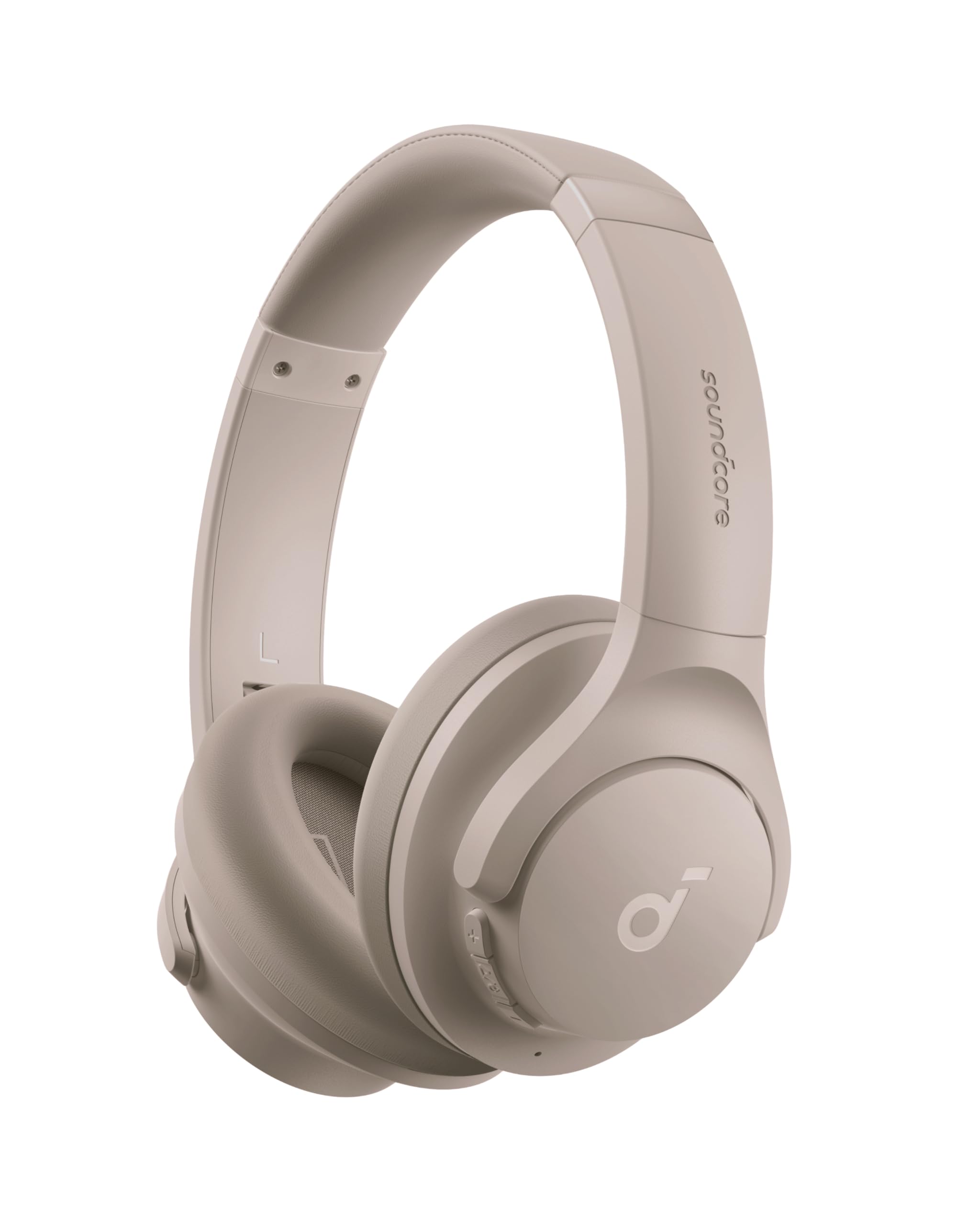
4. Soundcore Q20i
Best for a First Pair
Key Features
- Weight: 9.12 oz
- Multipoint: Two devices at once
- Battery life: 40 hours with ANC, 60 without
- Noise cancellation: Hybrid ANC, transparency mode
- Price: Inexpensive
Everything the Bose QuietComfort does, the Q20i does a little less well, and it costs a fraction as much. That’s not a criticism, it’s why this is the pair we suggest to someone who flies a few times a year and can’t justify flagship money. The hybrid cancellation, with two microphones inside and two outside, cuts the engine drone convincingly once music is playing.
Battery is where it beats most of the group outright: up to 40 hours with cancellation on, 60 with it off, so a return trip plus a week of commuting happens on one charge. Two devices stay connected at once, the feature we miss when it’s missing, a laptop for a film and a phone for when someone calls. The 3.5 mm jack takes the included cable for seatback screens.
Two catches are worth knowing. Plug the audio cable in and noise cancellation switches off, so if the seatback screen is your in-flight entertainment you’ll be hearing the engines after all. And the headband runs loose: comfortable on a larger head, sliding around on a smaller one. Neither has a rival at this price, which is why it stays near the top of our list, with the fit the one thing to check first.
Pros
- 40 hours with ANC on, 60 without
- Two devices connected at once
- Hybrid ANC that handles engine drone
- Soft earcups for long listening sessions
Cons
- Cancellation shuts off when the cable goes in
- Loose fit on smaller heads
The pair we suggest to anyone buying noise cancellation for the first time: 40 hours with ANC on, a comfortable fit and a price that makes a spare easy.
5. TOZO HT3
Best Budget
Key Features
- Weight: 8.96 oz
- Battery life: Up to 90 hours
- Wired listening: 3.5 mm AUX and USB-C
- Noise cancellation: Hybrid ANC, transparency mode
- Price: Budget
The headband is the first thing we noticed, and not in a good way: there’s very little padding up top, and on a long flight that thin strip is the difference between forgetting the headphones and feeling them. Below the headband it’s a different story. The earcups are deep and soft, the clamp is gentle, and at 254 grams the HT3 sits closer to the Sony than to the Bose Ultra in the hand.
Battery is the headline and it holds up: up to 90 hours, with a ten-minute charge adding around nine hours when you’re boarding empty. That’s several trips between charges, and it turns charging into an errand you run once a month instead of a ritual before every flight. The hybrid cancellation, four microphones in all, doesn’t erase the cabin the way the Bose pairs do, but it takes a real bite out of the engines, and we left it on for the whole flight rather than reaching for transparency.
Longevity is the open question. The cups on some units separate from the frame within a few months, and the thin headband is the visible sign of where the money went. As a second pair that lives in a carry-on, though, the trade is easy: the app EQ, the AUX and USB-C inputs and that battery make it more flexible than anything else at this end of the list.
Pros
- Up to 90 hours per charge
- Ten minutes of charging adds nine hours
- Hybrid cancellation with four microphones
- App EQ plus 3.5 mm and USB-C audio
Cons
- Build is the weak point over months of use
The best budget buy here: ninety hours a charge, soft deep cups and cancellation that holds its own, as long as you accept it won’t last for years.
6. RUNOLIM ANC Headphones
Budget Backup Pair

Key Features
- Weight: 9.17 oz
- Battery life: Up to 100 hours (65 with ANC)
- Wired listening: 3.5 mm backup cable
- Noise cancellation: ANC with transparency mode
- Price: Budget
This is the pair for the traveler who wants noise cancellation, a cable for the seatback screen and nothing else on the receipt. RUNOLIM quotes up to 100 hours of playback, or about 65 with cancellation running, comfortably the longest noise-cancelling run time in this group and more than a week of flights for most people.
The rest is honest rather than impressive. The protein-leather earcups are soft, the headband adjusts widely, and passive isolation is decent before you even press the ANC button. Active cancellation handles the drone well and lets chatty neighbors through, and there’s a transparency mode for when you need the gate announcement. A 3.5 mm backup cable means a dead battery doesn’t end the flight.
The calculation is simple: most of the quiet of a premium pair for a fraction of the outlay, with the knowledge that it won’t be the pair you keep for years. For a second set that lives in a carry-on, or a first set you’re not certain you’ll use, that’s the right trade, and we treat it as a good two-year pair rather than an heirloom.
Pros
- Up to 100 hours, about 65 with ANC
- Soft protein-leather earcups
- Transparency mode and backup cable
Cons
- No case or pouch in the box
- Light plastic shell wears at the pivots
The lowest-spend way onto this list: the longest ANC run time here, soft cups and a backup cable, in a plastic shell that won’t last forever.
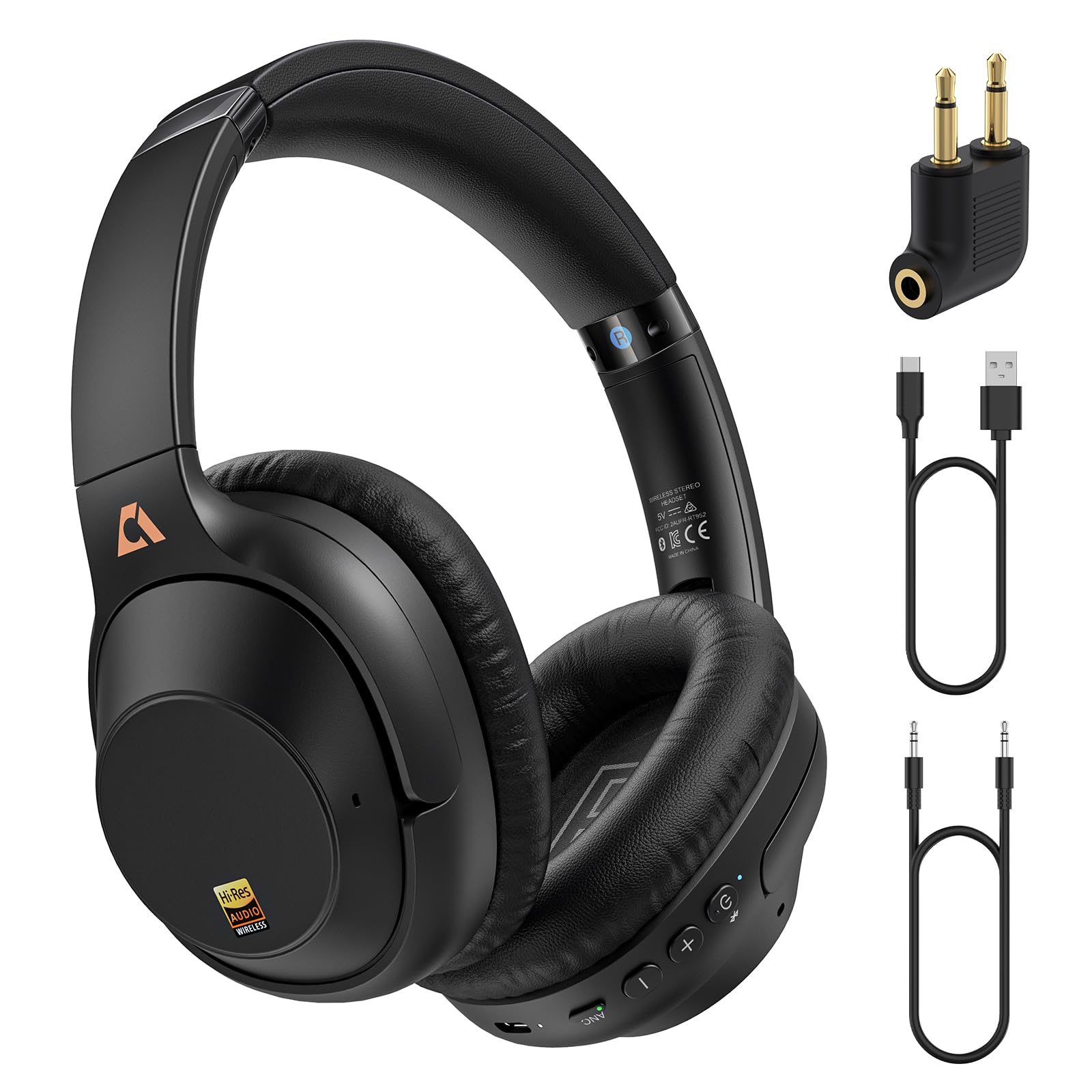
7. YMOO Y7Pro
Best for Seatback Screens
Key Features
- Weight: 9.45 oz
- In the box: 3.5 mm cable and airline adapter
- Battery life: Up to 100 hours
- Noise cancellation: Hybrid ANC, four microphones
- Price: Inexpensive
The box includes something almost nobody bothers with: a two-prong airline adapter, alongside the 3.5 mm cable. It’s a small thing that costs the maker almost nothing and spares you the gate-side scramble when the seatback socket doesn’t match your plug. That kind of thinking runs through the Y7Pro, which is designed by someone who has flown with headphones.
On paper the hardware is competitive. Forty-millimeter drivers with LDAC for hi-res audio over Bluetooth, a four-microphone hybrid cancellation system, 100 hours of playback and an app with a custom EQ. At 268 grams it sits mid-pack: heavier than the Sony, lighter than the Bose Ultra.
In use, cancellation is where it lands in the middle. It quiets the constant roar of the engines without erasing the cabin the way the Bose pairs do, and the effect depends more on getting a good seal here than it does on the more expensive sets. Sound is bass-forward and lively; LDAC is worth having if your phone supports it and irrelevant if it doesn’t. The onboard translation and voice-assistant features we never touched.
What keeps this in also-consider is confidence rather than capability. There’s far less real-world history behind the Y7Pro than behind a Sony or a Soundcore, and not enough of it to promise these will still be working in three years. If you want the airline adapter, a wired option and enormous battery for modest money, it’s a reasonable flyer. If you want the pair you never think about, spend a little more.
Pros
- Airline adapter and 3.5 mm cable included
- 100 hours of playback
- LDAC hi-res audio and app EQ
- Wired or wireless listening
Cons
- Cancellation trails the better-known brands here
- No long track record to judge reliability
The only pick that ships an airline adapter, with 100 hours and LDAC on board, though cancellation and long-term confidence trail the better-known brands.
How We Tested Headphones for Long-Haul Flights
We started by pulling every over-ear model with active noise cancellation we could find, then cut by spec and weight: anything that didn’t fold, anything claiming less than a full travel day of battery, and anything too heavy to wear six hours straight. That left a dozen pairs and eight months of testing.
Most of the work happened in the air and in the hours before it. On four long-haul flights, I wore each pair from boarding to descent and noted when the clamp started to ache, how hot my ears got, and whether I could still hear the beverage cart coming. At home, I played a two-hour recording of cabin drone through a speaker and sat with each pair for six hours straight, running the same bass-heavy track, the same acoustic album, and a podcast, listening for whether the low rumble dropped away or just sat underneath the music.
Battery testing was a straight rundown with cancellation on, plus a fifteen-minute top-up to see how much play time that actually bought. For connectivity, I paired each set to a phone and a laptop at once and walked the length of a crowded terminal to see whether the signal broke. For fit, I wore glasses under every pair and checked how far each headband extended over a hood. Durability meant folding and unfolding each pair a few dozen times, then tossing them uncased into a carry-on with a laptop and a water bottle and checking the hinges and pads afterward.
The last stretch was simply living with them: weeks of commutes, calls from a noisy kitchen, and a wired cable run from a seatback jack on flights where the screen was the only entertainment. A few pairs impressed me in the first hour and lost me by the sixth.
How to Choose Headphones for Long Flights
The right pair is the one that still feels comfortable and still cuts the drone at hour eight; everything else is a bonus.
Noise cancellation is aimed at the engines
The cancellation that matters in the air targets steady low-frequency sound: engine drone, air-conditioning roar, the hum of the fuselage. It is very good at that and only mildly effective against a crying baby or a conversation two rows back, so expect the drone to drop away rather than expect silence.
Make sure there is a transparency or aware mode you can reach without pulling the headphones off, because you will want it for boarding calls, meal service and crew instructions. All five of our main picks have one, and the Bose pairs make it the easiest to toggle.
Read the battery figure for the mode you’ll use
Headline run times are quoted with cancellation on for some models and off for others, which is why the numbers on this page run from 24 hours to 100. Match the figure to your habits: the Soundcore Q20i gives 40 hours with ANC on and 60 without, and the RUNOLIM’s 100 hours drops to about 65 with cancellation running.
Quick charging matters as much as capacity. Fifteen minutes on the Bose QuietComfort buys roughly two and a half hours, enough for a short hop when you forgot to charge the night before. Anything over 30 hours covers a long-haul round trip with airport time left over.
Weight and clamp decide how hour eight feels
Two pairs with similar specifications can feel nothing alike after six hours. Weight is the easiest proxy you have: the Sony WH-CH720N is 192 grams, the Bose QuietComfort Ultra is 480, and the difference shows up as pressure behind the ears. Lighter sets suit glasses wearers and anyone who resents clamp; heavier, snugger ones tend to seal better, which is part of why they cancel more effectively.
Earcup depth matters too, since deep cups keep the driver housing off your ears. If you have never worn over-ears for six hours straight, that is the spec to think about before anything else.
The cable still earns its place
Seatback entertainment is overwhelmingly wired, and many airlines still use a two-prong socket that needs an adapter. A 3.5 mm cable turns headphones into a way to watch the movie, and the YMOO Y7Pro is the only pick here that throws the airline adapter in the box.
There is a trap worth checking first: on some headphones, the Soundcore Q20i among them, plugging in the cable switches noise cancellation off, so you get the film and the engine noise together. Confirm the behavior before you plan a flight around it.
Frequently Asked Questions
Can you use Bluetooth headphones on a plane?
Yes. U.S. airlines and most international carriers allow Bluetooth headphones in flight, including during takeoff and landing, so there’s no need to pack them away. What you can’t do is pair them with the seatback screen, because those systems are wired. Download your entertainment to a phone or tablet before boarding and pair to that instead.
Do noise-cancelling headphones help with ear pressure on a plane?
Not directly. Cabin pressure changes are physical and no headphone alters them; what cancellation removes is the engine drone that makes the pressure feel worse. Swallowing, yawning or chewing during descent does more for your ears than any setting. Where ANC genuinely helps is sleep, because fewer interruptions mean you land having actually rested.
Are expensive headphones worth it for long flights?
If you fly long-haul several times a year, yes. The gap between our top pick and a budget pair is mostly in how completely the drone disappears, and that is the thing that keeps light sleepers awake over the Atlantic. If you fly a couple of times a year, the Soundcore Q20i closes most of that gap for a fraction of the money.
Final Verdict
Buy the Bose QuietComfort. It is the pair we hand to almost anyone flying long-haul: the softest fit in this group, cancellation that turns the engines into background, 24 hours of battery, and a cable for the seatback screen. Nothing else here balances those four things as well or as affordably.
If you fly overnight regularly and silence is the entire point, the QuietComfort Ultra is a real step up in cancellation and a step back in comfort, so try the clamp before you commit. And if the budget says no, the Soundcore Q20i gets you most of the way there for a fraction of the money, with one quirk in wired mode.