This post contains affiliate links. We may earn a small commission when you buy through our links — at no extra cost to you.
Grabbing any 20,000mAh power bank and hoping it keeps your phone alive across the Atlantic is a gamble—real seat-back testing shows many struggle to deliver even two full phone charges before hitting empty, or they crawl so slowly your battery barely climbs during a movie. Worse, fumbling with loose USB cables in a cramped economy seat turns a quick top-up into a juggling act.
The difference between a travel charger that disappears into the experience and one that becomes another source of stress comes down to three things: true multi-device wattage, built-in cable design, and the bank’s own recharge speed. A unit that can push 65W or more to a laptop while charging a phone isn’t just convenient—it means you land with everything ready to go.
Choosing often means weighing absolute power and a cable-free design against weight and pack space. A 25,000mAh brick with retractable cables handles every device you own but adds noticeable heft to your carry-on, while a compact 20,000mAh unit with a single built-in cord still covers a laptop and phone for far less bulk. This balance of capability versus carry weight is what separates the right travel companion from the one you resent unpacking.


1. Anker 25K 165W Retractable
Best for All-In-One Travel
Key Features
- Battery Capacity: 25,000 mAh
- Max Output: 165W total
- Airline Compliance: Yes (<100 Wh)
- Ports: 3x USB-C, 1x USB-A
- Built-in Cables: Yes, 2 retractable USB-C
- Price: $$$
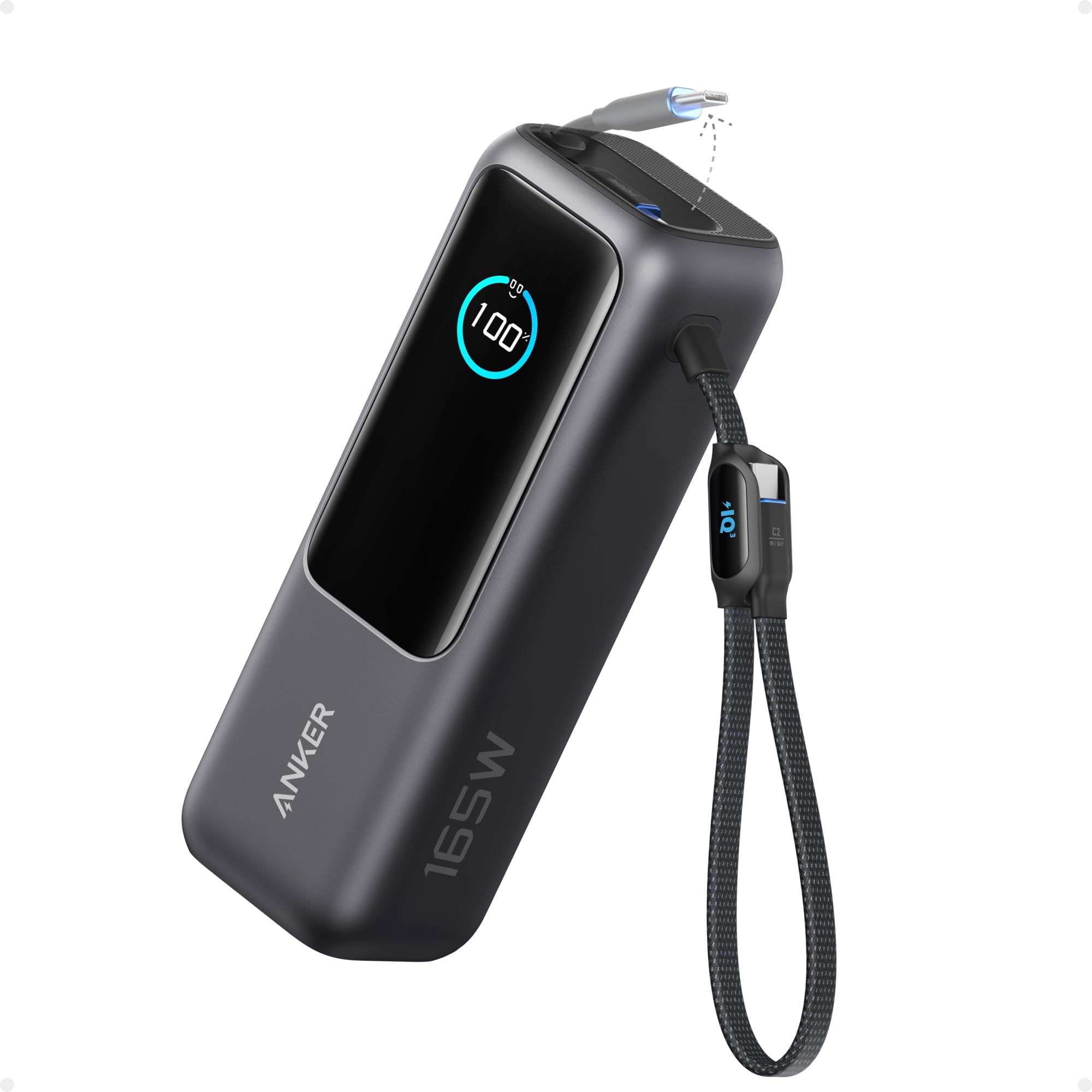
The Anker 25K Retractable integrates two USB-C cables directly into the power bank: a retractable 2.3-foot cord that stays tangle-free and a shorter strap-style cable. Combined with three USB-C ports that each deliver 100W, this bank can charge a MacBook Pro, an iPad, and an iPhone simultaneously at full speed — a capability few competing travel banks match without requiring separate cables.
The 25,000mAh capacity (99.54Wh) complies with TSA carry-on limits and provides enough energy to recharge a depleted 13-inch laptop roughly 1.5 times, plus a phone and tablet during a long-haul flight. The digital display shows remaining percentage and estimated charge time, removing guesswork mid-flight.
This bank is built for travelers who regularly carry a laptop, phone, and tablet and hate packing multiple cables. The built-in USB-C cords cover modern devices, but the 1.31-pound weight makes it feel heavy in a small purse or when hand-carrying just a phone — better suited for a backpack or carry-on where extra ounces are less noticeable.
The digital display shows wattage output per port, a detail that appeals to those who want to verify charging speeds. The matte plastic shell resists scratches, and the retractable cable mechanism feels sturdy enough for regular packing and unpacking.
Pros
- Fast multi-device charging: powers a laptop, phone, and tablet simultaneously.
- High 25,000mAh capacity lasts through long-haul flights and multiple days of travel.
- Convenient dual built-in USB-C cables, including a retractable one that stays tangle-free.
- Premium build quality and clear digital display showing remaining power.
Cons
- In a small bag or when carrying only a phone, the 1.31-pound weight becomes noticeable — less of an issue in a backpack with a laptop.
- Some units may develop charging port issues or stop functioning after several months of use — a consideration for heavy daily dependence.
For travelers who want to eliminate extra cables while maintaining top-tier charging speeds for a laptop, phone, and tablet across long flights, this Anker is the most complete solution — as long as bag space accommodates its weight.
2. Anker 20K 87W Built-in
Best for Business Laptop
Key Features
- Battery Capacity: 20,000 mAh
- Max Output: 87W total
- Airline Compliance: Yes (<100 Wh)
- Ports: Built-in USB-C, 1x USB-C, 1x USB-A
- Built-in Cables: Yes, USB-C handle
- Price: $$
Where the top pick bundles dual retractable cables and 165W across three devices, this Anker streamlines to a single built-in USB-C cord, 65W laptop output, and a 0.97-pound frame that is nearly a quarter-pound lighter. A 20,000mAh capacity, digital display, and extra USB-C port keep it capable without piling on features you may not need on a single-laptop trip.
MacBook Air and business travelers who want one full laptop charge during a long-haul flight — without remembering a separate cable — hit the sweet spot here. The built-in cord handles the laptop, the spare USB-C port services earbuds or a phone, and the precise display removes charge-level guesswork. The trade-off is weight: at 0.97 pounds, it is heavier than many 20,000mAh banks and draws frequent remarks about heft. It settles best into a laptop bag, not a pocket.
Holding a charge between trips and delivering steady wattage even after months of road use, this bank rarely surprises with sudden dips. The construction feels robust, and the cable doubles as a sturdy handle that stays attached. It is not the flashiest charger, but it is the one that will be there when the seat-back outlet is dead and you need 65W of certainty.
Pros
- Fast 65W USB-C output keeps an ultrabook powered through a long-haul flight
- Built-in USB-C cable means one less cord to pack and never lose
- Consistent long-term performance, with power delivery that stays stable across repeated trips
- 20,000mAh capacity charges most ultrabooks once and a smartphone multiple times
Cons
- At 0.97 pounds, noticeably heavier than typical 20,000mAh banks — best carried in a bag, not a pocket
It is the bank for MacBook Air and ultrabook travelers who want a single built-in cable and a lighter carry than the do-everything flagships. If max multi-device charging or retractable cables are priorities, the top pick earns its extra weight.
3. UGREEN Nexode 20K 165W
Best for Tech Enthusiast
Key Features
- Battery Capacity: 20,000 mAh
- Max Output: 165W total
- Airline Compliance: Yes (<100 Wh)
- Ports: 2x USB-C, 1x USB-A, retractable cable
- Built-in Cables: Yes, retractable
- Price: $$
The UGREEN Nexode 20K 165W integrates a 25.6-inch retractable USB-C cable that tucks away cleanly, eliminating the need to carry a separate cord for most devices. Combined with two additional USB ports, it can charge a laptop via the 100W USB-C port and a phone or tablet simultaneously. Where a raw-power brick demands a separate cable for every device, this UGREEN streamlines your travel kit to just the bank itself.
This charger suits tech-savvy travelers who prioritize a cord-free setup and fast recharge during short layovers. The retractable cable and 165W multi-device output cover a laptop, phone, and earbuds. The bank feels heavier than many 20,000mAh competitors—1.17 pounds is noticeable—so it’s better in a laptop bag than a jacket pocket. A few users have noted battery capacity decline after many cycles, so those planning heavy, multi-year use may want to factor that in.
At a mid-range price, it undercuts the top cable-free flagship while delivering near-identical retractable convenience and charge speed. The bright digital display shows remaining percentage and fast-charge status, adding at-a-glance reassurance during travel.
Pros
- 165W total output (100W USB-C) charges a laptop and phone at full speed, and 100W input refills the bank in under 2 hours.
- 25.6-inch retractable USB-C cable stows internally, reducing cable clutter and doubling as a grab handle.
- Smart digital display shows exact remaining capacity and fast-charging status, so you’re never guessing.
- Compact enough to slip into a laptop bag alongside a notebook, despite its 20,000mAh capacity.
Cons
- At 1.17 pounds, the bank weighs more than typical 20,000mAh units; it’s noticeable in a small daypack or when hand-carrying with just a phone.
If you want a cable-free travel charger without the top-tier price tag, the UGREEN Nexode’s retractable design and rapid self-refill make it a practical choice—just budget an extra pocket of bag space for its weight.
4. Anker Zolo Dual Cable
Best for Mixed Devices
Key Features
- Battery Capacity: 20,000 mAh
- Max Output: 30W
- Airline Compliance: Yes (<100 Wh)
- Ports: Built-in Lightning+USB-C, USB-C, USB-A
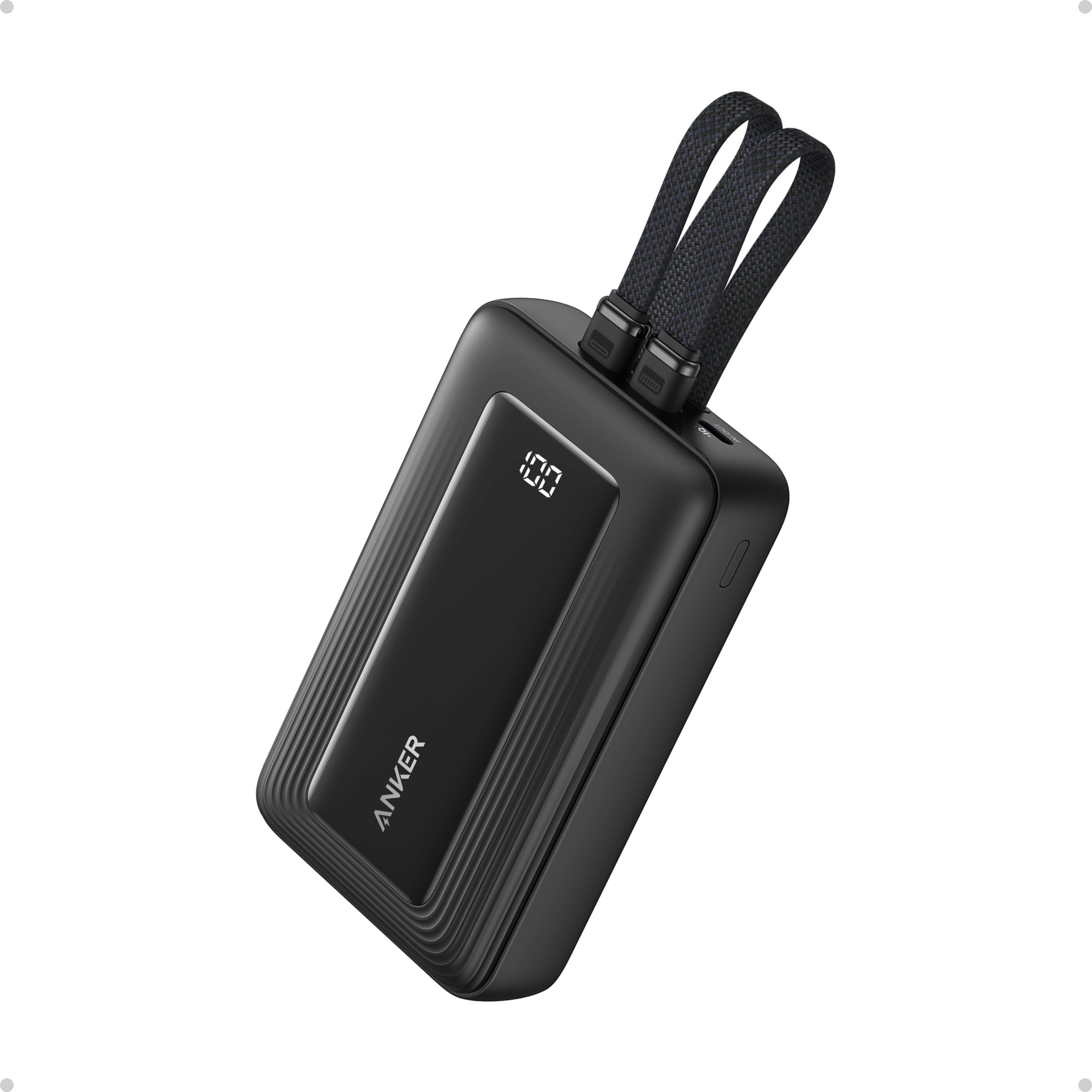
- Built-in Cables: Yes, Lightning+USB-C
- Price: $$
While the top pick handles laptops with 165W output, the Zolo focuses on what matters most for mixed-device families: built-in cables for both Lightning and USB-C. That convenience makes it a more practical travel companion for households juggling iPhones and Androids than a single-cable battery.
The 30W output is sufficient for multiple phone charges on a long flight, though large flagship phones will charge slower than with a 60W+ bank. On an overnight journey, you can still top up an iPhone 15 Pro twice without hunting for a wall outlet.
This is the right choice for families where one member uses an iPhone with Lightning and another carries an Android with USB-C — everyone can plug in directly without adapters. The 30W output means it is strictly a phone and tablet companion; it will not charge a laptop. For travelers who only need to keep phones going through a long-haul flight, the Zolo’s dual cables eliminate the cable-hassle that other banks introduce.
Pros
- Built-in Lightning and USB-C cables cover iPhones and Androids without adapters.
- Compact and lightweight for a 20,000mAh capacity — fits in a travel pouch or purse.
Cons
- 30W max output charges large phones slower than faster power banks and cannot power a laptop.
For families with mixed iPhones and Androids, the Zolo’s built-in cables remove the biggest travel friction — just remember it is a phone-only bank, not a laptop companion.
5. Orfeika 20K 4-Cable
Best for Budget Multi-Cable
Key Features
- Battery Capacity: 20,000 mAh
- Max Output: 20W PD
- Airline Compliance: Yes (<100 Wh)
- Ports: 3 built-in cables, 3 external ports
- Built-in Cables: Yes, 4 cables
- Price: $$
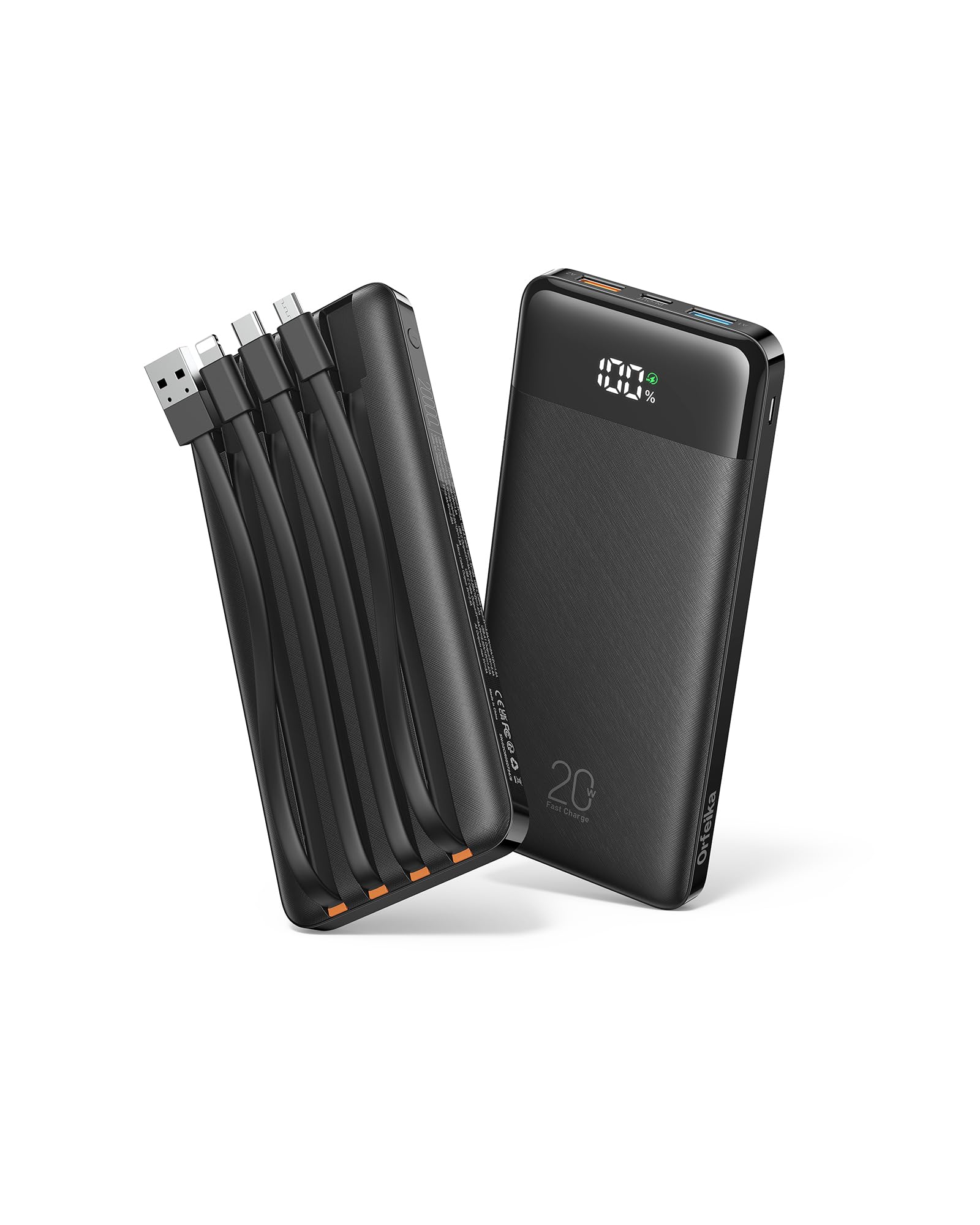
Four built-in cables cover every common device connector — Lightning, USB-C, and even Micro USB — so you can charge an iPhone, an Android phone, and an older tablet from one bank without hunting for loose cords. The 20,000 mAh capacity holds enough power for a weekend trip, and the slim 0.74-inch profile slides into a purse or carry-on pocket without bulging. Where the top pick adds retractable cables and laptop-level wattage, this Orfeika keeps things simpler and lighter, though the 20W output means it won’t fast-charge a modern phone the way a higher-wattage bank can.
This bank suits budget-minded travelers who prioritize cable convenience above all else — anyone who routinely juggles Lightning and USB-C devices (and maybe an older Micro USB accessory) will appreciate never needing to pack a separate cord. The tradeoff is charging speed: at 20W, a typical flagship phone takes over two hours for a full charge, so it’s better for topping up during a meal or overnight than for a quick boost between flights. The 0.73-pound weight is heavier than its compact dimensions suggest, but a bag or tote carries it without issue; pants pockets may feel the heft.
For the price, you get reliable overnight charging for phones and tablets across a weekend trip. The three external ports (plus the built-in cables) let you charge up to six devices simultaneously, though spreading 20W across multiple connections slows each one further — best used for a single primary device plus a few slow-charging accessories like earbuds or a smartwatch.
Pros
- Four built-in cables eliminate the need to carry separate charging cords for Lightning, USB-C, and Micro USB devices.
- Slim enough for a purse or small bag despite holding 20,000 mAh of capacity.
- Provides enough power to keep phones and tablets charged over a long weekend trip without needing a wall outlet.
Cons
- 20W output is slow for modern phones — expect over two hours for a full charge, and virtually no laptop charging.
- Weight is higher than the compact size suggests; noticeable in a pants pocket but fine in a bag.
If you travel with a mix of Lightning and USB-C gear and want a single, cable-free solution for phones and tablets without paying for laptop power, this Orfeika delivers on convenience and budget.
6. UGREEN Nexode 25K 145W
Best for Laptop Fast Charge

Key Features
- Battery Capacity: 25,000 mAh
- Max Output: 145W total
- Airline Compliance: Yes (<100 Wh)
- Ports: 2x USB-C, 1x USB-A
- Built-in Cables: No
- Price: $$
The UGREEN Nexode 25K delivers 145W total output with a single port capable of 140W, enough to push a full 65W charge to a MacBook Pro while topping off a phone at the same time. Its 25,000mAh capacity packs into a casing just over an inch thick, slipping into a laptop bag without bulk.
The lack of any built-in or retractable cable means you’ll always need to carry a USB-C cord, which is the price for its focused power delivery. Long-term durability may be a concern; in some cases, units have stopped functioning after a couple of months, making it less suited for trips where a dead battery bank would be a real setback.
Pros
- Delivers 140W single-port output, charging a large laptop as fast as a wall charger.
- Compact for a 25,000mAh bank; smaller than many travelers expect.
Cons
- The 505 g weight may feel heavy in a small bag or when hand-carrying only a phone.
- In some cases, the power bank may stop functioning after a couple of months, with ports ceasing to work entirely.
This is a strong choice for power users who prioritize compact fast-charging over cable convenience, provided they have a backup plan for the rare scenario of a unit stopping mid-trip.
7. EcoFlow Rapid 25K 170W
Best for No-Cord Power
Key Features
- Battery Capacity: 25,000 mAh
- Max Output: 170W total
- Airline Compliance: Yes (<100 Wh)
- Ports: 1x USB-C, 2 built-in USB-C, 1x USB-A
- Built-in Cables: Yes, retractable
- Price: $$$
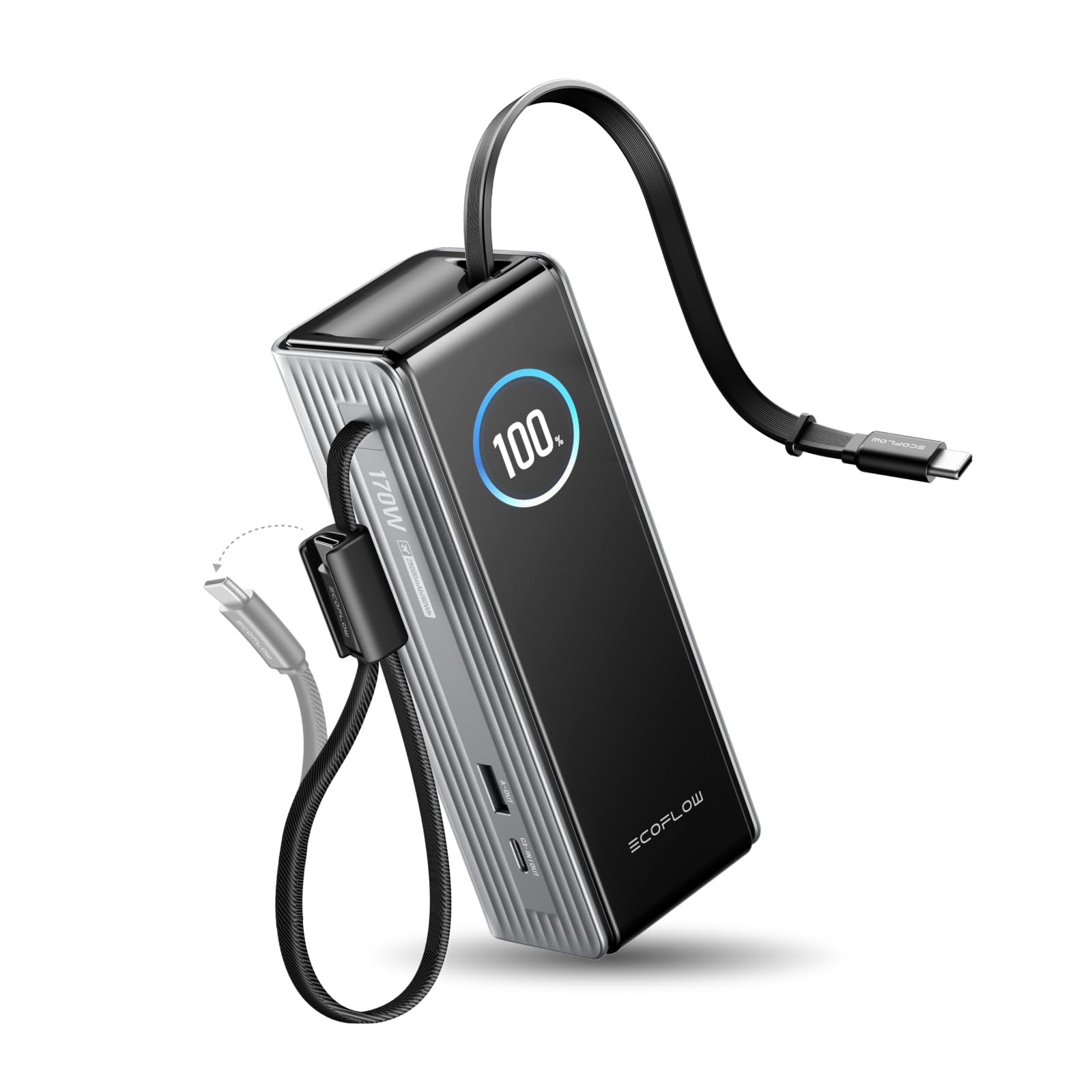
EcoFlow’s Rapid 25K delivers 170W total output and two built-in USB-C cables—one retractable—making it a close competitor to the cable-free leader. It charges a laptop and fast-charging phone simultaneously at full speed, and the integrated cords eliminate loose wires during a flight. The main trade-off is longevity: its real-world reliability record is shorter, so early adopters accept a bit more uncertainty. For travelers who prioritize top specs and the cable-free experience when the established best-seller isn’t available, this is a strong alternative.
Pros
- 170W total output handles a laptop and fast-charging phone simultaneously at full speed
- Built-in retractable USB-C cable removes the need to carry separate cords for travel
Cons
- Self-discharge can occur, so topping up before a trip is recommended
- Weight at 20.46 oz is heavier than some competitors, making it less pocket-friendly
If the market-leading retractable power bank is out of stock or you prefer the EcoFlow ecosystem, the Rapid 25K delivers identical day-of-travel convenience with slightly more peak power—just plan to test it before a critical trip.
8. Anker 737 24K 140W
Best for App-Connected Power
Key Features
- Battery Capacity: 24,000 mAh
- Max Output: 140W total
- Airline Compliance: Yes (<100 Wh)
- Ports: 2x USB-C, 1x USB-A
- Built-in Cables: No
- Price: $$$
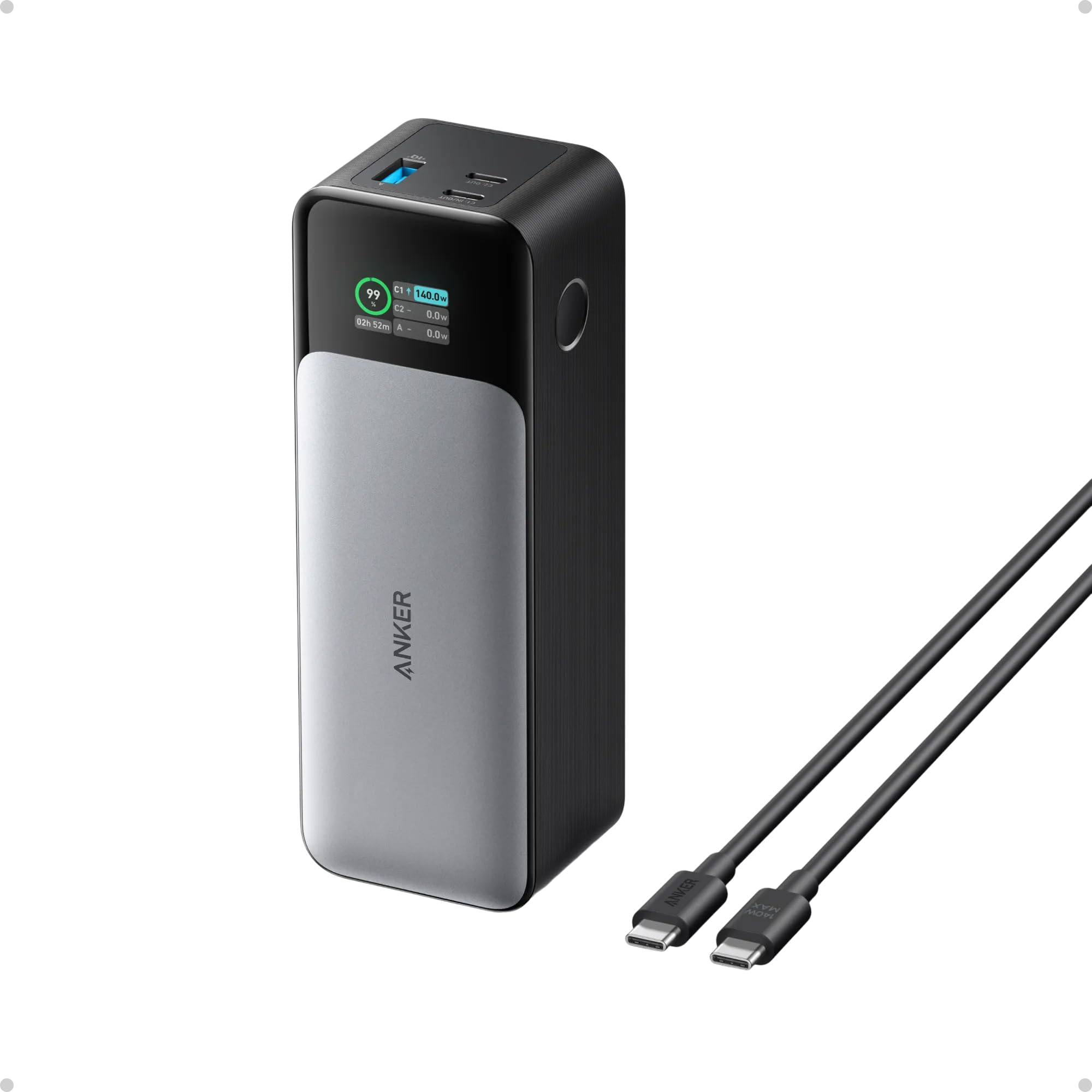
The 737’s 140W output can fast-charge a laptop, tablet, and phone at once, and the smart display shows wattage, remaining capacity, and recharge time—appealing for those who like to monitor charging metrics. It recharges itself quickly using a 140W charger. At 1.39 pounds, it’s the heaviest bank in this group, and it requires separate cables, which adds bulk for carry-on-only travel. Long-term reliability can be inconsistent; occasional units may fail early or show error codes. For data-minded travelers who prioritize a detailed display over built-in convenience, this older flagship still works, but newer retractable-cable options now offer similar power with less hassle.
Pros
- Delivers 140W output to fast-charge a laptop and phone simultaneously without throttling
- Smart display shows real-time wattage, remaining capacity, and recharge time
- Recharges from empty quickly with a 140W adapter
Cons
- At 1.39 lbs, it’s the heaviest power bank in its capacity class—a noticeable load in a carry-on or daypack
- Long-term durability can be uneven; occasional reports of early failure or error codes
The 737 remains a capable pick for tech enthusiasts who want a wattage display and maximum raw power overhead, provided they don’t mind the weight and carry their own cables—knowing that long-term reliability may require a warranty check.
How to Choose
The mAh number on the box only tells half the story—what actually matters is how much power your devices draw and whether the bank can deliver it fast enough to be useful mid-flight.
Battery Capacity: More Than Just mAh
For long-haul flights, a 20,000–27,000mAh range is the practical ceiling that still clears carry-on rules. A 20,000mAh bank can refuel a modern phone roughly 3–4 times, while a 25,000mAh unit stretches that to 4–6 charges, enough for a 12-hour journey plus a tablet session.
Real-world output is lower than the label due to voltage conversion and heat loss—expect around 60–70% usable energy. This is why a 20,000mAh bank might only fully charge a 4,500mAh phone twice, not four times, and it’s the reason capacity alone shouldn’t drive your decision.
Total Power Output: The Wattage Reality
Wattage determines what you can actually keep alive. A 30W bank will top up a phone but can’t supply the 45–65W many ultrabooks need to charge while in use; the laptop battery may still drain during a work session. Moving to 65W or higher means your laptop charges at full speed even with the screen on.
Multi-port output is equally important—a 100W-rated bank often splits power across devices, so charging a laptop and phone simultaneously drops each port’s delivery. Look for a total output rating that exceeds the sum of your typical device demands, not just a single-port peak number.
Airline Compliance: Staying Within Carry-On Limits
Commercial airlines cap lithium-ion power banks at 100 watt-hours (Wh), which translates to roughly 27,000mAh at 3.7V. Anything above that—like 50,000mAh units—must stay home. Even at 99.5Wh, the bank must travel in your carry-on, never in checked luggage.
This rule applies to all UK and European flights, so always check the Wh rating rather than assuming mAh alone equals approval. A 25,000mAh pack at 3.7V hits about 92.5Wh, leaving a small safety margin.
Ports and Connectors: Future-Proofing Your Charge
USB-C with Power Delivery (PD) has become the universal fast-charging standard for everything from iPhones to MacBooks. Having at least two USB-C ports lets you charge a phone and laptop simultaneously without a dongle. USB-A remains useful for older earbuds or Kindles, but it’s fading fast.
The hidden trade-off is that many banks advertise a high port count but slow-charge the USB-A slots, turning them into 5V trickle chargers. Always check that the port you plan to use for your primary device supports PD at the wattage your device needs, rather than relying on the headline number.
Built-in Cables: Convenience or Compromise?
Attached cables—especially retractable or handle-strap style—eliminate the forgetful scramble for cords in a dark cabin. They also reduce the number of accessories you carry, which is a genuine win on a budget airline with strict baggage allowances.
The concern is longevity: a permanently attached cable can’t be replaced if it frays, so quality of the cable mechanism matters. Units with spooled retractors add mechanical complexity, but reviews from frequent flyers show the convenience nearly always outweighs the risk, provided the brand’s cable durability is proven.
FAQ
Can I bring a 25,000 mAh power bank on a UK or Europe flight?
Yes, as long as its watt-hour rating is 100 or below. A 25,000mAh bank at the standard 3.7V is about 92.5Wh, so it’s compliant. Always carry it in your hand luggage—checked-bag rules forbid lithium batteries of this size. If you’re transiting through multiple countries, the same 100Wh limit applies across all major European and UK carriers.
Why does my power bank say 20,000 mAh but only charges my phone twice?
Because of voltage conversion losses. The bank’s internal cells operate at 3.7V, but USB output bumps to 5V or higher, and the step-up process loses about 20–30% of the energy. That means a 20,000mAh pack typically delivers 12,000–14,000mAh of usable charge to your phone, which translates to two full cycles for a large modern phone battery.
Do I need 65W or 100W to charge my laptop from a power bank during a long-haul flight?
It depends on your laptop’s power draw while in use. MacBook Air and similar ultrabooks can charge steadily at 45–65W, and a 65W bank will slowly replenish the battery even if you’re working. Larger laptops like a 15-inch MacBook Pro or a gaming laptop often need 85–100W to keep the battery from draining under load, so opt for 100W output if you plan to use the laptop continuously.
Are built-in cables on power banks durable enough for frequent travel?
They are durable enough for typical travel when the cable is thick and the connection point is reinforced, but they aren’t indestructible. The most common failure occurs where the cable meets the housing. However, thousands of long-term reviews show built-in USB-C cables—especially those doubling as a handle or using retractable spools—hold up well over years of regular use, making them more convenient than the risk of a broken cord.