This post contains affiliate links. We may earn a small commission when you buy through our links — at no extra cost to you.
The trouble with economy seating usually isn’t the seat itself — it’s what to do with your legs. On a redeye last winter I spent six hours with my knees braced against the seatback and my feet dangling, and I landed with ankles the size of dinner rolls. A footrest fixes that, but the two main styles go about it differently.
A sling hangs from the tray table arms and holds your feet up off the floor, so your knees stop clashing with the row ahead. An inflatable is closer to a stackable block you pump up to whatever height your legs want, and some double as a bed for a toddler. Over five months, my team and I tested 16 of both kinds, on the ground and in the air, and what separated a good one from a frustrating one was how it fit the seat in front of you, how it fit in your bag, and whether it stayed put once you settled in.
Here’s what nobody tells you before your first flight with one: a footrest that wobbles, sags, or slowly leaks is worse than no footrest at all, because you spend the whole trip readjusting it instead of sleeping. The picks below are the ones that held.
Our Top Picks


The Best Airplane Footrests, Reviewed
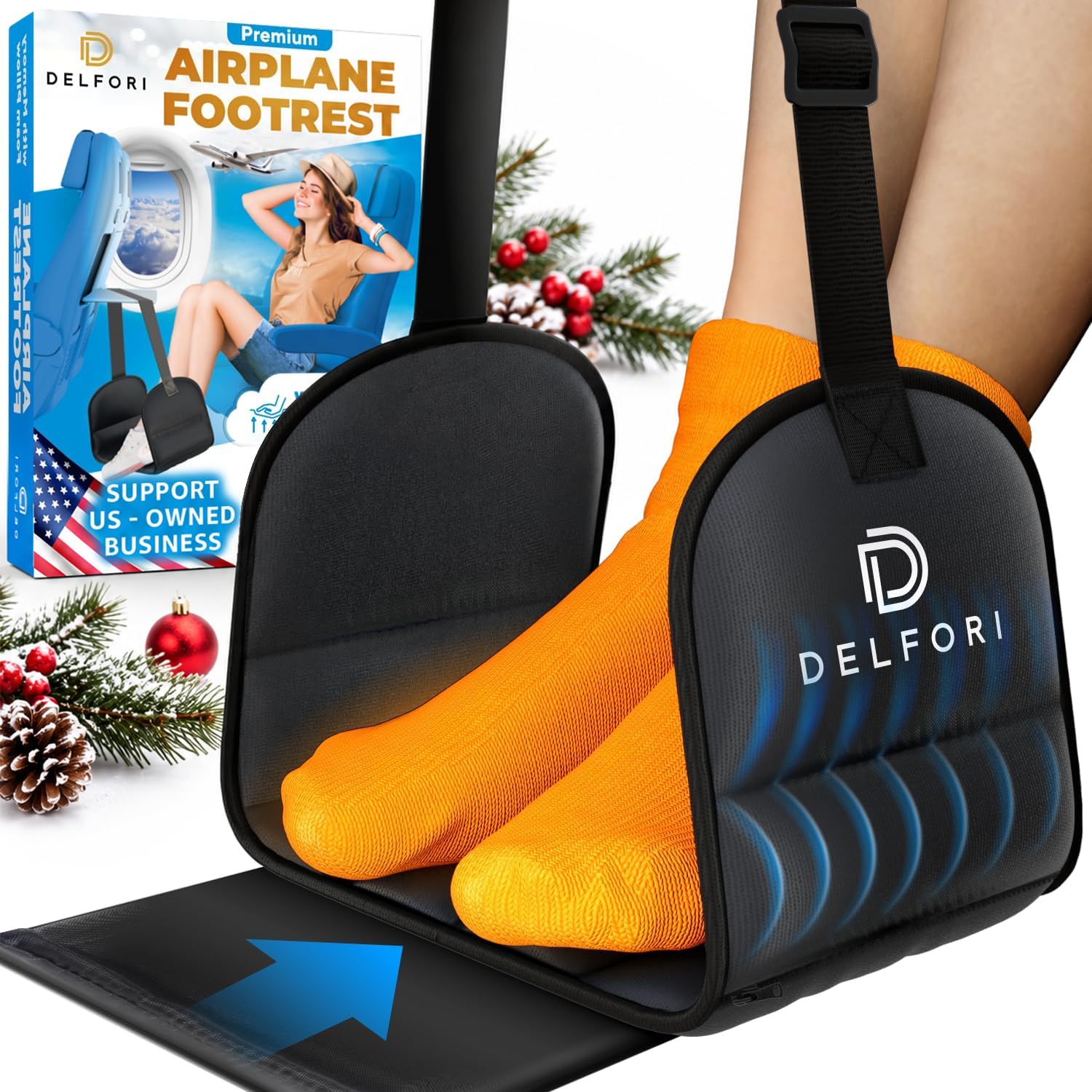
1. Delfori Foot Hammock
Best Overall
Key Features
- Type: Hanging foot hammock
- Weight: 14.5 oz
- Footbed: Removable hardboard plus memory foam
- Strap range: 20 to 37 inches
- Price: Budget
A soft foot sling has one job, and most of them fail at it: your heels drift toward the middle until both feet are stacked in the same sagging pouch. Delfori puts a removable hardboard plate under 60D memory foam, so the bed stays flat and your feet stay apart. That one piece of construction is why we point people here first — it turns a strap and a pad into something that holds a position for a full flight.
The strap adjusts from 20 to 37 inches, a wider range than the other slings in this guide and enough to cover a five-foot passenger whose feet never reach the floor as well as someone tall enough to need the sling dropped low. Setup is one loop over the seat-back table, one closed table, one buckle, and it holds the height you set instead of creeping down the way softer slings do.
It weighs 14.5 ounces and folds to roughly 7.9 by 6.7 inches, so it lives in a backpack rather than a pocket. The rigid base is what that weight buys, and it earns it: the same platform makes this the best of the slings for under-desk use once you are home, which is more than most travel gear manages.
One quirk of the design is that it goes slack every time the table comes down for a meal cart, so time your nap between services rather than across them. For a standard economy seat, it is the best value on this page — a rigid, flat platform for less than any inflatable here.
Pros
- Hardboard keeps the footbed flat
- Strap spans 20 to 37 inches
- Folds to 7.9 by 6.7 inches
Cons
- Needs a tray table, so bulkhead rows are out
- Heaviest sling here at 14.5 oz
We recommend the Delfori first because its hardboard plate keeps your feet where you put them, and the strap range covers short and tall passengers alike.
2. Angemay Foot Hammock
Best Extra-Large Footbed
Key Features
- Fill: Ventilated memory foam
- Type: Hanging foot hammock
- Weight: 6.35 oz
- Footbed: 17 x 11 inches
- Price: Midrange
Measured against our top pick, the Angemay wins one thing outright: surface. The bed is 17 by 11 inches, the largest in this guide, and at 6.35 ounces it is also the lightest sling here — a flat pad you can stuff into a jacket pocket. Setup takes about two minutes, which we appreciated on a full flight with a queue behind us.
What it does not have is a rigid base, and that shows up in how it sits. Feet drift toward the center, so you end up with both ankles in the same dip, and the padding bunches and rolls and needs smoothing back out mid-flight. If a wide, soft surface under your calves sounds better than a firm plate, this is the trade: the lightest thing on the page in exchange for repositioning every hour or so.
The memory foam is perforated with air holes, which keeps it from turning into a heat pad on a summer flight, and the 24-month warranty is longer than most here. It works as well under a desk as it does in seat 34C. Just go in knowing that the surface is the selling point and the shape is the compromise.
Pros
- Largest footbed here at 17 by 11 inches
- Lightest hammock at 6.35 oz
- Air holes vent heat from the foam
Cons
- Feet slide together without a rigid base
- Padding bunches and needs smoothing
Buy it if you want the widest, lightest bed here and do not mind nudging your feet back apart every so often.
3. HOMCA Inflatable Footrest
Best Inflatable for Adults
Key Features
- Type: Inflatable footrest pillow
- Pack count: 2
- Inflated size: 15 x 10 x 18 inches
- Height settings: 3 chambers
- Price: Midrange
Three chambers, one valve, 18 inches of height: this is the inflatable we hand to an adult rather than a toddler. You blow it up once, then let air out of a chamber at a time until your calves sit where you want them, which is more control than the single-chamber pillows give you and the reason this one earns a place ahead of the cheaper inflatables here.
It sells as a pair, which matters more than it sounds. One goes in the gap in front of your seat, the other rides in the overhead bin as a spare, and two people traveling together are not fighting over a single pillow. The double cap valve is the practical part: it fills by mouth in a couple of minutes and dumps its air fast when the crew announces descent.
The catch is floor space. At 15 by 10 by 18 inches inflated it occupies the whole gap in front of your seat, and in a tight economy row it simply does not go in. The soft base can also tip when you use it as a leg prop rather than a footrest. In a bulkhead or extra-legroom row — where a sling has no tray table to hang from anyway — that is a trade worth making.
Pros
- Three chambers set the height
- Double valve deflates fast
- Two pillows per pack
Cons
- Takes the whole seat gap when inflated
- Tips when used as a leg prop
This is the inflatable for adults: three chambers put your calves at the height you pick, and the pair covers two seats.
4. NOONCRAZY Foot Hammock
Best Budget
Key Features
- Base: 1 cm bamboo
- Type: Hanging foot hammock
- Weight: 10.6 oz
- Weight limit: 200 lb
- Price: Budget
The NOONCRAZY is the least expensive thing in this guide, and it is the version to buy if you want to find out whether a foot hammock suits you without committing. What the money buys is real: a 1 cm bamboo board under the padding, high-density nylon straps, and a 200-pound rating, so the base stays flat instead of folding around your ankles.
At 10.58 ounces it adds little to a carry-on, and the strap runs long enough for a tall passenger to get their feet properly off the floor. We also like that the maker prints the right advice in its own listing — check with your airline before you plan on using it — instead of pretending the rules do not exist.
The weak point is the strap. It creeps, so you set your height and twenty minutes later you are hauling it back up, and the bamboo board is narrow enough that there is less room to shift your feet than the bigger slings give you. For a first hammock, a short flight or a train, neither is a dealbreaker; for a fourteen-hour haul, spend more.
Pros
- Bamboo base stays flat
- Rated to 200 pounds
- Least expensive here
Cons
- Strap creeps and needs re-tightening
- Narrow board under two feet
For a first foot hammock or a short flight, the firm bamboo base and the low price make this the low-risk try.
5. Maliton Inflatable Footrest
Best for Toddlers
Key Features
- Type: Inflatable footrest pillow
- Pack count: 2
- Inflated size: 17 x 12 x 18 inches
- Airline limits: Not allowed on several carriers
- Price: Premium
Maliton prints the list most makers leave out: Emirates, Korean Air, Hawaiian, Asiana, Virgin Atlantic, Air France, Air Malta, Egypt Air and Qantas do not allow this product on their flights. That is not a reason to skip the pillow. It is a reason to trust the rest of the listing, and the first thing to check before you build a long-haul plan around it.
What you get is a 17 by 12 by 18-inch inflatable that fills the gap between your seat and the one in front, which is the whole point: it turns an economy row into a flat surface a toddler can lie across. Height adjusts while it is inflated, so you can drop a chamber for a smaller child, and the flocked PVC is soft against bare legs and wipes clean with a cloth.
Inflation is the honest cost. It takes a lot of breath to fill and can lose pressure between gate and landing, so plan on a top-up mid-flight. It is also among the pricier picks here, and in a tight row the inflated width may not squeeze into the gap. If your carrier is on that list, none of it matters — pack a sling instead.
Pros
- Turns the seat gap into a toddler bed
- Height adjusts while inflated
- Wipe-clean flocked PVC
Cons
- Hard work to inflate by mouth
- Can lose pressure on a long flight
The pick for a toddler on a long haul — provided your airline is not on the list that bans it.
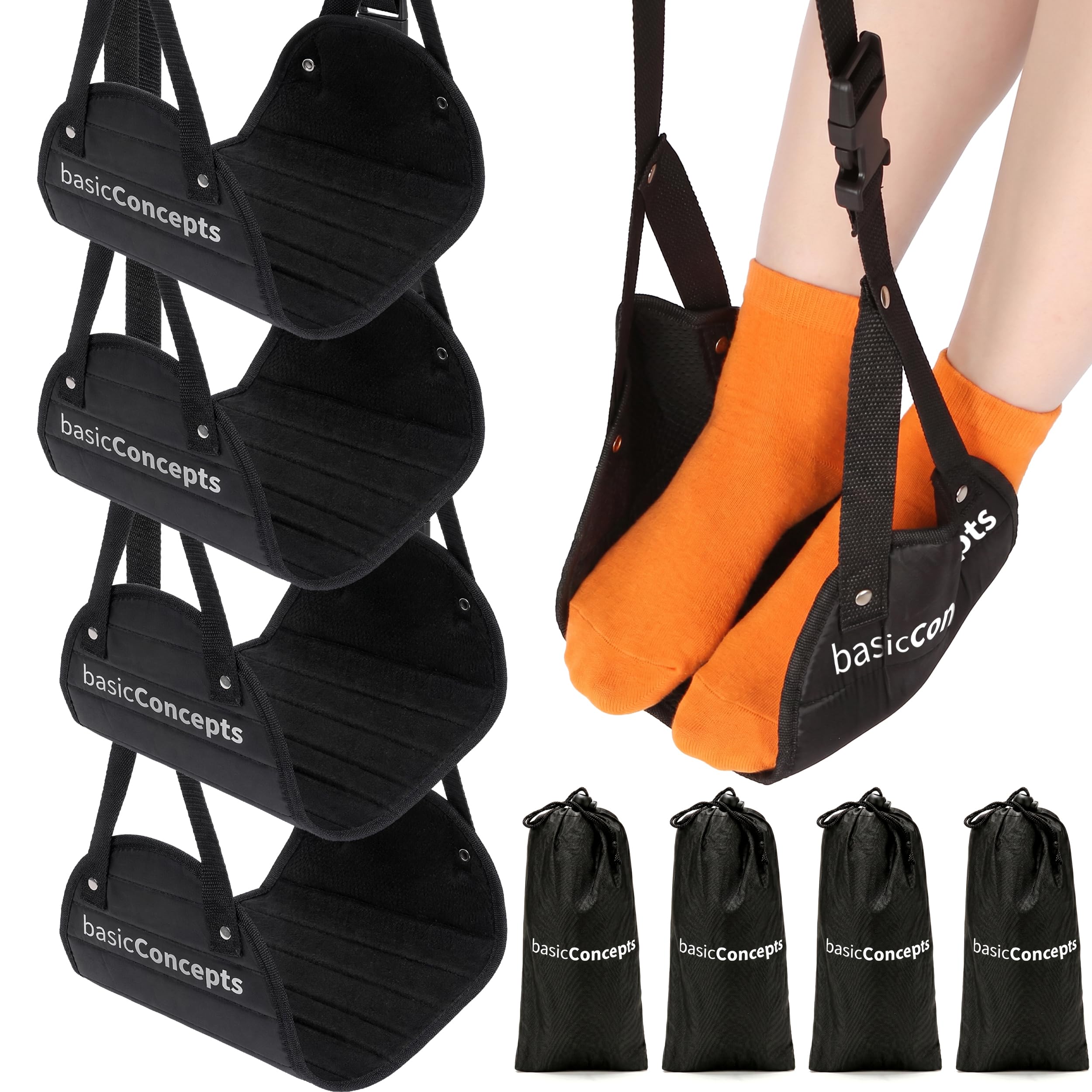
6. BASIC CONCEPTS Foot Hammock
Best for Families
Key Features
- Type: Hanging foot hammock
- Strap: Extra-long, adjustable
- Weight: 10.6 oz
- Pack count: 4
- Price: Premium
Plenty of foot hammocks are cut short, to the point where even a small child cannot get comfortable in one. BASIC CONCEPTS builds around an extra-long adjustable strap instead, so a tall passenger can drop the sling low enough for their legs to actually rest rather than dangle. The even padding is unremarkable, which is a compliment here.
The pack is the argument. Four hammocks cost about what two of the better singles here do, so a family of four, or two couples on the same trip, can each have one instead of passing a sling back and forth across the aisle. It weighs 10.55 ounces, comes with a drawstring travel bag, and carries a lifetime replacement promise.
What you give up is rigidity. The base does not stay as flat as the product photos suggest, feet slide toward the ends rather than sitting where you put them, and the webbing feels lighter-duty than the Delfori’s. Tall travelers in a tight row get very little out of it, because the sling needs legroom to hang into.
Buy it for the arithmetic and the company. A spare in the bag means a snapped strap does not end anyone’s flight, and the four-pack quietly solves the group problem no single sling can. Traveling alone, skip it — you are paying for three hammocks that stay in the closet.
Pros
- Four hammocks in one pack
- Extra-long strap suits tall users
- Lifetime replacement offered
Cons
- Only sold as a four-pack
- Feet slide to the sling’s ends
Four hammocks with straps long enough for adults: this is the pack to buy when more than one person is flying.
7. Sunany Inflatable Footrest
Two Travelers at Once

Key Features
- Type: Inflatable footrest pillow
- Pack count: 2
- Inflated size: 15 x 9 x 17.7 inches
- Height settings: 3
- Price: Premium
Open the box and you get two pillows, two eye masks, four earplugs, two dust covers and two drawstring bags. The extras are a nice touch on a red-eye, but the pillow is the point: three inflatable chambers, a one-way inlet valve, and a shape that folds down to about 7 by 4 by 2 inches.
Fifteen by nine by 17.7 inches inflated puts it in the same class as the other seat-gap pillows, which means the same caveat — it needs the floor space in front of you and will not go into a tight row. The three heights are the useful part. One chamber is a footrest, two make a calf prop, all three get you close to knee height without stacking anything.
The valve design is better than most. You can top it up mid-flight through the one-way inlet without dumping what is already inside, and it empties in seconds when the cabin lights come on. At 12.8 ounces it is not the lightest pillow in this guide, and a pair packs heavier than any sling.
Holding air is what to watch. These are PVC bladders, and the failure mode is a slow leak that shows up on the second or third trip rather than the first, which is exactly why the two-pack is worth having. The price stings a little next to the HOMCA. Between trips, it is also the most useful desk footrest here.
Pros
- Three heights from one pillow
- Folds to 7 by 4 by 2 inches
- Eye masks and earplugs included
Cons
- Can develop a slow leak
- Costs more than the HOMCA pair
Two pillows, three heights and a valve that lets you top up mid-flight — good gear if your carrier allows it.
8. STYDDI Inflatable Footrest
Best for Tight Rows, Short Legs

Key Features
- Type: Inflatable footrest pillow
- Weight: 5.21 oz
- Pack count: 2
- Inflated size: 14.76 x 11 x 6.3 inches
- Price: Budget
Six inches of lift is a different product from eighteen. The STYDDI inflates to 14.76 by 11 by 6.3 inches — a cushion that raises your feet off the cabin floor rather than a platform that puts your legs up at knee height. If your complaint is dangling feet and a numb heel rather than swollen calves, that is exactly enough.
Two nozzles share one plug, with the large one filling the pillow in about ninety seconds and the small one topping it off. At 5.21 ounces each, the pair weighs less than one seat-gap pillow, and the flocked surface tends to stay put on cabin carpet. Two in the pack means one for you and one for whoever is sitting next to you.
The limits are honest ones. Six inches will not help if what you want is your legs elevated, and this is the least reliable inflatable in this guide — a pillow can go soft by landing, and the valves take some fiddling to seat properly. At this price, though, a two-pack that gives out on the third trip has still cost you less than a single premium pillow.
Pros
- Low profile fits tight rows
- Lightest inflatable at 5.21 oz
Cons
- Too low to elevate your legs
- Air loss on longer flights
Buy the STYDDI for a modest lift in a tight row, not for elevating your legs.
How We Tested the Best Airplane Footrests
We started with a running list of about 40 footrests from major retailers, then cut anything with no owner reviews to learn from, anything too bulky to slide into a personal item, and the many listings that were plainly the same design resold under different names. That left 16 — slings, inflatables, and a couple of hybrids — spanning the cheapest two-packs through the thickest memory-foam versions.
Testing began at home. I taped out a 31-inch seat pitch on the living room floor with a kitchen chair in front of it to approximate economy legroom, then ran every footrest through the same sequence. Hammock styles got hung from the chair’s arms and pushed down with both feet to see whether the straps held or the sling sagged to the floor; inflatables were blown up by mouth while I counted breaths and timed it, then squeezed to check the valve.
From there they flew: two cross-country round trips, a long-haul redeye, and a handful of short regional hops, plus a passenger seat on a road trip and several weeks at an office desk. On board, I set a 30-minute timer in each one and noted where it started to bother me — foam that bottomed out under my heels, a sling that cut into my calves, a height that left my knees higher than my hips. I also weighed each one on a kitchen scale and packed it into a personal-item bag to see how much room it really ate.
After five months of use, we checked the seams, re-inflated every air pillow and left it overnight to catch slow leaks, and pressed the memory foam to see how quickly it sprang back. That’s also how we judged value: a two-pack only earns its price if the second one actually gets used, and more than one spare ended up staying in a drawer.
How to Choose an Airplane Footrest
Your seat narrows this decision before any feature does: a hanging foot hammock needs a tray table in front of you, and an inflatable pillow needs floor space plus an airline that allows it.
Sling or inflatable: pick by seat, not by preference
The two designs solve the same problem from opposite directions. A foot hammock — the padded sling that loops over the seat-back tray table — takes up no floor space and gives your feet something to push against, which is why it works in rows where there is barely room to cross your legs. An inflatable pillow fills the gap in front of your seat and lifts your legs, which is more restful on a long haul and is the only version that turns a row into a bed for a small child.
Take the sling if you are in a standard economy seat with a working table, or if you are tall and your problem is knees pushed up rather than feet dangling. Take the inflatable if you are in a bulkhead or extra-legroom row, if you want your calves supported rather than your feet, or if you are flying with a toddler. If you are still undecided, the sling is the safer default: it packs smaller, costs less, and does not run into airline rules.
Check your airline before you pack an inflatable
Several carriers do not allow a seat-gap inflatable at all. One manufacturer prints the list in its own product description — Emirates, Korean Air, Hawaiian, Asiana, Virgin Atlantic, Air France, Air Malta, Egypt Air and Qantas — and it is worth treating that as a starting point rather than the whole story, because policies change and cabin crew make the final call on the day.
Spend two minutes on your carrier’s restricted-items page before you fly, and pack a plan B. A sling is the usual fallback because it attaches to the seat in front rather than occupying the space in front of you, though it too comes down whenever the trays have to be stowed.
The footbed is where cheap slings let you down
A sling with nothing rigid inside becomes a pouch. Your heels migrate toward the middle, both feet end up in the same dip, and you spend the flight hitching yourself back up. A hardboard or bamboo plate under the padding keeps the surface flat, and that single difference separates the slings you keep using from the ones that stay in the bag.
Size and strap length come next. A 17-by-11-inch bed gives you room to shift around; a narrower one is fine for resting but not for fidgeting. Look for a strap that adjusts across a wide range — the widest here runs from 20 to 37 inches — so the same sling works whether you are five feet tall or well over six, which is the usual reason a tall passenger finds one useless.
Packed size, weight, and what you will actually carry
Every pick here fits in a personal item, but portable covers a wide spread: the lightest inflatable weighs 5.21 ounces and folds to the size of a paperback, while the heaviest sling runs to 14.5 ounces with a rigid plate inside. On a fare that weighs your cabin bag the difference is small; on a four-leg trip where you carry everything, the one you forget about is the one that comes along.
The cost that never makes it into a listing is breath. A seat-gap pillow takes a couple of minutes of blowing to fill, which is fine once and tedious by the third flight of the week. A sling asks nothing of you but a buckle.
Frequently Asked Questions
How long should an airplane footrest last?
Treat it as travel gear rather than luggage. A fabric-and-webbing sling generally outlasts an inflatable because there is nothing to puncture — the wear points are a strap and a buckle. PVC pillows are the ones that develop seam and valve leaks, often within a handful of trips rather than years.
If you fly several times a year, either buy a sling or buy your inflatable in a two-pack, so one soft pillow does not end the trip.
Can my toddler sleep on an inflatable footrest in flight?
Makers market the seat-gap pillows as a way to turn an economy seat into a bed for a small child, and parents use them that way. But it is comfort gear, not a safety device: it is not a child restraint, and it should be deflated and stowed for taxi, takeoff, landing and any turbulence.
Cabin crew can ask you to move it at any point, so treat the setup as temporary rather than a permanent part of the seat.
Can I use an airplane footrest in a car or under a desk?
Yes, and most of these are sold for exactly that. An inflatable adapts best, because you can let a chamber or two of air out to match a desk height or a passenger footwell. A sling needs something fixed to loop around, such as a tray table or a rail.
If the flight is the main event and the desk is a bonus, the sling with a rigid base works as well under a keyboard as it does in seat 22A.
Final Verdict
The Delfori is the one we point people to. A rigid platform under the foam is what separates a sling you use from one you leave in the bag, its strap range covers short and tall passengers, and it costs less than every inflatable here.
If you are in a bulkhead row, or you want your legs up rather than your feet, take the HOMCA instead — three chambers and 18 inches of height, paid for with the floor space in front of you. Flying with a toddler on a carrier that permits it, the Maliton is the one to pack.