This post contains affiliate links. We may earn a small commission when you buy through our links — at no extra cost to you.
Travel umbrellas are stuck with an unfair tradeoff: the tiny ones disappear into a bag and then fold themselves inside out at the first real gust, while the sturdy ones live by the front door and never make the trip. What you actually want is something you forget you’re carrying until the sky opens — and then it holds its shape instead of turning into a tulip.
I’ve bent more drugstore umbrellas than I care to count, so over the past six months my team and I carried 14 compact models through commutes, school pickups, and a few thoroughly soaked weekend trips. What separated them had little to do with how they looked on the shelf: it came down to frame material, canopy venting, and whether the auto-open button still worked in month two.
One thing shoppers tend to overrate is rib count. Strength comes from what those ribs are made of and how tightly the canopy is tensioned, not how many there are. Folded length matters just as much, since a couple of inches decides whether an umbrella rides in your bag or lives in the trunk. The picks below are the ones worth the space.
Our Top Picks


The Best Travel Umbrellas, Reviewed
1. Tumella Windproof Travel Umbrella
Best Overall
Key Features
- Weight: 14.5 oz
- Opening: One-hand auto open/close
- Dimensions: 40.94 x 40.94 x 9.84 inches
- Price: Midrange
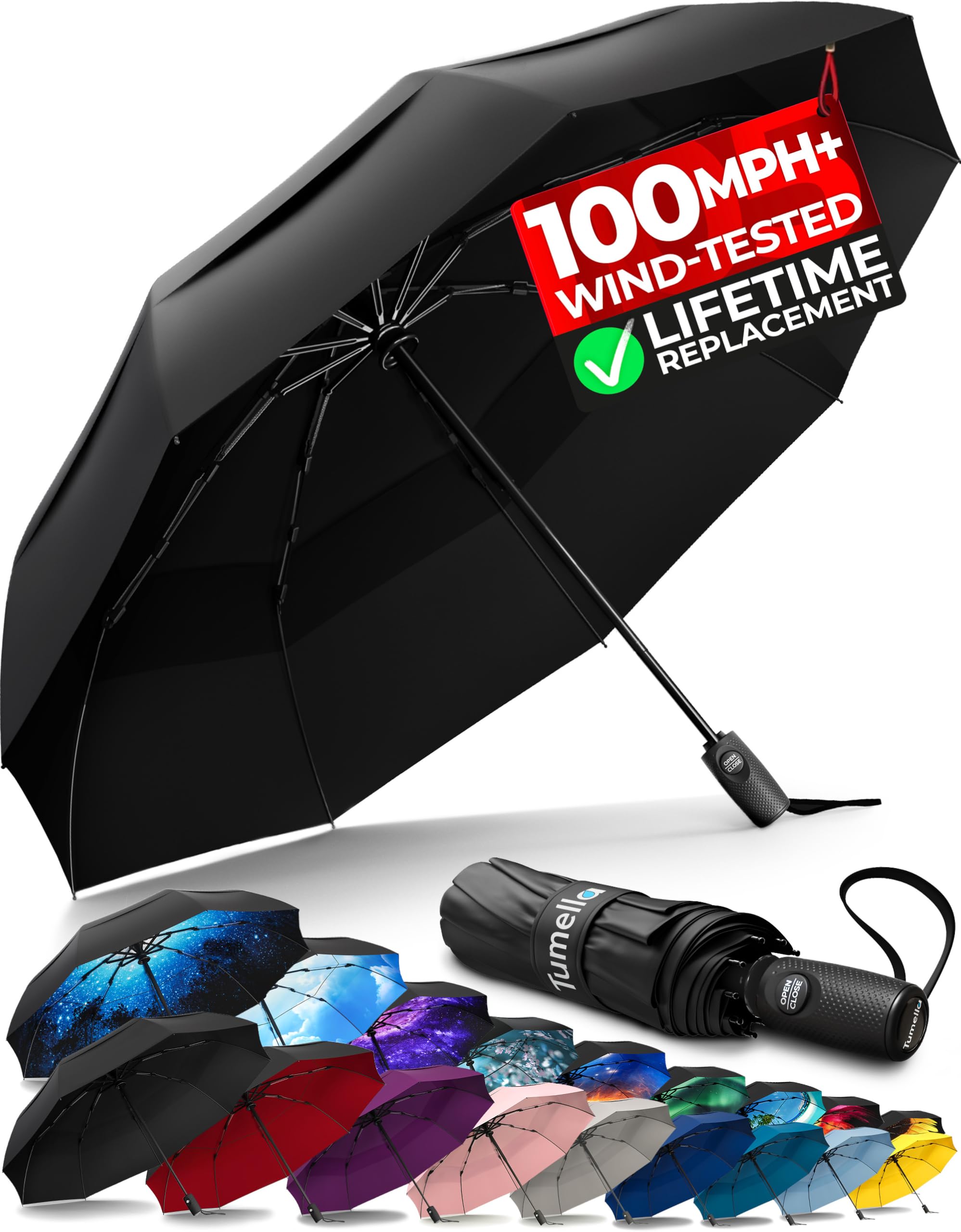
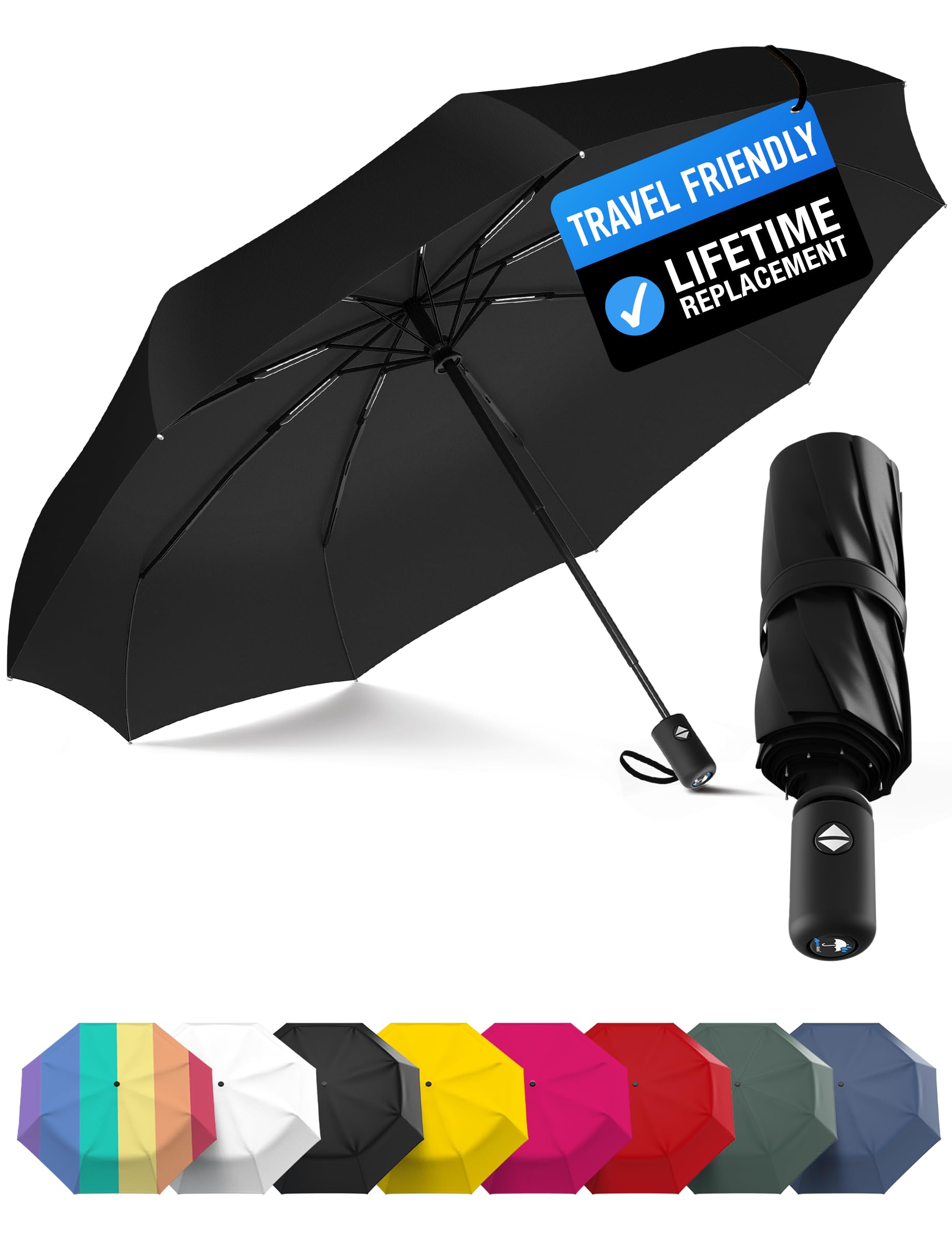
Fourteen and a half ounces with a canopy a shade under 41 inches across is the pairing that won this one for us. Plenty of travel umbrellas are that light; plenty are that wide; very few manage both without feeling like a toy in the hand. It disappears into a day bag and still covers both shoulders, which is more than we can say for the folders that pack down to the size of a soda can.
The frame is the other reason it leads. Gusts load a canopy until the ribs give or the whole thing turns inside out, and this one bends, sheds the pressure, and comes back to shape, so a walk across an open block doesn’t turn into a wrestling match at the corner. One press opens it fully, one-handed, at a curb, with a coffee in the other hand.
Tumella backs it with a lifetime replacement guarantee, and in a category where a bent rib usually means a new umbrella, that is worth more than a few dollars off the sticker. It sits in the middle of this group on price, and it is the one we hand to someone who wants to buy an umbrella once and stop thinking about umbrellas.
Pros
- 14.46 ounces with a canopy just under 41 inches
- Sturdiest frame of the folding picks here
- One-button opening you can work with one hand
- Lifetime replacement guarantee
Cons
- Canopy can invert in a genuine gust
The travel umbrella we recommend first: 14.46 ounces, a canopy just under 41 inches, one-handed opening, and the sturdiest frame in this group.
2. EEZ-Y Windproof Travel Umbrella
Best for Windy Walks
Key Features
- Frame: Fiberglass and steel
- Weight: 1.2 lb
- Open Canopy: 42 inches
- Canopy Style: Vented double canopy
- Price: Midrange
The double canopy is the whole idea here: two layers of fabric with a gap between them, so a gust passes through the vent instead of filling the canopy like a sail. On an exposed crossing, that vent is the difference between an umbrella that stays up and an umbrella that becomes a dish.
It is the best wind handler in this group, and the margin isn’t close. Fiberglass and steel in the frame, ribs that flex instead of snapping, and a canopy that sheds pressure before it turns: three things that matter more than any wind number on a package. If your commute has ten unsheltered minutes in it rather than a dash from a car to a door, this is the one that earns the space in your bag.
What you pay for that is weight: 1.2 pounds, the heaviest here, which you notice at the end of an hour of carrying. The payoff is a 42-inch canopy wide enough for two people walking close, and a button that opens it while both hands are full of groceries. On a wet, blustery evening, that trade is the right way around.
Pros
- Vented double canopy sheds gusts
- Best wind handling in this group
- 42-inch canopy covers two at a squeeze
Cons
- Heaviest carry in this group at 1.2 pounds
If your walk crosses open ground — a bridge, a stadium lot, a long parking apron — the vented canopy here is worth carrying the extra weight for.
3. Bodyguard Inverted Umbrella
Best for Car Commutes
Key Features
- Ribs: 12
- Weight: 15.4 oz
- Opening: Auto open and close
- Canopy Diameter: 46 inches
- Price: Premium
Every umbrella works until you reach the car door. That is where the water goes: the canopy is soaked, the seat is dry, and there is nowhere to put the thing. This one closes inside out, so the wet fabric ends up folded inside the dry fabric, and you can drop it on the passenger seat without a towel under it.
We like it most as the trunk umbrella, the one that comes out twice a week for the school run or the grocery store. The 46-inch canopy with 12 ribs covers an adult plus a backpack, and the reflective stripe around the edge matters more than it sounds: on a dark, wet evening a black umbrella is invisible to drivers, and this one isn’t.
Give the auto mechanism a shakedown in the first week, opening and closing it half a dozen times so a jam shows up while you can still return it. Do that and it is the most convenient umbrella here for anyone whose trips start and end in a parking lot.
Pros
- Wet canopy folds inside, so the car seat stays dry
- 46-inch canopy on a 12-rib frame
- Reflective stripe for dark, wet evenings
Cons
- Stiff close that needs two hands
- Heavy at 435 grams
The reverse fold is the reason to buy: the wet canopy ends up inside, so the car seat, the doorway, and your hands stay dry. Heavy, but it does that one job beautifully.
4. Rain-Mate Compact Umbrella
Best Budget
Key Features
- Ribs: Reinforced fiberglass
- Weight: 11.5 oz
- Opening: Auto open and close
- Package Dimensions: 12 x 2 x 2 inches
- Price: Budget
The yellow is not a small thing. A bright canopy is easier to find in the stand by the door, easier to spot in a crowded crosswalk, and much less likely to be the black umbrella someone else picks up by mistake. It is also the cheeriest object in the group, which counts for something on a gray morning in a way a spec sheet never will.
Under the color it is a straightforward auto-open, auto-close folder: 12 inches packed, 11.52 ounces, reinforced fiberglass ribs, and one button that does both jobs. It opens quickly and the canopy covers a person plus a backpack, which is why it works as a commuter umbrella and not just as a spare.
As a budget pick we think it is the best value in this group, with one honest caveat: the ribs are the part that gives out, so this is a buy-it-again umbrella rather than a ten-year purchase. Leave it in the office drawer, the glove box, or the tote you carry when the forecast is vague, and keep the Tumella for the days that mean it.
Pros
- Bright canopy is easy to spot and hard to lose
- One button opens and closes it
- Cheap enough to buy a second one
Cons
- Longest listed folded length among the compact picks
Our budget pick: bright enough to find in a crowded stand, small enough for a glove box, and cheap enough that a second one for the office makes sense.
5. SY Compact Travel Umbrella
Best for Small Bags
Key Features
- Ribs: 8 fiberglass
- Weight: 10.9 oz
- Folded Length: 11 inches
- Canopy Diameter: 38 inches
- Price: Budget
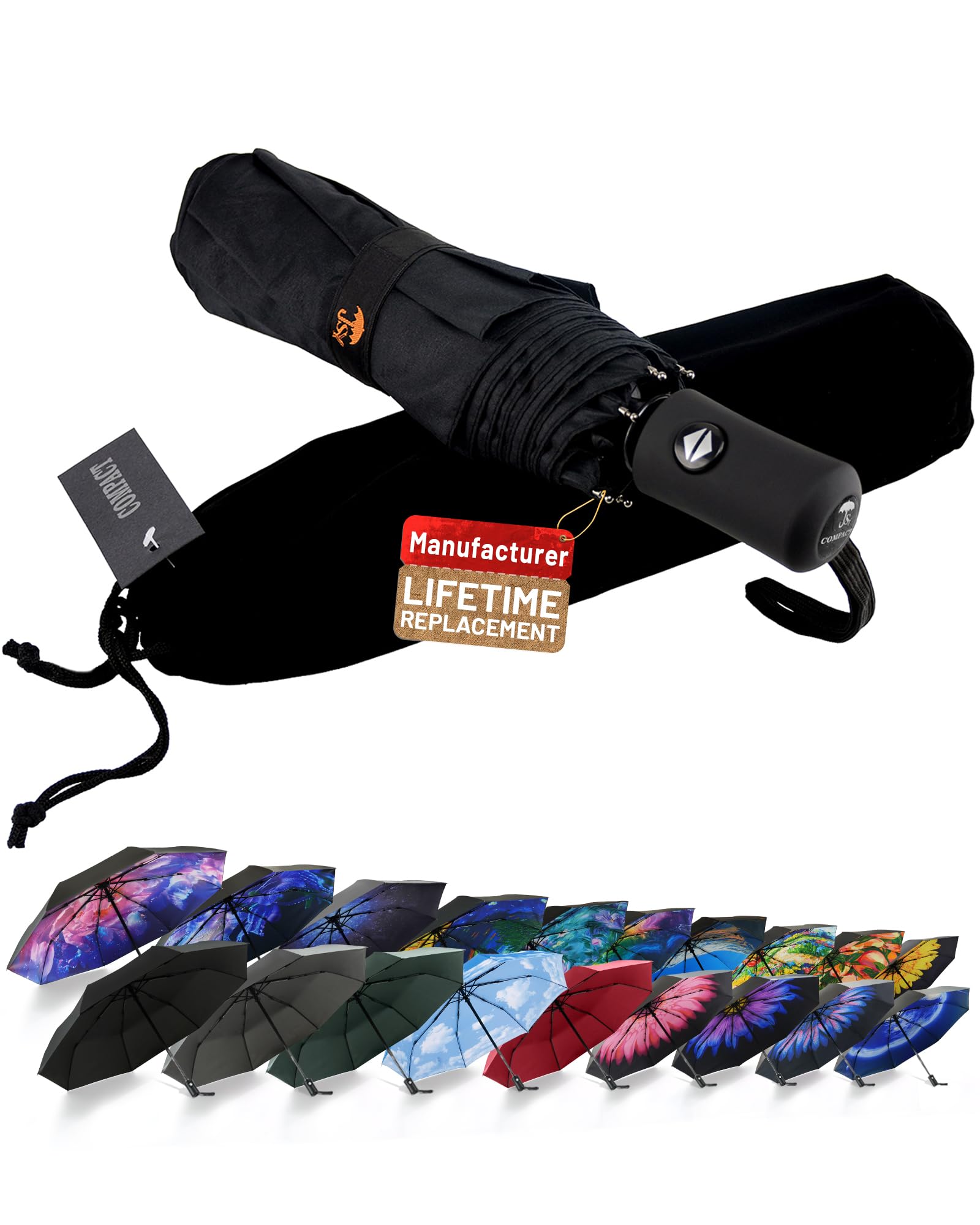
Eleven inches folded and 310 grams is small enough for a coat pocket or the water-bottle slot of a daypack, and that is the entire case for this umbrella. It is the one you stop noticing until you need it, and the reason buying a second for the office drawer isn’t really a decision.
The canopy opens to 38 inches, which covers one person and a shoulder bag and not much else, and the aluminum-and-fiberglass frame with eight ribs handles ordinary city rain without drama. The button opens it one-handed, and it arrives with a soft drawstring bag that keeps the wet fabric off your things, a small thing we appreciated more on the second wet day than the first.
Where it lands in this group is the small-bag slot: one of the lightest and shortest umbrellas here, and honest about being a one-person canopy. For a traveler who packs light and walks short distances between train and hotel, that is plenty; for a daily commuter in real weather, the Tumella is worth the extra outlay.
Pros
- 11-inch fold fits a coat pocket or side pocket
- 310 grams, one of the lightest here
- Auto open and close with a soft carry bag
Cons
- Open button can stop working after a few months
Buy this one for the bag you carry every day: 11 inches folded and 310 grams make it the easiest umbrella here to keep with you and forget about.
6. Anntrue Windproof Travel Umbrella
Wide Coverage

Key Features
- Ribs: 8 fiberglass
- Opening: One-hand auto open and close
- Folded Length: 11.81 inches
- Canopy Diameter: 46 inches
- Price: Budget
A 46-inch canopy on a frame that folds to 11.81 inches is the reason to look at this one. It is the widest umbrella here at a budget price, and that extra width is what keeps both shoulders and the top of a backpack dry when the rain comes in at an angle. We think of it as the two-person spare, the one that lives in the car and gets handed to whoever forgot theirs.
What tempers it is heft. It carries more weight in the hand than the folded size suggests, and you feel it in a purse on a long day. Otherwise it does the plain job: the button opens and closes it, the ribs are fiberglass, and the canopy is the widest you will get at this price.
Pros
- 46-inch canopy, the widest at a budget price
- Folds to 11.81 inches despite the width
- Eight fiberglass ribs and one-hand open/close
Cons
- Wind handling is ordinary on an exposed corner
The widest canopy at a budget price: 46 inches of coverage on a frame that folds to 11.81 inches, best kept in a car or an office rather than a purse.
7. SIEPASA Compact Travel Umbrella
Lightest Carry

Key Features
- Weight: 7.41 oz
- Canopy Fabric: Teflon-treated 210T pongee
- Folded Length: 11.8 inches
- Canopy Diameter: 42 inches
- Price: Budget
The close is the part to think about with this one. The button collapses the canopy, and then the shaft has to be pushed home by hand against a stiff spring to get back to 11.8 inches. On this umbrella that push is stiffer than it needs to be, and if your hands are full, or it is the second umbrella of the morning, you will feel it.
What you get in exchange is lightness: 210 grams on the listing, the lowest figure in this group, and a canopy that still opens to 42 inches. The Teflon-treated fabric sheds water rather than soaking it up, so a shake at the door handles most of the drying, and in steady, ordinary rain it does everything you want.
It also looks better than it costs. The colors are strong, the canopy holds its shape when it is up, and the whole thing rolls back into its sleeve without a fight, the sort of detail that decides whether an umbrella actually travels with you or stays in a closet.
We think of it as the umbrella for the bag you carry every day: insurance for the shower you didn’t plan for, light enough that there is no reason to leave it behind. For a daily walk in real weather, its light frame is the reason to step up to the Tumella instead.
Pros
- 210 grams, the lowest listed weight here
- 42-inch canopy on a very light frame
- Teflon-treated fabric sheds water quickly
Cons
- Frame can turn in a strong gust
The lightest listed umbrella here and the easiest to keep in a tote, as long as you accept a stiff close and a frame that gives ground in gusts.
How We Tested Travel Umbrellas in Actual Weather
We started by gathering every compact umbrella we could find that made a genuine windproof claim and folded to roughly a foot or less, then narrowed the field to models with fiberglass or steel frames, an auto open-and-close mechanism, and enough consistent user feedback to suggest they survive more than a season. Fourteen made the cut, and we carried them for six months in backpacks, totes, glove boxes, and one badly overstuffed carry-on.
Wind was the headline test. On gusty days we opened each umbrella into the crosswind between buildings and on an exposed bridge, watching for canopy inversion, ribs bending out of line, and whether the umbrella snapped back into shape or stayed blown out. We worked the auto-open-and-close button one-handed, over and over, while holding a coffee and a phone, and kept track of which mechanisms went soft, stuck, or jammed.
For portability, we weighed every umbrella on a kitchen scale and checked its folded length against a real backpack pocket, a purse, and a car door — a couple of inches was often the difference between an umbrella that came inside with us and one that stayed in the trunk. After each wet walk we shook them out and noted how fast the canopy dried and whether it dampened whatever it was packed against. We also opened and closed them dozens of times, checking seams, shaft wobble, and how the grip felt when the wind tried to twist the handle out of our hands.
Value came last. We set what each umbrella cost against how it behaved in wind and how it looked after six months of real use, because an inexpensive umbrella you replace every spring costs more than one that lasts.
How to Choose a Travel Umbrella
The wind number printed on the package is marketing; the folded length, the canopy width, and the way the frame is built are what you can actually judge before you buy.
Folded Size and Weight Come First
Most compact folding umbrellas land between 11 and 12 inches folded, and the difference between one inch and the next barely registers in a bag. Weight is what you feel: this group runs from 210 grams to 1.2 pounds, and the heavy end is obvious by mid-afternoon.
Watch the word compact in a listing. It usually means the umbrella fits a tote or a backpack pocket, not a jacket pocket. Measure the pocket you plan to use before you order, then decide whether a few saved ounces are worth a smaller canopy.
Vented Canopies Handle Gusts Better
A vented canopy is two layers of fabric with a gap between them, so wind passes through instead of filling the canopy like a sail. It is the single most effective design feature for walking in exposed places, and it costs weight and bulk. Fiberglass ribs help for the same reason: they flex and spring back where steel stays rigid and bends.
If you cross bridges, round the corners of tall buildings, or walk a campus, pay for the vent. If your umbrella mostly travels from a car to a door, a simpler canopy will do and you will save the ounces.
Know What the Auto Button Does
One press opens the canopy and locks the shaft. A second press collapses the canopy but leaves the shaft extended, and you still push it home by hand, ideally bracing the tip on the ground first. That is the step that catches people out and the reason a good umbrella sometimes gets called hard to close.
Try it once at home before you need it in a doorway with an armful of groceries. If the push annoys you, a manual folder is simpler and lighter for the same money.
Ribs and Storage Decide How Long It Lasts
What fails first on these umbrellas is the joint where a rib meets the runner, not the fabric. Two habits add seasons: shake it out and let it dry open rather than folding it wet, and don’t leave it compressed in a hot car for weeks at a time.
A soaked umbrella rolled straight into its sleeve is the fastest way to corrode a steel shaft and stiffen the mechanism. If yours lives in a car, take it out and open it in the garage every week or so.
Match the Canopy to How You Walk
Canopy width decides whether you arrive with a wet shoulder. Thirty-eight inches covers one person and a small bag; 42 covers one person comfortably and two at a squeeze; 46 covers an adult plus a backpack, or two people walking close.
Wider canopies also catch more wind, so pair the width you need with a vented or well-ribbed frame instead of simply buying the largest one you can find.
Frequently Asked Questions
Can you take a travel umbrella in a carry-on?
Yes. Folding umbrellas are allowed in both carry-on and checked bags on U.S. flights and are not on the TSA prohibited list. Pack it in an outer pocket or a sleeve so a damp canopy doesn’t soak your clothes, and expect to hand it over if an officer wants a closer look.
Is an umbrella or a rain jacket better for a commute?
For door-to-door city trips, an umbrella keeps your head, phone, and bag drier than a hood, and it folds away when the shower passes. A jacket wins in wind and for anything active, like cycling, hiking, or a long unsheltered walk in gusts.
If your commute includes more than fifteen minutes of open ground in bad weather, take the jacket.
Can I use a travel umbrella for sun protection?
A dark canopy gives real shade and keeps direct sun off your face and shoulders on a walk. That is not the same as tested UV protection: only a stated UPF rating means the fabric was measured, and most umbrellas in this group don’t list one.
For a beach day or a long afternoon outside, treat the umbrella as shade and keep using sunscreen.
Final Verdict
The Tumella is the travel umbrella we point most people to. At 14.46 ounces with a canopy just under 41 inches, one-handed opening, and the sturdiest frame in this group, it covers the ordinary case better than anything else here.
If your walk is genuinely exposed — a bridge, a campus, a long parking lot — the vented EEZ-Y handles gusts better and is worth the extra weight. For a car, the reverse-folding Bodyguard keeps the wet side in; for a drawer you raid twice a month, the Rain-Mate.