This post contains affiliate links. We may earn a small commission when you buy through our links — at no extra cost to you.
The first time I gate-checked a stroller, I watched a baggage handler slide it down a chute like a sack of laundry and spent the rest of the trip wondering what shape it would come back in. That’s usually when parents start shopping for a travel stroller: something light enough to carry up a jet bridge with a baby on one hip, compact enough to fold at the gate, and padded enough for a newborn who can’t sit up.
Light and sturdy pull against each other, and the specs that matter most for an infant are the first ones a budget model cuts. A near-flat recline is the big one, since babies under six months shouldn’t be slumped upright for long, along with a canopy that truly shades a sleeping face and a fold you can manage with one hand while holding a diaper bag. My team and I spent eight months pushing 12 travel strollers through airports, parking lots, and cracked sidewalks, and the picks below are the ones that still felt solid at the end of it.
Our Top Picks


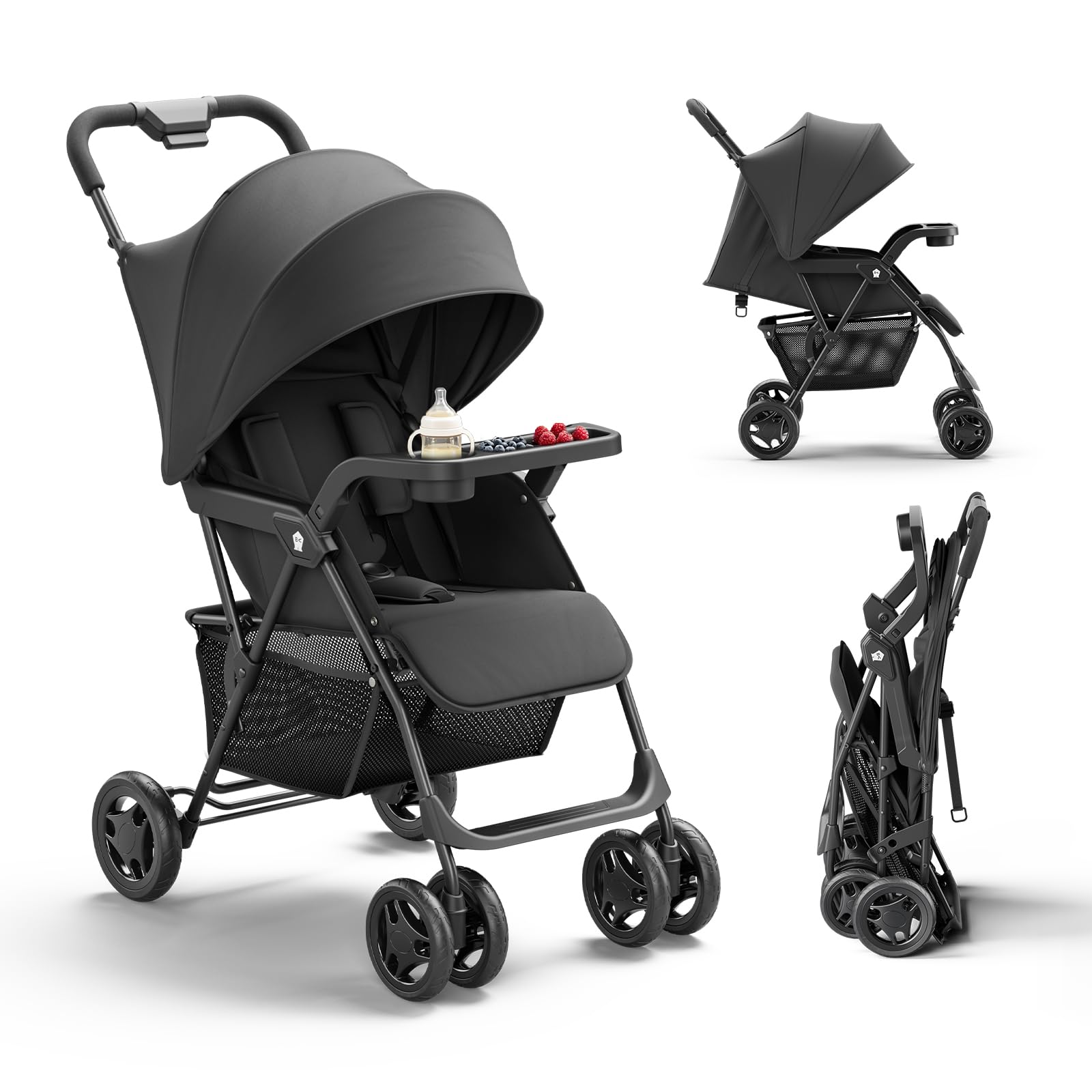


The Best Travel Strollers for Infants, Reviewed
1. Joie Nutmeg
Best Overall
Key Features
- Weight: 16.3 lb
- Seat limit: 50 lb
- Folded size: 12 x 19.5 x 30.5 in
- Newborn recline: Near-flat, from birth
- Price: Premium
Most strollers that fold this small make you wait until your baby can sit up on their own. The Nutmeg doesn’t. It’s rated from birth, and the seat drops into a near-flat recline that gives a newborn somewhere to lie back on a long day out. It also takes an infant car seat on the frame, so for the first few months you can click the bucket seat on and skip the transfer entirely. That combination is why it leads this list for an infant rather than a toddler.
At 16.3 pounds it isn’t the featherweight of the group — the carbon-fiber picks here are three to five pounds lighter — and we didn’t mind, because what that weight buys is a settled, quiet push and a seat a baby can actually stretch out in. The fold is a genuine one-hander: pull up on the handle and the frame collapses to 12 by 19.5 by 30.5 inches.
The details are where it earns its price. The harness adjusts through three shoulder heights, so it still fits at eleven months without a wrestle, and the leg rest and calf support adjust to keep a reclined newborn’s legs from dangling. The front wheels lock straight for cobblestones and unlock for tight store aisles, the canopy is UPF 50+ and water-repellent with a peek-a-boo window, and there’s a parent cup holder, a leatherette arm bar, and a pocket for a phone. The under-seat basket is on the small side; a diaper backpack on your shoulders covers what it can’t.
Where it stops suiting you is the weekly business flight, where a shorter fold is simply the better tool. For everyone else the 50-pound seat limit quietly does the long work here: it will still be carrying a four-year-old on the walk home from preschool, years after the newborn phase is a photograph.
Pros
- Rated from birth with a near-flat recline
- Accepts an infant car seat
- One-hand fold with three harness heights
- Adjustable leg rest and calf support
Cons
- 30.5-inch folded length rules out overhead bins
For a baby from birth through toddlerhood, this is the travel stroller we recommend: near-flat newborn recline, a one-hand fold, and car-seat compatibility in one compact package.
2. Mompush Nexis
Best Ultralight
Key Features
- Weight: 11.5-pound carbon frame
- Seat limit: 50 lb
- Folded size: 19.88 x 18.11 x 7.87 in
- Newborn recline: Multi-angle, near-flat
- Price: Premium
About 20 by 18 by 8 inches, folded. The Nexis collapses into a slab thin enough to slide into an overhead bin, and the carbon frame is the reason one hand can lift it there. The frame is 11.5 pounds; the complete stroller is listed at 13.9, which is the number your shoulder will actually feel. It self-stands once folded, there’s a shoulder strap for the walk down the jet bridge, and it arrives with no assembly at all.
For a family that flies more than once or twice a year, this is the stroller we hand over first. The auto fold runs from the handlebar in a single motion, the recline spans near-upright to near-flat so a newborn can lie back and a toddler can sit up and watch the concourse, and the seat is rated to 50 pounds. The XL canopy is UPF 50+ with a mesh window, and the rain cover and cup holder come in the box rather than as an upsell the week before you leave.
What you trade for the weight is plantedness. The Nexis is the least settled stroller in this group: it skitters on brick, wants two hands on broken sidewalk, and will tip backward if you hang a loaded tote on the handlebar. Load the basket, keep the heavier bag on your shoulder, and the trade is worth making — you are buying an 11.5-pound frame, and the flex is where 11.5 pounds comes from.
Pros
- 11.5-pound carbon fiber frame
- Folds to 7.87 inches deep
- One-hand auto fold that self-stands
Cons
- Least planted of this group on rough ground
We hand the Nexis to anyone who flies often: an 11.5-pound carbon frame and a 7.9-inch folded depth beat every other pick here on the overhead-bin question.
3. Mamazing Umbrella Stroller
Best Budget Newborn Pick
Key Features
- Weight: 13.7 lb
- Seat limit: 50 lb
- Folded size: 19 x 12.2 x 34 in
- Newborn recline: Multi-position near-flat
- Price: Budget
Two things make this umbrella stroller worth a look at its price: a multi-position near-flat recline rated from birth, and a removable snack tray with a cup holder that most strollers this cheap leave off entirely. For a household with a newborn and a nine-month-old in the same year, that’s the least expensive route here to a seat a baby can actually lie back in — and the tray means you aren’t balancing a pouch and a sippy cup on your wrist.
The rest of the package is honest rather than exciting. 13.7 pounds, a one-hand compact fold, a UPF 50+ canopy with a mesh peek-a-boo window, an adjustable-height five-point harness, and a 50-pound seat limit. The wheels are 7-inch rear and 6-inch front, which handles sidewalk seams and playground gravel and not much more. Folded, it measures 19 by 12.2 by 34 inches.
This is the budget pick that doesn’t make you give up the infant months, and that’s the whole argument for it. The finish is where the savings show: the frame and fabrics feel lighter-duty than the Joie or the Beberoad, and the seat padding is thinner than either. For a second stroller that lives in the trunk and comes out for errands, that’s a fair trade — and the low price is the point, not a compromise you have to talk yourself into.
Pros
- Near-flat recline rated 0 to 36 months
- Removable snack tray with cup holder
- 50-pound seat limit at a budget price
Cons
- 34-inch folded length means gate-checking
- Unfold latch can re-latch mid-open
If the budget drives the decision, this is the infant-capable stroller we point to: a from-birth near-flat recline and a snack tray at the lowest price in this group.
4. Beberoad Love R2
Best for Naps
Key Features
- Weight: 12.9 lb
- Recline: 110° to 152°
- Seat limit: 45 lb
- Folded size: 18.5 x 9.8 x 21.8 in
- Price: Midrange
The rain cover is the tell. Plenty of strollers this size charge extra for one; the R2 ships with a rain cover, a cup holder, and a travel bag, which says somebody was thinking about the actual journey rather than the showroom floor. It’s also the pick here for naps on the move: the seat runs from 110 degrees to 152 degrees, and that last stretch is what lets a baby drop off on a long museum afternoon instead of fighting it.
The hardware backs that up. The aluminum frame carries 12.9 pounds, the canopy is UPF 50+ and waterproof with a good forward pull, and there’s a rear pocket for a phone and keys plus a basket underneath. You get suspension in the wheels and a proper brake rather than a single bar you stomp, and the seat back is firm enough that a sleeping toddler doesn’t slump into the hinge. Folded, it’s 18.5 by 9.8 by 21.8 inches — a shape that goes into more overhead bins than most.
What we don’t love is the handlebar. It’s fixed and it sits low, so if you’re tall you’ll be pushing with a slight stoop, and by the second mile of a theme-park day you’ll feel it in your shoulders. Shorter parents won’t notice. It also stops at a 45-pound seat limit, which is a year or so less stroller than the 50-pound seats here — for the infant year and the toddler years right behind it, though, that’s still plenty.
Pros
- Recline runs back to 152 degrees
- Rain cover, cup holder, and travel bag included
- 12.9-pound aluminum frame with suspension
Cons
- 45-pound seat limit is the lowest here
Our pick for naps: the 152-degree recline and the included rain cover make the R2 the stroller we reach for on long, unpredictable days out.
5. Jeep Altitude
Best Ride
Key Features
- Weight: 16.6 lb
- Recline: Multi-position
- Seat limit: 50 lb
- Folded size: 12.5 x 19 x 29 in
- Price: Midrange
Four-wheel suspension on a stroller that folds to 12.5 inches deep is the entire pitch. The tires are puncture-proof EVA, 5.5 inches at the front and 6 at the rear, and the suspension is doing real work on the surfaces most travel strollers simply rattle across: brick, cracked sidewalk, the boardwalk loop at a theme park.
The rest of it is aimed at long days rather than tight connections. The one-hand auto fold drops the frame onto its own base, there’s a carry handle on the side, and the extendable canopy with a mesh peek-a-boo window pulls forward far enough to shade a sleeping face. The multi-position recline and adjustable footrest grow with the seat, the parent and child bars are leatherette, and it’s Greenguard Gold certified and JPMA listed — details that rarely show up at this end of the market.
Two things to know before you commit. It’s 16.6 pounds, the heaviest stroller here, and you feel every ounce lifting it into a trunk at the end of a long day. And it can tip if a child stands and leans back against the handlebar, so keep that bar clear and load the basket instead — the usual trade for a light, narrow footprint, but worth knowing before you hang a diaper bag there.
So: if your travel is a car, a trunk, and eight hours on your feet, this is the one we take. It’s the least convenient stroller here to carry up a jet bridge, and the only one that doesn’t leave your wrists sore by day three of a vacation.
Pros
- Four-wheel suspension with EVA tires
- One-hand auto fold with a carry handle
- Extendable canopy with mesh peek-a-boo window
Cons
- Heaviest pick here at 16.6 pounds
When the trip is a car and a full day on your feet, the Altitude’s four-wheel suspension and full canopy make it the most comfortable push in this set.
6. Mamazing Ultra Air
Best for Older Infants

Key Features
- Weight: 11.6 lb
- Age range: 6 to 36 months
- Seat limit: 50 lb
- Folded size: 22 x 19.3 x 11 in (H x W x D)
- Price: Premium
The age range settles it for a newborn buyer: the Ultra Air starts at six months. There’s a reclining seat, but the maker doesn’t rate it from birth, so a two-month-old has no business in it. Everything else about the stroller is aimed squarely at the family who is already past that stage.
Which is a shame, because the package is strong. 11.6 pounds on a carbon-fiber frame, a one-hand fold, a folded size of 22 by 19.3 by 11 inches, a 50-pound seat limit, a bumper bar and travel bag in the box, and a UPF 50+ canopy. The basket is the surprise: rated to 22 pounds, it takes a full diaper bag rather than a folded jacket. The wheels are 6-inch rear and 5.5-inch front, small enough that gravel makes itself known.
For a six-month-old and up, this is the better of the two Mamazing strollers here and one of the better values in the group. It’s lighter than everything except the Mompush, folds nearly as small, and costs less than the other carbon-fiber options. The frame also feels more solid than 11.6 pounds usually does, which is the thing that convinced us it belongs on this list despite the age problem.
The recurring weak point is the carry strap and its attachment — the bag strap is the part that gives out. Worth knowing if you plan to sling it over a shoulder through an airport rather than roll it.
Pros
- 11.6-pound carbon fiber frame
- 22-pound under-seat basket
- 50-pound seat limit and travel bag included
Cons
- Not rated for newborns
- Carry-strap attachment is a weak point
Past the newborn stage, we rate the Ultra Air highly: it folds small, weighs 11.6 pounds, and swallows a diaper bag in a 22-pound basket.
7. Gromast A1
Best for Quick Car Trips

Key Features
- Weight: 14 lb
- Backrest: Adjustable
- Seat limit: 48.5 lb
- Folded size: 19.3 x 10.6 x 22.4 in
- Price: Midrange
Gromast builds the A1 around an extra-wide seat, which is not the first thing most compact strollers brag about. Around it you get an adjustable backrest on a slide button, a UPF 50+ waterproof canopy with a peek-a-boo window, and a cup holder — a spec sheet that reads more like a full-size stroller’s than a folding one’s.
It isn’t full-size, and that’s the appeal. At 14 pounds with a one-hand fold and a 19.3 by 10.6 by 22.4-inch folded package, the A1 is a genuinely compact stroller that happens to have a wide seat, and that pairing is rarer than it should be. A chunky nine-month-old in a winter suit goes in without a fight, and the aluminum frame and 300D Oxford canopy wipe clean after a snack-heavy outing. The EVA tires are happiest on pavement.
The 22 kg seat limit is the highest in this group, which buys you roughly another year of use over the 45-pound seats, and it’s the reason to pick this over a cheaper compact stroller if your baby is tracking large. There’s a real basket underneath, and the harness is a five-point with adjustable straps.
The one thing to check on arrival is the lock. The frame can need a firm push before it clicks fully open, and a soft push leaves it half-set, which is not a state to put a baby in. Test it a few times in the driveway before your first trip and it stops being a surprise. There’s also no rain cover or travel bag in the box, unlike the Beberoad.
Pros
- Extra-wide seat in a compact fold
- 22 kg seat limit, the highest here
Cons
- No rain cover or travel bag included
For a bigger baby in a compact stroller, the A1’s wide seat and 22 kg limit give it a longer run than its size suggests, at a midrange price.
How We Chose and Tested Travel Strollers for Infants
We started with spec sheets, since the numbers that decide whether a travel stroller works are folded size, listed weight, and recline depth. Anything that couldn’t lay a newborn back near flat was cut from the infant group. From there we filtered for overhead-bin and gate-check claims, canopy UPF ratings, harness padding, and basket capacity, then ordered 12 strollers across the price range to compare side by side.
Testing happened where these strollers actually live: airport security lines, jet bridges, the gate counter, the trunk of a compact sedan, a week of errands, and the cracked sidewalks and tree roots in our own neighborhoods. I also folded and unfolded each one in a narrow hallway to mimic an apartment entry.
The one-hand fold got tested the way it gets used, with a loaded diaper bag in my other arm and a weighted doll in the seat. I timed the fold, counted the steps it took, and noted whether the stroller stood up on its own once collapsed. Each went into an overhead bin to see whether the claimed compactness held with the canopy attached. For stability, I packed the under-seat basket with an 8-pound bag, hung a tote off the handlebar, and pushed over cracked pavement to watch for shimmy or tipping.
Durability came down to repetition: dozens of folds a week, then a monthly check of hinges, wheels, and frame joints for play. Adjustability got judged with a wriggling doll, rethreading harness slots, dropping the leg rest, and raising the handlebar. We also wiped yogurt, spit-up, and rainwater off seat pads to see which fabrics stained, and weighed what came in the box against what we had to buy separately.
How to Choose a Travel Stroller for an Infant
The infant year is where compact strollers usually stop helping: a frame that folds to the size of a briefcase is often rated from six months, so the first question is whether the seat can take a newborn at all.
Newborn readiness comes before everything else
Two designs get a newborn into a travel stroller. The first is a seat that reclines close to flat and is rated from birth, which is what the Joie Nutmeg and the Mamazing LS04 do. The second is a frame that accepts an infant car seat, letting you clip the bucket seat on for the first few months and skip the debate entirely.
A reclining seat is not automatically a newborn seat. Several strollers here lean a long way back and still start at six months, so check the stated age range rather than the angle. If the listing doesn’t say from birth, it isn’t.
Folded size, not folded weight, decides whether it flies
Weight gets all the attention, but the longest folded dimension is what decides whether a stroller goes in the bin or gets gate-checked. U.S. carriers generally cap carry-ons at 22 x 14 x 9 inches and build the overhead bins around that, so a 30-inch fold like the Joie’s is a trunk fold no matter what the marketing says.
Folds in the low twenties — the Beberoad at 21.8 inches long, the Mompush at 7.87 inches deep — are the shapes that actually go aboard. Measure the long side of the folded frame before you promise yourself overhead storage.
The fold you can do with a baby on your hip
A one-hand fold is used every single day of a trip, and it isn’t a yes-or-no feature. Some frames drop open on a button and self-stand, which matters more than it sounds: a stroller that lies flat on the floor of a rideshare is one you have to bend over while holding a baby.
Look for a fold that finishes in one motion. Latches that catch again halfway through the unfold turn a two-second job into a two-hand wrestle, and that is exactly the moment when you have the least hands free.
Where you’ll push it decides the wheels
Small wheels on a light frame are wonderful in a terminal and mediocre on a brick sidewalk. If most of your miles are concourse and parking garage, a 12-pound stroller with 5-inch wheels is the right call and the extra pounds are wasted.
If your travel is really road trips, parks, and theme-park pavement, suspension earns its weight — the Jeep Altitude’s four-wheel setup is the clearest example here. Front wheels that lock straight help on gravel and cobblestone; unlocked swivel helps in a store aisle.
How long it lasts past the first birthday
Seat limits here run from 45 to 50 pounds, with the Gromast rated to 22 kg, which is roughly three to four years of use for most children. Weight is only half of it: seat height and canopy clearance decide when a tall toddler starts to look folded in.
If one stroller has to cover the infant year and beyond, spend the difference on a 50-pound seat with an adjustable leg rest rather than on a lighter frame. The recline is what you need now; the seat limit is what keeps you from shopping again next spring.
Frequently Asked Questions
Can I take a travel stroller through security and onto the plane?
Yes. A stroller goes through the security X-ray like any other bag, and most U.S. airlines gate-check one free — you leave it on the jet bridge and collect it there at the other end. Bringing it into the cabin depends on the folded size and on the crew that day, so plan on gate-checking unless yours folds to carry-on dimensions.
A padded gate-check bag keeps the frame out of the rain and makes your stroller findable in a pile of twenty at the bottom of the jet bridge.
Is an umbrella stroller okay for a newborn?
Usually not. Most umbrella strollers are rated from six months and use a three-point harness, which doesn’t hold a baby who can’t sit up yet. For the infant months you need a five-point harness and a seat rated from birth, or a frame that accepts your infant car seat.
The cheap umbrella stroller is a toddler-years purchase. Buy it second, not first.
Can my baby sleep in a travel stroller?
Short naps on the move are fine in a reclined seat — that’s what a near-flat recline is for. It isn’t a substitute for a crib, and a baby asleep in a stroller should stay in view.
If your baby sleeps deeply and often on the go, buy for recline depth. The Beberoad’s 152 degrees is the deepest seat in this group, and it shows on long afternoons.
How do I clean a travel stroller after a trip?
Spot-clean the polyester with a damp cloth and mild soap, wipe the frame, and let everything dry fully before folding it — the Joie, for one, is hand-wash only. Don’t machine-wash a canopy: the UPF coating and the water-repellent backing are what wear out first.
Vacuum the sand out of the fold mechanism before the stroller goes back in the car.
Final Verdict
The Joie Nutmeg is the stroller we recommend for most families with a baby under a year. It’s the only pick here that pairs a birth-rated near-flat recline with a car-seat mount and a one-hand fold, and it’s the most consistently praised stroller in this set.
If flying is the main event and it has to disappear into an overhead bin, the Mompush Nexis does that at 11.5 pounds and gives up some plantedness for it. If the budget decides, the Mamazing LS04 gets a newborn lying back for the least money here — just plan on gate-checking its 34-inch fold.