This post contains affiliate links. We may earn a small commission when you buy through our links — at no extra cost to you.
Every travel stroller meets its real test at the gate, ten minutes before boarding, when the agent calls for families and you’re holding a toddler in one arm and wrestling a folded frame with the other. I’ve had a stranger collapse mine while I stood there useless, and I’ve had one snap shut one-handed and slide straight into the overhead bin. That difference is what separates a stroller you tolerate from one you’re glad you brought.
Over the past six months, my team and I have pushed 11 of these through terminals, security lines, jet bridges, and the cracked sidewalks around my neighborhood. The tradeoff never changes: the lighter and smaller the fold, the less stroller there is underneath, and the more eagerly it tips when you hang a diaper bag on the handle. Maneuverability, storage, car seat compatibility, and how each one held up after months of use are where these models separate.
The picks below are the ones I’d wheel up to a gate agent without a second thought.
Our Top Picks


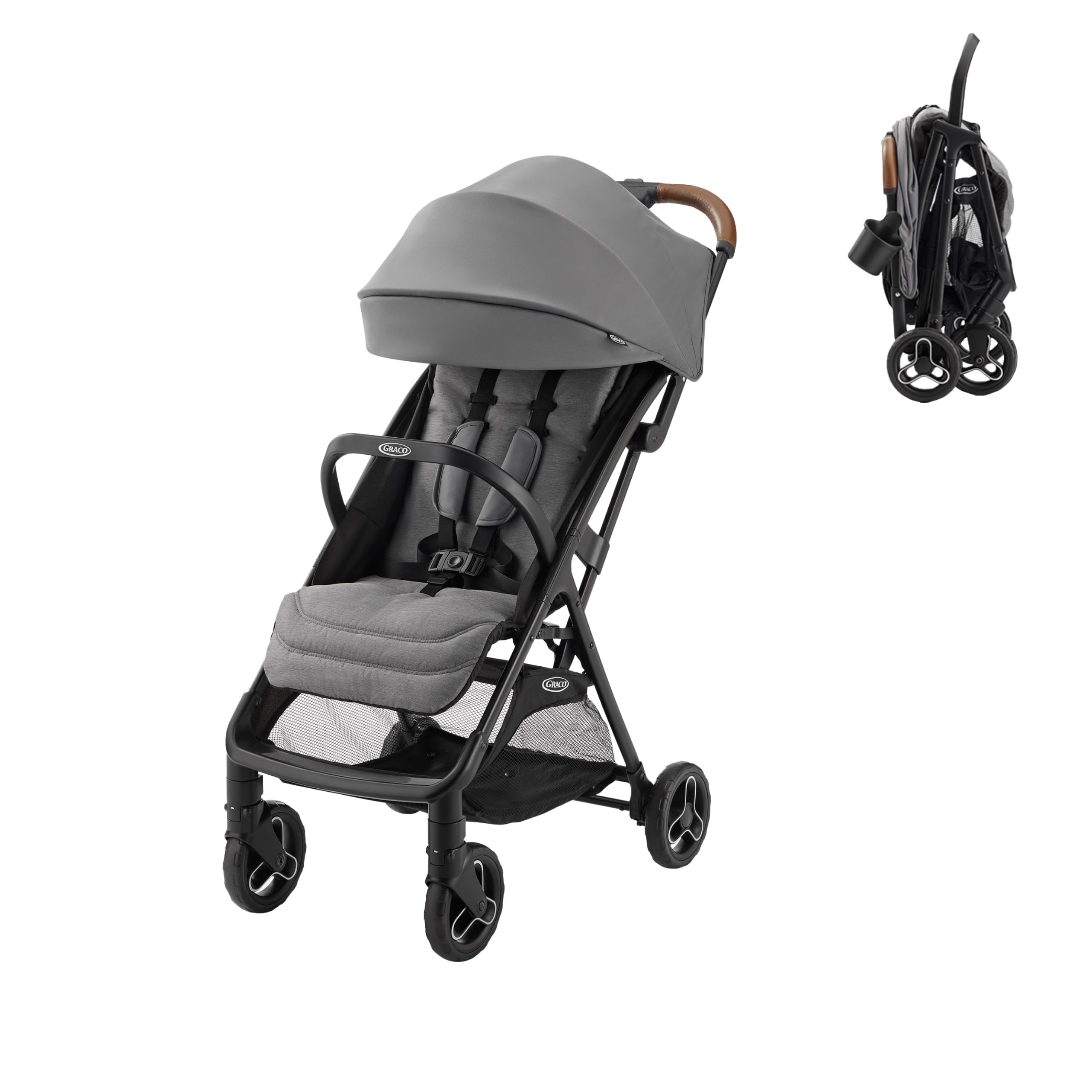


The Best Travel Strollers for Airplanes, Reviewed
1. Mamazing Ultra Air
Best Overall
Key Features
- Weight: 11.6 lb
- Folded size: 22 x 19.3 x 11 in
- Weight limit: 50 lb
- Basket capacity: 22 lb
- Price: Midrange
Twenty-two by 19.3 by 11 inches folded and 11.6 pounds: that is the shape of a stroller you carry onto the plane instead of handing to a baggage cart. The carbon fiber frame is why the weight stays low without the frame feeling hollow, and between the folded size and the one-hand fold, this is the stroller we recommend first to families flying with one child.
Two numbers do most of the work. The seat is rated to 50 pounds with a 39.4-inch height ceiling, so it still fits the tall 4-year-old who has outgrown the umbrella stroller in the garage. And the basket underneath holds 22 pounds — the largest of any stroller here by a wide margin, next to 4.4 pounds on the Mompush Jeto. Diaper bag, jackets, snack tote: all of it goes under the seat instead of over your shoulder, which is the difference between one free hand and none at the security line.
The details land where travel actually gets annoying. The brake sets and releases on separate pedals, so you aren’t hunting for the right tab in a crosswalk; the tires are EVA foam and never need air; there’s a bumper bar for a toddler to hold, a travel bag in the box, and a canopy rated UPF 50+. The seat reclines for naps without lying flat, and the harness is a five-point with adjustable straps.
Durability is the one place it gives ground. The seat and canopy fabric are lighter than a full-size stroller’s, and the travel-bag strap is the part that goes first. Neither changes how it pushes, and for two or three trips a year plus weekend errands the trade is easy to make; if you fly monthly, count on replacing the bag at some point.
Pros
- Folds to 22 x 19.3 x 11 inches
- 11.6 pounds on a carbon fiber frame
- 50-pound seat limit fits a tall 4-year-old
- 22-pound basket, the biggest here
Cons
- Travel-bag strap is the weak point
- Rated from 6 months, not from birth
The default choice for most families: light enough to lift into a bin, with a one-hand fold and a basket that holds the whole day.
2. Mompush Jeto
Best Budget
Key Features
- Weight: 10.1 lb
- Folded size: 20.5 x 17.3 x 7.1 in
- Weight limit: 40 lb
- Basket capacity: 4.4 lb
- Price: Budget
At about half the price of our top pick and a pound and a half lighter, the Jeto is the stroller we point budget-minded travelers to. Folded, it’s a flat 20.5 by 17.3 by 7.1 inches — a slab rather than a bundle — and it stands on its own, which matters more than it sounds when you’re holding a boarding pass and a coffee. A carry strap runs along the frame for the walk down the jet bridge.
What the money doesn’t buy is longevity. The seat tops out at 40 pounds, so a heavy 3-year-old will be at the ceiling, and the wheels are small — 4.9 inches up front — which is fine on tile and jet bridge carpet and rough on cobblestones. We still reach for it on trips where the stroller gets thrown in a trunk and dragged through a rental car lot: at this price, a scuff doesn’t ruin your day.
Pros
- Just over ten pounds, the lightest here
- Folds flat to 20.5 x 17.3 x 7.1 inches
- Self-standing with a carry strap
- About half the price of our top pick
Cons
- Basket holds only 4.4 pounds
The budget pick that still folds into an overhead bin — buy it if you fly a couple of times a year and want the lightest stroller here.
3. Graco Ready2Jet
Best with an Infant Car Seat
Key Features
- Weight: 13.2 lb
- Harness: Convertible 3- or 5-point
- Car seat: All Graco SnugRide seats
- Weight limit: 50 lb
- Price: Midrange
The Ready2Jet’s trick is the automatic fold: one hand on the handle, a release, and the frame collapses and stands up on its own. At the security line, with a bin in one hand and a child in the other, that’s the difference between a clean handoff and a wrestling match on the floor.
The real reason to pick this one, though, is the car seat. Graco’s SnugRide infant seats lock onto the frame, so a sleeping baby moves from the car to the stroller without being unbuckled, and the removable belly bar doubles as a carry handle. It’s the first-year pick — the stroller that lives in the trunk while your child is still in the bucket seat — and at 13.2 pounds it’s light enough to lift into a bin when you’d rather not check it.
After the car seat stage, the seat is rated to 50 pounds and the calf support adjusts as legs get longer, so it keeps working into preschool. The canopy is UV 50, the harness converts between three and five points, and there’s a parent cup holder. It reads as a fully equipped stroller that happens to fold small, not a stripped-down one that happens to fly.
Pros
- Automatic one-hand fold stands on its own
- Takes Graco SnugRide infant car seats
- 50-pound seat with adjustable calf support
- 13.2 pounds for a full-featured stroller
Cons
- Under-seat basket is small
- Car seat can take a couple of tries to latch
The stroller to buy while your child is still in an infant bucket seat — the SnugRide clicks on and the frame folds itself.
4. Joie Nutmeg
Best for Newborns
Key Features
- Weight: 16.3 lb
- Folded size: 12 x 19.5 x 30.5 in
- Weight limit: 50 lb
- Rear wheel diameter: 8.25 in
- Price: Premium
Most compact strollers start at six months. The Nutmeg doesn’t: it’s rated from birth, with a near-flat recline, a foot barrier, and a leg rest that adjusts as a baby grows. For a family whose first flight is with a four-month-old, that single difference decides the purchase.
The wheels are the other reason it’s here. At 8.25 inches in back they’re the largest on this list, and the front swivels lock at the push of a button for cobblestones and gravel — the two surfaces that undo most travel strollers. That capability costs 16.3 pounds, which is a real number to raise over your head into a bin and a reasonable one to push through a city for a week. The seat is rated to 50 pounds, and the canopy is UPF 50+ and water-repellent.
Around the frame, the details are the ones you use on a trip: a cup holder, a leatherette arm bar, a tracker pocket, and a harness that adjusts to three heights without rethreading. The canopy pulls forward over a sleeping face, which is the part compact strollers usually skimp on.
Pros
- Rated from birth with a near-flat recline
- 8.25-inch rear wheels, the largest here
- Front swivels lock for rough ground
- Water-repellent UPF 50+ canopy
Cons
- Narrow basket fills up fast
- 16.3 pounds is heavy for a bin lift
For a first flight with a newborn, this is the one: a near-flat recline from birth and the biggest wheels here.
5. Mompush Lithe V2
Best for Toddlers
Key Features
- Weight: 17.4 lb
- Recline: 3 positions, near-flat
- Folded size: 21.26 x 11.2 x 26.9 in
- Weight limit: 40 lb
- Price: Midrange
Only one stroller here comes with a snack tray, and four hours into an airport day you’ll understand why that matters. The tray is removable and wipes clean, the cup holder is molded into it, and a toddler who can reach her own crackers is a toddler who isn’t asking you to open the diaper bag again.
The rest of the package is built for long days rather than short hops: a mechanical recline that goes to 175 degrees for naps, a UPF 50+ canopy, and — unusually — a travel bag and rain cover in the box, both of which you’d otherwise be buying the week before a trip. The seat is rated to 40 pounds.
Where it loses ground is bulk. At 17.4 pounds and 26.9 inches folded, it’s the biggest stroller we’d still call carry-on-ish, and the fold has a learning curve — the one-second claim is optimistic the first few times. Give it a dry run in the living room with a bag in one hand before you’re doing it at a gate. What you get back is a seat a toddler will sit in for a whole afternoon, which is not nothing when the alternative is carrying one through Terminal B.
Pros
- Snack tray and cup holder for toddlers
- Reclines to 175 degrees for naps
- Travel bag and rain cover included
- UPF 50+ canopy
Cons
- 40-pound weight limit
- Fold takes practice to latch open
The one-stroller answer for a whole trip: a snack tray, a 175-degree nap recline, and a travel bag in the box.
6. Kolcraft Cloud Plus
Best for Gate-Check Trips

Key Features
- Weight: 11.8 lb
- Cup holders: 4
- Folded size: 18 x 12 x 34 in
- Weight limit: 50 lb
- Price: Budget
Eleven-point-eight pounds, a 50-pound seat, and a basket that swallows a diaper bag and a bag of groceries: the Cloud Plus is the value play that doesn’t ask you to give up capacity. It’s also the cheapest stroller here with a parent tray — two cup holders up top, a child tray with two more, and a canopy that extends in three tiers with a peek-a-boo window.
The push is the compromise. Front suspension and rubber tires handle a sidewalk fine, but the front wheels get skittish on broken pavement and gravel, and the frame shudders when you take a corner fast. At this weight and price that’s a fair trade, and on airport tile it isn’t a problem at all.
The boring stuff is where it earns its keep: assembly takes minutes, the seat reclines for naps, the canopy is one of the longer ones here, and the whole thing wipes down. At 17.6 inches wide it slips through a store aisle without clipping displays, and the self-standing fold means it doesn’t end up splayed across a hotel room floor.
Our read is that this is the stroller for a family that wants one do-everything stroller at a low price and can live with a fold that takes two hands. If the airport is the main event rather than an occasional trip, the one-hand folds on this list buy back more time than the big basket buys convenience.
Pros
- 11.8 pounds with a 50-pound seat limit
- Large basket plus four cup holders
- Self-standing compact fold
Cons
- Fold needs two hands and practice
- Folded frame stands 34 inches tall
The do-everything stroller at a low price, as long as you can live with a two-handed fold at the gate.
7. Jeep Altitude
Best for Theme Parks

Key Features
- Weight: 16.6 lb
- Suspension: Four-wheel
- Folded size: 12.5 x 19 x 29 in
- Weight limit: 50 lb
The Altitude is the plushest stroller here: an extendable canopy with a mesh peek-a-boo window, leatherette parent and child bars, a multi-position recline, and four-wheel suspension over puncture-proof EVA tires. That’s a lot of stroller for something that folds with one hand.
The fold really is one-handed — a lever, a carry handle, and it stands — and the olive-on-tan colorway is the only one here that doesn’t look like airport furniture. Greenguard Gold certification covers the finishes, which is worth something if the stroller lives in a hot car. The seat is rated to 50 pounds, and the canopy extends far enough to shade a sleeping face.
The trade is the frame. At 16.6 pounds with a 29-inch fold, it’s a gate-check stroller rather than an overhead-bin one, and what the weight buys is a ride that soaks up gravel paths and theme-park pavement without jolting a sleeping child. Keep a hand on the handle when a toddler leans over the back: the front end gets light, and this one will tip.
Pros
- One-hand auto fold with a carry handle
- Four-wheel suspension and EVA tires
- Extendable canopy with peek-a-boo window
- Greenguard Gold certified
Cons
- Folded frame runs 29 inches
- Just under 17 pounds
For gravel paths, theme parks, and rental-car trunks, where the suspension earns back the 16.6 pounds.
8. Ingenuity 3D Mini
Best for Occasional Flyers

Key Features
- Frame: Steel
- Canopy: Pop-out sun visor
- Weight: 11 lb
- Recline: Multi-position
- Price: Budget
Eleven pounds, a steel frame, a multi-position recline, and the lowest price on this list by a wide margin — the 3D Mini is what you buy when the stroller is going to live in a trunk and get gate-checked twice a year. It’s essentially an umbrella stroller with a real recline and a padded five-point harness, and it does those basic things well.
What you’re paying for is the basics done properly rather than travel engineering: no one-hand mechanism, no compact-fold geometry, and a canopy that pops out as a visor instead of unfolding over a whole seat. For a family that hands the stroller over at the aircraft door and picks it up on the jet bridge, none of that is a loss. The recline is enough for a nap, the harness adjusts, and you won’t spend the flight worrying about a luggage belt.
Pros
- 11 pounds with a steel frame
- Lowest price in this set
- Multi-position recline and padded harness
Cons
- Umbrella fold won’t fit overhead
- Canopy is a visor, not full coverage
The cheapest way to fly with a stroller: 11 pounds, a real recline, and a fold you won’t mourn if the airline is rough.
How We Chose and Tested These Travel Strollers
We started with a shortlist of strollers sold as airplane-friendly and filtered it by folded dimensions, weight, and whether the fold happens in one motion. Anything that needed two hands, a foot pedal, or a separate bag to squeeze into a bin got cut before we ever pushed it. That left 11 strollers, which we used for six months.
The core test was the gate. I folded each one while holding a 25-pound toddler on the opposite hip, timed the fold, and counted the steps; then I carried it up a jet bridge and lifted it into an overhead bin on both a regional jet and a mainline one. Every stroller also went on a luggage scale after unboxing, because listed weights and real weights rarely agree.
Around home, we pushed each one single-handed through crowded grocery aisles and over brick sidewalks and a gravel path, hopping curbs to see how the front wheels caught. For stability, we hung a loaded diaper bag on the handlebar and let go on flat pavement. For storage, we packed a diaper bag, wipes, and a water bottle into the under-seat basket and noted whether it dragged or blocked the fold.
Durability got judged at the end, not the start: after six months we checked wheel wobble, stressed seams at the canopy joints, and slack in the folding mechanism, and a few rode through gate-check without a bag to see how they came back. We clicked infant car seats onto every model that accepted one and recorded whether adapters were included and whether the seat had to come off before folding. We also noted what came in the box, since travel bags, rain covers, and snack trays change what you’re actually paying for.
How to Choose a Travel Stroller for Airplanes
The stroller that makes a flight easier is not the smallest one in the listing — it’s the one you can fold with one hand while the other holds a boarding pass and a child.
Cabin, Gate, or Cargo
Every stroller takes one of three routes onto a plane, and they ask for different things. An overhead-bin stroller has to meet your airline’s carry-on size, which is the carrier’s call rather than the maker’s — Graco prints that caveat on its own box, and it applies to every stroller here. A gate-checked stroller only needs a fast fold and a bag; it rides in the hold and comes back on the jet bridge. Decide which of the three you’re actually buying for before you start comparing inches.
What a Few Pounds Buy
Under 12 pounds is the range where a stroller stops being a lift and becomes a carry: 11.6 pounds on our top pick, about 10 on the Mompush Jeto. Above 16, you’re paying for different priorities — the Joie Nutmeg’s 8.25-inch rear wheels and the Jeep Altitude’s four-wheel suspension are what the extra weight buys. If you plan to raise the stroller over your head into a bin, stay near 12 pounds. If you plan to gate-check it and push it all week, spend the pounds on wheels.
The Fold Has to Work With One Hand
Two things make a fold work in an airport: it finishes with one hand, and the stroller stands up when it’s done. A fold that needs a second hand to latch open is the failure mode you discover at security with a tray of shoes in your arms. Practice at home with a bag in one hand before the trip; the strollers here that claim one-second folds all get faster after three or four repetitions.
Recline Is What Buys You a Nap
A near-flat seat is the difference between a nap in the terminal and a fight about it. The Mompush Lithe V2 reclines to 175 degrees, the Joie Nutmeg goes near-flat and is rated from birth, and the Mamazing and Graco recline for naps without lying flat. If you’re flying with a newborn, recline is the spec that decides the purchase. If your passenger is two, canopy coverage and a snack tray matter more.
Baskets, Canopies, and Airport Floors
Basket capacity across these picks runs from about four pounds to 22, and that’s a bigger difference in daily use than any other number: a four-pound basket holds a water bottle, a 22-pound one holds the diaper bag. Judge canopies by coverage rather than a UPF figure alone — a pop-out visor shades a face, an extendable canopy shades a sleeping child. And think about the surfaces you’ll actually cross: tile, carpet, jet bridge, then whatever the destination throws at you.
Frequently Asked Questions
Can I take a stroller through airport security?
Yes. Fold it and send it through the X-ray belt with your carry-ons, then carry your child through the walk-through detector.
Practice the fold before you get in line. A stroller that collapses in one motion takes a minute at the belt; one that fights you takes five, and the line behind you notices.
What happens to the stroller when I board?
If it fits your airline’s carry-on size, ask at the gate whether you can bring it aboard. If not, it gets a gate-check tag, you leave it at the aircraft door, and you collect it on the jet bridge at the other end.
Strip the cup holder, snack tray, and anything else that clips on before you hand it over. Those are the parts that go missing.
How long will a travel stroller last as my child grows?
Check two numbers before you buy: the seat weight limit and the height ceiling. The picks here run from 40 to 50 pounds, with height ceilings around 39 to 43 inches, so a tall 3-year-old can outgrow a 40-pound seat while a smaller 4-year-old still fits a 50-pound one.
If your child is already near 35 pounds, buy the 50-pound seat. The Mamazing, Graco, Joie, Kolcraft, and Jeep all carry that rating.
Do I need a travel bag for a stroller?
If you’re gate-checking, yes. A bag keeps the seat fabric off the cargo hold floor and gives the frame some protection, and it’s the difference between a stroller that comes back grubby and one that doesn’t.
Two picks here include one: the Mamazing Ultra Air and the Mompush Lithe V2. Otherwise a generic gate-check bag is a cheap addition the week before you fly.
Final Verdict
The Mamazing Ultra Air is the stroller we recommend to most families flying with a baby or toddler. At 11.6 pounds it lifts into a bin, the fold finishes in one hand, the basket holds 22 pounds of the day’s gear, and the 50-pound seat lasts past preschool. That combination is why it sits at the top.
Two requirements change the answer. If you’re still clicking an infant car seat into a frame, buy the Graco Ready2Jet — the SnugRide seats lock on and the frame folds itself. If you’re flying with a newborn and will push over real sidewalks at the other end, the Joie Nutmeg‘s near-flat recline and 8.25-inch rear wheels are worth carrying the extra five pounds.