This post contains affiliate links. We may earn a small commission when you buy through our links — at no extra cost to you.
The worst part of flying with a baby usually isn’t the flight — it’s the ninety seconds before boarding, when you’re holding a toddler, a diaper bag, and a stroller that refuses to collapse. A travel stroller has to solve that moment: it should fold with one hand, roll through a crowded terminal without clipping ankles, and still feel solid after it’s been crammed into an overhead bin or gate-checked and tossed onto a belt. I’ve done both, and I’ve learned that the lightest stroller isn’t automatically the easiest one to live with.
Over the past nine months, my team and I tested 12 compact travel strollers on real trips and practice runs at home. We timed one-handed folds, carried each one up stairs and through security, and paid attention to sturdiness, durability, and maneuverability over carpet, tile, jet-bridge seams, and uneven sidewalks. We also checked canopy coverage, harness buckles, and whether an infant car seat could attach without turning the frame into a wrestling match.
Value matters here, too, but not in the way it does for a full-size stroller. A travel stroller earns its keep by being easy to carry, quick to fold, and sturdy enough that you’re not babying it between flights. The picks below are the ones that made the travel day feel lighter.
Our Top Picks




The Best Strollers for Airplane Travel, Reviewed
1. Mamazing Ultra Air
Best Overall
Key Features
- Weight: 11.6 lb
- Folded size: H22 x W19.3 x D11 inch
- Weight limit: 50 lb
- Basket capacity: 22 lb
A 22-pound basket is the number that sold us. Most of the compact strollers here give you a sling under the seat that swallows a sweatshirt and nothing else; the Ultra Air takes a full diaper bag, which is the difference between rolling through a terminal and juggling at the gate. It also weighs 11.6 pounds on a carbon fiber frame, so the bag can be heavy and the stroller still isn’t.
The fold is a real one-hander, collapsing and locking in a single motion, and the package measures 22 by 19.3 by 11 inches folded. A 50-pound weight limit and a 39.4-inch height limit mean it keeps working well past the toddler years, and the travel bag and bumper bar come in the box rather than as separate purchases.
On the move it feels like a small stroller rather than a cheap one. The 6-inch rear and 5.5-inch front EVA wheels rolled over concourse tile and a rough sidewalk without complaint, the UPF 50+ canopy pulls forward far enough to shade a sleeping face, and we pushed it one-handed with a coffee in the other hand.
The measurement to plan around is the folded length. At 22 inches it clears an overhead bin on most carriers but will not slide under the seat in front of you, so this is a stroller you stow up top or hand to a gate agent. Given what the basket buys you on a travel day, that is a trade we make happily.
Pros
- 22-pound basket holds a full diaper bag
- 11.6-pound carbon frame folds one-handed
- 50-pound limit lasts into the preschool years
- Travel bag and bumper bar included
Cons
- Bag strap and frame are the durability weak points
The best balance of weight, bin-friendly fold, and real storage here, and the one we take when a toddler and a diaper bag are both coming.
2. Mompush Jeto
Best Budget
Key Features
- Weight: 10.1 lb
- Harness: 5-point
- Folded size: 20.5 x 17.3 x 7.1 inches
- Weight limit: 40 lb
- Price: Budget
Under ten pounds is where a travel stroller stops being a chore. The Jeto is listed at 9.8 pounds and folds into a 20.5 by 17.3 by 7.1 inch package that stands on its own, small enough that we stopped thinking about where it would go and simply put it places.
The fold is the party trick: one motion, one hand, and it lands as a flat square with an integrated carry strap you can sling over a shoulder while the other hand holds a boarding pass. Aluminum frame, JPMA certification, and a five-point harness round out a package that undercuts the rest of the bin-friendly picks, which is why we send budget-minded travelers here first.
What you give up is capacity. The basket holds 4.4 pounds, so the diaper bag rides on your shoulder, and the recommended limit is 40 pounds, which suits a three-year-old but not a tall four-year-old. The wheels are small at 5.3 inches in back and 4.9 up front, and they are happiest on terminal floors and paved paths. For this weight and this price, we can live with all of it.
Pros
- Under ten pounds and folds flat in one motion
- Carry strap frees a hand at the gate
- Lowest price of the bin-friendly picks
Cons
- 4.4-pound basket leaves the diaper bag on your shoulder
- 40-pound limit arrives early for tall kids
The lightest way into a bin-friendly stroller: it folds flat, carries like a tote, and costs less than the other compact picks here.
3. gb Pockit Air
Best for Under-Seat Fit
Key Features
- Weight: 10.4 lb
- Harness: 3-point
- Folded size: 11.8 x 7 x 13.8 inches
- Weight limit: 55 lb
- Price: Premium
At 11.8 by 7 by 13.8 inches folded, the Pockit Air is closer to a tote bag than a stroller, and that changes the whole airport calculation. It goes under the seat in front of you or into a backpack, so you never hand it to anyone and you never stand at a carousel waiting for it.
It weighs 10.4 pounds, needs no assembly, and takes a child to 55 pounds, the highest limit among the compact picks. The doubled wheels are why we still recommend it for real trips rather than just airports: they roll over cobblestones and curb cuts that stop a single small wheel, and gb backs the stroller with a two-year warranty.
The fold is the catch. It takes a firm shove and a shake to get the last inch, and at a crowded gate with a toddler on your hip that is a genuine cost. Practice at home until it is automatic, because doing it for the first time in a jet-bridge line is not the moment you want to learn it.
The rest of the package is plain on purpose: a three-point harness, a modest canopy, and a seat built for a child who sits up and looks around. That is a fair description of most toddlers on a three-hour flight. It is a less fair description of a two-year-old on an overnight to Europe, and that is the trip where we leave this one at home.
Pros
- Folds to 11.8 by 7 by 13.8 inches
- 10.4 pounds with a 55-pound weight limit
- Double wheels roll over cobblestones
- Two-year warranty and no assembly
Cons
- Three-point harness only, where others use five
- Canopy is small for sunny destinations
The smallest folded package in this guide, and the only one that realistically slides under the seat in front of you.
4. Munchkin Sparrow
Best Fold for Overhead Bins
Key Features
- Weight: 12.8 lb
- Harness: 5-point
- Folded size: 15 x 14 x 6.25 inches
- Weight limit: 55 lb
- Price: Premium
The canopy is the first thing you notice, and not in a good way. It is a small mesh visor that shades a forehead and leaves the rest of a child in the sun, so if your trip involves hours outdoors, budget for a clip-on shade before you go.
Everything else is aimed squarely at air travel. It folds forward into 15 by 14 by 6.25 inches, a flat package that drops into an overhead bin with room to spare, and at 12.8 pounds it lifts out with one hand. No assembly, a carry bag in the box, and a five-point harness rated to 55 pounds and 41 inches of height.
We like the harness more than we expected to. A three-point belt on a wriggling two-year-old is a negotiation; five points ends it. The mesh seat breathes in a hot cabin, the forward fold means you are not bent over a grimy floor to open it, and at 15 inches wide folded it fits spaces the bigger picks here cannot use.
Where it runs out is the tall end. Forty-one inches is roughly a tall four-year-old, and the seat sits upright, so this is a stroller for a child who naps on the go or not at all. For the years in between, it does the one thing that matters at an airport: it disappears into a bin and comes back out in seconds.
Pros
- Folds to 15 by 14 by 6.25 inches
- Five-point harness rated to 55 pounds
- No assembly and a carry bag included
- Mesh seat stays cool in a cabin
Cons
- Low handle height suits shorter parents
- Under-seat storage is minimal
The best fold-and-harness combination here for a toddler: bin-sized when folded, and properly strapped in when open.
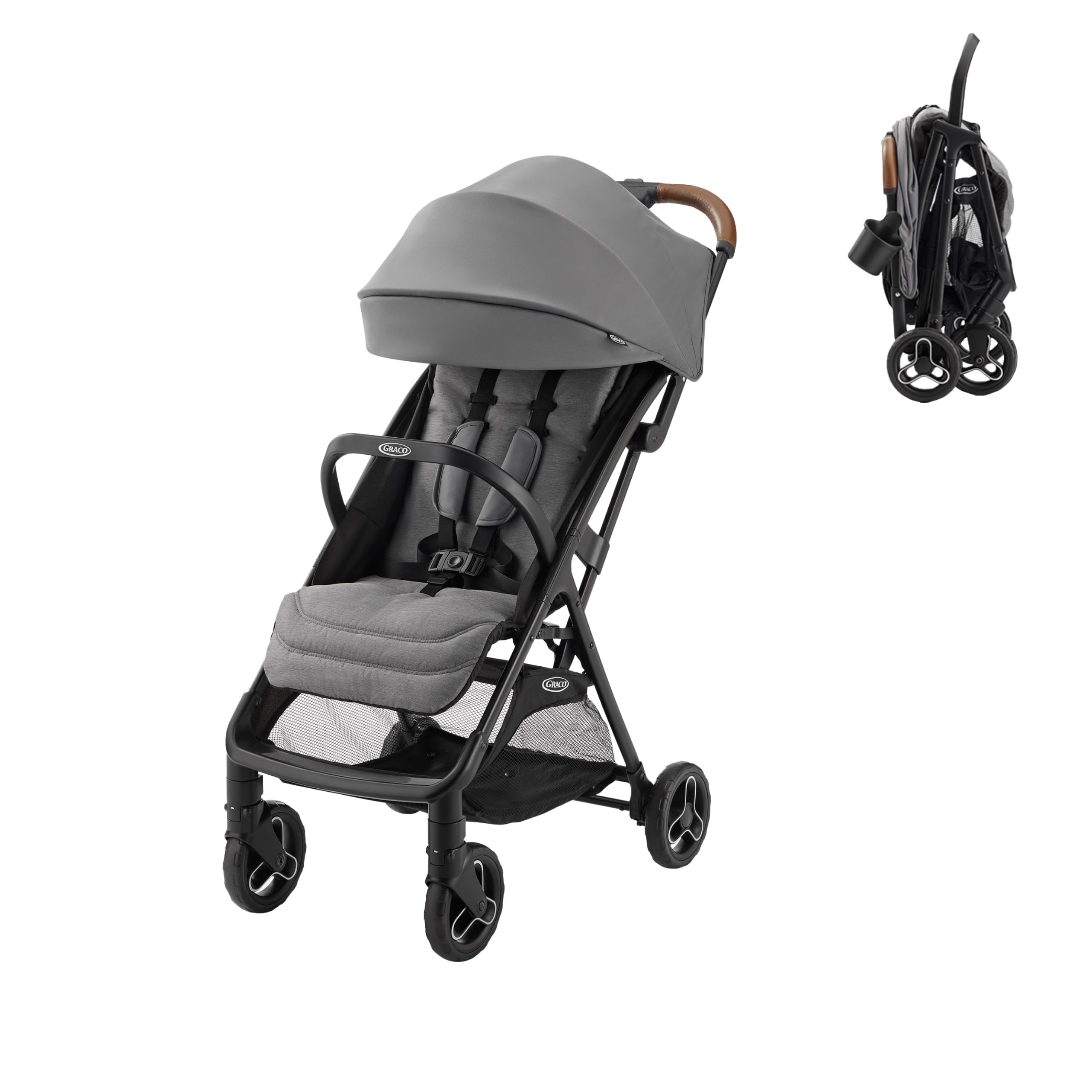
5. Graco Ready2Jet
Best for Car Seat Compatibility
Key Features
- Weight: 13.2 lb
- Harness: 3- or 5-point
- Car seat: Graco SnugRide
- Weight limit: 50 lb
- Price: Premium
If you already own a Graco SnugRide infant car seat, the Ready2Jet answers a question none of the other strollers here can: it takes the seat on top, so you can move a sleeping baby from a taxi to the terminal without waking them. That single trick is worth more than a pound of weight to the right family.
The rest of the package is built for one adult traveling alone. At 13.2 pounds it is mid-weight in this group, but the automatic fold is one-handed and self-standing, and the removable belly bar doubles as a carry handle, a detail we used more often than the parent cup holder. All-wheel suspension, a UV 50 canopy, adjustable calf support, and a convertible three- or five-point harness cover a 50-pound child.
It pushes straight and steady, and the canopy is one of the more generous ones here. The seat connection is the part to learn: getting the car seat to lock takes a couple of attempts, so practice in a parking lot rather than at the curb outside departures.
The honest boundary is that this is a heavier stroller than the ultralights and it buys you nothing if no car seat is coming along. With a SnugRide in the trip, it is the only pick that solves the problem, and the fold is good enough that we would still choose it over a travel system.
Pros
- Takes Graco SnugRide infant seats on top
- One-hand automatic fold stands on its own
- Belly bar doubles as a carry handle
- 50-pound limit with all-wheel suspension
Cons
- Car seat can take a few tries to click
For anyone already carrying a Graco infant seat, this is the travel stroller that turns two pieces of gear into one.
6. rollingsurfer F1
Best for Rolling Behind You
Key Features
- Harness: 5-point
- Recline: 100° to 170°
- Folded size: 25.2 x 19.29 x 9 inches
- Weight limit: 48.5 lb
- Price: Midrange
The detail that changed our mind about this one is the luggage handle. Folded, it turns into something you roll behind you through the terminal, and that is a completely different kind of tired from carrying the same stroller on one shoulder for half a mile.
It is also better equipped than most of the lightweights. The backrest runs from 100 degrees upright to 170 degrees flat, enough for a real nap, and the five-point harness, removable padded armrest, and included foot cover read like a bigger stroller’s spec sheet. Folded it measures 25.2 by 19.29 by 9 inches, long but manageable in an overhead bin.
The 5.9-inch rear and 5.5-inch front wheels roll well for the size and turn tightly enough for an airplane aisle, which is not something we can say about every pick here. The weak point is the buckle hardware, so check the harness clips before a trip and do not force one that is fighting you.
Pros
- Luggage handle lets you roll it folded
- Reclines from 100 to 170 degrees
- Five-point harness and JPMA certified
- Tight turning radius for airplane aisles
Cons
- Buckle hardware is the weak spot
- 16.3 pounds is heavy for one-handed carrying
The one stroller here you can pull behind you like luggage, which matters more than a pound of weight when you are alone with a carry-on.
7. Mompush Nexis
Best Premium Pick
Key Features
- Recline: Near-flat
- Folded size: 19.88 x 18.11 x 7.87 inches
- Frame weight: 11.5 lb
- Weight limit: 50 lb
- Price: Premium
This is the Mompush to choose over the Jeto when the budget stretches. Same brand, same one-hand philosophy, but the Nexis adds an auto-fold that drops and stands on its own, a carbon fiber frame listed at 11.5 pounds, and a seat that reclines to nearly flat.
Folded, it measures 19.88 by 18.11 by 7.87 inches, thinner than most of this group and flat enough to slide into a bin beside a bag. The included shoulder strap keeps both hands free for a coffee and a boarding pass. The near-flat recline is the reason to pick it over the other ultralights, since a toddler can actually sleep on a red-eye rather than slumping against the harness.
We noticed the trade-off the first time we hung a diaper bag on the handlebar. With a light frame and a narrow footprint, it feels less planted than the heavier strollers here, and a bag on the back makes it feel tippier still. Load the basket instead of the handlebar and the problem mostly goes away. Between the rain cover, cup holder, and belly bar in the box, it is a fair swap for the weight you save.
Pros
- Auto-fold lands flat and stands on its own
- Carbon frame listed at 11.5 pounds
- Near-flat recline suits red-eye naps
- Rain cover, cup holder, and belly bar included
Cons
- Feels tippy with a bag on the handlebar
The premium pick: a flat, self-standing fold and a carbon frame that keeps a 50-pound-rated stroller light enough to lift into a bin.
8. Colugo Compact+
Best for Comfort on Long Trips

Key Features
- Fold: One-hand auto-fold
- Weight: 18 lb
- Folded size: 17.6 x 10.6 x 22 inches
- Weight limit: 55 lb
- Price: Premium
Eighteen pounds is a lot for a stroller you are supposed to carry onto a plane, and it is the first thing we noticed lifting the Compact+ out of the box. What that weight buys is a seat that feels like a full-size stroller’s, with padding and a canopy that a toddler can disappear under.
The fold is the best trick here. You lift the handle and the whole thing collapses, no buttons or latches to find, and it stands back up on its own. Folded it measures 17.6 by 10.6 by 22 inches, small enough for an overhead bin and easy to get into a trunk. The fabrics are machine-washable, which after a sticky flight is the feature we appreciated most.
Two details to know. The buckles are stiff enough that clipping in a wriggling toddler takes a couple of attempts, and the seat is not designed for a fully reclined newborn, so this one starts at six months. For a preschooler on a week-long trip, the comfort is worth the extra pounds and then some.
Pros
- One-hand auto-fold with no buttons or latches
- Folds small enough for an overhead bin
- Machine-washable fabrics and a long canopy
- Carry bag, rain cover, and cup holder included
Cons
- 18 pounds is heavy to lift overhead
- Buckles can be stiff to clip
A comfortable, well-equipped stroller with the easiest fold in this group, as long as you do not mind lifting it.
9. Dream On Me Aero
Gate-Check Basics

Key Features
- Weight: 7.2 lb
- Harness: 3-point
- Folded size: 40.6 x 7.7 inches
- Weight limit: 33 lb
- Price: Budget
At 7.2 pounds the Aero is the lightest stroller here by a wide margin, and it costs the least of any pick in this guide. That combination makes it the stroller we hand to families who want a second stroller for trips rather than a primary one, the thing that lives in the trunk and comes out for the airport run.
What it does well is simple: a one-hand fold, a steel frame, dual brakes, a removable canopy, and ASTM certification. The folded package is 40.6 by 7.7 inches, an umbrella fold that is long and thin, so it gate-checks rather than flying in the cabin. If your airline lets you leave it at the jet bridge and hands it back on arrival, that is all you need from it.
The compromises show up in use. The handles are short enough that an average-height adult ends up hunched over the push, the canopy is a token shade, and the 33-pound limit arrives earlier than a tall child would like. None of that matters for a twenty-minute walk through a concourse, which is the job this stroller is actually being asked to do. For a week of sightseeing, it is the wrong tool.
Pros
- 7.2 pounds, the lightest stroller here
- One-hand fold on a steel frame
- Costs the least of the picks here
Cons
- Long folded length means gate-check, not cabin
- Short handles and a 33-pound limit
The lightest and cheapest way to keep a toddler off your hip in a terminal, as long as you plan on gate-checking it.
How We Tested Airplane Travel Strollers
We started by researching the compact strollers that airlines and frequent flyers actually talk about, then filtered the field by folded size, listed weight, one-hand fold claims, canopy coverage, harness type, and whether a car seat adapter was available. From that shortlist, we tested 12 strollers over nine months. Some came on round-trip flights with us; others logged months of daily errands, school pickups, and weekend drives so we could see how they held up between trips.
At the airport, I folded and unfolded each stroller while holding a tote and a boarding pass, then tried to slide it into an overhead bin and a carry-on sizer. I weighed each folded stroller on a luggage scale, carried it up stairs and through security queues, and rolled it over jet-bridge lips, carpet, tile, and uneven sidewalks. At home, we loaded the baskets, bumped them over curbs, and checked for wobble in the frame and looseness in the wheels after repeated folding.
We also paid attention to the details that get overlooked in a spec sheet: whether the canopy actually shaded a doll’s face at midday, whether buckles clicked shut without fumbling, and whether the brakes engaged with one foot. For car seat accessibility, we checked which strollers accepted an infant seat and how much that setup changed the fold. And we judged value by what came in the box and whether the stroller earned its space in the trunk, not by the sticker alone.
How to Choose a Stroller for Airplane Travel
The stroller that makes a flight easier is not the smallest or the lightest one, it is the one you can fold with one hand while the other hand is holding a boarding pass.
Start With the Airline, Not the Stroller
Rules vary by carrier, and the overhead bin on a regional jet is a different animal from the one on a wide-body. Compare a stroller’s folded dimensions with your airline’s carry-on allowance before you buy, then decide what happens if it does not fit. Here is the trap worth remembering: compact in a listing usually means it fits a car trunk. The Dream On Me Aero folds to 40.6 inches, which makes it a gate-check stroller, while the gb Pockit Air folds to 11.8 by 7 by 13.8 inches and can genuinely go under a seat.
Weight Is a Jet-Bridge Number
Ten pounds and seventeen pounds look identical in a product photo and feel completely different at the end of a moving walkway with a child on your hip. We care less about the headline figure than about how the stroller carries once it is folded: a shoulder strap, a backpack bag, or a luggage handle you pull behind you, as on the rollingsurfer. Storage counts toward the same math. A stroller with a 4.4-pound basket, like the Jeto, leaves the diaper bag on your shoulder, which cancels a couple of pounds of savings.
Fold Mechanics Beat Fold Size
A fold you can do one-handed, standing up, without setting anything down is worth more than an inch of folded width. Look for a single-motion fold, a package that stands on its own, and a release that does not need two hands. Then practice it. The Pockit Air needs a firm shake to finish the fold, and learning that in a jet-bridge line with people behind you is miserable.
Decide Whether You Need a Recline
Recline is the first feature dropped as strollers get lighter, and it is the difference between a nap and a meltdown on a four-hour flight. The rollingsurfer runs from 100 to 170 degrees, the Nexis reclines to nearly flat, and the Colugo Compact+ offers multiple positions. If your child sleeps in the car, pay for the recline. If they spend the flight climbing over the armrest and pointing out the window, save the weight and put the money into a better fold.
Wheels, Harness, and Canopy
Airport floors are easy; the destination is not. Larger wheels and doubled front wheels handle cobblestones and broken pavement, and the Pockit Air’s twin wheels are the reason it works on a European sidewalk. A five-point harness is worth insisting on for a child under three, because a three-point belt gives a wriggler room to work. Check the canopy too: coverage is the specification most often sacrificed to save weight, and a visor that shades only a forehead leaves the rest of a child in the sun.
Frequently Asked Questions
What happens to my stroller when I gate-check it?
You tag it at the jet bridge, leave it at the aircraft door, and collect it on the jet bridge when you land. It travels in the hold, so a travel bag keeps fabric and frame out of the grime, and pulling cup holders and trays off first means fewer parts to lose.
Ask at check-in whether it comes back at the door or on the baggage carousel, since smaller airports sometimes send strollers to the belt.
Can I use a travel stroller for a newborn?
Most of the strollers here start at six months. A newborn needs a seat that reclines nearly flat and a five-point harness. The rollingsurfer goes to 170 degrees and the Nexis reclines to nearly flat, while the Colugo Compact+ is not designed for fully reclined newborn use.
Under six months, a car-seat-compatible stroller such as the Graco Ready2Jet is the simpler answer.
Do I need a car seat at my destination?
If you are renting a car or taking taxis, yes, and only the Graco Ready2Jet among these accepts an infant car seat on top. For a toddler, a stroller plus a rented seat is usually simpler than flying with a convertible seat.
Confirm the rental company has one reserved in writing before you land. Availability, not price, is the part that fails.
Final Verdict
The Mamazing Ultra Air is where we start every conversation about flying with a toddler. It folds with one hand into an overhead-bin package, carries a 50-pound child, and has the only basket here that genuinely swallows a diaper bag, which are the three things that decide whether an airport day is manageable.
If the smallest possible fold matters most, the gb Pockit Air slips under the seat in front of you. If a Graco infant seat is part of the trip, the Ready2Jet is the only pick that takes it. Everyone else should start with the Mamazing.