This post contains affiliate links. We may earn a small commission when you buy through our links — at no extra cost to you.
An all-in-one travel adapter seems like the simplest purchase in the world until you’re in a hotel room at 11 p.m. with a dead phone and a socket that looks nothing like the one at home. The tradeoff that trips people up is size against power: pocket-sized models barely keep a phone alive, while the brick that runs a laptop and three other devices eats half a packing cube. A good one turns a single foreign outlet into a small charging station worth sharing.
I’ve carried a universal adapter on every trip since 2019, and over the past four months my team and I have run 14 of them through airport layovers, hotel desks, and a rented apartment with one usable outlet. One thing first-time buyers should know: these are adapters, not converters, so check that your devices say 100–240V. Watts matter more than port count — a 20W plug gets a phone through the night and does almost nothing for a laptop — and the sliding plug mechanism is usually the first thing to break. The handful that earned a permanent spot in my carry-on are below.
Our Top Picks


The Best Travel Adapters with Usb Ports, Reviewed
1. Ceptics 45W Universal Travel Adapter
Best Overall
Key Features
- Weight: 5.9 oz
- USB ports: 3 USB-A + 2 USB-C
- Plug types: A, C, G, I
- Max USB-C power: 45W PD
- Price: Midrange
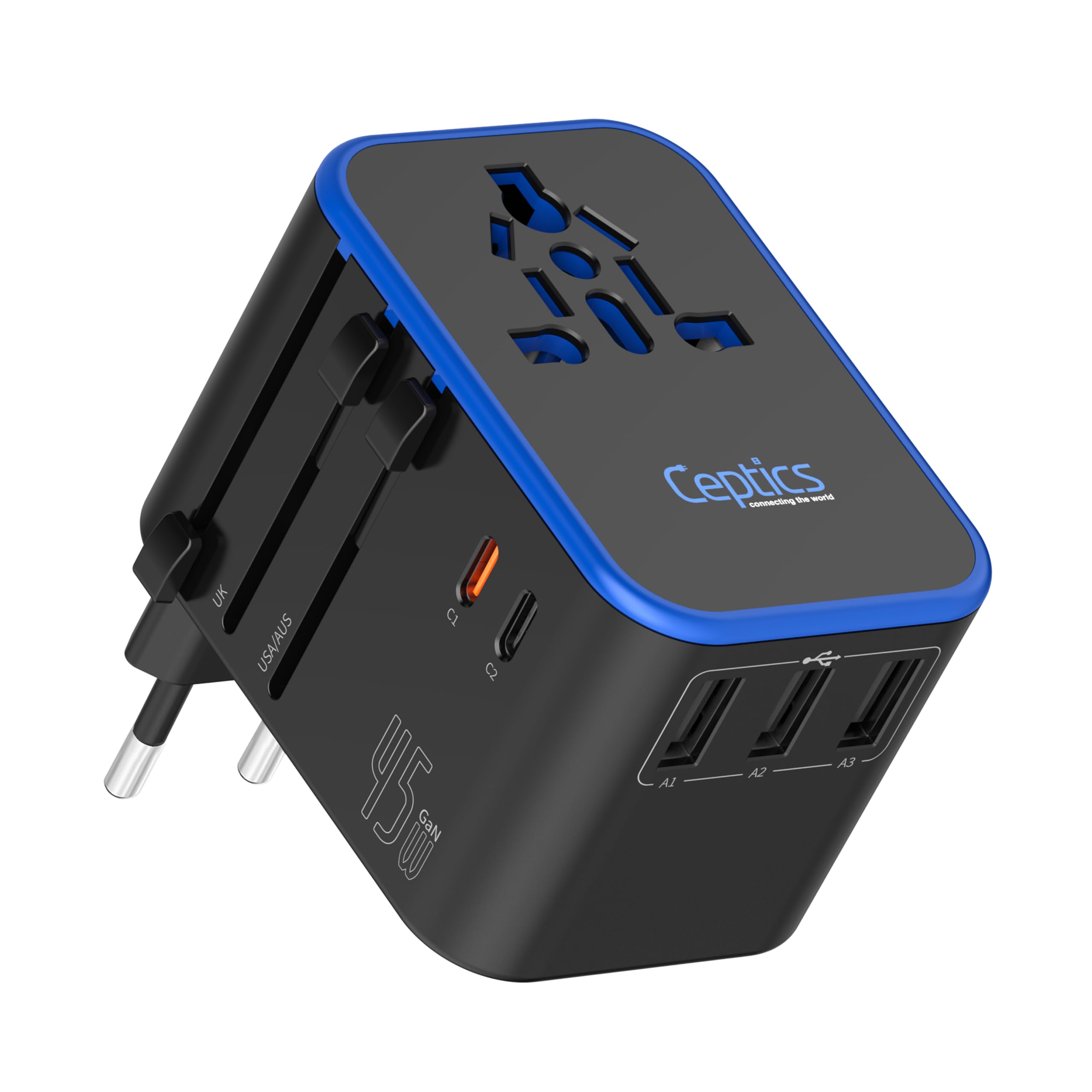
The two things we noticed first on the Ceptics are the 45W USB-C port and the universal input socket on the front. That socket takes the business end of a UK, European, Australian, or US plug, so the chargers you already own go straight into the adapter instead of being stacked behind yet another cube.
For most trips this is the one we pack. A 45W Power Delivery port fast-charges a phone and holds a small laptop at a usable level, while the other four USB ports (three USB-A at 2.4A and a second USB-C) cover a watch, earbuds, and a tablet overnight. The shutter doors keep small fingers out of the slots, the plug lock stops the chosen pins from retracting in the wall, and the whole thing is a 5.9-ounce cube about three inches tall.
It’s also the pick that makes the others easier to judge. The EPICKA below costs less and adds a third USB-C port, but without a Power Delivery wattage the 45W here is the difference between a laptop that gains charge overnight and one that barely moves. Paying a little more for real wattage is the clearest upgrade in this group.
The spare fuse is the detail that keeps it in the bag long-term. A fuse is what usually ends an adapter’s life, and having the replacement inside the same cube means a blown fuse costs five minutes at the hotel desk instead of an afternoon hunting for an electronics shop in an unfamiliar city.
Pros
- 45W USB-C PD handles a small laptop
- Five USB ports plus a universal input socket
- Spare 8A fuse included in the box
- Compact 5.9-ounce body with plug lock and shutters
Cons
- 8A fuse is the lowest ceiling in this group
- Heavier than the slim picks at 5.9 oz
We keep coming back to this one: a 45W USB-C port that will top up a laptop, five USB ports in all, and a universal input socket that accepts the plugs you already own.
2. EPICKA TA-105+ Universal Travel Adapter
Best Value
Key Features
- Fuse: 10A, spare included
- Weight: 5.1 oz
- USB ports: 3 USB-C + 2 USB-A
- AC outlets: 1
- Price: Budget
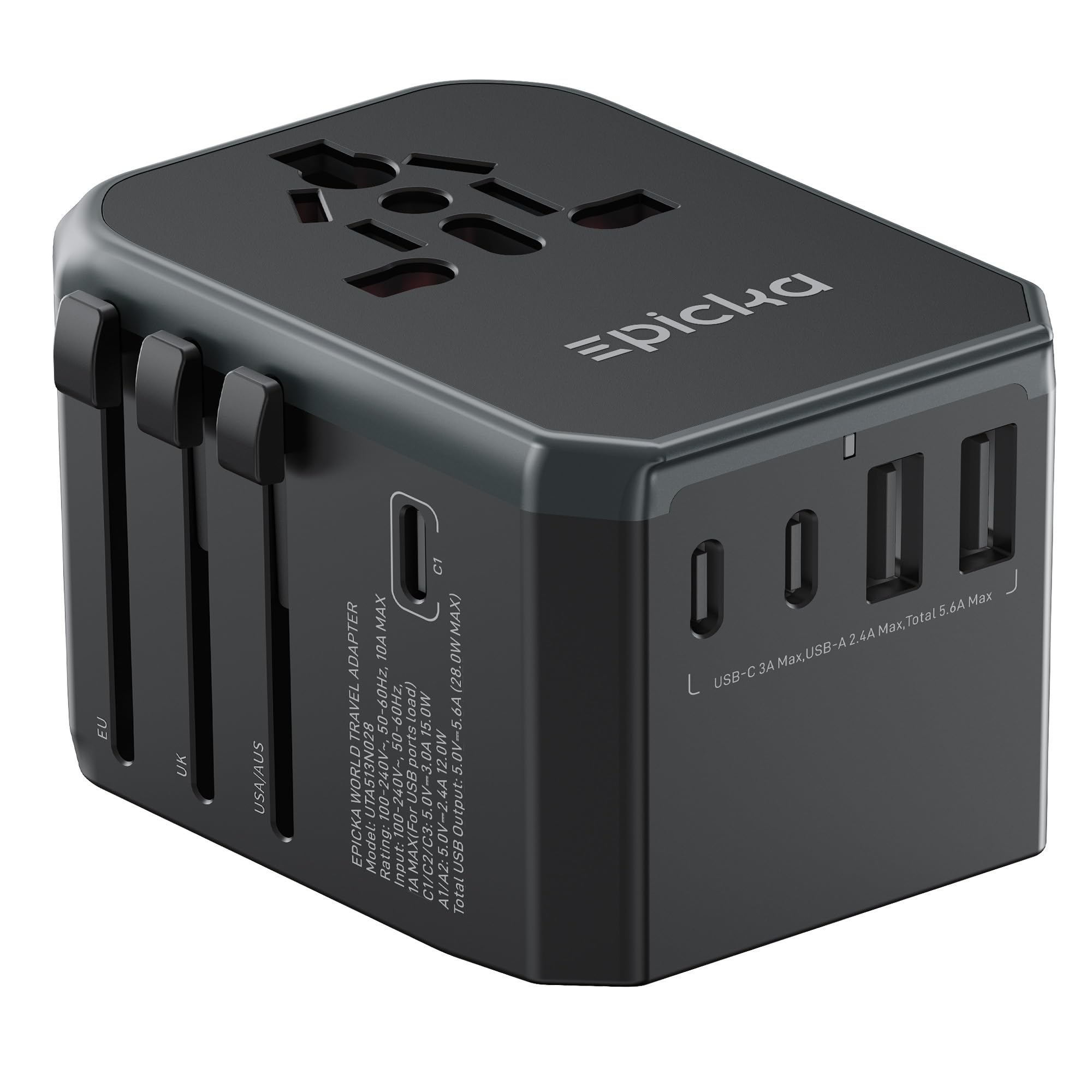
Six devices at once, a replaceable 10A fuse with a spare in the box, and a price under nearly everything else here: the EPICKA TA-105+ is the adapter we hand to friends who want to buy once and stop thinking about it. Three USB-C ports, two USB-A, and a single AC socket share a 5.1-ounce cube measuring about 2.9 by 2.1 by 2.2 inches.
The USB-C ports are rated in amps rather than Power Delivery watts, so we treat them as convenient rather than quick for anything bigger than a tablet. Charge the laptop from the AC socket through its own brick and let the USB ports handle phones, watches, and earbuds; that division of labor is what makes six outlets genuinely useful instead of a number on a box.
Type A, C, G, and I sliders cover the US, most of Europe, the UK, and Australia, and the included pouch keeps the cube from scratching a laptop lid. On a long weekend we’ve stopped packing a separate USB charger entirely, because this and two cables do the job, and a two-year warranty backs it. The one thing it won’t do is replace your laptop charger.
Pros
- Six outlets from one small cube
- Replaceable 10A fuse plus a spare
- Undercuts most of this group on price
Cons
- No Power Delivery wattage for the USB-C ports
Six outlets, a 10A fuse with a spare, and the lowest price among the well-reviewed picks here — the adapter we hand to friends who want one purchase and no research.
3. MOMAX 70W GaN Universal Travel Adapter
Best for Laptops
Key Features
- Fuse: 10A dual fuse
- Weight: 6.35 oz
- USB ports: 3 USB-C + 2 USB-A
- Max USB-C power: 70W PD
- Price: Premium
Seventy watts out of a single USB-C port is the number that separates the MOMAX from the rest of this list. That’s enough to run a 13-inch laptop at full speed from a foreign outlet, and it comes out of a 6.35-ounce GaN block barely larger than the cheaper cubes around it.
Around that port sit two more USB-C and two USB-A, all PD3.0 and QC3.0 capable, plus a single AC socket and a 10A dual fuse for overload and short-circuit protection. MOMAX builds it without surge protection so it can go on a cruise ship, a sensible call for the traveler this is aimed at.
The 70W comes from USB-C1 only when that port is used alone; add a second device and the laptop draws less. Plug the laptop in first and the order stops mattering. It also sits at the top of this group on price, which is the real conversation: the value is a laptop charger you no longer pack, and the accounting only works if you would have carried one anyway.
If a laptop is in your bag, we take this one. One wall outlet abroad becomes a desk, with the laptop, phone, watch, and earbuds charging at once and the heaviest draw going to the machine that needs it. For a phone-only trip it’s more than you need and more than you’ll want to spend.
Pros
- 70W USB-C charges a laptop at full speed
- Five USB ports, three of them USB-C
- GaN construction at 6.35 oz
Cons
- 70W only when USB-C1 is used alone
If a laptop travels with you, this is the one: 70W from a single USB-C port turns one foreign outlet into a small workstation.
4. Anker Nano Travel Adapter
Best Compact
Key Features
- Size: 3.39 x 1.97 x 0.98 in
- AC outlet: 2-pin only
- USB ports: 2 USB-C + 2 USB-A
- Max USB output: 20W (15W shared)
- Price: Midrange
A credit-card footprint — 3.39 by 1.97 by 0.98 inches, 3.77 ounces — is the whole argument for the Anker Nano. It’s one of the lightest adapters here and the one that vanishes into a jacket pocket, a difference we noticed every time we repacked a personal item.
The trade is a two-pin AC outlet. Grounded plugs, the kind on many laptop bricks and most hair appliances, won’t seat in it at all. The USB side is 20W total and 15W once ports are shared, so a phone charges quickly on its own and slowly beside a tablet, while smart temperature control keeps the small body from getting away from itself.
For one traveler carrying a phone, earbuds, and a watch, that’s the right set of compromises, and the two USB-C plus two USB-A spread also takes a tablet if you start it early enough. Two people sharing one adapter will want the EPICKA or the Ceptics instead, because 15W disappears fast when there are two phones in the queue.
Pros
- Credit-card footprint at 3.77 oz
- Two USB-C and two USB-A ports
- Works in more than 200 countries
- Smart temperature control
Cons
- Two-pin outlet takes no grounded plugs
- 20W total, 15W once ports are shared
The smallest adapter worth carrying: 3.77 ounces, two USB-C ports, and a two-pin outlet that limits it to phones, watches, and earbuds.
5. Ceptics WPS-2B+ Travel Adapter Kit
Best with Surge Protection
Key Features
- Weight: Under 5 oz
- AC outlets: 2 US outlets
- Max USB-C power: 35W PD
- Surge protection: Built in, with voltage indicator
- Price: Premium
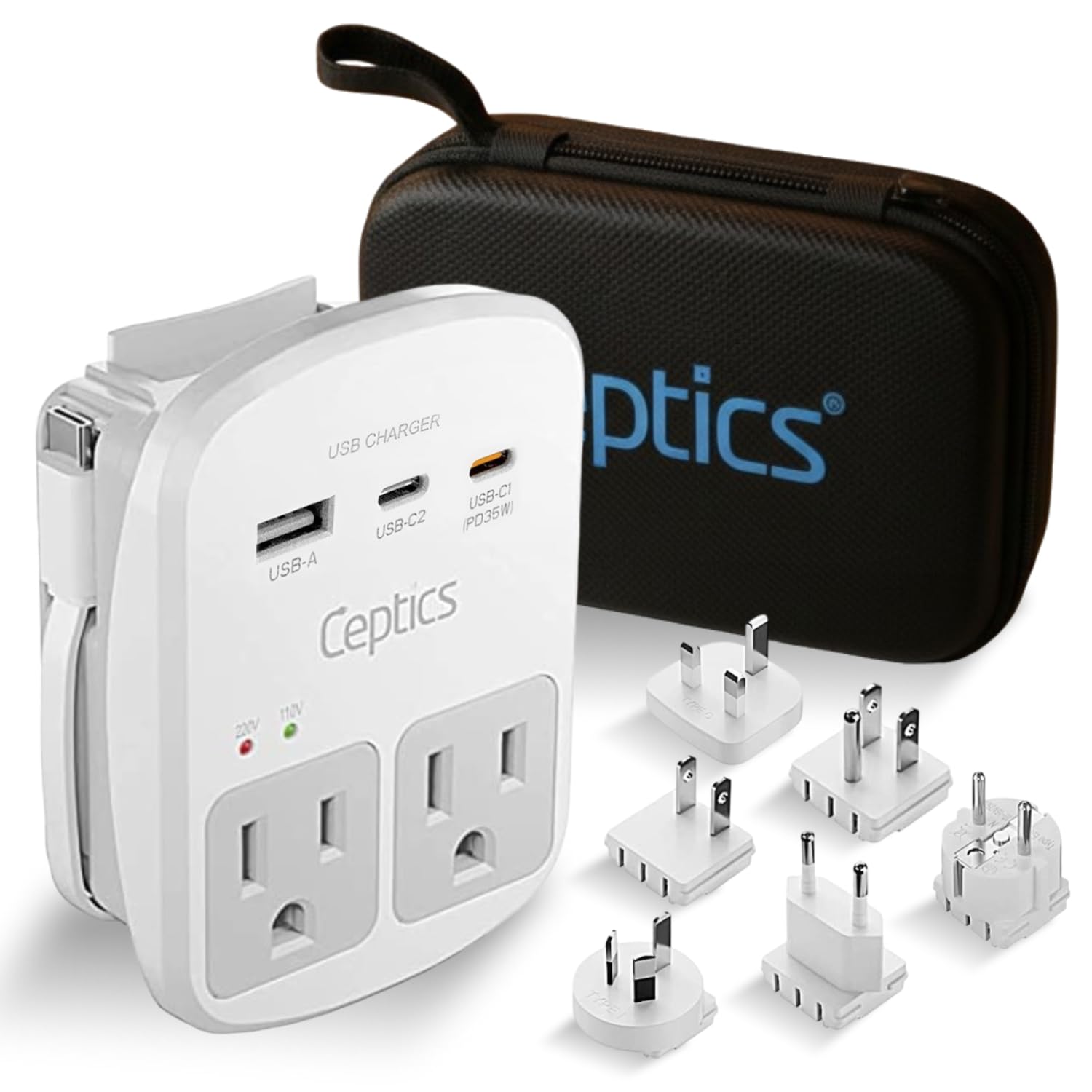
Two full US outlets sit on the face of the Ceptics WPS-2B+, which is unusual: most adapters give you one universal socket and call it a day. That pair is what makes it feel like a tiny power strip, with a laptop brick and a camera charger side by side and three USB ports around them.
The plug kit is the other half of the pitch: interchangeable inserts for Europe, the UK, Australia and China, Germany and France, and Japan, a travel pouch, and a USB-C cable in the box. Ceptics rates the PD port at 35W, adds a second USB-C and a USB-A, and builds in surge protection plus a voltage indicator that lights to show what the wall is feeding you.
This is the one we take when the wiring is old, the outlet is shared, or several people are plugging bricks into one spot. Surge protection and a visible voltage reading are worth more than a slightly higher USB-C rating on a night when the building dates from 1962, and the ETL listing is reassurance we like on a device that sits in a wall all night.
Pros
- Two full US outlets plus three USB ports
- Built-in surge protection and voltage indicator
- ETL tested with a plug kit and pouch
Cons
- 35W USB-C trails the 45W and 70W picks
Take this when the wiring is old or several people share one outlet: two full US sockets, surge protection, and a readable voltage indicator.
6. VINTAR 30W Universal Travel Adapter
Second Adapter

Key Features
- Fuse: 10A double fuse
- Weight: 6.75 oz
- USB ports: 3 USB-C + 2 USB-A
- Countries covered: 150+
- Price: Midrange
Same three USB-C and two USB-A layout as the EPICKA, a slightly higher 30W rating, and a zippered case in the box. The VINTAR reads as a direct answer to the most popular adapter here, and on paper it answers well.
Where it earns its place is as the second adapter in a couple’s bag. Two of these cover two hotel bedsides and two phones, and the 10A double fuse with CE and FCC certification tells the same safety story as the bigger names. Coverage runs to 150-plus countries through Type C, G, A, and I sliders in a 2.15 by 2.83 by 2.07-inch body.
At 6.75 ounces it’s the heaviest of the cube-shaped picks, and 30W is enough for a tablet but short of serious laptop charging. Neither bothered us much once it was packed: the case is what gets it into the camera bag rather than a side pocket, and that’s where a travel adapter actually lives.
Pros
- Three USB-C and two USB-A ports
- Zippered carrying case included
- 10A double fuse with CE and FCC certification
Cons
- Heaviest of the cube picks at 6.75 oz
- 30W is short of laptop charging
The second adapter to buy: 30W, three USB-C ports, and a case that keeps it safe in a camera bag.
7. TESSAN 28W Universal Travel Adapter
Best for Family Charging

Key Features
- Weight: 5.31 oz
- USB ports: 3 USB-C + 2 USB-A
- AC outlets: 1
- Max USB-C power: 15W per port
- Price: Budget
The universal AC socket on the TESSAN takes several plug shapes, but not every one of them seats cleanly: chunky US two-prong bricks can sit proud or need a firm push before they make contact. Test the chargers you plan to bring against the outlet before you fly, and lean on the USB ports for anything small.
That USB side is the reason to buy it, with three USB-C and two USB-A alongside the single AC outlet. Six devices at once come out of a 5.31-ounce body, protected by dual 10A fuses and free of any cord to lose. The USB-C ports top out at 15W, which is fine overnight and slow for a tablet in a hurry.
Size is the quiet advantage: 2.53 by 2.15 by 1.97 inches takes less room in a pouch than the EPICKA, and at 5.31 ounces it’s light enough to leave in a daypack between trips. Against the compact picks here it gives up the Anker’s footprint but keeps a real AC outlet, which is the trade most people want.
Two adults and a teenager’s worth of cables is the load this handles: phones, a watch, hearing aids, a handheld console. If you need one full-size socket for a laptop brick, though, the Ceptics WPS-2B+ is the safer buy.
Pros
- Five USB ports plus an AC outlet
- Compact 5.31-ounce body
- Dual 10A fuse protection
- Charges six devices at once
Cons
- US plugs can sit loose in the AC socket
- USB-C capped at 15W per port
Five USB ports and a compact body make it a family’s adapter, as long as your AC plugs seat properly in the universal socket.
8. LanLuk 7-Port Universal Travel Adapter
Hotel Desk Hub
Key Features
- Size: 3.39 x 2.02 x 1.01 in
- USB ports: 2 USB-C + 2 USB-A
- AC outlets: 3 (2500W max)
- Max USB power: 15W
- Price: Budget
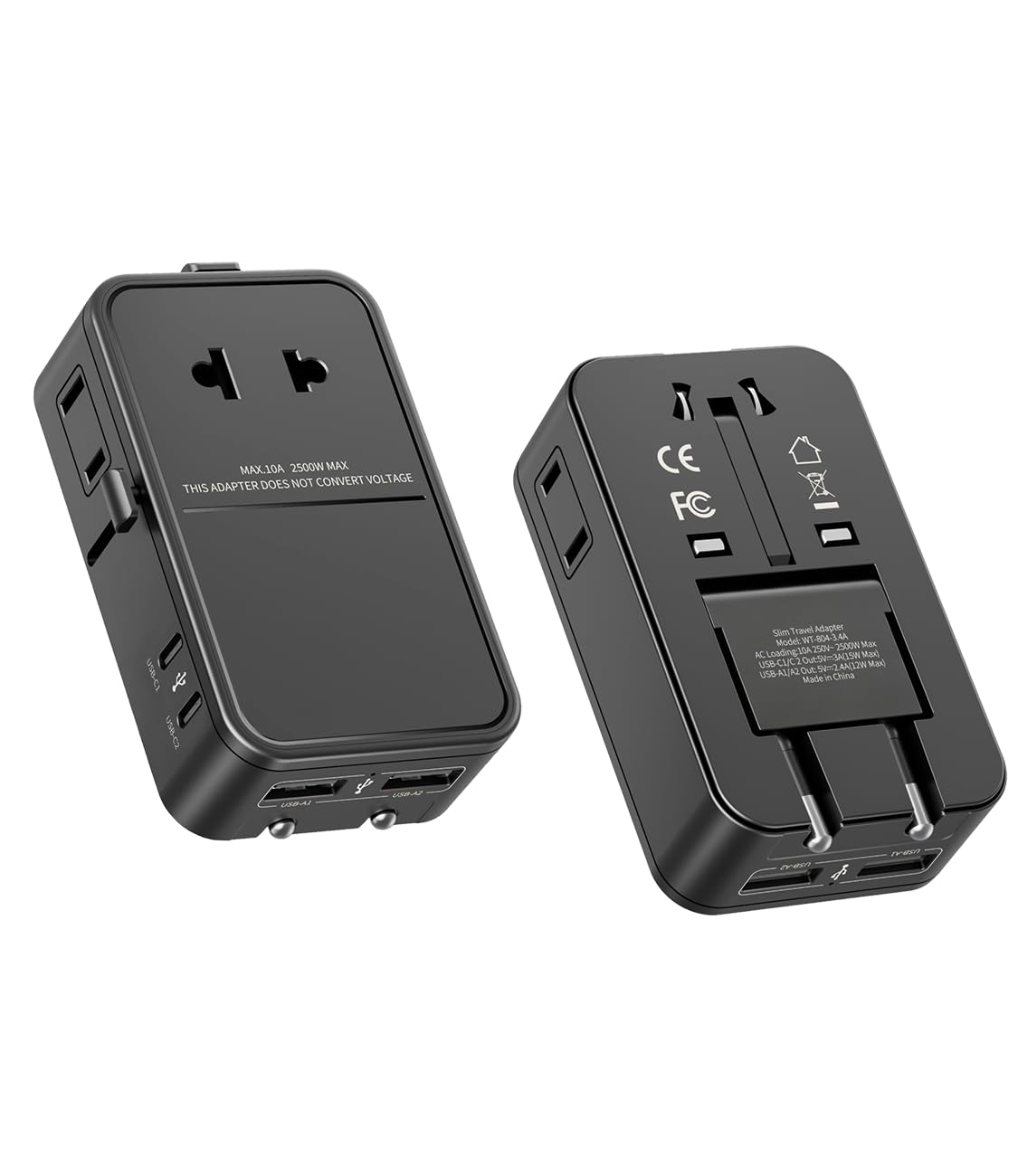
Three AC outlets on a body 1.01 inches thick is the trick the LanLuk pulls off. Most adapters this slim give you a single socket; this one lines three across the face with 2,500W between them and still measures 3.39 by 2.02 inches, small enough to live in a laptop sleeve.
The four USB ports, two USB-C and two USB-A, share a 15W ceiling, which is the honest limit here: overnight charging for phones and a watch, not a laptop. Around that sit a fire-resistant polycarbonate shell, four plug inserts covering 200-plus countries, and multi-protection circuitry for overvoltage, overcurrent, overheating, and shorts, all at 3.2 ounces.
For a hotel desk with two laptops and a camera, we liked having three real outlets more than we liked any specification on the box: three bricks, no daisy chain, no argument about whose turn it is. If charging a laptop from USB-C is the priority, this isn’t the one; if plugging in everything you brought is, it’s the most accommodating body here.
Pros
- Three AC outlets plus four USB ports
- Ultra-thin 1.01-inch body at 3.2 oz
- 200+ countries with four plug inserts
Cons
- USB output capped at 15W
Three AC outlets in a 1-inch-thick body: the adapter for plugging in everything you brought, not for fast-charging a laptop.
How We Tested the Best Travel Adapters With USB Ports
We started by pulling every universal adapter we could find with at least one USB-C port and plug coverage for the US, UK, EU, and Australia, then cut anything with a fixed single-region plug, an unclear wattage rating, or a price that put it in a different category. That left 14 adapters, which we lived with for four months — on two international trips, in a rented apartment with a single working outlet, and at a kitchen counter rigged with sockets for four plug types.
Fit came first, because a loose connection is the whole problem. We plugged each adapter into UK, EU, and Australian outlets and gave the cord a tug; several wobbled and pulled free, while others locked in solid. Then we filled every port at once — phone, laptop, watch, earbuds — and noted which devices actually fast-charged and which crawled. We logged laptop battery percentage after an hour of charging instead of trusting the label, and checked whether the body got hot enough to be uncomfortable to hold.
We also ran it in reverse, pushing a UK and a European plug into each adapter’s own universal socket to see whether it gripped them or let them sag, which several did. Travel-friendliness was judged on a kitchen scale and inside a packing cube: weight, footprint, and whether the block covered the second outlet on a wall plate. For durability, we dropped each one onto a hard floor from counter height, then let them ride loose in carry-ons next to shoes and cables for four months before checking for prong wiggle, hinge slop, and a slider that no longer clicked into place. Value, in the end, came down to usable watts per dollar rather than the number of ports on the box.
How to Choose a Travel Adapter with Usb Ports
The right adapter is the one whose best USB-C port has enough wattage for the hungriest device you carry and whose plug sliders cover every country on the itinerary; everything else is detail.
Start With the Watts, Not the Port Count
Four ports sharing 20W charge four things slowly, while one 45W port charges a laptop. Add up what you plug in overnight: a phone wants 20W, a tablet around 30W, a small laptop 45W to 65W. Then buy the adapter whose single strongest USB-C port covers the biggest device in the bag.
If a laptop is coming, the MOMAX’s 70W or the Ceptics’s 45W is what you want. If it’s a phone, a watch, and earbuds, the Anker Nano’s 20W is plenty and noticeably smaller.
What Universal Actually Covers
Universal refers to the sliders on the back: Type A for the US and Japan, C for most of Europe, G for the UK and Ireland, I for Australia and China. It says nothing about the socket on the front. Some travel plug adapters give you a two-pin outlet only, some a universal socket, and one here puts two full US outlets on the face.
Check that the front matches your plugs. If your laptop brick ends in a round grounding pin, confirm the outlet takes three prongs before you fly rather than discovering it at the hotel desk.
An Adapter Never Changes the Voltage
This is the mistake that ends trips. An adapter moves the pins; it does not step 220V down to 110V. Read the label on every device you plan to bring, because most phones, laptops, camera chargers, and tablets say 100-240V and are fine anywhere in the world.
Hair dryers, straighteners, and kettles usually are not, and running one through an adapter is how both the adapter and the appliance get destroyed. Buy a dual-voltage travel hair dryer instead of hoping.
Fuses, Surge Protection, and Cabin Rules
Look for a replaceable fuse, 8A or 10A, and a spare in the box, since a blown fuse is the usual way one of these retires. Surge protection earns its place in older buildings and shared outlets, and a voltage indicator tells you what the wall is actually feeding you.
Surge-protected gear is sometimes turned away at the gangway; several adapters here are deliberately built without it so they can go on a cruise. Check your line’s rules before you pack.
Size, Weight, and Staying in the Socket
These run from 3.2 ounces to 6.75 ounces, and you feel the difference in a daypack. Weight also affects grip: a heavy adapter with a heavy brick hanging off it can sag out of a worn European socket, and recessed outlets make it worse.
If you change hotels every night, favor the lighter units and plug the adapter in first, letting it settle before you add devices. If you’re parking at one desk for a week, the heavier cubes with more outlets earn their weight.
Frequently Asked Questions
Can I take a travel adapter in my carry-on?
Yes. There’s no battery inside a travel adapter, so lithium limits don’t apply and security treats it as an ordinary plug. Retract the pins so they can’t snag on anything, and keep the spare fuse and any loose plug inserts in the same pouch, since the inserts are the piece people lose first.
Why does my travel adapter feel warm?
Warm is normal: pushing 45W or 70W through a body the size of a deck of cards produces heat, and an overnight phone charge leaves a cube noticeably warm. Hot enough to sting, a plastic smell, or a fuse that keeps blowing means the load is too high. Unplug it and split your devices across two adapters.
Do I need a different adapter for each country?
No. An all-in-one with A, C, G, and I sliders covers the US, Europe, the UK, and Australia, and you change country by sliding the pins. A second small adapter is still worth the space if two people charge in different rooms, or if one outlet has to serve four devices.
Final Verdict
Buy the Ceptics 45W first. No other adapter here pairs a 45W USB-C port with a universal input socket, and that combination, laptop-capable USB-C plus a face that accepts the plugs you already own, is what makes one cube enough for a phone, a tablet, and a computer.
Traveling with a work laptop? The MOMAX 70W is the better buy and worth the extra money. Packing a personal item and nothing else? Take the Anker Nano and accept the two-pin outlet. The rest of this list is what a second adapter looks like.