This post contains affiliate links. We may earn a small commission when you buy through our links — at no extra cost to you.
It’s a common travel frustration: You buy a ‘European’ travel adapter, confident it’ll work everywhere from Paris to Prague — then you land in London and discover the prongs don’t fit UK outlets. Or you plug in your laptop at a German hotel, and the USB-C port barely trickle-charges it, despite the ‘fast charging’ label on the box.
A good adapter shouldn’t force you to pack extra plugs or charge overnight. The models below are chosen specifically because they include Type G for the UK, multiple AC outlets for hair dryers or CPAP machines, and USB ports with honest wattage — so you know exactly how fast your devices will charge.
Whether you’re a family juggling six devices in a Rome hotel room or a solo remote worker who needs a laptop fully juiced before a café session, there’s a pick that matches your travel style.



1. EPICKA TA-105
Best for Global Families
Key Features
- Plug Coverage: Type C, G, I, A
- USB Ports & Wattage: 4 USB-A, 1 USB-C (15W)
- AC Outlets & Max Wattage: 1 AC (2400W)
- Size & Weight: 5.1 oz
- Price: Mid-Range
The EPICKA TA-105 covers four common plug standards — Type G (UK), Type C (Europe), Type I (Australia/China), and Type A (US/Japan) — in a single compact cube. Four USB-A ports and one USB-C port let you charge phones, tablets, and cameras simultaneously from the same adapter, reducing the number of chargers you need to pack. The cube shape is small enough to slip into a jacket pocket or side compartment of a daypack.
Using the adapter is simple: slide the selector to the appropriate plug type and push it out. The USB ports deliver standard 5V charging suitable for most handheld devices. The USB-C port is rated at 3A (15W), which is fine for phones and small tablets, but it won’t fast-charge a larger laptop. If you need to power a laptop that requires more than 15W, you can plug the laptop’s own charger into the AC outlet — the adapter supports up to 2400W at 240V. This trade-off keeps the size down and cost moderate.
This adapter is best for travelers who carry multiple USB-charged devices and visit a mix of countries — especially those that need Type G (UK) alongside Type C (mainland Europe). Families with several phones, tablets, and cameras will appreciate having four USB-A ports. The 15W USB-C limit means you should plan to use the AC outlet for any device that demands faster charging, such as a modern laptop. For anyone who needs full Power Delivery for a MacBook Pro, a higher-wattage adapter like the 45W PD specialist in this category would be a better fit.
While some adapters in this category prioritize laptop charging speed or add extra features like surge protection, the EPICKA focuses on doing the basics well: reliable plug conversion and generous USB-A capacity. The sliding mechanism feels sturdy, and the AC outlet accepts most two- and three-prong plugs. The unit has been used on thousands of trips, and its design has held up to normal wear. Occasional USB port issues have been noted on some units, so it’s worth checking the ports shortly after purchase.
Pros
- Covers Type G, C, I, and A plugs for use in 200+ countries
- Four USB-A ports let you charge multiple handheld devices at once
- Compact cube design slips easily into a bag or pocket
- Simple slider mechanism to switch between plug types
- AC outlet handles high-power devices like hair dryers or laptop chargers
Cons
- USB-C port delivers only 15W, not enough to fast-charge a large laptop
- Some units may have a USB port that stops working
For travelers who need to charge multiple USB devices across Europe and the UK without carrying separate adapters, the EPICKA TA-105 delivers the right mix of plug compatibility and port count — just bring your laptop’s own charger for fast charging.
2. Ceptics 45W PD
Best for Laptop Remote Workers
Key Features
- Plug Coverage: Type C, G, I, A
- USB Ports & Wattage: 3 USB-A, 2 USB-C (45W PD)
- AC Outlets & Max Wattage: 1 AC (2400W)
- Size & Weight: 15.04 oz
- Price: Mid-Range
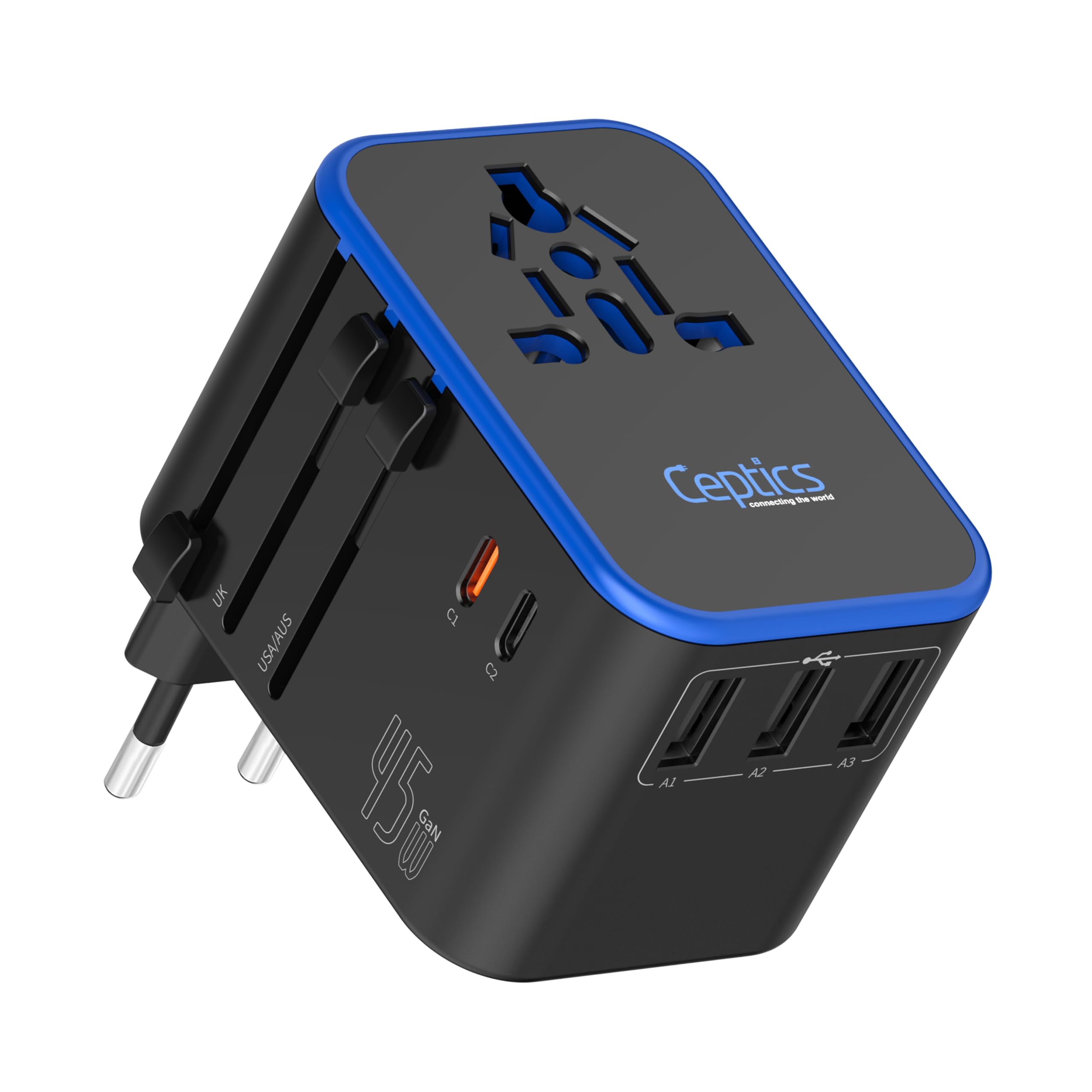
Ceptics 45W adapter delivers the highest USB-C wattage in this roundup at 45W, enough to charge a 13-inch MacBook Pro at full speed while the USB-A ports supply Quick Charge 3.0 for phones and tablets.
Users report simultaneous charging of a laptop, phone, and earbuds without slowdown. The adapter supports Type A, C, G, and I plugs via sliding mechanisms, covering outlets across Europe and beyond.
The casing feels dense and durable, with sturdy plug prongs and reassuring heft that suggests repeated daily use won’t loosen it. This build quality matches the premium feel of the top pick, though the weight is the clear difference.
This adapter suits remote workers who need one compact unit to fast-charge a USB-C laptop plus accessories. At 15 oz (1.08 lbs), it’s heavier than typical travel adapters — a tradeoff for the power output. Ultralight packers carrying only phones and tablets will find lighter options better.
Pros
- Charging performance across all ports
- Solid build quality that holds up to regular travel
- Good value for the power it delivers
- Compact for its capability despite the weight
Cons
- In a daypack or jacket pocket, the 15 oz weight is noticeable — ultralight travelers may prefer a lighter adapter.
For remote workers who need laptop-level USB-C power on the go, the Ceptics delivers — the weight is a reasonable tradeoff for the charging capability.
3. TESSAN EU 2-Pack
Best for Europe Families
Key Features
- Plug Coverage: Type C only
- USB Ports & Wattage: 2 USB-A, 1 USB-C (20W)
- AC Outlets & Max Wattage: 4 AC (2500W)
- Size & Weight: 3.48 oz each
- Price: Mid-Range
Where the top pick in this set covers the UK, Europe, and beyond with a single universal device, the TESSAN 2-Pack doubles down on continental Europe, packing four grounded AC outlets and three USB ports into each adapter. That translates to eight total outlets and six USB ports across two units, enough for a CPAP, a hair dryer, a laptop, and phones all drawing power simultaneously.
Strictly Type C, the adapter will not fit sockets in the United Kingdom, Ireland, or any destination using Type G plugs. This rules it out for itineraries that cross the Channel or include a London layover. For a trip confined entirely to France, Spain, Italy, Germany, and similar countries, skipping universal compatibility lets TESSAN focus on outlet density and a mid-range price for the pair.
Each adapter’s 20W USB-C port handles modern iPhones and Android phones at decent speed, while two USB-A ports cover older cables and peripherals. The 2-pack costs less than buying a pair of single-outlet universal adapters, making it practical for a family splitting two hotel rooms or two travelers who each want their own dedicated station.
Pros
- Four grounded AC outlets per adapter let a family power hair dryers, CPAP machines, and laptops simultaneously.
- Integrated USB-C Power Delivery (20W) and two USB-A ports charge phones and tablets directly, freeing up the AC outlets.
- Built with a solid feel that withstands the rigors of frequent packing and different wall sockets.
- Two adapters at a mid-range price provide double the outlets of a single device, a better value than buying two generic travelers.
Cons
- Type C only; incompatible with Type G outlets in the United Kingdom and Ireland.
If your itinerary stays entirely within mainland Europe and you need a clutter-free way to charge everyone’s devices, this 2-pack delivers exceptional per-person outlet coverage at a mid-range price.
4. LENCENT Foldable
Best for Budget Backpackers
Key Features
- Plug Coverage: Type C only
- USB Ports & Wattage: 2 USB-A, 2 USB-C (17.5W)
- AC Outlets & Max Wattage: 4 AC
- Size & Weight: 4.2 oz
- Price: Budget
The LENCENT Foldable stands out for its combination of four AC outlets and four USB ports in a package small enough to slip into a daypack. The foldable Type C prongs tuck away neatly, making it a straightforward choice for anyone who needs to power multiple devices across continental Europe without dedicating bag space to a bulkier brick.
While the AC side delivers exactly what budget-conscious travelers expect — four grounded outlets that work reliably across Type C, E, and F sockets — the USB section is where expectations need adjusting. The total 17.5W output is split across all four ports, so charging a modern phone or tablet will be noticeably slower than using the device’s own wall charger. This adapter suits shared hotel rooms where the priority is keeping everyone’s gear topped off overnight, not fast recharges between sightseeing stops.
Pros
- Four AC outlets accommodate multiple wall warts and laptop chargers at once.
- Foldable plug design stows compactly for easy packing in carry-on bags.
- Budget-friendly price point makes it an entry-level option for first-time Europe travelers.
Cons
- USB total output of 17.5W means charging speeds are slow, especially with multiple devices connected.
If you mainly rely on AC outlets and want a no-fuss adapter for shared hotel rooms, the LENCENT delivers exceptional outlet count at a low price — just don’t count on it for fast USB charging.
5. Anker Nano 20W
Best for Minimalist Solo Travelers
Key Features
- Plug Coverage: Universal (C/G/A/I)
- USB Ports & Wattage: 2 USB-A, 2 USB-C (20W)
- AC Outlets & Max Wattage: 1 AC (2-pin only)
- Size & Weight: 3.77 oz
- Price: Premium
The Anker Nano 20W packs four USB ports and a universal AC outlet into a body barely larger than a credit card, with retractable pins that slide flush for packing. It’s noticeably smaller and lighter than a full-sized universal adapter, disappearing into a jacket pocket where bulkier options would bulge.
Minimalist solo travelers are the match: someone who relies on USB for a phone, earbuds, and a power bank, perhaps with a small 2‑pin gadget like a shaver or travel steamer. The 2‑pin AC outlet cannot accept grounded laptop plugs, and USB output tops out at 20W — meaning multi‑device charging is slow. For charging a single large battery overnight or keeping low‑draw devices topped up in a hotel room, that’s acceptable. Road warriors needing a grounded MacBook charger or fast simultaneous charging should consider a heavier option.
When you plug in two phones, earbuds, and a watch, the total 20W is divided, so each device charges at a crawl. Using a single USB‑C port delivers up to 20W, but adding anything to the USB‑A ports cuts speeds further. The compact shell stays cool and pins retract with a firm click, holding steady in French and German outlets despite the lightweight body.
Pros
- Ultra-slim, credit-card-sized design disappears into any pocket or bag.
- Solid, premium construction withstands frequent packing and travel jostling.
- Retractable universal pins and light 3.77 oz weight make it never feel like extra bulk.
- Four USB ports let a solo traveler charge a phone, watch, earbuds, and backup battery simultaneously.
Cons
- The AC outlet accepts only 2‑pin plugs; grounded (3‑prong) laptop chargers and hair dryers won’t fit.
- Total USB output is capped at 20W, so charging slows to a trickle when multiple devices are connected.
For the traveler who values a pocket-sized adapter above all else—and can live without grounded outlets and high-speed multi-device charging—this Anker Nano delivers build quality and portability no rival matches at this size.
6. Ceptics 35W Kit
Best for Surge Protection
Key Features
- Plug Coverage: Universal (C, G, etc.)
- USB Ports & Wattage: 1 USB-A, USB-C PD 35W
- AC Outlets & Max Wattage: 2 AC (US, surge)
- Size & Weight: 4.5 oz
- Price: Premium
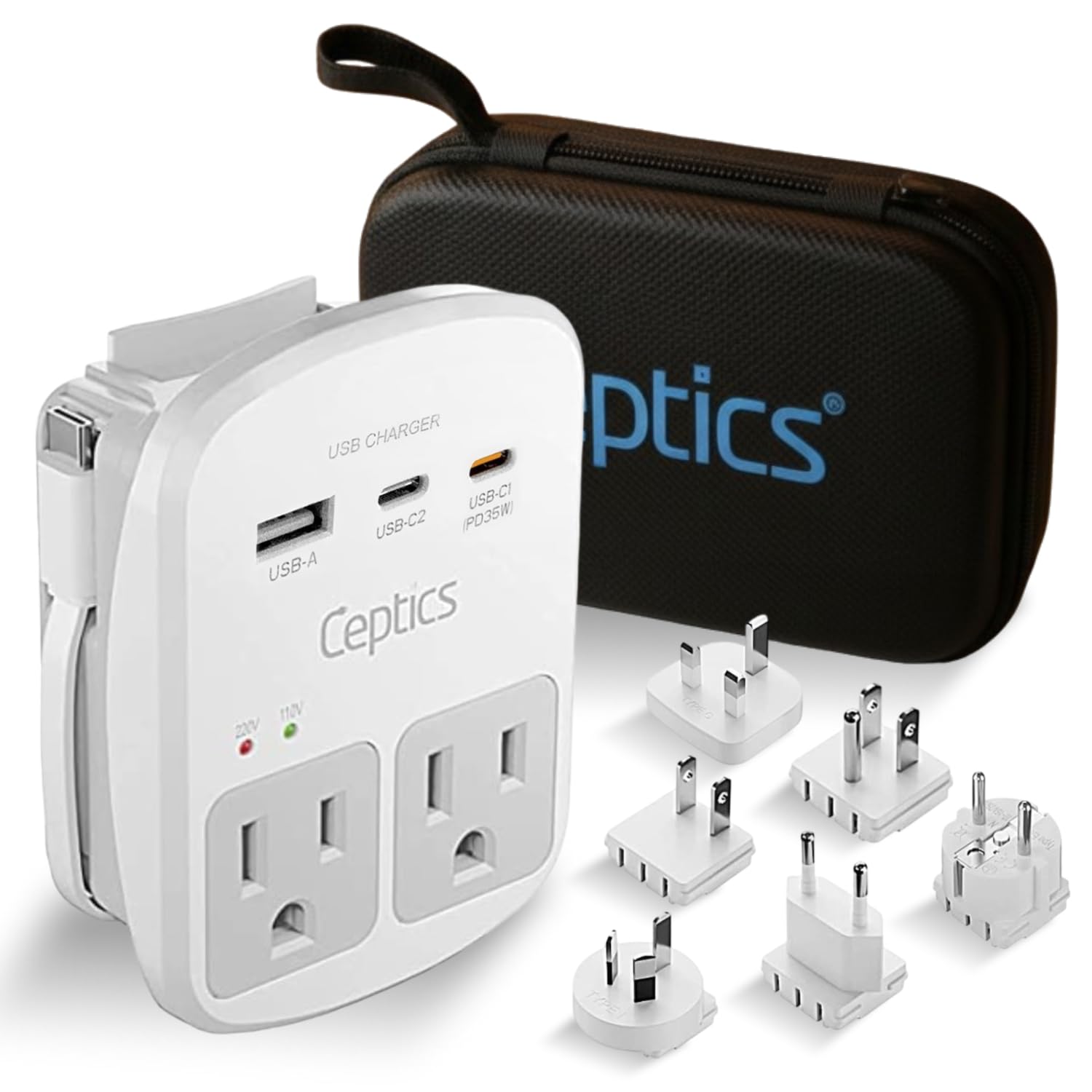
Where most adapters optimize for a single brick, this Ceptics kit adds active surge protection and a dedicated 35W USB‑C Power Delivery cable to protect laptops and cameras from voltage spikes. The main body houses two USA sockets, a USB‑A port, and an additional USB‑C port, while the tethered PD cable means you don’t need to pack an extra laptop charger.
Travelers who split time between continental Europe, the UK, and beyond will appreciate that the interchangeable heads cover Type C, G, and other standards without guessing. You simply click on the EU or UK head and plug in. This modular approach does mean managing loose pieces, and the kit takes up more bag space than a single‑body adapter. If you routinely pack multiple heads, a small pouch becomes essential.
The adapter’s construction holds up to frequent international travel — the plastic housing resists cracking when jostled in a carry‑on, and the sliding plug locks feel secure. Surge protection absorbs transient voltages, and the 35W PD cable supplies enough power to charge modern ultrabooks at their native speed, while the USB‑A port handles a phone or e‑reader overnight.
Pros
- Consistent performance across diverse power systems worldwide, with surge protection safeguarding connected electronics.
- Packs flat and light enough for carry‑ons, with a sturdy build that withstands frequent travel.
- Modular plug heads cover EU, UK, US, and AU outlets, letting you carry only the one you need.
- Dedicated 35W USB‑C PD cable charges a laptop at full speed, and the USB‑A port handles a phone simultaneously.
Cons
- The separate plug heads can be misplaced in transit, and the connection may loosen with repeated swapping.
If protecting laptops from power surges in regions with flaky grids tops your packing list, this kit’s dedicated PD cable and active protection justify carrying a few extra pieces.
7. kakahigh Corded
Best for Bedside Convenience

Key Features
- Plug Coverage: Type C only
- USB Ports & Wattage: 2 USB-A, 2 USB-C (24W)
- AC Outlets & Max Wattage: 3 AC (2500W)
- Size & Weight: 8.5 oz
- Price: Mid-Range
The integrated 3-foot cord transforms a single European outlet into a bedside charging station. Three grounded AC outlets handle your device plugs, while two USB-C and two USB-A ports (24W total) keep phones and earbuds powered. In shared rooms, the cord lets you position the adapter centrally so multiple people can plug in without crowding a wall socket.
The cord adds weight — 8.5 oz, which feels substantial compared to compact plug-in adapters. The USB-C ports max out at 12W, so they will not fast-charge a laptop or high-demand tablet. That shifts the adapter’s role from a universal fast hub to a dedicated nightstand companion, where overnight charging is the norm.
Pros
- Integrated 3-foot cord reaches outlets behind beds or furniture, turning a distant wall socket into a nightstand hub.
- Three grounded AC outlets and four USB ports support simultaneous charging for phones, tablets, cameras, and small appliances.
- Handles US-style 2- and 3-prong plugs across Type C, E, F, and G outlets for smooth compatibility throughout Europe and New Zealand.
Cons
- For ultralight packers, the 8.5-oz weight — driven by the built-in cord — feels noticeably heavier than a simple plug adapter.
- If you rely on USB-C Power Delivery to charge a laptop quickly, the 12W output will not deliver enough juice, requiring a separate high-wattage charger.
This corded adapter is the right pick when outlet distance is the main headache, and slow overnight charging fits your habits. Just keep a separate USB-C PD brick in your luggage if you need to power a laptop quickly.
8. Anker EU E/F
Best for France/germany Trips

Key Features
- Plug Coverage: Type E/F only
- USB Ports & Wattage: 1 USB-A, 2 USB-C (15W)
- AC Outlets & Max Wattage: 2 AC grounded
- Size & Weight: 3.2 oz
- Price: Mid-Range
Anker’s travel adapter delivers grounded connections through two AC outlets and three USB ports, engineered specifically for Type E/F sockets in France, Germany, and Spain.
That single-region focus means it skips universal compatibility—this adapter won’t help in Italy, Switzerland, or the UK. For travelers who know their destinations use Type E/F exclusively, the trade-off is negligible. You get a grounded solution with Anker’s sturdy construction, and the 15W USB total is fine for overnight charging of phones and accessories.
Pros
- Steady performance across Type E/F countries without tripping or overheating.
- Anker’s signature build quality with snug, wobble-free plug fit.
- Handles simultaneous charging of multiple USB devices smoothly.
Cons
- Restricted to Type E/F sockets; not functional in Italy, Switzerland, or the UK.
If your travel path never leaves Type E/F territory and you want a grounded, well-made adapter, this is a sensible choice.
9. Romeda 6-Pack Basic
Best for Simple Plug Needs

Key Features
- Plug Coverage: Type C only
- AC Outlets & Max Wattage: 1 AC (600W per unit)
- Price: Budget
This pack of six Type C adapters is one of the more budget-friendly ways to outfit a family trip or group booking, with each unit small enough to slip into a pocket. The design is intentionally simple — no USB ports and a single AC outlet per adapter — so it only makes sense if you already own separate USB chargers for your devices. The 600W ceiling also rules out high-wattage appliances like hair dryers or travel kettles.
Pros
- Six adapters for the price of one, useful for multi-room family stays.
- Each adapter is pocket-sized and adds negligible weight to luggage.
- Accepts US two-prong plugs for laptops or device chargers.
Cons
- No USB ports means you need separate chargers for phones, tablets, and other USB devices.
- 600W maximum power — cannot be used with hair dryers, travel irons, or other high-wattage appliances.
Best for travelers who already own a multi-port USB charger and need multiple basic adapters for different rooms or family members.
How to Choose
The key to a stress‑free trip is matching your adapter’s plug type coverage to your exact itinerary, especially whether the UK is on your list.
Plug Type Coverage (UK vs. Europe‑Only)
A ‘European’ label is dangerously vague. Type C adapters work in most continental countries but will not fit UK sockets (Type G). If your trip includes London, Edinburgh, or Dublin, you must choose an adapter that explicitly lists Type G — or a universal adapter covering Type C, G, I, and A. Without it, you’ll be stranded without power.
Even within continental Europe, socket depth varies. Some adapters sit loosely in recessed Schuko or Italian outlets, causing intermittent connections. Adapters with well‑machined prongs and a snug fit are less likely to sag under the weight of a USB hub. For grounded devices like laptops with three‑prong plugs, a grounded adapter like a dedicated Type E/F model is safer than a 2‑pin universal unit.
USB Port Count and True Charging Speed
USB‑C ports labeled ‘fast charging’ often deliver only 15W — enough for a phone, but painfully slow for a modern laptop. To charge a MacBook Pro at full speed, you need a USB‑C port with Power Delivery (PD) rated at 45W or higher. Even a 20W port will keep a phone happy but cannot sustain a laptop under heavy use.
Total wattage is shared across all ports. If an adapter advertises 20W total and you plug in two phones, each may receive only 10W, doubling charge time. Always check the combined USB output, not just the port count. For a family with multiple devices, look for at least 30W total spread across USB‑C and USB‑A ports.
Number of AC Outlets and Maximum Wattage
A single AC outlet forces you to juggle devices. If you travel with a hair dryer, CPAP machine, or camera battery charger, an adapter with two or more outlets is a practical necessity. The max wattage rating matters just as much: most adapters handle up to 2400W at 240V, which covers hair dryers, but some budget models cap at 600W — enough for a phone charger, but not a heating appliance.
When several high‑wattage devices run simultaneously, exceeding the adapter’s limit can blow a fuse inside the unit. A built‑in replaceable fuse adds a layer of safety. Travelers with medical equipment or high‑draw tools should pick an adapter with a generous wattage ceiling and, ideally, surge protection.
Size and Weight for Carry‑On Packing
A 15‑ounce adapter may not sound heavy, but it feels like a brick in a daypack. Most users prefer adapters in the 3–5 oz range. Lighter units often sacrifice some USB‑C wattage or extra AC outlets, so it’s a direct trade‑off between portability and capability.
For minimalist packers, a credit‑card‑sized universal adapter with retractable pins slides into any pocket. If you need more power, accept the extra weight and consider a modular kit that breaks into smaller pieces to distribute bulk across your luggage.
Build Quality, Fuse, and Surge Protection
Frequent plugging and unplugging can cause wear, especially on interchangeable slide‑out heads. Models with a solid, one‑piece body tend to develop fewer loose connections over time. A replaceable fuse is helpful — if the adapter fails, swapping a cheap fuse can save it.
Surge protection is a separate layer. It shields sensitive electronics from voltage spikes, common in regions with unstable grids. Not every traveler needs it, but if you carry an expensive laptop or camera gear, a surge‑protected adapter like a modular kit with a dedicated 35W PD cable is cheap insurance against fried circuits.
FAQ
Do I need a voltage converter for Europe or just a plug adapter?
Most modern chargers and devices are dual voltage (100–240V), so you only need a plug adapter. Check the fine print on your device or brick: if it says ‘Input 100‑240V’, a simple adapter suffices. Older single‑voltage appliances like some hair dryers may still require a converter, but they’re increasingly rare.
Can I use a Type C travel adapter in the UK?
No. The UK uses Type G sockets with three rectangular prongs, and Type C plugs physically won’t fit. You need an adapter with a Type G plug or a universal adapter that supports Type G. Arriving with only a Type C adapter in London means an emergency purchase at the airport.
Why is my travel adapter charging so slowly?
Two reasons usually: the USB‑C port lacks Power Delivery and is capped at 15W, or the total wattage is shared across too many devices. A laptop that needs 45W will charge at a crawl on a 15W port, and two phones sharing a 20W budget will each slow down. Always check the adapter’s total USB wattage and whether it supports PD for your laptop.
Are 2‑pin travel adapters safe for my laptop?
If your laptop charger has a two‑pin plug, a 2‑pin adapter is fine. But if the original charger includes a third grounding pin, using a 2‑pin adapter defeats the safety ground. In the rare event of a fault, the metal chassis could become live. For grounded devices, pick an adapter with a 3‑pin connection or a dedicated grounded Europlug adapter.
How can I keep my adapter from falling out of recessed European outlets?
Some European sockets (especially in older hotels) are deeply recessed, and lightweight adapters with short prongs can sag or lose contact. Look for adapters with longer, well‑machined prongs and a compact, rigid body that doesn’t hang too far from the wall. Universal adapters with interchangeable plug heads often provide a more secure fit than thin, retractable‑pin designs.