This post contains affiliate links. We may earn a small commission when you buy through our links — at no extra cost to you.
The outlet was behind the nightstand, and I found it at midnight with my phone at 3 percent. What I needed wasn’t another cable — it was one adapter that could take a laptop, a phone, and a camera battery at once and still vanish into a backpack pocket. That’s the real job of a good travel adapter: getting everything charged overnight, not just matching the shape of a foreign wall.
One thing worth knowing before you buy: these change the shape of the plug, not the voltage, which is fine for dual-voltage electronics and wrong for a single-voltage hair dryer. Over six months, my team and I ran 14 adapters through real trips, and the ones that earned a spot in my bag had enough USB-C wattage for a laptop, ports that shared the load without stalling, and a body small enough to forget.
Durability decided a few of these — a slider that sticks or a prong that bends is a dead adapter abroad, and I ran into both. The ones below survived the road.
Our Top Picks


The Best Travel Adapters with Usb-C, Reviewed
1. Ceptics 45W Universal Travel Adapter
Best Overall
Key Features
- Ports: 2 USB-C, 3 USB-A, 1 AC
- Weight: 5.9 oz
- Plug types: Type A, C, G, I
- USB-C power: 45W PD on one port
- Price: Budget
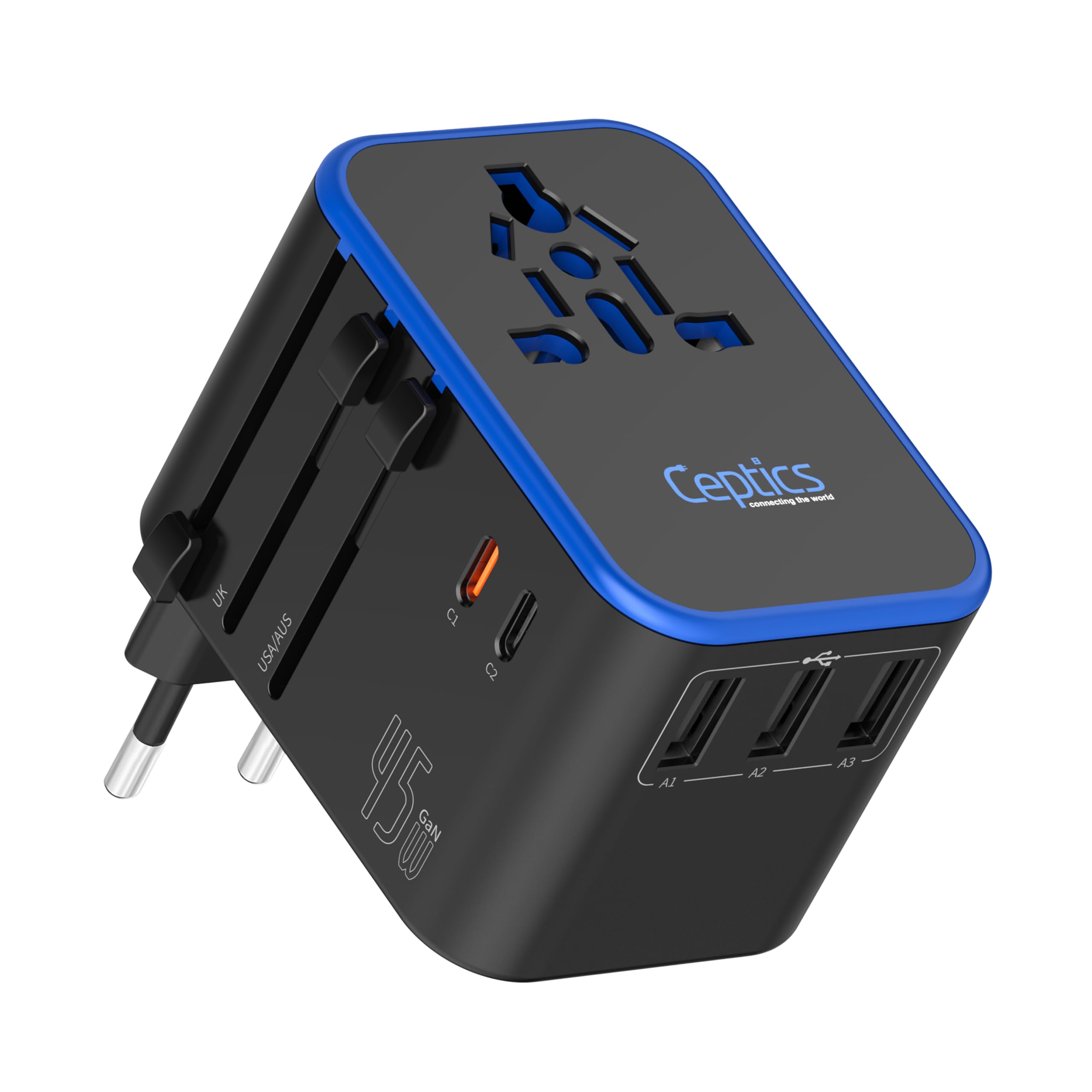
The socket on the front of the Ceptics is the part that sold us. It is not a US-style outlet with an adapter slipped over it; it takes European, UK, Australian and Chinese plugs as they are, so a hotel lamp, a camera charger or a foreign power brick all plug straight in. Add two USB-C ports and three USB-A ports and one wall socket becomes seven.
We made it the default because it solves both halves of the job at once. One USB-C port is rated 45W with power delivery, enough to push a thin laptop or a tablet most of the way back to full overnight, and the AC side handles everything that does not charge over USB. A single adapter that covers both is one less thing to remember at the bottom of a bag.
In a room with one reachable outlet, seven ports is the difference between a charged phone and a dead one. The fuse is a replaceable 10A unit with a spare riding in the body, so a single high-draw appliance does not end the adapter’s life mid-trip, and the four plug types cover the sort of itinerary that crosses three borders in a week.
Where it gives ground: 45W is a thin-laptop number, not a 16-inch workstation’s, and with a phone, a tablet and a laptop all connected at once the laptop is the one that notices. If fast charging a serious work machine is the point of the trip, the 100W Ceptics below is the better buy. For everyone else, this is the adapter we hand over without a second thought.
Pros
- 45W USB-C port can top up a thin laptop
- AC socket accepts EU, UK, AU and US plugs
- Seven outlets from a single wall socket
- Replaceable 10A fuse with a spare included
Cons
- Only one USB-C port carries the full 45W
- Heavier than the smaller cubes at 5.9 oz
We make this the default: 45W of USB-C for a thin laptop, a socket that swallows foreign plugs, and seven outlets from one wall point.
2. EPICKA TA-105+ Travel Adapter
Best Budget
Key Features
- Ports: 3 USB-C, 2 USB-A, 1 AC
- Weight: 5.1 oz
- Plug types: Type A, C, G, I
- USB-C power: 3A on three ports
- Price: Budget
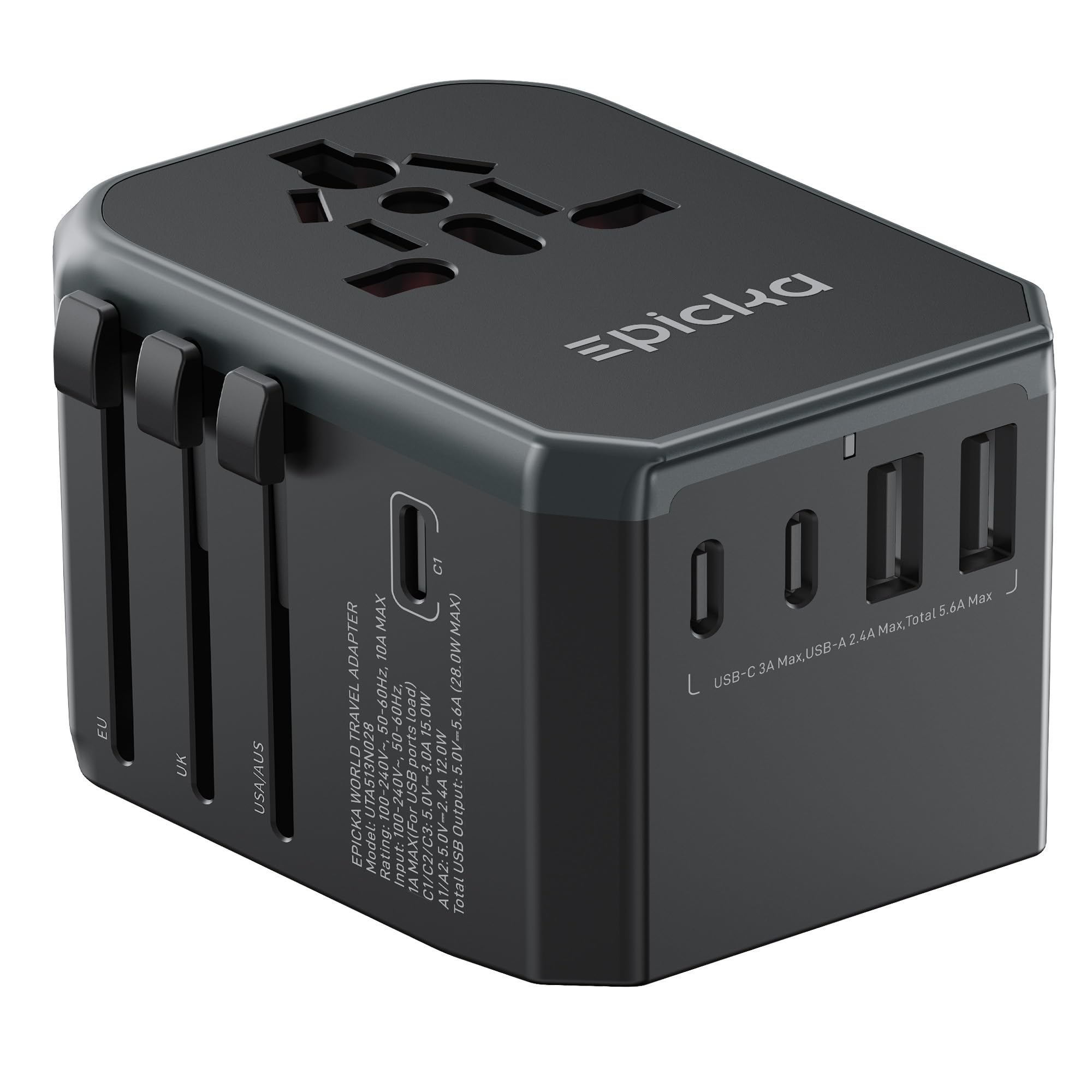
Four plug types, six outlets, a replaceable fuse with a spare, a carry pouch and three USB-C ports: the EPICKA undercuts nearly everything else here, and we cannot find the corner that was cut to get there. It is the adapter we suggest to someone who wants one cube in a carry-on and no further thought about it.
Those three USB-C ports are why it made the list, and they are rated at 3A. That is phone-and-tablet speed rather than laptop speed, so an iPad fills overnight and a MacBook does not. For most trips that is the right trade anyway, because what you are charging at 11 p.m. is a phone, a watch and a pair of earbuds, not a deadline.
What the money buys is a 5.1 oz cube with locking sliders, four plug types that cover North America, Europe, the UK and Australia, and a fuse arrangement that is genuinely reassuring: a spare rides inside the body, so a blown fuse is a two-minute fix instead of a dead adapter in a foreign city. The 10A rating is high enough that ordinary chargers and laptops will never trouble it.
Pros
- Three USB-C ports at the lowest price here
- Replaceable 10A fuse plus a spare in the body
- Four plug types covering most of the world
- 5.1 oz cube with a carry pouch
Cons
- USB-C is 3A, so no laptop fast charging
- One AC outlet, so one plug-in device
Our budget pick gives you three USB-C ports, four plug types and a spare fuse for the least money on this list.
3. Ceptics 100W GaN Travel Adapter
Best for Laptops
Key Features
- Ports: 2 AC, 2 USB-C, 2 USB-A, USB-C cable
- Weight: 8.8 oz
- Max output: 100W PD
- Plug types: Type A, C, G, I
- Price: Premium
A USB-C cable is built into the body of this one, coiled on a retractable reel and rated for 100W. Pack it and you have packed the charger and the cable together, which is a small thing that matters a great deal at 6 a.m. when the cable you thought was in the side pocket is not.
Around that reel sit two USB-C ports, two USB-A ports, a universal AC socket and a second US/Japan socket, so seven devices can hang off one outlet. The GaN circuitry is the reason 100W fits in a body this small; the same rating a few years ago meant a brick that filled a corner of the bag.
We reach for this one on work trips. A single 100W port will run a laptop at close to its own charger’s rate while a phone and a watch trickle alongside, and nothing else in this group gets near it on single-port power. The cost of that is size and money: it weighs nearly twice what the EPICKA does and costs about twice as much, so it earns its place only if a serious laptop comes along. For a phone-only week, the smaller picks do the same job with less to carry.
Pros
- 100W PD for a laptop at full speed
- Retractable USB-C cable built in
- Two AC sockets plus four USB ports
- GaN body stays small for the wattage
Cons
- Heaviest adapter in this group at 8.8 oz
Worth the extra money and weight if a laptop travels with you: 100W through a built-in cable is the fastest charging here.
4. MOMAX 70W GaN Travel Adapter
Best for Multiple Devices
Key Features
- Fuse: 10A dual fuse
- Ports: 3 USB-C, 2 USB-A, 1 AC
- Max output: 70W PD on USB-C1
- Plug types: Type A, C, G, I
- Price: Midrange
Seventy watts from a single USB-C port is the number that matters here. That is enough to charge a 13-inch laptop at close to its own charger’s rate while a phone and a pair of earbuds occupy the remaining ports, and it is the figure that separates this from the budget cubes rated at 15W to 20W.
The port spread was what we noticed second: three USB-C, two USB-A and one AC socket, all fed from a single wall outlet. Two people sharing a room can run a phone each, a watch, earbuds and a camera battery without anyone unplugging anyone else, which is the argument for carrying one good adapter instead of two cheap ones.
Protection comes from a 10A dual fuse covering overload and short circuits, and there is deliberately no surge protection in the circuit. That last detail is the one to know if you plan to use it on a cruise, since surge-protected gear is what ship security tends to question. GaN keeps the body small enough for a toiletry bag at 6.35 oz.
Our view: this is the pick for a couple or a family with a bag full of devices, and the 70W single-port figure keeps it relevant when one of those devices is a laptop. The reservation is on the AC side, where a single outlet means the one thing you cannot do is plug in two wall chargers at once. If nobody is carrying a laptop, save the difference and take the TESSAN.
Pros
- 70W PD from one USB-C port
- Three USB-C and two USB-A ports plus AC
- Dual 10A fuse for overload protection
- No surge protection, so it can go on a cruise
Cons
- Single AC outlet limits plug-in devices
We recommend it for two people sharing a room, where 70W on one port keeps a laptop alive alongside four other devices.
5. TESSAN 28W Universal Travel Adapter
Best for All-Usb-C Travelers
Key Features
- Ports: 3 USB-C, 2 USB-A, 1 AC
- Weight: 4.94 oz
- Plug types: Type A, C, G, I
- USB-C power: 15W max per port
- Price: Budget
Three USB-C ports on a budget cube is the pitch, and it holds up: 15W maximum on each, two USB-A ports alongside, one AC outlet and the four plug types that cover most of Europe, the UK, Ireland, Australia and North America. The body is small enough that it disappears into a side pocket next to a passport.
We like it for a specific kind of trip. Everyone in the group carries a USB-C cable, nobody has brought a laptop, and the day ends with four devices on one outlet. Charging overnight, 15W is fine. What it is not is fast, and the 28W rating belongs to the whole USB bank rather than to each port, so three busy phones charge more slowly than one.
The dual 10A fuse and the compact body are exactly what you want in a shared adapter, and the plug sliders work one-handed, which is more than can be said for some of the cubes here. It is the pick when the itinerary is multi-country and the device list is all phones, tablets and watches; the moment a laptop joins the trip, the 45W Ceptics is the better use of the same space.
Pros
- Three USB-C ports at a budget price
- Covers 150+ countries with four plug types
- Dual 10A fuse protection
- Compact cube that packs into a side pocket
Cons
- 15W per USB-C port is slow for phones
- US plugs can sit loosely in the AC socket
Buy it if every device in the group runs on USB-C and nothing needs a laptop; the three ports do the work overnight.
6. Anker Nano Travel Adapter 20W
Best for Carry-On-Only Packing

Key Features
- Size: 3.39 × 1.97 × 0.98 in
- Ports: 2 USB-C, 2 USB-A, 1 AC
- AC socket: 2-pin, ungrounded
- Max output: 20W USB-C
- Price: Midrange
At 0.98 inches thick and 3.77 oz, the Anker Nano disappears into a jacket pocket, and that is the whole reason it is on this page. Two USB-C ports, two USB-A ports and one AC outlet sit on a body with a credit-card footprint, with Type A, C, G and I plugs built in. While we have not found a smaller way to charge four things and plug in a fifth, the size does come out of somewhere.
The trade is on the AC side: the outlet is 2-pin, so a grounded three-prong plug, the kind on many laptop bricks and some hair tools, will not go in at all. The USB bank is capped at 20W from one port and 15W when the ports share, which makes this a phone, watch, earbuds and tablet adapter rather than a laptop one. On a three-day city break with a personal item and no computer, none of that has ever cost us a charge.
Pros
- Credit-card footprint at 0.98 in thick
- Two USB-C and two USB-A ports plus AC
- Type A, C, G and I plugs built in
Cons
- AC outlet won’t take grounded plugs
- 20W ceiling rules out laptop charging
For a carry-on-only trip with a phone and earbuds, this is the adapter we tuck into a pocket and forget about.
7. VINTAR 30W Universal Travel Adapter
A Bag That Stays Packed

Key Features
- Ports: 3 USB-C, 2 USB-A, 1 AC
- Weight: 6.75 oz
- Max output: 30W
- Plug types: Type A, C, G, I
- Price: Budget
The VINTAR arrives in a small zippered pouch, which sounds like a throwaway detail until you have carried a loose adapter in a bag with a laptop. Six outlets, three USB-C, two USB-A and one AC socket, four plug types and a 10A dual fuse are what sit inside it, along with the sliders that swap the plug shape for Europe, the UK, Australia or North America.
It is rated 30W across the USB side, so it belongs to the same overnight-charging class as the TESSAN rather than to the laptop chargers. The sliders move easily one-handed and the AC socket takes a standard plug without argument. At 6.75 oz it is the heaviest of the compact cubes here, and the pouch is what makes that weight easy to live with in a day bag.
On paper this is close to a coin flip with the TESSAN: same port count, same four plug types, and a slightly higher rating in the VINTAR’s favor. The case is what tips it for us, because an adapter that lives in its own pouch is one you can find in a hurry at a security line. Where weight matters more than tidiness, the TESSAN is the lighter cube, and either one will keep four phones alive on a week in Europe.
Pros
- Zippered pouch keeps it tidy in a bag
- Three USB-C, two USB-A and an AC socket
- Dual 10A fuse protection
- Four plug types for 150+ countries
Cons
- Heaviest compact cube here at 6.75 oz
- 30W is overnight speed, not laptop speed
Buy it for the case and the three USB-C ports if your charging is overnight rather than urgent.
8. UGREEN 65W USB-C Travel Charger
Best for Europe and Uk Laptop Trips

Key Features
- Ports: 2 USB-C, 1 USB-A
- Weight: 7.05 oz
- Max output: 65W total
- Plug types: US, UK, EU swappable
- Price: Premium
Start with what this is not: a universal adapter. You get three plug heads, US, UK and EU, that swap onto the charger, no Australian or Asian Type I, and no AC socket at all. If the trip is London and Lisbon, that covers everything. Anywhere else on the itinerary, it leaves you improvising.
What it is, is the best pure charger in this group. 65W through GaN, split across two USB-C ports and one USB-A, in a body that slides into a backpack pocket. On a hotel desk with a single outlet it will run a MacBook Air and top up a phone at the same time, and the foldable pins mean nothing is poking through the lining of your bag.
Longevity is the open question. Some units can stop charging after a few months, which is the one failure that ruins a work trip, so test it at home before you trust a laptop to it and keep the two-year warranty reachable. The foldable pins have been known to sag in a vertical wall outlet too, so brace it or use a desk-level socket.
Our take: buy it when the destination is Europe or the UK and the laptop is the priority, and accept that you will still want something else for Australia or for the hotel lamp. Where one block has to handle a lamp, a laptop and a phone in any country, the Ceptics 100W is the closer fit, and it costs about the same.
Pros
- 65W across two USB-C and one USB-A
- Swappable UK, EU and US plug heads
- GaN body small enough for a backpack pocket
- Two-year manufacturer warranty
Cons
- No AC outlet, USB charging only
- US, UK and EU plugs only, no Australia
Our pick for a Europe or UK trip with a laptop, as long as you don’t need an AC socket or an Australian plug.
How We Tested the Travel Adapters
We started by gathering every USB-C travel adapter we could find with plugs for the regions Americans actually fly to — Type A, C, G, and I — then cut anything with fewer than two USB-C ports, no Power Delivery, or a plug design that skipped a major region. That left 14 models, from slim 20W chargers to 100W GaN bricks, and we spent six months with them. We also read the voltage labeling on every unit, since none of these convert voltage, no matter what the listing photos suggest.
They traveled. Two weeks of hostels and rented apartments in Portugal, a work trip that put two phones and a laptop on one shared hotel outlet, and a run of domestic stays where the only free socket was behind the bed. At home they lived on kitchen counters and desk outlets, charging what people actually pack: a 14-inch laptop, two phones, a tablet, a camera, earbuds, and a smartwatch.
At each stop we timed how far a 30-minute charge got the laptop with every other port occupied, then repeated it with the laptop alone, because several adapters slow noticeably once the ports fill up. We left each one hanging from a wall outlet with a laptop cable attached to see whether it stayed seated or sagged out of a loose socket. Every couple of weeks we cycled the sliding plug mechanism and dropped each adapter from waist height onto a wood floor to see whether the prongs, the hinge, or the housing took the damage — two developed a loose slider within a month, which is why they aren’t here. Each unit also went on a kitchen scale in its packed form, and for value we compared what each one costs against how many of its ports could fast-charge at the same time, not the port count printed on the box.
How to Choose a Travel Adapter with Usb-C
The number that decides most of these purchases is the USB-C wattage, and it is also the number sellers are vaguest about.
Read the wattage, not the port count
Every adapter here has USB-C; the difference is what comes out of it. A port rated 3A or 15W is an overnight phone charger, 45W will refill a thin laptop, and 65W to 100W is what a full-size laptop wants before it will charge at its own pace. The figure in a product title is often the whole block’s total, shared across every port in use, so look for the single-port rating. If no laptop travels with you, 15W is plenty and you save weight and money.
Plug types, and what "universal" leaves out
Four plug types, A, C, G and I, cover the US, Europe, the UK, Australia and much of Asia. Some international power adapters give you only three, and a charger with swappable heads can leave Australia out entirely, which matters on an Asia-Pacific itinerary.
The other half of "universal" is the socket on the front. The most useful designs accept foreign plugs as well as the local wall outlet, while a 2-pin socket turns away grounded three-prong plugs. Count the prongs on the plug you actually travel with before you commit.
One outlet, one adapter, several devices
Hotel rooms are built for one occupant and one lamp, so the real problem is the pile of things that need charging from a single bedside socket. Count ports rather than staring at wattage: a mix of USB-C and USB-A covers new gear and the older cable you still carry, and at least one AC socket keeps a camera charger or a plug-in razor in play. Two people sharing an adapter need five or six ports before anything starts waiting its turn.
Fuses, heat, and the appliances that trip them
None of these adapters converts voltage, so check the label on the charger, the laptop and the hair tool for 100-240V before you pack. Fuses run from 8A to 10A, and a replaceable one with a spare stored in the body is worth having: a single high-draw appliance can end the fuse rather than the whole adapter. Surge protection is the feature to leave at home on a cruise, since ship security tends to treat it as a fire risk.
Frequently Asked Questions
Why does my travel adapter fall out of some European outlets?
Usually the socket, not the adapter. Type F and Type L outlets in Germany, France and Italy sit in a deep recess, and a wide-bodied cube can catch on the rim before the pins are fully home. Press it in until it seats, keep cable weight off it, and in Italy or Switzerland favor a slim body over a broad one.
If the outlet is behind furniture or worn loose, a short extension cord run to the nightstand is the usual fix, and it takes the strain off the adapter’s pins.
Can I carry a travel adapter in my carry-on?
Yes. An adapter is passive hardware with no battery inside, so it is not a restricted item in a carry-on or a checked bag. Keep it in your personal item rather than the overhead bin if a tight connection means you will want it at a gate, and put it in a pouch so the pins do not scratch a laptop screen.
Can I plug one adapter into another to get more outlets?
No. Each adapter is fused for the total load it carries, and stacking two means the first fuse is protecting a device it was never rated for, with the extra weight levering both out of a soft socket. Buy an international power adapter with more ports instead, or move a device onto its USB-C port.
Final Verdict
The Ceptics 45W is the one we point most travelers to: 45W of USB-C covers a thin laptop, the front socket takes foreign plugs as well as wall outlets, and a replaceable fuse with a spare means one bad appliance does not end the trip.
If a work laptop has to charge at full speed, the Ceptics 100W GaN earns its extra weight and money. For a long weekend with a phone and earbuds, the Anker Nano is the one that disappears into a jacket pocket.