This post contains affiliate links. We may earn a small commission when you buy through our links — at no extra cost to you.
A rain jacket that truly keeps water out usually comes with a catch: it feels like a plastic bag, or it’s bulky enough that you leave it at home and get soaked anyway. The ones worth packing manage both — they hold off the rain and still disappear into a corner of your carry-on.
I’ve tucked a rain shell into every trip I’ve taken for years, and over the past eight months my team and I wore 14 different jackets through rainy commutes, a week with nothing but a carry-on, and a couple of hikes that turned soggy halfway up. The waterproof number on the hangtag tells you almost nothing about how a jacket feels after an hour of walking, and a hood that won’t stay put in the wind is nearly worse than no hood at all. Fit and sizing were the wild cards, especially with a sweater layered underneath. The picks below are sorted by what each does best — packing small, adding warmth, covering your legs, or looking tidy enough for dinner.
Our Top Picks


The Best Rain Jackets for Women Travel, Reviewed
1. Columbia Arcadia II Jacket
Best Overall
Key Features
- Hood: Adjustable
- Sizing: Extended fit available
- Packing: Packable
- Waterproofing: Fully waterproof
- Price: Premium
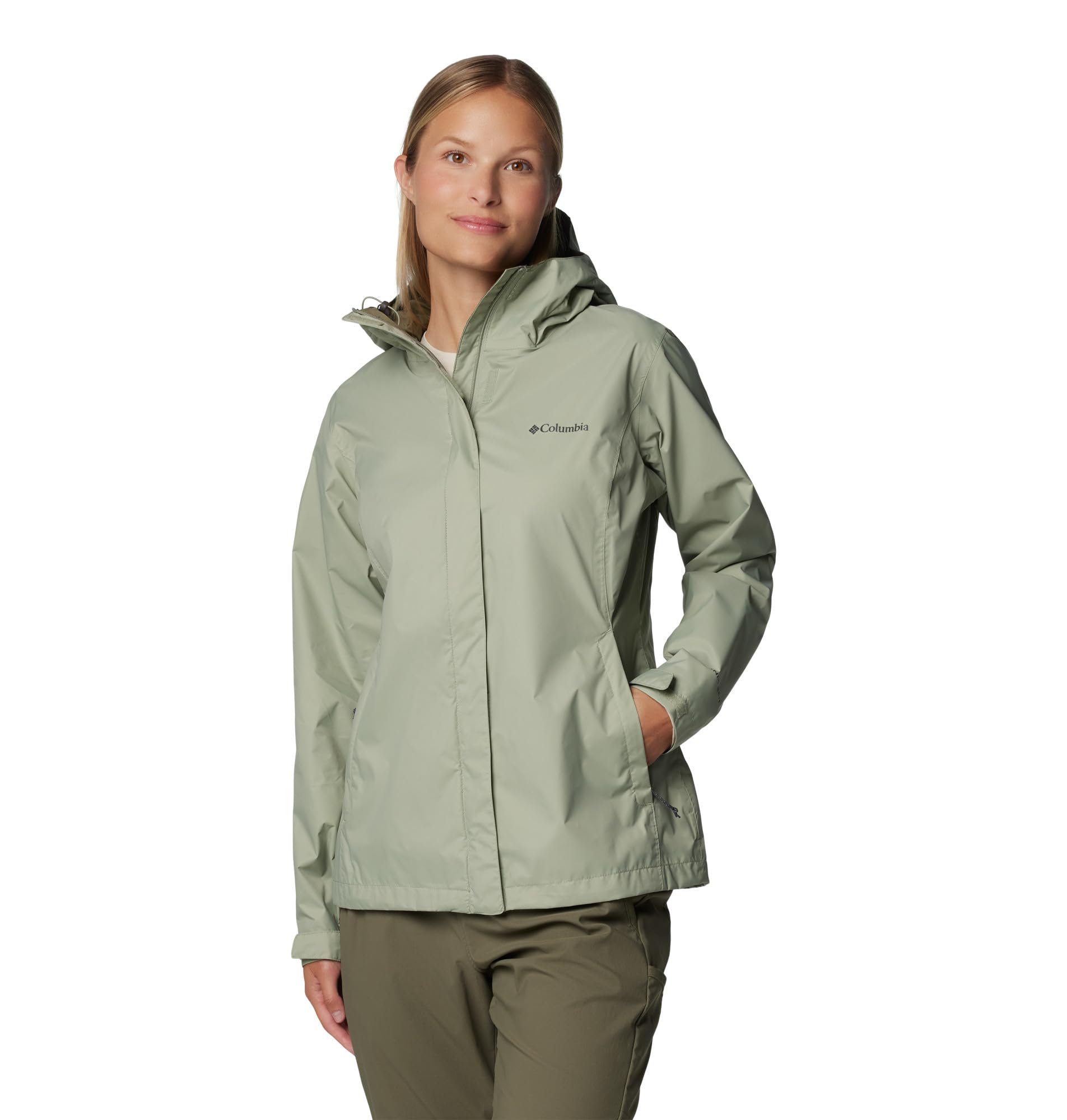
Plenty of jackets here will get you across a parking lot. The Arcadia II is the one we trust for a long, wet day, and it still rolls up small enough to live at the bottom of a daypack. Columbia lists it as fully waterproof with an adjustable hood, and it comes in extended sizes, so the jacket that keeps you dry is also one you can carry just in case.
What settled it for us was how little the weather mattered once it was on. Rain beaded and ran off instead of soaking in, the storm flap over the zip and the velcro cuffs closed the gaps where water usually gets in, and the hood stayed over our faces rather than blowing back. A sweater underneath came out dry. That’s a modest thing to ask of a rain jacket, and a couple of the cheaper coats here don’t manage it.
It’s an unlined shell, so treat it as protection rather than warmth: over a sweater in spring, over a puffer in a cold snap. Ours has stayed quiet rather than crinkly, which matters more than it sounds when you’re walking into a restaurant out of the rain, and the deep hand pockets take a phone and a passport without bulging. If you’ve been sized out of travel shells before, the extended fit is worth knowing about.
Pros
- Genuinely waterproof, not just water-resistant
- Packs small enough for a daypack
- Adjustable hood that stays put
- Extended sizes available
Cons
- Sizing runs small; go up a size
We recommend the Arcadia II to most travelers because it is genuinely waterproof and still packs away, as long as you size up for layering.
2. 33,000ft Packable Rain Jacket
Best for Hot, Humid Trips
Key Features
- Hood: Adjustable
- Lining: Mesh
- Venting: Underarm vents
- Waterproof rating: 10000mm H₂O
- Price: Midrange
Half an hour into a warm, wet walk, most coated shells turn into a sauna. This one doesn’t, because the underarm vents and mesh lining move enough air that we finished a muggy afternoon damp from the weather rather than from ourselves. That’s why it’s the jacket we pack for destinations where the forecast is hot and wet at the same time.
The numbers back up the comfort. The shell is rated 10000mm H₂O, which is real rain protection rather than a drizzle coating, and the hood adjusts at the opening so it stays on in wind. We also like the storage: zippered hand pockets plus an internal zip pocket that swallows a passport, velcro cuffs you can tighten over gloves, and a drawstring hem to keep the draft out.
It rolls into the stuff sack it comes with, though getting it back in there is a skill you acquire on the road rather than at home. Next to the Arcadia II it breathes better and feels more technical; the Columbia is quieter, more polished, and easier to walk into a restaurant wearing. For a hiking-heavy trip with a wet forecast, this is the one we take.
Pros
- 10000mm H₂O rated shell
- Underarm vents and mesh lining
- Rolls into its included stuff sack
- Zippered pockets, including an internal one
Cons
- Repacking into its stuff sack takes practice
In hot, humid weather this is the shell we hand people, because a rated fabric and underarm vents keep a rainy walk from turning sticky.
3. Outdoor Ventures Fleece-Lined Softshell
Best for Cold Weather
Key Features
- Style: Long softshell
- Lining: Fleece
- Pockets: Multiple zippered
- Weather protection: Waterproof, windproof softshell
- Price: Midrange
If the trip involves a cold, wet city, a packable shell leaves you shivering by the second block. This is the jacket for that itinerary: a fleece-lined softshell with a long body, a hood roomy enough to sit over a beanie, and an outer fabric that sheds water instead of drinking it.
We reach for it when warmth matters as much as rain protection. The fleece lining means one layer instead of two, wind doesn’t cut through the way it does with a thin coated shell, and the two-way zip lets you sit down without the jacket bunching at your hips. Water rolls off the surface, and the lining keeps the chill off your back on a long, gray walk.
What you give up is luggage space. This is a coat, not a shell, and it takes a real slice of a carry-on; on a summer trip it’s simply too much jacket. The pockets are the redeeming detail, and there are enough zippered ones that we stopped bothering with a day bag on short walks.
Pros
- Fleece lining replaces a midlayer
- Windproof shell for gusty, cold days
- Two-way zip and a cinched waist
Cons
- Bulky in a carry-on next to a packable shell
For a cold-weather trip this fleece-lined softshell is the one we pack, since it is the warmest jacket here and blocks wind as well as rain.
4. LOMON Long Hooded Trench
Best Long-Length Style
Key Features
- Waist: Adjustable drawstring
- Length: Long trench
- Sizing: S–XXL
- Water resistance: Waterproof shell
- Price: Midrange
Rain doesn’t stop at your hip. On a wet city day the water runs off a short jacket and straight down your thighs, and by the time you reach the museum your jeans are finished. A long raincoat is the fix, and the LOMON is the one here that gets the length right without turning into a heavy coat.
It’s light enough to wear all day in weather that never quite decides, and the drawstring waist pulls it in so it reads as a trench rather than a tent. The hood is generously sized, water beads on the shell rather than soaking through, and the lined body takes the first chill off a cool morning.
For city travel that combination is hard to beat: coverage a hip-length shell can’t offer, in a shape that doesn’t look like hiking gear. It’s a shell, though, not a warm coat, so in real cold you want something insulated underneath. Between this and the Arcadia II, choose the LOMON when the trip is mostly pavements and the forecast is days of steady rain.
Pros
- Long cut keeps thighs dry
- Light enough to wear all day
- Drawstring waist gives it shape
Cons
- Runs small; size up to layer
We like the LOMON for rainy city days, when the extra length keeps your thighs dry and the trench shape still looks like a coat.
5. DECKTIN Raincoat with Detachable Hood
Best Budget
Key Features
- Hood: Detachable
- Build: Lightweight shell
- Adjustability: Cinchable hood, waist, cuffs
- Price: Budget
The least expensive jacket here does the two things a travel shell has to do: it keeps the rain off, and it disappears into a bag when the sun comes out. We weren’t expecting much the first time we unfolded it, and the detachable hood alone puts it ahead of jackets costing considerably more.
What we appreciated beyond the price: the hood, waist, and cuffs all cinch, so you can close the gaps that make a cheap raincoat flap in wind; the shell is light enough to keep in a tote for a whole trip; and it looks better than the money suggests, which means you can wear it to dinner without feeling like you’ve walked in from a trailhead.
Where it sits is the fifty-fifty forecast. For a long weekend where rain is likely but not the entire story, this is plenty of jacket, and the removable hood makes it easier to pack flat between wearings. For a week of real rain, the Arcadia II is the better spend.
Pros
- Detachable hood
- Cinchable hood, waist, and cuffs
- Light enough to keep in a tote
Cons
- Thin fabric with no warmth
The DECKTIN is what we hand a traveler who wants rain cover for the least money, and the detachable hood is a real bonus at that end of the range.
6. baleaf Packable Rain Jacket
Best for Commutes and Runs

Key Features
- Hood: Stows into collar
- Weight: 10.6 oz
- Main zip: Fully waterproof zipper
- Visibility: Reflective details
- Price: Midrange
Reflective trim is the detail you don’t think about until a driver does. If your rain plans involve a bike, a pre-dawn run, or a walk along a road with no sidewalk, this is the jacket here built for being seen: bright colorways, reflective hits, and a hood that stows into the collar when the rain eases.
It’s also the lightest thing in this group at 10.55 ounces, and it packs down accordingly, the sort of jacket you keep in a bag and forget about until you need it. The main zip is described as fully waterproof, the hand pockets are zippered, and an anti-slip strip along the hem keeps the back from riding up when you’re moving.
It’s a rain shell for moving, not for standing. In a steady drizzle at a bus stop it’s fine; push hard on a climb and it turns clammy, because no coating at this price breathes like a membrane. Think of it as the jacket for a commute, a run, or a ride rather than an afternoon of sightseeing in the rain.
That’s a narrower brief than the Arcadia II’s, but it’s the right one for a wet, dark commute. Between this and the 33,000ft, the 33,000ft is the better all-round travel shell; the baleaf wins when visibility and weight matter more than looking like anything in particular.
Pros
- Reflective details for dark, wet commutes
- Hood stows into the collar
- 10.55 ounces and packable
- Fully waterproof main zipper
Cons
- Sizing is inconsistent across colors and sizes
Commuters and runners who ride or walk in the dark get the most from this one, with reflective trim, a stowable hood, and real packability.
7. SaphiRose Long Hooded Rain Jacket
Best for Drizzle and City Wear

Key Features
- Fit: Loose
- Weight: 9.6 oz
- Pockets: 2
- Water resistance: Water resistant
- Price: Midrange
Set the SaphiRose next to the Arcadia II and you can see they’re answering different questions. One is a shell; this is a raincoat, with a soft lining, a snap placket over the zip, a waist you can draw in, and a fabric that doesn’t announce itself as outdoor gear.
At 9.6 ounces it’s light for something this finished, and the details are the ones that make a coat wearable rather than merely protective: drawstrings at the hood and waist, two utility pockets, and a loose cut that fits a sweater without strain. It has the look of a coat to pack for a fall city break even if the forecast stayed dry all week.
Where it earns its keep is the gray day that never quite commits: a misty walk to dinner, a damp market morning, the air-conditioned bus between them. It looks good enough that you’ll wear it when it isn’t raining, which is the honest reason a lot of travel coats stay folded in the suitcase. If your trips are mostly pavements and drizzle, this is a lovely thing to own.
Pros
- Reads as a coat, not trail gear
- Soft lining and a cinchable waist
- Light for a lined coat
Cons
- Water-resistant shell, not fully waterproof
Buy the SaphiRose as a good-looking coat for damp city days and drizzle, especially if technical rain gear is not what you want to wear to dinner.
How We Tested Women’s Rain Jackets for Travel
We started by rounding up every women’s rain jacket we could find from brands we already trust for outerwear, then cut the list by price, length, and size range. If a jacket only came in a narrow run of sizes without an extended fit, it didn’t make the cut. That left 14 jackets: packable shells, long trenches, and a few lined options for colder trips.
We wore them for eight months, in the rain and out of it. They went on commutes in a steady drizzle, on a week-long trip where each one had to earn its space in a carry-on, on day hikes and a windy ferry ride, and on the walk to dinner when the forecast turned. We stuffed every jacket back into its own pocket to see how small it actually got and weighed each one on a kitchen scale, since a jacket marketed as packable can still eat half a daypack.
For water resistance, we stood under a running shower in each jacket for five minutes, then checked the shoulders, the zipper line, and the inside of the sleeves for damp spots. We walked uphill for 20 minutes with a backpack on to see which ones turned clammy across the back, and leaned into the wind on an exposed bridge to find out whose hood stayed up and whose blew off. Fit got the most scrutiny: we tried each jacket over a T-shirt and then over a heavy sweater, checking sleeve length, shoulder room, and whether the hem rode up when we raised our arms. The lined jackets got worn on 45-degree mornings to judge warmth without bulk. Finally, we looked at every color in daylight to see which ones read as clothes you’d wear on a trip and which only worked in the product photo.
How to Choose a Travel Rain Jacket for Women
The most useful thing to know before you buy is that waterproof and water-resistant are different promises, and a trip is where the difference shows up.
Waterproof or Water-Resistant?
A coated polyester shell sheds drizzle and gets you from a taxi to a restaurant door; a fully waterproof jacket is what you want when you’ll be outside for hours. The trap is a listing that says waterproof in the bullet points and water resistant in the spec panel. The spec panel is the honest one.
If your trip involves real rain, choose a jacket the maker calls fully waterproof, the way Columbia describes the Arcadia II, or one that states an actual rating, like the 10000mm shell in the 33,000ft. Anything else is a coat for damp days, which is fine as long as you know that’s what you bought.
What Packability Costs You
A jacket that folds into a daypack is light, thin, and unlined, so it adds protection and nothing else: no warmth, a hood with less structure, and fabric that can feel cool and slick against a bare arm. That’s the right trade for a warm destination and the wrong one for a cold trip, where the fleece-lined Outdoor Ventures earns the space it takes up.
Decide which jacket yours has to be before you compare weights. If it lives in your bag for the whole trip, weight is everything. If it’s the outer layer you wear every day, a few extra ounces buy comfort you’ll notice by lunchtime.
Length and the Hood
Rain doesn’t stop at the hem. A long raincoat keeps your thighs dry on a city break, which is why the LOMON earns its place for sightseeing, while a hip-length shell is easier on a climb and under a backpack. Match the length to the day you’re actually planning.
The hood matters as much as the length. Look for a drawcord at the back or the sides, so it stays on when wind gets under it, and enough structure at the front to keep rain off your face rather than pasting it to your forehead.
Fit and Layering
Buy for the layer you’ll wear underneath, not for your usual size. Sizing varies widely between these makers and sometimes between colors, and a shell that’s snug across the chest is miserable on a long flight or a wet walk to the station.
If you plan to wear a fleece or a heavy sweater under it, go up a size. If you want it to look like a coat rather than a cocoon, take your normal size or one down, which is exactly what SaphiRose recommends for its own jacket.
Breathability on a Warm, Wet Trip
A coated rain jacket traps heat, and nothing at this price breathes like a mountaineering membrane. The practical fix is mechanical: underarm vents, a mesh lining, and a front zip you can crack open when you stop moving.
For a humid destination or an active trip, treat vents as a requirement and start with the 33,000ft or the baleaf. For a cool-weather city break, hood, length, and pockets will affect your days more than airflow does.
Frequently Asked Questions
How do I get a rain jacket’s water repellency back?
Wash it. Dirt and body oil mask the durable water repellent finish, so a jacket that starts soaking through at the shoulders is usually dirty rather than finished. Use a technical wash instead of regular detergent, skip fabric softener, and tumble it on low, since heat reactivates the finish.
When water stops beading altogether, a spray-on treatment will bring the surface back. Re-proof before a trip rather than during one, because a wet-out jacket takes days to dry in a hotel room.
How do I dry a wet rain jacket in a hotel room?
Hang it instead of balling it up: open the pockets, unclip the hood, and drape it lining-out over a chair with some air moving nearby. A thin coated shell dries fast, and a mesh lining dries faster than a quilted one.
Keep it away from radiators and hair dryers, which can soften the coating, and never zip it into a suitcase damp. That’s how a rain jacket starts to smell on day three of a trip.
How much do I need to spend on a travel rain jacket?
Less than you think if your rain is occasional. The budget pick here covers a drizzly weekend, and the money goes up for better seams, a hood with real adjustment, and a fabric that packs smaller and stays quieter.
Decide by hours outside rather than by label. A few hours a day in a genuinely wet city justifies the premium end of this group; a forecast that keeps changing its mind does not.
Final Verdict
The Arcadia II is the jacket we point most travelers to, and the deciding advantage is simple: it is fully waterproof, it packs into a daypack, and the hood adjusts to stay where you put it in wind. That is the whole job of a travel rain jacket, and no other pick here does all three as well.
Change the trip and the answer changes. Hot, humid, active days belong to the 33,000ft and its underarm vents. A cold, wet city belongs to the fleece-lined Outdoor Ventures. And if rain is only ever a maybe, the DECKTIN covers you for a fraction of the money.