This post contains affiliate links. We may earn a small commission when you buy through our links — at no extra cost to you.
A packable rain jacket is a small miracle until the sky opens — then you learn whether the fabric breathes or turns into a sauna, and whether the seams hold. That trade-off is the whole game: the lighter and more compressible a shell gets, the more likely it leaks at the shoulders or soaks you from inside.
I’ve been caught in enough surprise downpours — bike commutes, dog walks, one treeless hike — to have opinions. Over the past six months, my team and I wore 14 of these jackets through drizzle, sideways rain, and a few miserable afternoons. The differences came down to what photos can’t show: whether the hood stays put in a headwind, whether the underarm vents actually move air, and whether the sizing leaves room for a fleece. A couple looked sharp enough to wear into a coffee shop afterward.
One thing worth knowing: the waterproof number on the hangtag is a starting point, not a verdict — taped seams and an adjustable hood matter just as much. The picks below span budgets and body types, and each earned its place.
Our Top Picks




The Best Lightweight Rain Jackets for Travel, Reviewed
1. 33,000ft Women’s Packable Rain Jacket
Best Overall
Key Features
- Pockets: Multiple zippered pockets
- Packability: Packs into travel bag
- Ventilation: Underarm vents
- Waterproofing: 10000mm H₂O
- Price: Premium
A 10,000mm waterproof rating is useful on its own, but the underarm vents are what make this shell work across a trip that swings from drizzle to humid. The mesh lining keeps the inside from feeling like a plastic bag, and the adjustable hood cinches down without swallowing your face. Zippered hand pockets hold a phone and passport, and the whole jacket rolls into its own travel bag.
We kept reaching for it because it covers the awkward middle of travel weather: wet enough for a hood, warm enough that a heavy coat feels wrong. The fit leaves room for a fleece, and the adjustable hood stays put when you cinch it. It is the jacket we recommend when one shell has to do everything.
The detail we appreciate most is the stuff sack, which lets us keep the jacket in a daypack without sacrificing a packing cube. That is the difference between a rain jacket you own and one you actually carry.
Pros
- 10,000mm waterproof rating for wet days
- Underarm vents and mesh lining add airflow
- Packs into its own travel bag
- Several zippered pockets keep items secure
Cons
- No insulation for cold weather
We recommend this one first for travel: the 10,000mm shell, underarm vents, and packable stuff sack cover more trips than any other jacket here.
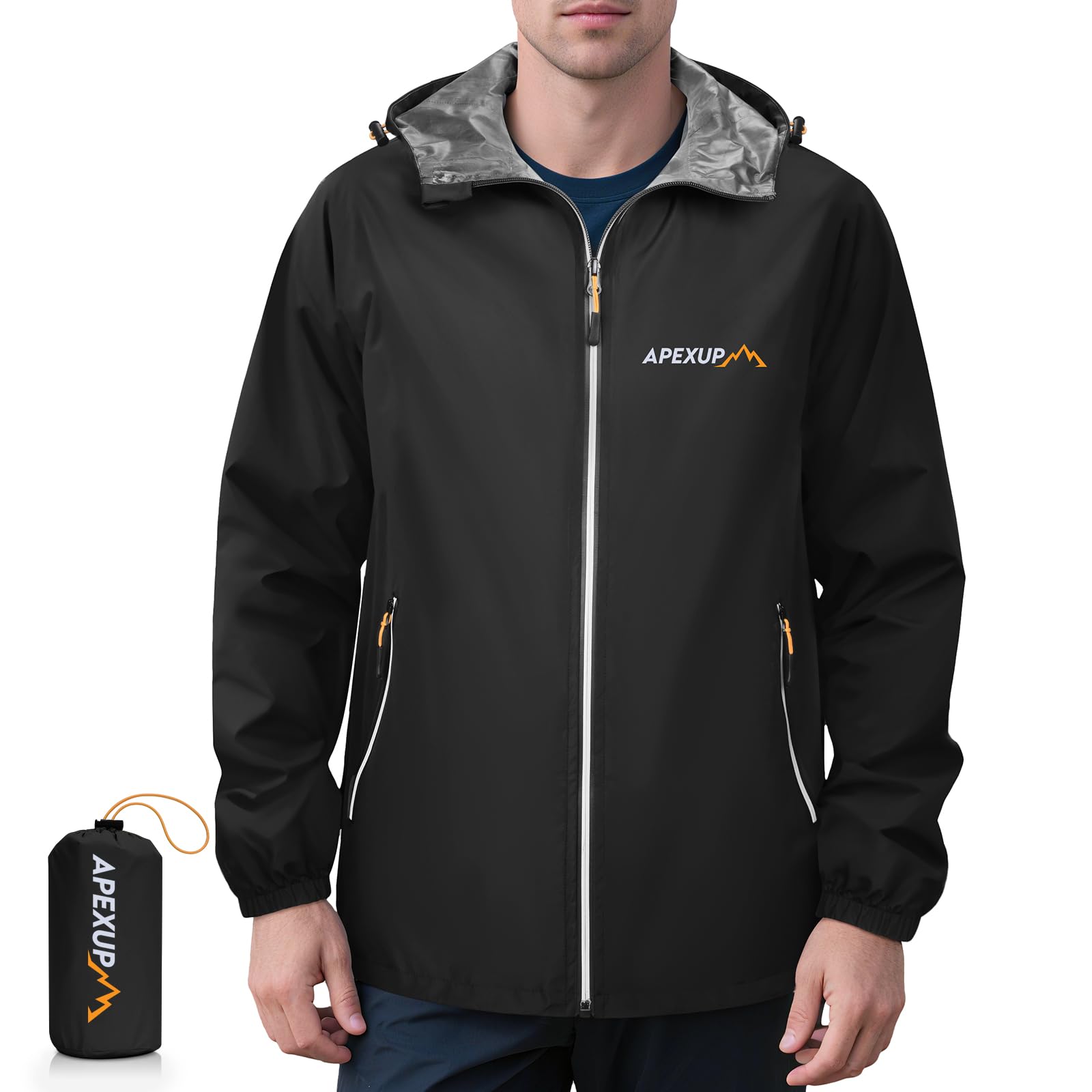
2. APEXUP Packable Rain Jacket
Best Budget
Key Features
- Hood: Adjustable
- Packability: Folds into included bag
- Waterproofing: 5000-8000mm
- Package weight: 8.82 oz
- Price: Budget
The listed package weight is 8.82 ounces, and the jacket folds into its included bag, so it earns a place in a daypack even when the forecast is only vaguely threatening. The 5000-8000mm shell shrugs off travel showers, and the adjustable hood and hem let you seal the openings without fighting a stiff cut. We also like the reflective details, which are subtle enough to wear in town.
The trade-off is breathability. This is not a shell we choose for a warm-weather hike; it can feel clammy once you work up a sweat. The zippers are also the part we handle carefully, because a lightweight shell lives or dies by them. For a backup layer in a city bag, though, the combination of low weight and a stuff sack is hard to beat.
Pros
- Packs into an included stuff sack
- Adjustable hood and hem seal out weather
- Subtle reflective details add visibility
- Roomy enough to layer a sweatshirt
Cons
- Waterproofing is best for light to moderate rain
We reach for this when luggage space is tight: it packs into its own bag, weighs little, and handles showery days without much fuss.
3. Outdoor Ventures Women’s Rain Jacket
Best for Heavy Rain
Key Features
- Seams: Fully taped
- Ventilation: Underarm vents
- Waterproofing: 10000mm H₂O
- Package weight: 1.13 lb
- Price: Premium
Fully taped seams are the reason this jacket sits at the top of our wet-weather list. The 10,000mm shell, mesh lining, and underarm vents are a sensible combination for travel: the fabric keeps rain out, and the vents give you somewhere to dump heat when you are moving with a pack. The hood adjusts with the jacket rather than flapping loose.
At a listed package weight of 1.13 pounds, it is heavier than the ultralight stuff-sack shells here, and we felt that when packing tight. The extra fabric buys a more substantial hood, taped seams, and a hand feel that does not crinkle like an emergency blanket. Zippered pockets keep a phone and small items secure.
What settles it for us is the hood and the seams together. In a trip where rain is the main event, we want the jacket that feels most like a proper shell, not the one that disappears smallest into a bag. The mesh lining also keeps the jacket from clinging to a T-shirt when you take it off and put it back on.
Pros
- Fully taped seams for steady rain
- 10,000mm waterproof rating for travel
- Underarm vents and mesh lining
- Packs into its own bag
Cons
- Sleeves run short for taller wearers
We recommend this for wet, windy itineraries: fully taped seams and a 10,000mm shell give it the most convincing rain protection in this group.
4. 33,000ft Men’s Packable Rain Jacket
Best for Men
Key Features
- Hood: Stowaway
- Seams: Fully taped
- Packability: Packs into bag
- Package weight: 10.9 oz
- Price: Midrange
A stowaway hood is a small thing until you are wearing a backpack and the hood is bunched behind your neck. This jacket rolls the hood into the collar, so it lies flat when the rain stops and stays out of the way when you are moving. The rest of the build is travel-focused: fully taped seams, a breathable shell, and four pockets.
The men’s cut is roomy through the chest, which is useful for a sweater or a light fleece. At 10.86 ounces, it is light enough to keep in a daypack without thinking about it. The reflective details are a nice touch on dark, wet mornings.
The one thing we watch is the lining. The shell itself feels sturdy, but the inner layer is where hard use shows first, especially around the shoulders and arms. That does not change our recommendation for travel, but it is the part to inspect if you plan to wear the jacket hard for a long trip.
What makes it our men’s pick is the way it combines a proper hood, taped seams, and a packable build without turning into a technical-looking shell. It is the jacket we hand to a guy who wants one rain layer for a week away, not a wardrobe of outdoor gear.
Pros
- Fully taped seams for wet weather
- Stowaway hood lies flat
- Light enough to carry daily
- Four pockets keep travel items handy
Cons
- Sizing runs large for some
We point men to this one first: taped seams, a stowaway hood, and a packable build make it a practical travel shell.
5. Diamond Candy Women’s Rain Jacket
Best for Hiking
Key Features
- Hood: Detachable
- Lining: Soft
- Storage: Easy to store
- Waterproofing: Waterproof
- Price: Midrange
The soft lining is what makes this jacket feel less like a crisp shell and more like something you can wear on a cool trail without a second thought. It is thicker than a windbreaker but not as heavy as a full rain coat, and the detachable hood zips off when you want a simpler collar. The shell is waterproof and windproof, with covered pockets and a roll-up build that stores easily.
We like it for hiking because the hood comes off and the lining takes the edge off a damp morning. It is a better cool-weather layer than a hot-weather shell, so we save it for spring, fall, and damp trail days. For a traveler who wants a softer rain layer rather than a pure stuff-sack shell, this is a comfortable choice.
Pros
- Soft lining adds comfort on cool days
- Detachable hood changes coverage
- Waterproof shell with wind protection
- Easy to roll up and store
Cons
- Runs small through the hips
We like this for hikers who want a softer, warmer rain layer: the detachable hood and soft lining make it comfortable on cool trails.
6. baleaf Packable Rain Jacket
Best for Visibility
Key Features
- Visibility: Reflective details
- Packability: Packable
- Package weight: 10.6 oz
- Waterproof zipper: Yes
- Price: Midrange
The reflective trim and bright color options are the reason this jacket earns a spot for wet commutes and active travel. The hood has a slightly stiff brim that keeps rain off your face, and the waterproof zipper adds protection where a cheap shell usually leaks. It packs down small enough for a carry-on, and the weight is light enough to forget in a daypack.
It gets clammy when you work hard, so we treat it as a rain shell for commuting and travel, not a running jacket. The hood brim is the detail we come back to: it keeps rain off your face without a cap. If you want a shell that doubles as a visibility layer on dark, wet mornings, the trade-off is worth it.
Pros
- Reflective details improve low-light visibility
- Waterproof zipper adds protection
- Hood brim keeps rain off your face
- Packs small for a carry-on
Cons
- Sizing is inconsistent across the range
We choose this for wet commutes and active travel: reflective details and bright color options make you easier to see in low light.
7. DECKTIN Women’s Waterproof Raincoat
City Style

Key Features
- Fit: Waist cinch
- Hood: Detachable
- Waterproofing: Waterproof
- Price: Budget
A cinched waist is not the first feature we look for in a rain shell, but it is why this one works as a city coat. The waist drawstring gives it a shape, the detachable hood lets you change the look, and the shell is light enough to wear on a damp sightseeing day without feeling bundled up.
The waterproof shell handles drizzle and light rain, and the hood covers your hair without a hat. It is not the technical jacket we grab for a long hike or a steady downpour; the seams and fabric are built for city weather rather than trail weather. For a trip that mixes museums, cafes, and wet sidewalks, that is a fair trade.
What makes it our city pick is the way it looks and packs. It has a softer, less technical silhouette than the stuff-sack shells here, and the detachable hood means you can wear it with a scarf or without. We recommend it for a traveler who wants one raincoat that works for dinner as well as the bus stop.
Pros
- Cinched waist gives a less technical look
- Detachable hood adds styling flexibility
- Lightweight for city days
- Waterproof shell for rainy walks
Cons
- Snug over heavy layers
We recommend this for city travelers who want a softer-looking raincoat: the cinched waist and detachable hood make it easy to wear.
8. Outdoor Ventures Men’s Rain Pullover
Best for Minimalist Packing

Key Features
- Hood: Stowaway
- Seams: Fully taped
- Visibility: Reflective details
- Packability: Folds into pouch
- Price: Midrange
A pullover rain shell is a deliberate choice: fewer zippers, less bulk, and a hood that disappears into the collar. This one has fully taped seams, reflective details, and zippered pockets, so it covers the practical side without the extra fuss of a full front zip.
The center pocket doubles as the packing sleeve, which is the detail we appreciate most. You stuff the jacket into its own front, zip it closed, and toss it in a daypack or golf bag. The stowaway hood leaves the collar flat when the rain stops, so it does not look like a technical shell in town.
It is not very breathable, so we wear it in rain rather than as an all-day hiking layer. The pullover cut also means you put it on over your head, which is fine in a drizzle and less fun in a downpour. Those are the trade-offs for a shell that packs this small.
What makes it our pullover pick is the way it stores itself and keeps the hood out of the way. It is the jacket we recommend for a traveler who wants a simple, packable rain layer and does not need a full-zip shell for layering.
Pros
- Stowaway hood keeps collar flat
- Fully taped seams for rain
- Center pocket doubles as stuff sack
- Reflective details add visibility
Cons
- Sizing runs large and inconsistent
We recommend this pullover for minimalist packers: the stowaway hood, taped seams, and self-storing pocket make it a versatile emergency shell.
How We Chose and Tested These Rain Jackets
We started by pulling every jacket sold as packable or lightweight with a hood, then cut anything that didn’t mention sealed or taped seams, a stowable or adjustable hood, or a packed size small enough to disappear into a daypack. That left 14 jackets, which we wore over six months on bike commutes, dog walks in the rain, weekend hikes, and the inevitable dash from the car to the airport door.
Water resistance got a controlled test: we laid each jacket flat over a paper towel, ran a faucet over the shoulders and hood for five minutes, and checked for damp spots, paying extra attention to seams and zippers. Out in real weather, we noted whether water beaded and shook off or soaked straight in, and whether the hood stayed put in a headwind or slid down over our eyes.
For fit, each tester tried the jacket over a t-shirt and then over a fleece, checking sleeve length, room through the shoulders, and whether the hem rode up when reaching overhead — sizing ran inconsistent enough that we logged the difference by body type. We weighed every jacket and measured how small it packed after stuffing it back into its own pocket five times in a row, which doubled as a durability check on zippers, seam tape, and fabric snagging. Appearance we judged the honest way: whether we’d wear it somewhere other than a trail. Value came down to whether the price bought details that survived the six months, not just a longer list on the hangtag.
How to Choose a Lightweight Travel Rain Jacket
The best travel rain jacket is the one you can carry without noticing and trust when the weather turns, so weight and pack size matter as much as the waterproof label.
Start With Waterproofing and Seams
Water-resistant fabric sheds a light drizzle, but a waterproof shell with taped seams is what keeps you dry when rain settles in. A rating like 10,000mm tells you the fabric can take more pressure before water pushes through, yet the seams, zippers, and hood matter just as much. For a city trip with scattered showers, a water-resistant jacket can be enough. For a wet-weather itinerary, choose fully taped seams and a hood you can cinch. Our wet-weather pick, the Outdoor Ventures women’s jacket, is fully taped.
Pack Size Matters More Than Ounces
An eight-ounce jacket that does not compress is less useful than a twelve-ounce jacket that disappears into a daypack. Look for a stuff sack, a self-storing pocket, or a shell that rolls tight enough to live beside a water bottle. We check packed size before weight because the jacket you carry is the one that helps. The APEXUP’s included bag and the baleaf’s packable build are the examples we reach for here.
Plan for Breathability
Waterproof fabric traps heat, and a jacket that feels fine on a windy ferry can turn clammy on a humid walk. Underarm vents, mesh linings, and a looser cut all help move air. If you run hot or plan to move fast, put ventilation ahead of a slightly lower weight. The 33,000ft women’s jacket earns its place with underarm vents and a mesh lining; the baleaf is better for short, visible commutes than for a sweaty hike.
Fit the Hood and Layers
A rain jacket should fit over the layer you wear underneath, not just over a T-shirt. Check the chest and shoulders with a fleece on, then make sure the hood adjusts at the back and around the face. A hood that cannot cinch will blow back in wind; one that is too small will not cover a cap. Sizing varies widely here, so use the size chart and expect some women’s cuts to run small.
Secure Pockets and Useful Length
Zippered pockets are worth the small weight penalty on a travel jacket: they keep a phone, passport, or transit card from sliding out when you sit down or take the jacket off. Length is a comfort choice. A hip-length shell is easier to pack and less likely to soak up water at the hem, while a longer cut gives more coverage on a cold walk. Pick the length for the weather you expect, not the look alone.
Frequently Asked Questions
Do I need a rain jacket if I already carry an umbrella?
An umbrella is fine for calm city drizzle, but a hooded jacket keeps both hands free for a suitcase, phone, or handrail and will not turn inside out in wind. For a trip with exposed walks or changing weather, pack a lightweight shell and use the umbrella as a backup for steady, windless rain.
Can I machine wash a packable rain jacket?
Usually yes, if the care label allows it. Use a gentle detergent without fabric softener, skip bleach, and tumble on low or hang dry. Heat can help revive the water-repellent finish on some shells, but check the label first because linings and laminates vary.
Will a rain jacket keep me warm on a cold trip?
A rain shell blocks wind and rain but adds little insulation. For cold, wet travel, wear a fleece or sweater underneath and choose a cut with room for it. The Diamond Candy’s soft lining takes the chill off, but it is not a replacement for a warm midlayer.
Final Verdict
For most travelers, the 33,000ft women’s packable jacket is the one to start with. It has the best balance in this group of a genuinely waterproof shell, underarm ventilation, secure pockets, and a stuff sack that disappears into a carry-on.
If steady rain is likely, the Outdoor Ventures women’s jacket’s fully taped seams are worth the extra weight. Men should look first at the 33,000ft men’s cut; for the smallest backup layer, the APEXUP is the one we stuff in a daypack.