This post contains affiliate links. We may earn a small commission when you buy through our links — at no extra cost to you.
The engine drone starts before the plane leaves the gate, and by hour two your kid is asking how much longer. A good pair of headphones buys you the next three hours — but only if they stay put on a small head and get loud enough to be heard over the cabin. Plenty of kids’ headphones fail at that.
Nobody tells you this before your first flight with a toddler: the volume cap that makes a pair appropriate for a 4-year-old is the same cap that can make a movie inaudible at cruising altitude. Look for a second, higher setting or active noise cancellation, and check for a 3.5mm plug — seatback screens still want a wire.
Over the past four months, my team and I have tested 16 pairs on real flights, in the back seat on school runs, and on the living room floor next to an iPad. We listened for tinny sound, counted Bluetooth dropouts mid-movie, and watched which earcups slid off a wiggly 3-year-old. A couple of the cheapest beat pairs that cost twice as much.
Our Top Picks



The Best Kids Headphones for Airplane Travel, Reviewed
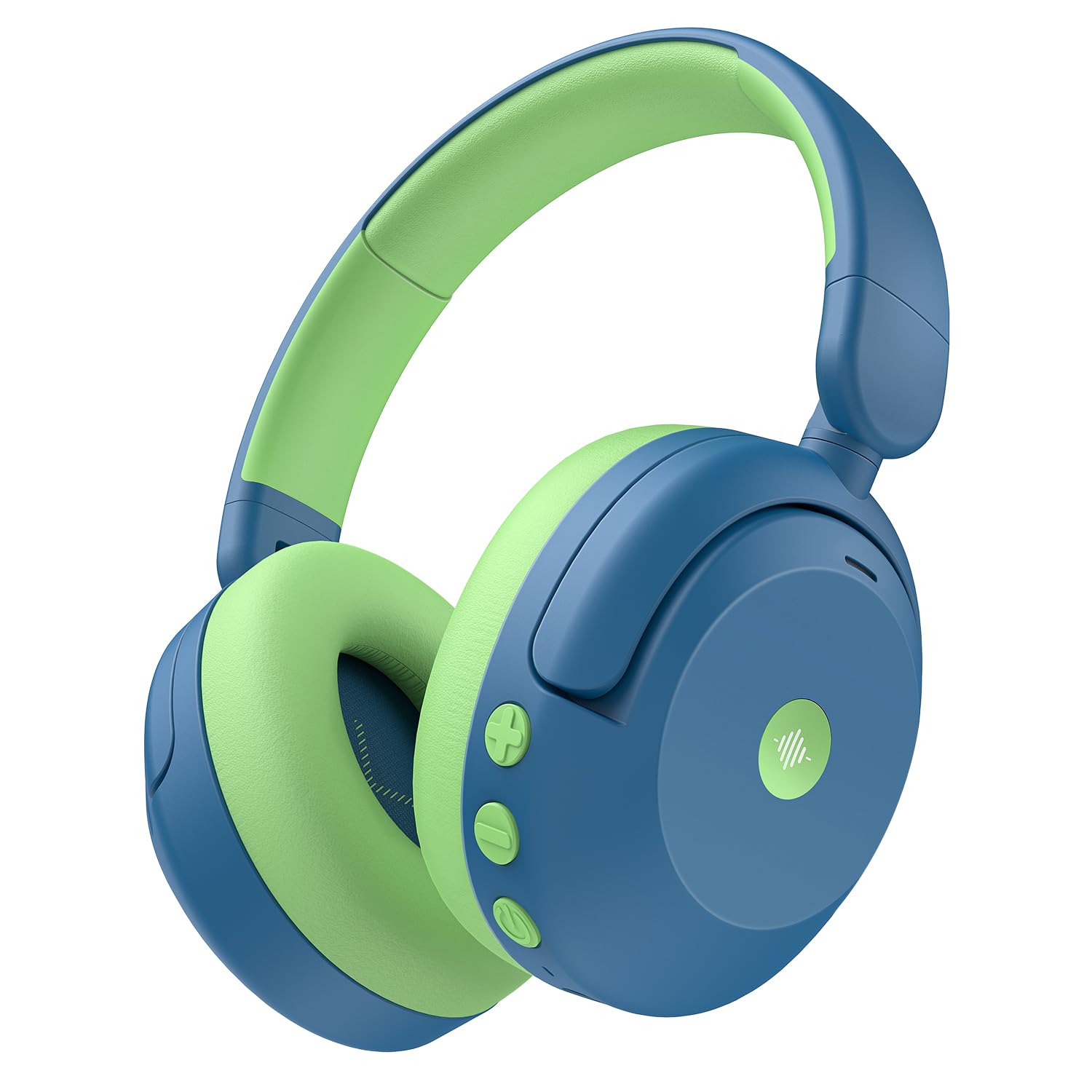
1. iClever BTH20
Best Overall
Key Features
- Battery: 60 hours (ANC off)
- Connectivity: Bluetooth 5.4 + 3.5mm
- Volume limit: 80 dBA
- Noise control: Active, up to 40 dB
- Price: Premium
The first thing we noticed about the iClever BTH20 is how directly it attacks the airplane problem: cabin rumble. Its active noise cancellation is rated to cut up to 40 dB, and that matters because the easiest way to make kids’ headphones unsafe is to make them quiet enough that a child turns the volume up. With ANC on, the headphones can stay at their 80 dBA ceiling and still let a show come through. That is a lower ceiling than the 85 dBA limit on many kids’ models, and we think it is the right call for young ears.
We reach for the BTH20 first because it is the only pair here that combines ANC, a detachable 3.5mm cable, and Bluetooth 5.4 in one travel-ready package. The detachable cable is the detail we appreciate most: seatback screens are still wired, and a snagged cord is replaceable rather than a dead pair. Bluetooth handles a tablet, and the 60-hour battery rating is with ANC off, so plan around that number if you keep cancellation on for a long flight. At 7.68 ounces, it is not the lightest pair here, but the over-ear cushions and pressure-reducing pads make the weight feel purposeful.
The lower ceiling does have a trade-off. In a loud cabin, 80 dBA can feel quiet, especially for an older child who is used to more volume; the ANC is what makes that ceiling workable. If your child is older and wants headroom, a dual-limit model like the Candy Bila or EarFun K1 gives you a 94 dB setting. For a first pair for a young traveler, we prefer the quieter ceiling and the cancellation.
Pros
- Active noise cancellation for cabin roar
- 80 dBA limit protects young ears
- Wired and Bluetooth in one pair
- 60-hour battery with ANC off
Cons
- Some units stop holding a charge
The iClever BTH20 is our top pick for flights because its active noise cancellation, 80 dBA limit, and wired-or-Bluetooth flexibility cover both seatback screens and tablets.
2. iClever BTH22
Best Budget Wireless
Key Features
- Weight: 5.26 oz
- Battery: 60 hours
- Connectivity: Bluetooth 5.4 + 3.5mm
- Volume limit: 85 dBA
- Price: Midrange
At roughly half the price of our top pick, the iClever BTH22 is the budget wireless pair we recommend for families who want fewer cables. It pairs over Bluetooth 5.4 and still includes a detachable 3.5mm cable, so it can switch from a tablet to a seatback screen without a fuss. The 60-hour battery rating is generous for a travel day, and the 149-gram build is light enough for a child to wear through a layover.
The BTH22 is not an ANC pair, so it relies on passive isolation. In a noisy cabin, that means the 85 dBA ceiling does more of the work; it is a sensible default for young kids, but it is not a shield against engine noise. We see it as the right pick for a child who mostly watches downloaded shows and does not need the quiet of active cancellation. The 10-level headband and rotating ear cups give it a better chance of fitting a growing child than a fixed-size set.
The controls are physical buttons rather than touch, which we prefer for a kid who is trying to pause a movie without looking. The BTH22 is not the pair we choose for a long-haul flight with a noise-sensitive child, but it is the one we buy when the budget is tight and the trip is mostly tablet time. It is a lot of headphone for the money, and the wired backup keeps it useful when Bluetooth is not an option.
Pros
- Bluetooth 5.4 with wired backup
- 60-hour battery rating
- Light 149-gram build
Cons
- Headband can crack with rough handling
The iClever BTH22 is our budget wireless pick for flights, with Bluetooth 5.4, a 3.5mm backup cable, and a 60-hour battery in a 149-gram frame.
3. EarFun K1
Best Wired Value
Key Features
- Weight: 6.98 oz
- Sharing: Built-in share port
- Connectivity: 3.5mm wired
- Volume limit: 85/94 dB
- Price: Budget
The EarFun K1 is the wired pair we keep for simple, cable-reliant listening. The nylon-braided cord resists tangling, and the 3.5mm plug works with seatback screens, tablets, and Chromebooks without pairing. The share port is the feature we did not expect to use as much as we did: it lets a second pair daisy-chain from the same device, which is handy when two children are splitting one screen.
The volume limiter has two settings, 85 and 94 dB. We prefer the lower setting for younger children and treat 94 dB as a noisy-cabin option for older kids, not a default. The 40mm drivers deliver clear dialogue, and the inline mic is useful for classroom calls even if it is not the reason to buy a travel pair. For a wired headphone, the controls are simple enough that a child can learn them in one trip.
At 198 grams, the K1 is heavier than the BTH22, and the on-ear fit runs small for some older kids. We still reach for it when we want a wired pair that can share audio and survive a backpack. The 3.5mm plug is the one part that never needs charging, which is why it stays in our carry-on.
Pros
- Share port for a second pair
- Dual 85/94 dB volume limits
- Tangle-resistant braided cord
Cons
- Durability is inconsistent
The EarFun K1 is our wired value pick for flights because it combines a share port, dual 85/94 dB limits, and a tough braided cord at a budget price.
4. Belkin SoundForm Mini
Best Travel Kit
Key Features
- Battery: Up to 30 hours
- Included: Protective case
- Connectivity: Bluetooth 5.3 + 3.5mm
- Volume limit: 85 dB
- Price: Premium
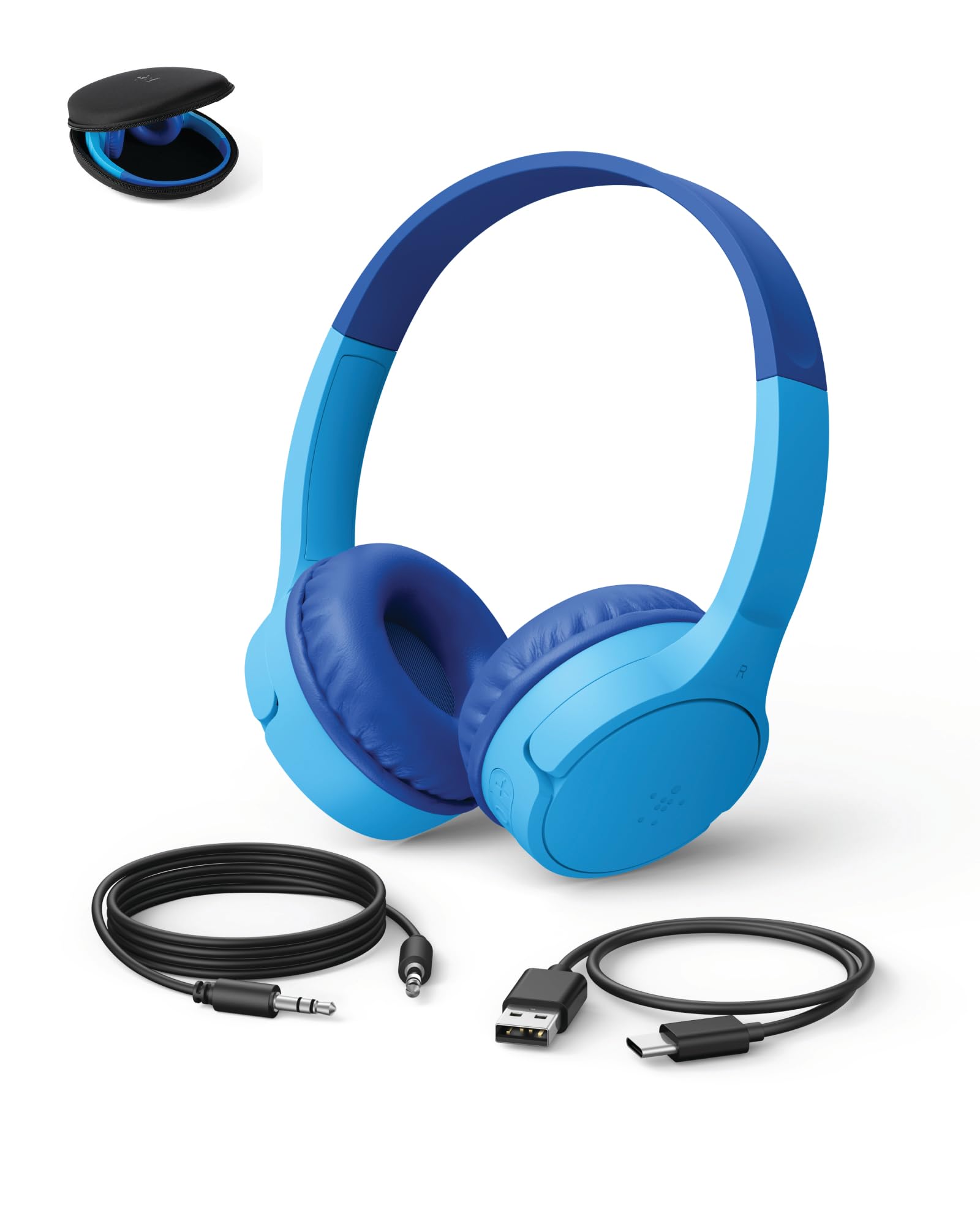
The Belkin SoundForm Mini is the pair we pack when we want the headphones to arrive in one piece. It comes with a protective case, a 3.5mm AUX cable, and a USB-C charging cable, so the kit is complete before you zip it into a backpack. The case is not a small detail on a family trip: it keeps the headband and ear cups from being crushed at the bottom of a bag.
Belkin gives you Bluetooth 5.3 for tablets and a 3.5mm port for seatback screens, plus a 30-hour battery rating and an 85 dB volume limit. The over-ear cushions are kid-sized and the headband adjusts, so it fits a range of ages. The touch controls are easy to wipe clean, though a child who fidgets may trigger them by accident. We like the two-year warranty more than the touch panel.
The BTH20 adds active noise cancellation, which is why it takes the top spot for noisy cabins; the Belkin is the better pick when a case and a simple wired backup matter more than silence. For a younger child who will mostly use the cable, the SoundForm Mini is a sensible travel kit. The 3.5mm port is the reliable path for a seatback screen, and the included cable makes that easy.
Pros
- Protective case included
- Bluetooth 5.3 and 3.5mm wired
- 30-hour battery rating
Cons
- Bluetooth pairing can be unreliable
The Belkin SoundForm Mini is our travel-kit pick for flights, with a protective case, 85 dB limit, and wired or Bluetooth listening for tablets and seatback screens.
5. iClever HS22 2-Pack
Best for Siblings
Key Features
- Fit: Adjustable, all ages
- Pack: 2 headphones + splitter
- Connectivity: 3.5mm wired
- Volume limiting: SafeSound Tech 3.0
- Price: Midrange
Two children, one seatback screen, and a single headphone jack: that is the situation the iClever HS22 2-pack is built for. You get two wired headphones and a splitter in the box, so both kids can listen to the same movie without passing a tablet back and forth. The headphones fold, the ear cups are padded, and the headband adjusts across a wide range.
The HS22 uses iClever’s SafeSound volume limiting, and the 3.5mm connection is the right call for airplane entertainment because it does not need pairing or charging. We like the splitter more than we expected: it is the difference between a shared screen being a treat and being a negotiation. The 40mm drivers are clear enough for dialogue, and the nylon cord resists tangles. For a family with two kids close in age, this is a practical set rather than a premium one.
The trade-off is volume. With a safe ceiling and no active noise cancellation, the HS22 can be too quiet in a noisy cabin, especially on older planes. The fit also runs loose on smaller toddlers; the headband adjusts, but a 2-year-old may still be between sizes. For siblings close in age who will share a screen, the two-pack and splitter are worth the compromise. For a single young traveler, a more adjustable pair like the BTH22 is easier to fit.
Pros
- Two headphones plus a splitter
- Folds for travel
- Adjustable headband for a range of ages
Cons
The iClever HS22 2-Pack is our pick for siblings on a plane, with two wired headphones and a splitter that let them share one seatback screen.
6. Botesty Sound BS01
Best for Budget Lights

Key Features
- Battery: Up to 85 hours (lights off)
- Lighting: LED lights
- Connectivity: Bluetooth 5.4 + 3.5mm
- Volume limit: 85/94 dBA
- Price: Budget
The Botesty Sound BS01 is the pair that made us check the battery rating twice. It is listed at up to 85 hours with the LED lights off, which is a huge number for a budget kids’ headphone. That means the lights can be a fun feature rather than a battery tax you have to manage every night. The plastic-wrapped steel frame is designed to resist twisting, and the ear cups rotate for packing.
We think this is the budget wireless pick for a child who wants the light-up look. It has Bluetooth 5.4, a 3.5mm cable for seatback screens, and a dual 85/94 dB limit. The 94 dB setting is useful in a loud cabin, but we keep younger kids on 85 dB and use the higher setting only when plane noise makes dialogue impossible. The controls are physical buttons, which is easier for a kid than a touch panel.
For a short trip or a child who loves the lights, the Botesty is a lot of fun for the money. For a pair with a longer warranty, we point to the BTH22. The BS01 has the attention-grabbing feature; the BTH22 has the more adjustable fit for everyday wear.
Pros
- Up to 85-hour battery with lights off
- 85/94 dB volume limit
- Bluetooth 5.4 and 3.5mm cable
- LED lights kids like
Cons
- Three-month warranty
- Lights cut battery to about 20 hours
The Botesty Sound BS01 is our budget wireless pick for flights, with an 85-hour battery, Bluetooth plus a 3.5mm cable, and lights that make it fun.
7. Candy Bila BH03
School Backup

Key Features
- Weight: 8 oz
- Microphone: In-line mic
- Connectivity: 3.5mm wired
- Volume limit: 85/94 dB
- Price: Midrange
The Candy Bila BH03 is one of the few wired pairs here with a switch between 85 and 94 dB. That sounds like a small thing until you are on a plane: 85 dB is the safer setting for a young child, but a noisy cabin can swallow dialogue at that level. The higher setting gives older kids a little more headroom without handing them an open volume dial.
We see the Candy Bila as a midprice wired option for a child who wants an over-ear fit and a microphone for classroom calls. The ear cups are padded, the headband adjusts, and the whole thing folds. The inline control is a single button, which is simpler than a row of tiny buttons. At 8 ounces, it is not the lightest pair here, but the over-ear cushioning makes it comfortable for a long movie.
For a child who needs a microphone for school and a wired connection for the plane, the dual-limit switch is the reason to consider it. It is not the pair we choose for a rough-and-tumble kid, but it is a useful backup for a careful older child. The 3.5mm plug is the simple connection that works with a seatback screen.
Pros
- Dual 85/94 dB volume switch
- In-line microphone for class
- Comfortable over-ear padding
Cons
- Sound and reliability are inconsistent
The Candy Bila BH03 is a useful wired backup for older kids who need an 85/94 dB switch and a microphone for class.
8. IMYB V1
Best for Young Kids
Key Features
- Fit: Ages 2-12
- Weight: 4 oz
- Connectivity: 3.5mm wired
- Volume limit: 85 dB, locked
- Price: Budget
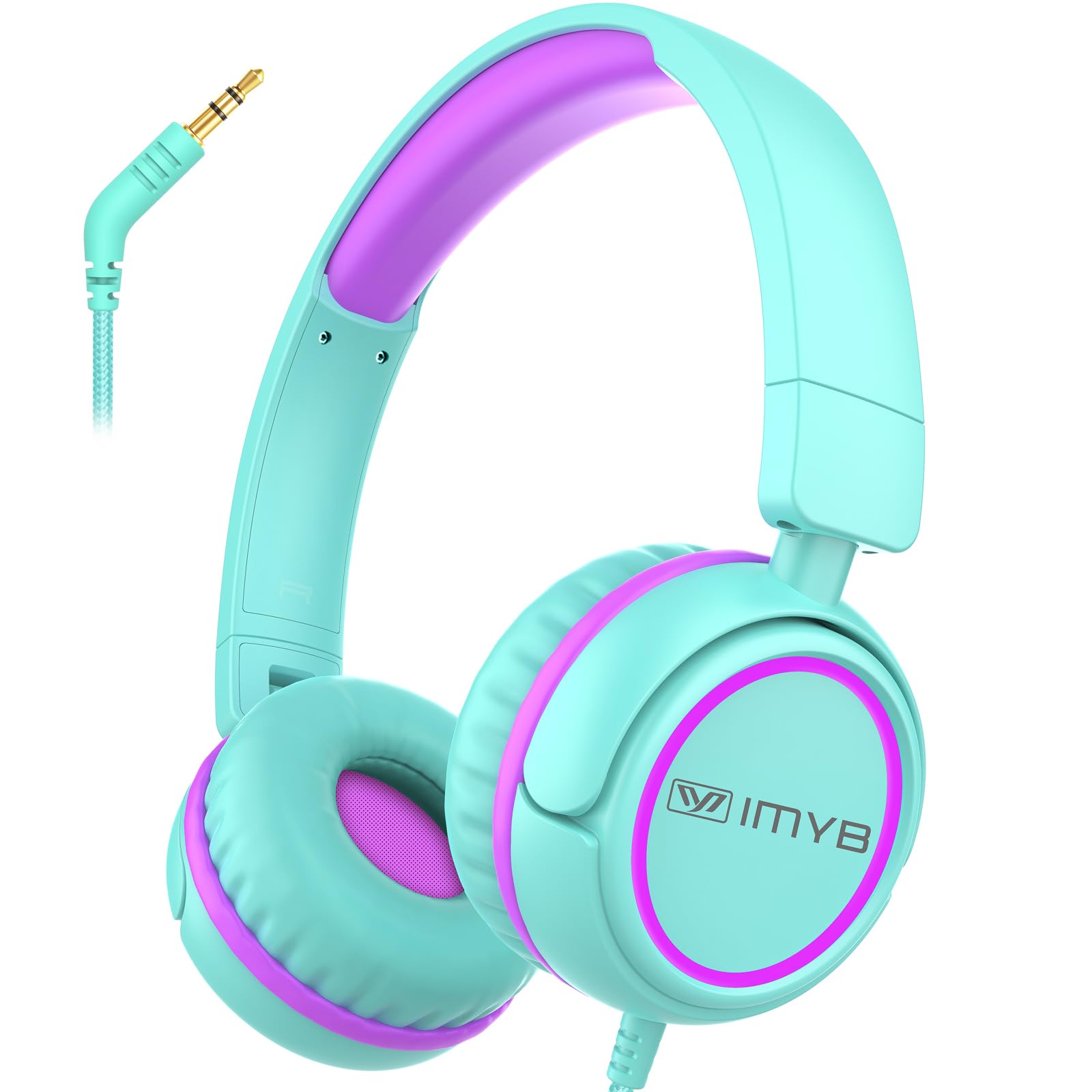
The IMYB V1 takes the opposite approach to volume control: it locks the limit at 85 dB and leaves no button for a child to override. For a young child or a classroom setting, that is exactly the point. The 4-ounce build is light enough to disappear in a backpack, and the braided nylon cord is designed to resist tangling and pulls.
We recommend the V1 as the budget wired pair for a child who does not need a microphone or a sharing port. The 3.5mm plug works with a seatback screen, a tablet, or a Kindle, and the adjustable headband is sized for ages 2 to 12. The on-ear pads are soft, and the fold-flat design makes it easy to stash in a carry-on pocket. For a first pair or a spare, that simplicity is the appeal.
The locked ceiling is also the limitation: on a loud plane, a child may struggle to hear dialogue, and there is no higher setting to switch to. The V1 is not the pair for a noise-sensitive kid or a long-haul flight with a lot of engine roar. It is the pair you buy when you want a safe, light, inexpensive wired backup that a child cannot turn up.
Pros
- Factory-locked 85 dB limit
- Light 4-ounce build
- Braided nylon cord
Cons
- Durability is inconsistent
The IMYB V1 is our pick for a simple, locked-volume wired pair for young kids, with a light build and a tangle-resistant cord at a budget price.
How We Tested Kids Headphones at 35,000 Feet and at the Kitchen Table
We started by pulling more than 40 models and cutting anything that lacked a documented volume limit or a 3.5mm jack, since a wireless-only pair is dead weight the moment the seatback screen is the only entertainment on board. Filtering by size range, battery claims, and price left us with 16 pairs, which we bought ourselves over four months so no brand could send a handpicked unit.
Testing happened where these headphones actually live. We flew with them — a 90-minute hop and a coast-to-coast flight — and held a decibel meter against the earcup to see how much engine drone got through at the lower and higher volume settings, listening for the thin, tinny treble that turns dialogue into mush. We also used them in the car on the school run, at the kitchen table with a tablet, and on the floor during a tantrum or two.
Fit came down to watching rather than measuring. We put each pair on kids from 2 to 11, noted how long it took before someone pushed them off, whether the earcups clamped too hard on a small head, and whether the band slid down when a kid looked at a tablet. For durability, we dropped each one from counter height, folded and unfolded the hinges until they loosened, and stuffed them uncased into a backpack next to a water bottle.
We paired every Bluetooth model to a tablet with the device in another room and counted dropouts over an afternoon, then ran the batteries down to see whether the stated playtime held with the volume up. Pairs with a share port got two kids on one screen, which is the only honest way to tell whether that feature earns its place.
How to Choose Kids Headphones for Airplane Travel
The right pair for a flight has to do two jobs at once: protect young ears and stay useful when the seatback screen is the only entertainment.
Start With the Volume Limit
Kids’ headphones are not automatically safe because they are small. Look for a stated ceiling, usually 85 dBA, and decide whether a second 94 dB setting is useful for an older child. We prefer 85 dB as the default for young kids, especially on a plane where a parent may not hear what is playing. A lower 80 dBA ceiling, like the iClever BTH20’s, is even more protective, but it needs noise cancellation or a good seal to stay usable. If the limit is switchable, check that the higher setting is deliberate rather than easy for a child to toggle.
Wired, Bluetooth, or Both
Airplane seatback screens are almost always wired, while tablets and phones are easier over Bluetooth. That makes a dual-mode pair the most flexible travel choice: the cable handles the plane, and Bluetooth handles the layover. If you choose a Bluetooth-only model, pack a wired backup or expect to use the tablet instead of the seatback screen. A detachable 3.5mm cable is worth paying for because a snagged cord can be replaced. For young children, a simple wired pair is often easier to manage than pairing, charging, and switching inputs.
Noise Cancellation and Cabin Noise
Engine roar is why a volume-limited pair can feel too quiet. Active noise cancellation reduces the low-frequency rumble, so a child can hear dialogue at a lower volume. Passive isolation from over-ear cushions helps too, but it is not the same as ANC. Not every child tolerates the pressure sensation of active cancellation, so test it before a trip. We see ANC as the feature worth paying for on frequent flights; for a short hop or a child who mostly uses a tablet, a well-sealed passive pair is enough.
Fit, Weight, and Durability
A travel pair has to survive a backpack and fit a growing head. Look for an adjustable headband, rotating ear cups, and a weight around 5 to 8 ounces; the iClever BTH22 is 149 grams, while the IMYB V1 is 4 ounces. Check the folding hinges and headband joints, which are the parts most likely to crack. A case helps, but a two-year warranty is better if the child is rough on gear. For small toddlers, a loose fit can be as annoying as a tight one, so buy from a seller with easy returns.
Sharing and Packing
Two children and one screen is a common flight problem. A 3.5mm splitter solves it, and some sets, like the iClever HS22 two-pack, include one. If you already own headphones, a separate splitter is a small addition to a carry-on. Pack the cable, a case, and a charged battery pack if the headphones are wireless. A case matters more than it sounds: it keeps the headband from being crushed and gives the cable a place to live so it does not knot at the bottom of a bag.
Frequently Asked Questions
Are Bluetooth headphones allowed on airplanes?
Yes. Airlines allow Bluetooth headphones once devices are in airplane mode, and pairing before boarding saves fumbling at the seat. The catch is the seatback screen: most inflight entertainment systems do not support Bluetooth, so a wired 3.5mm cable is still the reliable connection for the plane’s own movies. Put the tablet in airplane mode, pair the headphones, and keep the cable in the bag as backup.
Do airplane seatback screens need an adapter?
Most seatback jacks are standard 3.5mm, and the headphones here plug in directly. Some older aircraft use a twin-pin jack, which needs a twin-pin airline adapter; pack one if you fly older planes or are unsure. A standard 3.5mm splitter is also useful for two listeners. Test the connection at your seat before takeoff so you are not hunting for an adapter mid-flight.
How should I clean kids headphones after a trip?
Wipe the ear pads and headband with a damp cloth and a little mild soap, then let them air-dry completely. Keep water away from the drivers, ports, and microphone, and do not submerge the headphones. Avoid alcohol on leather or faux-leather pads because it can dry them out. A quick wipe after each trip keeps sticky snack residue and sunscreen from turning into a bigger cleaning job.
Final Verdict
Buy the iClever BTH20 for a noisy flight. Its active noise cancellation lets a child listen at the 80 dBA ceiling without constantly asking for more volume, and the detachable 3.5mm cable keeps it useful with a seatback screen. For a budget wireless pair, the iClever BTH22 is the better value; for a simple wired pair with sharing, the EarFun K1 is the one we pack for siblings.