This post contains affiliate links. We may earn a small commission when you buy through our links — at no extra cost to you.
The market is flooded with knee-high socks labelled “compression,” yet on a long flight, many feel no tighter than everyday cotton. That’s because true graduated pressure — where the sock squeezes hardest at the ankle and tapers up the calf — is rarer than the packaging suggests. For flyers, 15-20 mmHg often disappoints; 20-30 mmHg is what reliably reduces swelling.
Beyond the numbers, how the sock fits your calf matters as much as the compression level. A band that digs in or a sleeve that slides down can ruin a journey just as surely as puffiness. We’ve mapped out the options that prioritise proper sizing, proven support, and the on-off struggle you’ll actually tolerate at 35,000 feet.


1. SB SOX 20-30 mmHg
Best for Long-Haul Swelling Prevention
Key Features
- Compression Level: 20-30 mmHg
- Pairs: 1 pair
- Ease of Use: Very difficult (high spandex)
- Durability: Reinforced heel/toe, hand wash
- Price: $$
True 20-30 mmHg graduated compression and calf-circumference sizing eliminate the guesswork of shoe-size-based fit. The dense nylon-spandex fabric applies firm pressure that effectively reduces lower-leg swelling on long-haul flights, while the cushioned heel and toe add comfort for walking through terminals. Once on, the breathable material stays comfortable for hours without causing overheating.
These are for long-distance flyers who need consistent swelling prevention and want a fit based on calf circumference — a system that ensures proper compression even for wider calves. The trade-off is clear: the high spandex content makes donning extremely difficult. Anyone with arthritis, limited hand mobility, or a preference for quick on/off should consider a lighter-compression model or use a donning aid. For everyone else, the payoff is medical-grade support that keeps legs fresh after eight hours in the air.
Pros
- Effectively eliminates lower-leg swelling during long flights
- True 20-30 mmHg graduated compression with durable construction
- Calf-circumference sizing ensures precise fit for a wide range of leg shapes
Cons
- Extremely difficult to put on and remove, requiring significant hand strength
For long-haul flyers who prioritize swelling prevention, SB SOX’s precise calf-circumference fit and true 20-30 mmHg compression justify the effort — but putting them on is a workout.
2. Physix Gear 20-30 mmHg
Best for Frequent Flyers
Key Features
- Compression Level: 20-30 mmHg
- Pairs: 1 pair
- Ease of Use: Difficult (tight on/off)
- Durability: High durability
- Price: $$
Unlike the top pick, which uses calf-circumference sizing, this sock sticks to standard shoe-size sizing — a straightforward approach that still delivers reliable 20-30 mmHg graduated compression for most legs. The top band can feel tight and may leave indentations, while putting them on demands some muscle. For travelers without hand-strength limitations, the payoff is a durable, medical-grade squeeze that reduces swelling on long flights at a price that’s easier to justify for multiple pairs. Frequent flyers who want hospital-grade support without splurging on the top pick’s precision sizing will find these a practical, long-lasting choice.
Pros
- Reduces leg swelling effectively with consistent 20-30 mmHg graduated compression.
- Build quality stands up to repeated wear and washing, lasting far longer than budget socks.
- All-day comfort that eases leg fatigue, even after 12+ hours of standing or sitting.
Cons
- The top band can dig in and leave marks after long flights, especially for those with larger calves.
- Pulling them on requires significant effort — the high compression level resists stretching, which may be a challenge for anyone with limited hand strength.
If you don’t need the top pick’s calf-circumference precision, these socks deliver the same 20-30 mmHg relief with exceptional durability — a solid choice for flyers who don’t mind a firm pull-on.
3. CHARMKING 8-Pair 15-20 mmHg
Best for Family Trips
Key Features
- Compression Level: 15-20 mmHg
- Pairs: 8 pairs
- Ease of Use: Easy (low compression)
- Durability: Solid build
- Price: $
This eight-pack delivers noticeable comfort and style for those who want a mild squeeze rather than medical-grade pressure. Compared to the hospital-strength models, the compression here is noticeably lighter — think of them as a step above regular socks rather than a swelling solution for long-haul flights. The colourful patterns make them enjoyable to wear, and the build quality holds up well for the price.
Best for budget-conscious travellers who want a large set of supportive socks for short trips or everyday wear, and who value variety over maximum compression. The mild 15-20 mmHg rating means they won’t prevent significant puffiness on flights over four hours — treat them as comfort socks that feel better than bare legs, not a medical device. Those with very wide or narrow calves may find fit varies between colour patterns, so ordering a size up can help.
Pros
- Comfortable for all-day wear, leaving legs and feet feeling better.
- Eight pairs at a budget-friendly price, enough for a whole trip.
Cons
- Fit can vary between patterns or batches — some pairs may be too tight, others too loose.
A solid value bundle for light compression and style variety, but not a replacement for 20-30 mmHg socks if swelling prevention on long flights is your priority.
4. FITRELL 20-30 mmHg 3-Pack
Best for Occasional Use
Key Features
- Compression Level: 20-30 mmHg
- Pairs: 3 pairs
- Ease of Use: Moderate (soft, top band tight)
- Price: $
Three pairs of 20-30 mmHg socks with a heavily cushioned sole soften the transition into compression wear. The footbed eases the stiffness of airport floors, while the graduated squeeze is gentler than the hospital-grade top pick, appealing to occasional flyers who want swelling relief without the intense hug.
The fit works best on average calves; the top band can dig in and leave marks if you have thicker legs. Those with very large calves or thick ankles may find the top circumference too constricting. Compression strength may feel closer to 15-20 mmHg for some, so it’s suited for short to medium flights rather than long-haul medical needs.
Pros
- Soft, cushioned sole reduces foot fatigue during long airport walks
- Effectively eases swelling and leg discomfort after sitting
- Three pairs of genuine 20-30 mmHg socks at an entry-level price
Cons
- Top band can constrict on thicker calves, leaving indentations after extended wear
- Compression may feel less intense than other 20-30 mmHg socks, closer to light support
A comfortable, cushioned alternative to medical-grade socks, trading precise fit and full pressure for affordability — best for short-haul flyers with average calf size.
5. NEWZILL 20-30 mmHg
Best for Style-First Support
Key Features
- Compression Level: 20-30 mmHg
- Pairs: 1 pair
- Ease of Use: Difficult
- Durability: Excellent
- Price: $$$
For the traveler who refuses to sacrifice style, the NEWZILL socks deliver 20-30 mmHg compression with designer looks and a plush feel that remains comfortable all day. The graduated pressure stays in place without constricting, and colours remain vivid after many cycles. This premium single-pair option comes at a higher cost than multi-pack alternatives; those with wider calves may find the top band leaves marks even in larger sizes, so checking the size chart is essential.
Pros
- Luxuriously soft fabric that feels like a premium athletic sock, not a medical device.
- Graduated 20-30 mmHg compression holds firm without excessive constriction.
- Striking designer patterns and vibrant colours that resist fading wash after wash.
Cons
- Top band can feel overly tight on wider calves, leaving marks even with larger sizes.
For travellers who want compression that looks as good as their travel wardrobe, the NEWZILL offers a rare combination of genuine 20-30 mmHg support and standout style — just measure your calves carefully before committing.
6. fenglaoda 20-30 mmHg 8-Pk
Best for Daily Standing
Key Features
- Compression Level: 20-30 mmHg (variable)
- Pairs: 8 pairs
- Durability: Mixed durability
- Price: $$
Eight pairs of 20-30 mmHg socks for the price of a couple of singles make daily wear affordable. Unlike precisely graded medical compression socks, this bundle prioritizes quantity over exact mmHg calibration — a sensible trade when you need multiple pairs on rotation for work, travel, or recovery.
You’ll get the most out of these if you need a stack of socks and aren’t counting on hospital-grade squeeze. Compression can feel closer to 15-20 mmHg on some pairs, and durability may vary — no single pair is guaranteed to last as long as premium alternatives. Frequent flyers who need consistent swelling prevention will be better served by the top pick’s calf-circumference system, but for light travel or everyday nursing, having eight pairs softens the blow of any unit wearing out early.
Pros
- Eight pairs of 20-30 mmHg socks at a budget-friendly cost, the most per-pack value.
- Keeps legs feeling less fatigued through long days of standing or sitting.
Cons
- Socks can fray or develop holes relatively early, so longevity varies between pairs.
- Compression strength can feel lighter than the stated 20-30 mmHg — some units deliver pressure closer to 15-20 mmHg.
Occasional flyers and anyone who needs a full rotation of compression socks will appreciate the value, but those who depend on accurate 20-30 mmHg for long-haul swelling should look to the top pick’s calf-circumference sizing.
7. Bluemaple 6-Pack Copper
Bluemaple 6-Pack Copper

The six pairs offer cheerful patterns that stay bright wash after wash, and the toe area avoids pinching for all-day sit-down comfort. However, the compression is barely perceptible — for a long flight where you need graduated pressure to keep swelling down, these are little more than a fashion knee-high.
Pros
- Cute patterns and bright colours that stay vibrant after washing
- Comfortable for all-day wear with no pinching at toes
Cons
- Compression feels no stronger than a regular sock; insufficient for flight-related swelling reduction
If you want cute knee-highs with a hint of snugness for casual wear or short hops, this pack fits the bill — just don’t rely on them for long-haul swelling prevention.
8. COOLOVER 6-Pair Copper
Coolover 6-Pair Copper
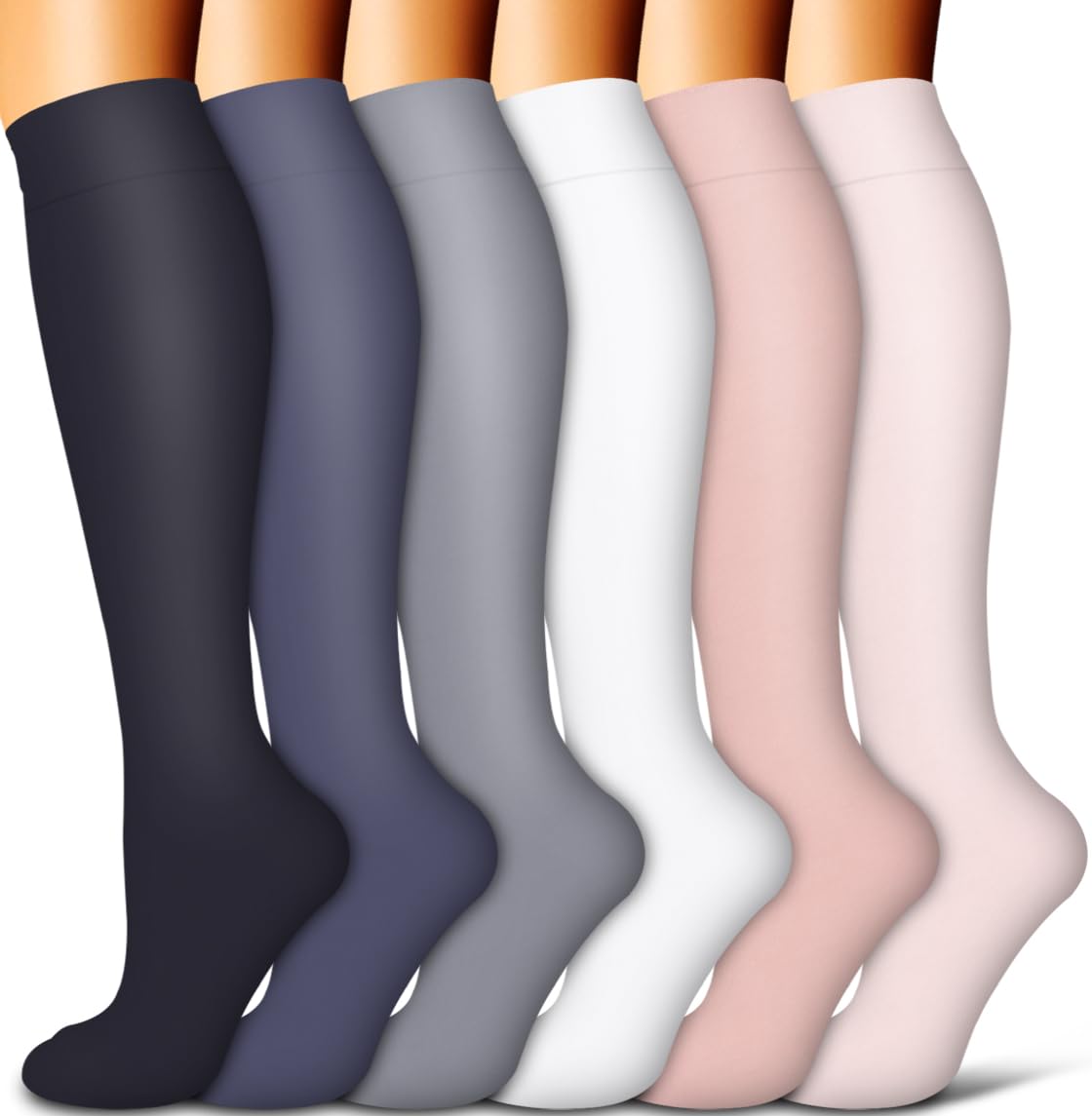
Six pairs of copper-infused knee-highs deliver playful patterns and a barely-there squeeze that suits everyday wear and long sitting sessions. The compression is so light it won’t reduce flight-related swelling — treat these as cute fashion socks, not tools for circulation support.
Pros
- Adorable designs and vibrant colours that stay bright wash after wash.
- Soft, non-binding fabric provides gentle comfort without leaving marks.
Cons
- Compression is barely perceptible, functioning like a standard knee-high rather than a compression sock.
For desk work, casual wear, or anyone who dislikes tight socks and wants a splash of colour, this six-pack is a cheerful steal — just leave it out of your carry-on if swelling is a concern.
9. Iseasoo 8-Pair Copper
Best for Light Daily Use

Key Features
- Compression Level: 15-20 mmHg
- Pairs: 8 pairs
- Durability: Poor (holes develop)
- Price: $
The Iseasoo 8-pack offers copper-infused fabric and moisture-wicking for a light supportive feel that reduces leg fatigue during long shifts or walking. The 15-20 mmHg pressure, however, is too subtle for typical air travel swelling, and some pairs may develop stitching issues after repeated washes.
Pros
- Good value for an 8-pack of copper-infused socks with moisture-wicking fabric.
- Comfortable fit that eases leg fatigue during prolonged standing.
Cons
- Compression may feel more like a regular sock than a flying aid, insufficient for long flights.
For short hops where mild support is enough and you want an affordable multi-pack, these fit the bill — just don’t rely on them for long-haul swelling relief.
10. Aoliks 4-Pair 15-20 mmHg
Aoliks 4-Pair 15-20 Mmhg

Aoliks offers four pairs of 15-20 mmHg socks at an ultra-cheap price, with breathable fabric that eases leg fatigue. But the fit runs large, weakening compression for flight swelling. This pack works for budget-conscious daily wear or light recovery, not for robust in-flight swelling prevention.
Pros
- Ultra-affordable 4-pack offering 15-20 mmHg graduated compression for a fraction of typical cost.
- Soft, breathable material reduces leg discomfort during long shifts and travel days.
Cons
- Fit runs large in foot and ankle, which can reduce compression needed to prevent swelling.
A budget pack for daily standing comfort and light recovery; size down, but leave it out of your carry-on if in-flight swelling prevention is needed.
11. Dickies Light Compression
Best for Everyday Comfort

Key Features
- Compression Level: Light (non-medical)
- Pairs: 2 or 4 pairs
- Ease of Use: Easy
- Price: $
The Dickies Light Compression socks deliver plush cushioning, a smooth slide-on fit, and stay-up security that looks like a dress sock. The gentle hug is comfortable for sensitive feet and all-day office wear, but the pressure is too mild to act as travel compression. If your priority is comfort over swelling control, these fit the bill.
Pros
- Plush foot cushioning remains soft and comfortable all day, even for sensitive feet.
- Slides on effortlessly — no struggle, no folding.
Cons
If you need a soft, easy-on knee-high sock for daily wear or winter layering and don’t require flight-swelling relief, this is a comfortable choice.
How to Choose
The single most critical spec for flight compression socks is a true 20-30 mmHg graduated compression, verified by real-world user reports, not just packaging claims.
Compression Level
Compression strength is measured in millimetres of mercury (mmHg). For flights, 20-30 mmHg is the standard that visibly reduces ankle swelling and helps circulation during prolonged sitting. At 15-20 mmHg, the squeeze is mild; many travellers find it indistinguishable from a snug knee-high, offering little relief on long-haul journeys.
A hidden trade-off: budget multi-packs often claim 20-30 mmHg but deliver closer to 15-20. If you’re prone to puffiness after a few hours, ignore claims and look for explicit, independently verified 20-30 mmHg ratings — otherwise you risk packing socks that work no better than your usual lounge pair.
Number of Pairs
Multi-packs tempt with low per-pair cost, but they often compromise consistency. A single high-quality pair can outlast several cheap ones and provide uniform compression trip after trip. For a two-week trip, two pairs of durable 20-30 mmHg socks let you rotate and wash, rather than relying on a bulk pack where half may lose shape after one wash.
Material Composition
Nylon and spandex blends determine stretch and breathability. Higher spandex (around 20%) creates stronger, more resilient compression but traps more heat — a concern on stuffy planes. Copper-infused fabrics may reduce odour, but they offer no measurable benefit for circulation or graduated pressure; treat copper as a bonus, not a deciding factor.
Sizing Method
Shoe-size-only sizing is the single biggest source of bad fit. Calves vary enormously, yet many brands rely on foot size to estimate leg circumference. That’s why tops dig in or slide down. Socks with calf-circumference sizing — often a simple measurement around the widest part — almost eliminate the red-mark, slouching problems that plague one-size-fits-most designs.
Ease of Donning
The higher the compression, the harder the sock is to pull on. 20-30 mmHg models demand a firm grip and a bit of muscle; some users describe it as a workout. If you have arthritis or reduced hand strength, consider 15-20 mmHg or use a plastic sock donner — a cheap frame that holds the sock open so you can slide your foot in without wrestling.
Durability
Heel and toe reinforcement, flat seams, and proper washing (hand wash or gentle cycle, no dryer) extend life dramatically. Budget socks often skip these features, leading to holes after a few wears. For travellers who need compression to survive a multi-flight itinerary, spending a few pounds more for reinforced construction pays off in reliability.
FAQ
Do I really need 20-30 mmHg compression socks for a long-haul flight, or is 15-20 mmHg enough?
For preventing swelling on flights longer than four hours, 20-30 mmHg is the recognised level. 15-20 mmHg feels barely more than a regular sock and rarely stops puffiness in those prone to it. If you’ve ever stepped off a plane with swollen ankles, upgrading to a true 20-30 mmHg pair makes a clear difference.
Why do my compression socks leave red marks around my calves after flying?
Red marks typically signal that the top band is too tight for your calf circumference. Many socks are sized by shoe size, which ignores leg shape. Switching to a model with calf-circumference sizing will distribute pressure more evenly and greatly reduce indentations.
Are copper compression socks any better for circulation during air travel?
No. Copper infusion has no proven effect on blood flow or graduated compression. It may help control odour, but it does not replace the mechanical squeeze of proper 20-30 mmHg nylon/spandex socks. Choose your socks based on mmHg rating and fit, not copper content.
What is the easiest type of compression sock to put on for someone with arthritis or limited hand strength?
Look for 15-20 mmHg socks with a wider top and a bit less spandex, or use a sock donner — a simple plastic frame that holds the sock open for a foot to slide in. Even firm 20-30 mmHg socks become manageable with a donner, so you don’t have to sacrifice compression if you have the right tool.