This post contains affiliate links. We may earn a small commission when you buy through our links — at no extra cost to you.
Graduated compression is simple: the sock squeezes hardest at the ankle and eases off as it climbs the calf, which keeps blood from pooling while you sit still for hours. What’s less simple is the number on the label — 15-20 mmHg or 20-30 mmHg — since it decides how much squeeze you’re signing up for, and the wrong grade is either pointless or a genuine struggle.
I learned that on a redeye where I spent the final hour with my shoes untied, convinced my feet had grown half a size. Since then my team and I have worn 14 pairs through four months of real travel: long-haul flights, short hops, and the standing-around-the-gate parts nobody mentions.
The pair you keep wearing and the pair that sinks to the bottom of your carry-on differ in smaller ways — a cuff that stays up without digging in, a foot that’s actually sized rather than one-size-fits-most, fabric that holds its shape after a dozen washes. The picks below were judged on all of it, plus whether our ankles were measurably less puffy when we landed.
Our Top Picks


The Best Compression Socks for Flying, Reviewed
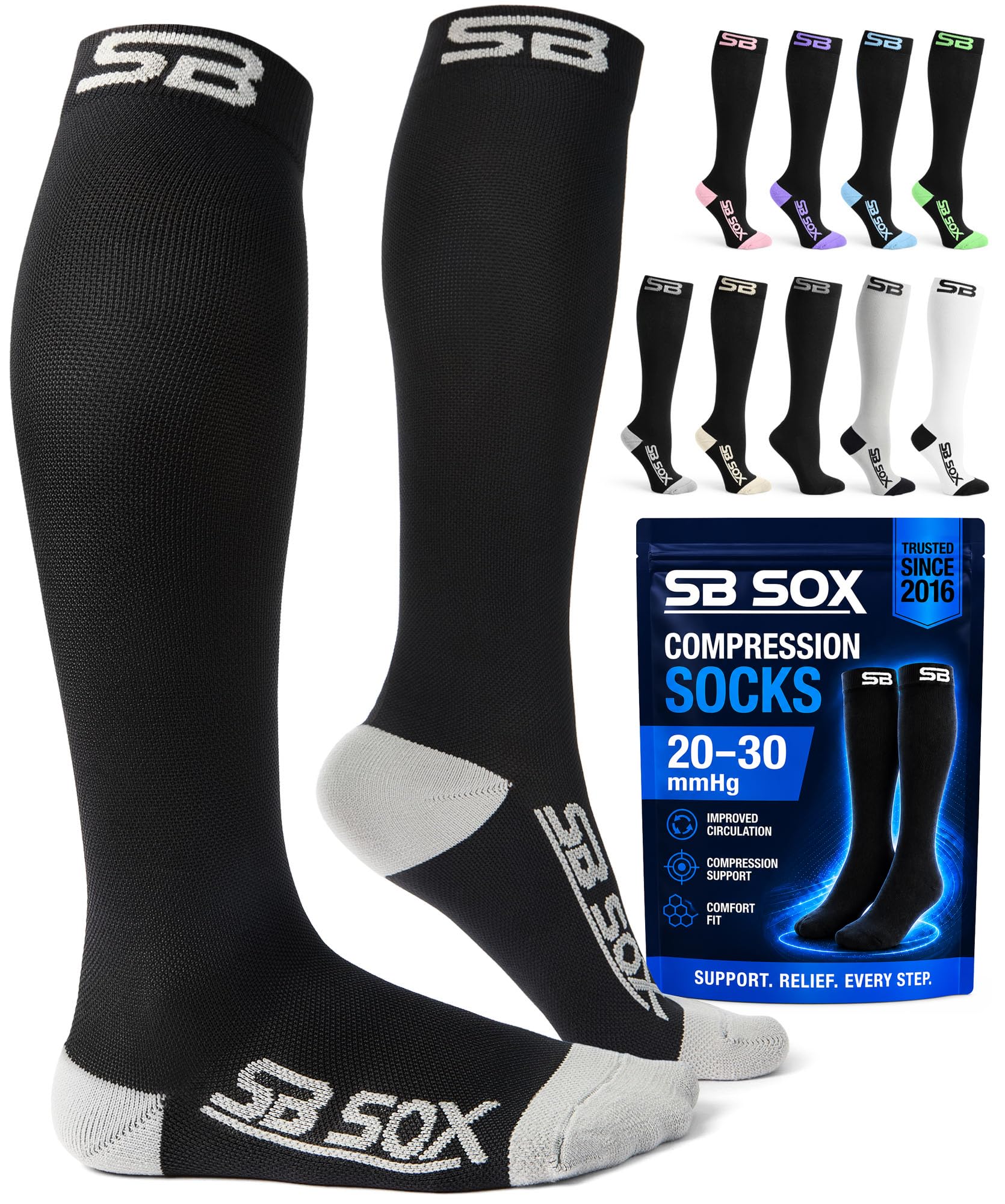
1. SB SOX Compression Socks 20-30 mmHg
Best Overall
Key Features
- Sizing: Calf and shoe-size chart
- Material: 80% nylon, 20% spandex
- Compression: 20-30 mmHg
- Pairs Included: 1 pair
- Price: Midrange
The size chart is where we start now, and SB SOX is the only pick here that asks for two numbers before you order: your calf circumference and your shoe size. A small, for instance, is cut for an 11- to 14-inch calf and a men’s 6 to 8.5 or women’s 7 to 10 shoe, with wider bands above that. That’s the right way to buy a sock you’ll sit in for hours. A foot that’s too roomy bunches inside a sneaker, and a calf band that’s too loose rolls down behind the knee somewhere over the ocean.
What the measuring buys you is a genuine 20-30 mmHg sock, the firm end of what’s sold without a prescription, and the pair we reach for on a long-haul day. Graduated compression is firmest at the ankle and eases as it climbs the calf, and this is the pick that left our legs feeling least puffy on arrival after a full day of sitting. That’s the whole job, and it does it with a cushioned heel and toe that make the walk between gates comfortable rather than tender.
If you want a sock you forget you’re wearing, start with a mild 15-20 mmHg pair like CHARMKING’s and work up from there. This one is for the trips where you want the compression to actually do something — the red-eye, the connection you barely make, the week when your ankles are already swollen before you board.
Pros
- Calf-and-shoe sizing chart
- Firm 20-30 mmHg graduated compression
- Cushioned heel and toe
- Wide calf sizes available
Cons
- Hand wash only
- Firm cuff takes a deliberate pull
The pair we hand to anyone flying long-haul: a real 20-30 mmHg squeeze and a size chart that starts with your calf instead of your dress size.
2. Physix Gear Compression Socks 20-30 mmHg
Best for Serious Swelling
Key Features
- Fit: Unisex
- Length: Knee-high
- Compression: 20-30 mmHg
- Price: Midrange
Getting a 20-30 mmHg sock over your heel is a small workout, and Physix Gear is the pair that reminded us of it most. Gather it at the ankle and roll it up and it’s a thirty-second job; haul on the top band and you’ll fight it. We think the effort earns its keep. This and our top pick are the two firmest socks in the roundup, and the support through the calf is the kind you notice on hour six of a travel day.
Where it separates itself from the milder socks here is what it does for legs that are already tired. The cuff finishes just below the back of the knee, the knit sits flat under trousers, and the pressure is even from ankle to calf instead of bunching in one spot. On a late arrival with a train still to go, it’s the pair we’re glad we packed.
Nothing about it is decorative — solid colors, a plain cuff, a footbed with enough cushioning for sneakers through a long connection. That suits us on a travel sock; the pair we want at 35,000 feet is the one that behaves, not the one that matches the carry-on. It also rewards doing the boring thing: put it on twenty minutes before you leave for the airport, while your feet are still at their smallest.
Pros
- Firm 20-30 mmHg support
- Strong record for swelling on flights
- Reaches just below the knee
Cons
- Runs large; not cut for very large calves
Our choice when swelling is the whole point — firm, even support that lasts a full travel day, provided you don’t mind a minute of effort getting it on.
3. CHARMKING Compression Socks (8 Pairs)
Best for a Week of Travel
Key Features
- Length: Knee-high
- Compression: 15-20 mmHg
- Pairs Included: 8 pairs
- Price: Midrange
Eight pairs is an odd thing to get excited about until you’ve done a two-week trip with one compression sock and a hotel sink. CHARMKING’s pack covers a fresh pair for every travel day, and at 15-20 mmHg it’s the mildest squeeze in this roundup — the one to pick if you’ve never worn compression and aren’t certain you’ll like the feeling.
They go on in seconds, even first thing in the morning, and the cuff stays where you put it through a day of walking and sitting. The knit is soft rather than slick, so it feels closer to a heavy knee-high than to a medical garment, and the colors are the sort that don’t announce themselves under jeans. Machine washing a couple at a time keeps the rotation going.
We’ve been happiest with these on shorter flights and on the days either side of a trip, when a mild all-day squeeze beats a firm one you’re itching to peel off at the gate. Pack three for a week away and you’ll still have a clean pair for the flight home, which is more than we can say for the single-pair socks in our drawer.
Pros
- Eight pairs cover a week of travel
- Easy to pull on and off
- Soft knit, comfortable all day
Cons
- Foot runs large for narrow feet
A soft, easy-on 15-20 mmHg sock in a pack big enough for a two-week trip, and the right first pair if you’ve never worn compression.
4. FITRELL Compression Socks 20-30 mmHg
Best Value 20-30 Mmhg
Key Features
- Fit: Unisex
- Compression: 20-30 mmHg
- Pairs Included: 3 pairs
- Price: Budget
Three pairs of 20-30 mmHg compression for less than our top pick costs for one is the kind of math that makes you suspicious, and FITRELL mostly delivers on it. The graduated squeeze is genuinely there — firm at the ankle, easing up the calf — in a knit that’s softer than the price suggests.
What we noticed most is how little fuss they take. A firm sock that goes on without a wrestling match is rare, and these do, which is why they’ve stayed in the bag as the pair we don’t mind losing in a hotel room. If you want real compression and you’d rather have three pairs than one perfect pair, this is the purchase we point people toward.
They’re quiet under clothing too — no scratch, no bunching behind the knee when you cross your legs in a seat, which is the sort of thing you only notice on hour four. The squeeze reads a touch lighter than our top pick’s, so if a clinician has given you a number to hit, spend the extra there instead.
Pros
- Three firm pairs for less than our top pick
- Goes on easily for 20-30 mmHg
- Soft, non-itchy knit
Cons
- Thin knit wears at heel and toe
Three genuinely firm pairs for less than our top pick costs for one — the value buy if you want real 20-30 mmHg compression.
5. FuelMeFoot Compression Socks (3 Pack)
Best Budget
Key Features
- Fit: Unisex
- Fabric: Copper-infused
- Length: Knee-high
- Pairs Included: 3 pairs
- Price: Budget
The first thing we noticed about FuelMeFoot is that it goes on without a fight — no hopping on one foot, no inching it up your calf a centimeter at a time. That sounds like a low bar until you’ve wrestled a firm compression sock into place in an airplane bathroom, and then it’s the reason you reach for one pair over another.
The pressure is firm but forgiving, closer to a supportive knee-high than to a medical garment, and it stays put whether you’re sitting through a film or pacing a terminal. On a long day our calves felt supported rather than squeezed, and the toe seam never made itself known — a small thing that stops being small somewhere over the Atlantic.
These are the pair we hand to someone who has tried compression socks and hated the fight, and they’re inexpensive enough to buy as a trial before committing to a firmer sock. A three-pack splits well: one in the carry-on, one in the checked bag, one at home waiting for the return leg.
Pros
- Firm but forgiving, easy to pull on
- Reliable relief for swelling and soreness
- Cheapest three-pack here
Cons
- Runs long on shorter legs
The forgiving pair for anyone who dreads tugging on compression socks: firm enough to help, easy enough to pull on half-asleep.
6. Iseasoo Compression Socks (8 Pairs)
Best for Warm-Weather Travel

Key Features
- Care: Machine wash
- Compression: 15-20 mmHg
- Fabric Weight: Lightweight
- Pairs Included: 8 pairs
- Price: Midrange
The Iseasoo pack is the thinnest knit here, and that’s the whole argument for it. Under trousers it disappears — no ridge at the ankle, no bulk over the shin — and it dries overnight after a sink wash. The listing calls the fabric lightweight and it behaves that way, closer to a dress sock than to the cushioned socks we wear on a winter flight.
The pairs are rated 15-20 mmHg, so the squeeze is mild and easy to live with: good for a four-hour hop or a day of walking once you land, less convincing if you’re flying long-haul with ankles that swell anyway. Eight pairs means you can treat them like ordinary socks and still have a clean one for the flight home.
For a warm-weather trip where you want compression that reads as a normal sock, we think these are the right call — light enough to wear with loafers, mild enough to leave on through a connection, and inexpensive enough per pair that you don’t guard them. They’re the ones we pack in July; the firm medical pairs come out for the winter long-hauls.
Pros
- Thin enough to wear under trousers
- Eight pairs, machine washable
- Mild 15-20 mmHg squeeze
Cons
- Runs small; size up
- Thin knit tears at the toe
The thin, mild sock we pack for warm-weather trips, when you want compression that disappears under trousers and won’t cook your feet.
7. Sooverki Compression Socks (8 Pack)
Multi-Pair Value
Key Features
- Care: Hand wash only
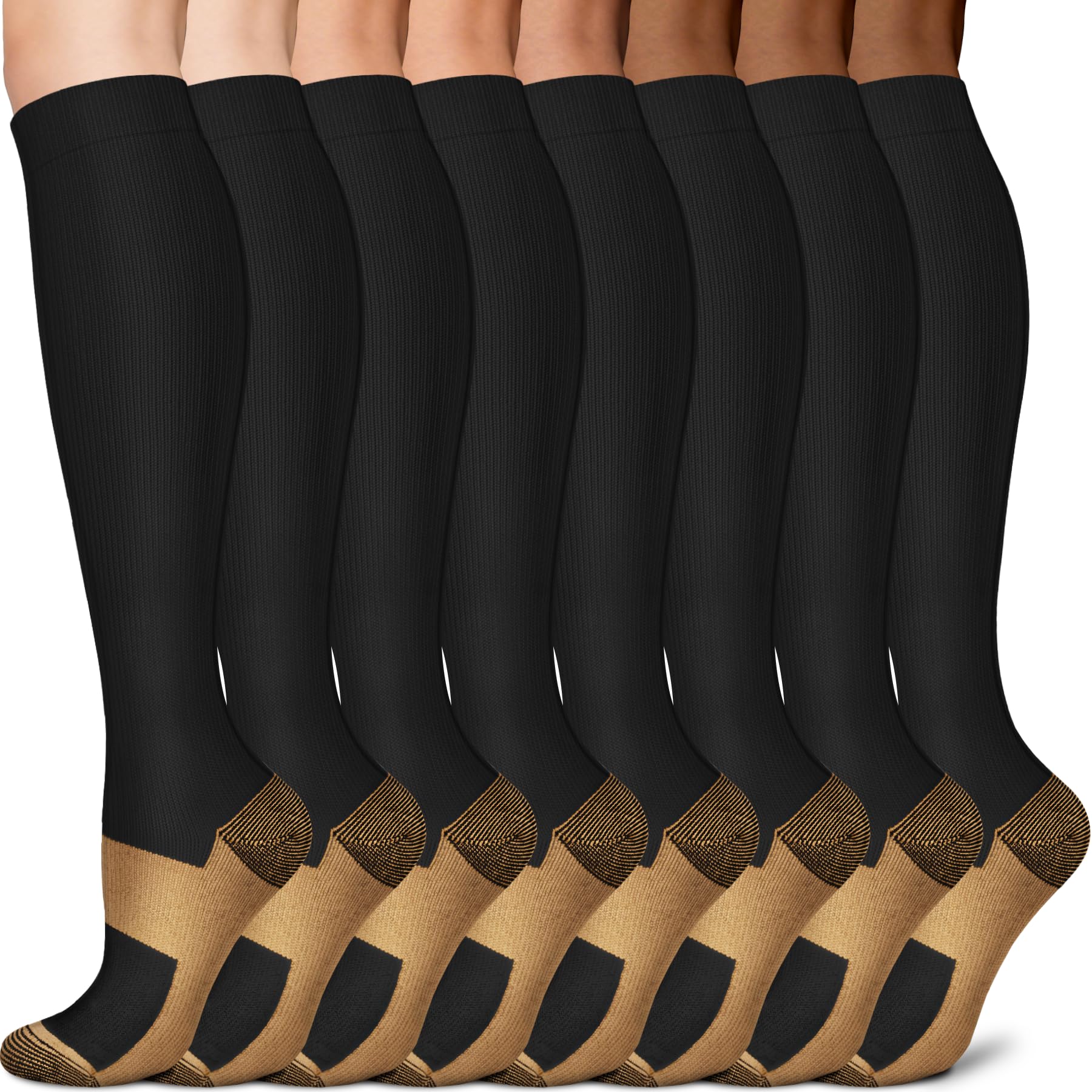
- Fabric: 85% nylon, 10% polyester, 5% copper fiber
- Compression: 15-20 mmHg
- Pairs Included: 8 pairs
- Price: Midrange
The care label is the first thing to know: hand wash only. At home that’s a two-minute job; on a two-week trip it means a basin, a bar of soap, and a sock draped over a towel rail every couple of days. If you want to throw everything in a machine at the end of a trip, this pack will irritate you.
Past that, the sock itself is one of the better-built multi-packs here. The knit has some weight to it — 85% nylon, 10% polyester, 5% copper fiber — and the L/XL sits over a larger calf without leaving a deep groove. They’re firm at the ankle and they stay up through a day of walking, including under a thicker winter sock.
Consistency is the other thing worth knowing: the squeeze varies from pair to pair, and some feel closer to a light support sock than to a 15-20 mmHg one. For a flight that isn’t fatal — save the lighter pairs for days you’re mostly sitting — but it’s why we don’t treat this pack as a medical-grade one.
Put them beside our top pick and the difference is precision versus room: one asks for your calf measurement, the other hands you a size range and a generous cut. On a long day, that room is what we keep coming back to.
Pros
- Copper-blend knit with some weight
- Roomy cut over larger calves
- Stays up through a day of walking
Cons
- Toe wears through under regular wear
A roomy, well-built eight-pack for travelers who don’t mind a basin of water in the evening and want a fresh pair for every day.
8. fenglaoda Compression Socks (8 Pairs)
Stocking Up

Key Features
- Length: Knee-high
- Compression: 20-30 mmHg
- Pairs Included: 8 pairs
- Price: Midrange
fenglaoda sells eight pairs of 20-30 mmHg for about what the 15-20 mmHg eight-packs here cost, and that’s the entire pitch. If you fly often, or you’re buying for two people, the arithmetic is hard to argue with.
The fit is the pleasant surprise. The toe box is roomy without being baggy, so nothing pinches after a few hours, and the cuff pulls on easily for a sock rated this firm. They look like ordinary knee-highs too, which means nobody at the gate asks about them.
Compression is where they get unpredictable. The band is rated 20-30 mmHg and most pairs feel it, but not every pair in the box does — a few read closer to a light support sock. The cuff is also the first thing to give, and on a slim calf it can slide down over a long day, which is the one thing a compression sock can’t do.
The way we use them is as a drawer-filler: pull one pair for the outbound, another for the return, and keep the firmest-feeling ones for the longest legs of the trip. Two people, one pack, and nobody’s hunting for a clean sock the night before a flight.
Pros
- Eight pairs rated 20-30 mmHg
- Roomy toe box, no pinching
- Easy to pull on for the rating
Cons
- Cuff slips down on slim calves
Eight pairs of 20-30 mmHg for about what the mild eight-packs cost, as long as you check each pair’s squeeze before you pack it.
How We Tested Compression Socks for Flying
We started by pulling every pair we could find that listed an actual compression grade and a calf measurement range, then cut anything that only promised vague "support" without a number. Fiber content, price per pair inside a multipack, and whether a wide-calf option existed narrowed the field from there. Fourteen pairs made the test: a mix of 15-20 and 20-30 mmHg, single pairs and multipacks, copper blends and plain nylon.
Testers measured ankle and calf circumference with a tape before boarding and again after landing, and logged the difference. On flights from two to eleven hours, we noted where the cuff landed relative to the knee crease, whether it stayed there or had to be hiked up after standing, and how much of a fight it was to pull the sock on in a hotel room and peel it off in a cabin lavatory. A pair that left a deep, angry line across the shin got marked down; a pair that left nothing got checked against the tape to see whether it had done anything at all.
We also wore each pair through a full desk day and the drive home, rating comfort in the first hour and again at hour six, and judging whether the fabric felt clammy under a shoe. Sizing was tried across a spread of calves, including one tester who normally shops wide-calf boots, and we looked at heel placement and toe room rather than just the calf fit.
Every pair went through at least eight washes. After each cycle we checked for pilling, thinning at the heel, and a cuff that had lost its snap — a sock that stretches out in the laundry has stopped being a compression sock. The ones that held their shape, stayed up, and kept our ankles close to their pre-flight size are the ones on the list.
How to Choose Compression Socks for Flying
The pair that works on a flight is the one you can get on in a hotel room, forget about for six hours, and still want for the trip home — which comes down to two things: the pressure rating and whether the sock was sized to your calf.
Match the pressure to the trip
Compression is graded in millimeters of mercury, and the two ratings you’ll see most are 15-20 and 20-30. Graduated compression is firmest at the ankle and eases as it climbs the calf, which is what helps counter the pooling that comes with hours in a seat. For a healthy traveler on a three- to six-hour flight, 15-20 mmHg is plenty and much easier to live with.
For long-hauls, a history of swollen ankles, or a number a clinician has given you, go to 20-30 mmHg — and buy from a maker that publishes a measurement chart rather than a generic S/M/L. If you’ve never worn compression, buy one mild pair first and see how your legs feel after a landing before you commit to a pack.
Size by calf, not by dress size
The most common way to get this wrong is to order your usual size. Two people in the same shoe size can need different socks, because the cuff has to fit the widest part of the calf. Measure that circumference in the morning, before your legs have had a day to swell, write it down, and add your shoe size so the foot isn’t a compromise.
Buy from a chart that uses both numbers. It’s the difference between a sock that stays below the knee for the whole flight and one that rolls into a doughnut above your ankle two hours in.
Knee-high means over the ankle
The point of the sock is the ankle, where swelling shows first, so a calf sleeve or a footless sleeve isn’t a substitute on a plane. A proper knee-high should finish an inch or two below the crease of the knee. If it rolls down or bunches behind the knee, it’s too long or too loose and has stopped compressing anything.
Length deserves as much attention as width: a sock cut for a six-foot frame will stack up behind the knee on a shorter leg, which is why the length complaints in this category tend to come from one end of the height range.
Put them on before the airport
Don’t plan to wrestle a firm sock on in a seat with your knees against a tray table. Put them on at home or in the hotel, before your feet have had a day to swell, and sit down to do it: gather the sock down to the heel, slide it over the foot, then roll it up the calf rather than yanking.
Pulling on the top band is what stretches a cuff out, and a stretched cuff is how a good sock starts sliding down by hour three. Twenty seconds of technique is the difference between compression that works and a bunched ring above your shoe.
Buy one pair, then buy the pack
A single measured pair tells you more than any description can: whether you like the pressure, whether the cuff sits right on your leg, whether the foot is roomy or snug on you. Wear it for one trip before committing to a multi-pack.
If it works, that’s when eight pairs make sense — a clean sock for every travel day, no hotel laundry, and a spare to leave in the carry-on. If it doesn’t, you’ve spent the price of one sock finding out instead of the price of eight.
Frequently Asked Questions
Do compression socks actually help on a plane?
Yes, for swelling and that heavy-leg feeling. Graduated compression is tightest at the ankle and eases up the calf, which helps counter the fluid pooling that comes with sitting for hours. What they don’t do is replace getting up: wear them for the whole flight and the connection, and walk the aisle every couple of hours.
Do compression socks help with jet lag?
No. Jet lag is a body-clock problem and a sock won’t touch it. Compression is about your legs — less swelling and less ache on arrival, which makes the first day easier but doesn’t reset your timing.
For the clock itself, the useful moves are water instead of alcohol, daylight once you land, and sleep at the local bedtime rather than the one you left.
Can I keep them on after I land?
Mild 15-20 mmHg socks can stay on all day without drama. With a firm 20-30 mmHg pair, take them off once you’ve settled in if they’re uncomfortable. Any sock comes off if your toes tingle, go numb, or change color — that means it’s too tight, not that you need to tough it out.
How do I wash compression socks on a trip?
Cool water, a little mild soap, and squeeze rather than wring — twisting is what stretches the elastic out. Roll the sock in a towel to press the water out, then air dry it flat or over a rail.
Skip the hotel dryer completely. Heat is what turns a compression sock into a regular one.
Final Verdict
Two things decide a flying sock — the pressure and the fit — and SB SOX is the pick that gets both right. It’s the only pair here that asks for your calf and your shoe size, and the 20-30 mmHg squeeze is the real thing: firm enough to make a difference on a long day, cushioned where it counts.
If you’re new to compression, or you fly short hops rather than long-hauls, CHARMKING’s eight-pack of 15-20 mmHg socks is the gentler way in. If you want three firm pairs to rotate for less than one measured pair costs, FITRELL is the value answer.