This post contains affiliate links. We may earn a small commission when you buy through our links — at no extra cost to you.
Six hours into a transatlantic flight, I tried to put my shoe back on and found my ankle had quietly turned into a dinner roll. That’s the moment compression socks stop sounding like a doctor’s suggestion and start sounding smart. They squeeze the leg in a gradient, firmest at the ankle and gentlest below the knee, so blood keeps moving while you sit still for hours.
More squeeze isn’t automatically better, though. The pressure rating is the first thing to sort out: 15-20 mmHg suits travel days and long desk shifts, while 20-30 mmHg is noticeably firmer and takes real effort to pull on. Fit matters just as much — a sock that’s too long or too short puts the tightest band in the wrong place, and the calf measurement, not the shoe size, decides that.
My team has spent four months with 16 pairs, on long-hauls, through nine-hour workdays, and across more laundry cycles than I can count. Copper blends, wide-calf sizing, and whether a multipack actually saves money all mattered more than I expected. Below you’ll find gentle travel support and firmer options alike.
Our Top Picks


The Best Compression Socks for Long Flights, Reviewed
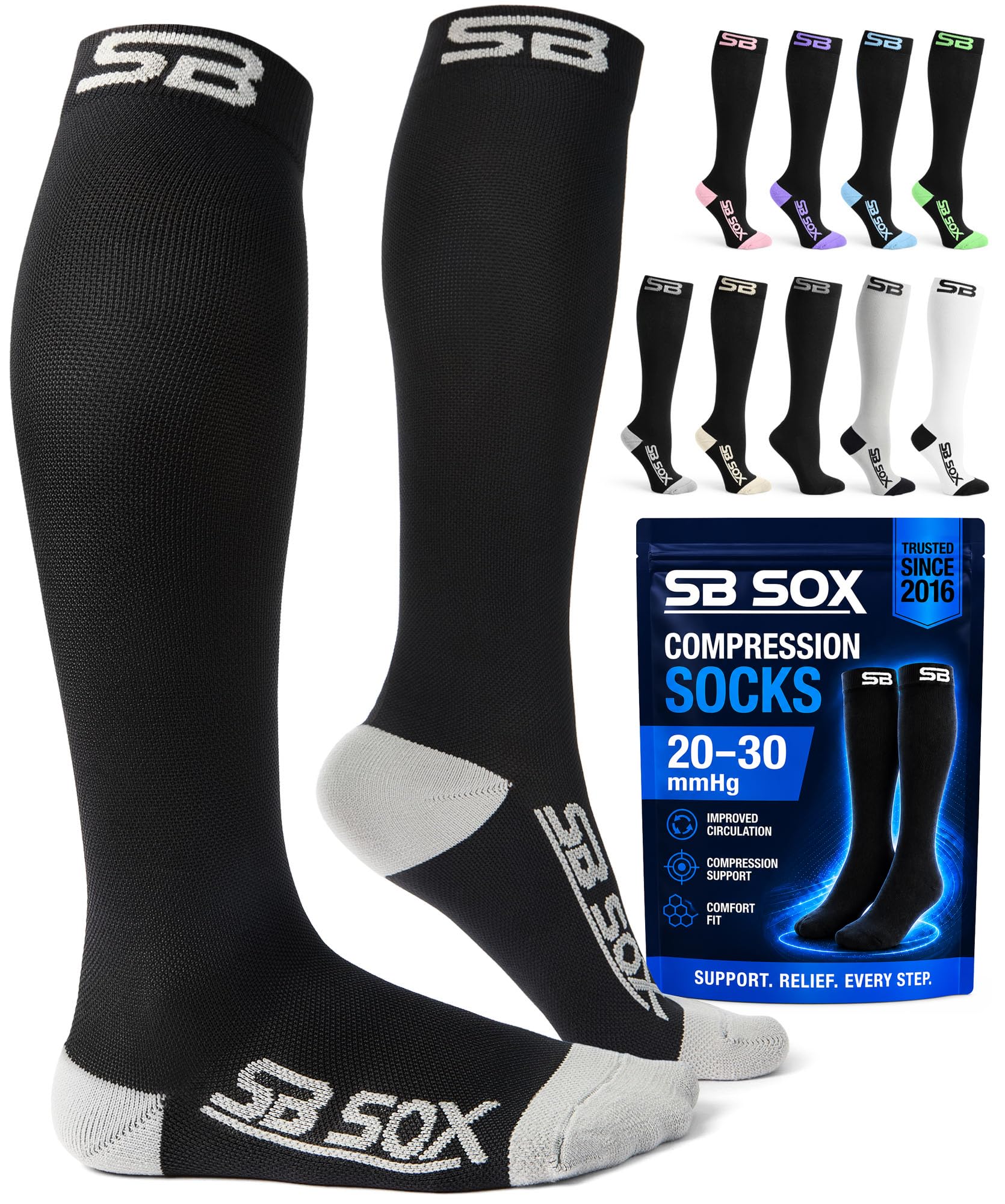
1. SB SOX Compression Socks 20-30 mmHg
Best Overall
Key Features
- Care: Hand wash only
- Fabric: 80% nylon, 20% spandex
- Sizing: By calf circumference
- Compression: 20-30 mmHg
- Price: Premium
Twenty to thirty millimeters of mercury is as firm as anything in this guide gets, and that number is the first thing to understand about the SB SOX pair: this is a support sock you wear to a flight, not a soft sock that happens to be snug. What we appreciate is the sizing instruction that comes with it — measure your calf, check your shoe size against the chart, and move up if your shoe size sits at the top of the band for your calf.
That chart is a big part of why this pair is our top pick. Almost every complaint that follows compression socks around is a fit complaint, and the fix is a tape measure around the widest part of your calf rather than a guess from your sneaker size. Once the size is right, the squeeze is even from ankle to just below the knee, the heel and toe are cushioned, and the record on swelling and compression is the strongest of anything here, as are the quality marks.
The boundary is pressure, not quality. Twenty to thirty is more than a casual traveler needs; if you have never worn compression, start with a 15-20 pair and come back to this one once you know your calf measurement.
The finish is plain — solid black and gray — which matters more than it sounds. These disappear under trousers and read as an ordinary sock at the far end of the trip, so nothing about them announces a medical device in a meeting room.
Pros
- Firm 20-30 mmHg compression
- Sizing chart built on calf circumference
- Cushioned heel and toe
Cons
- Hand wash only
- Takes effort to pull on
We recommend the SB SOX pair for long-haul flights: firm 20-30 mmHg compression, the best record on swelling in this set, and a calf-based size chart that takes the guesswork out of ordering.
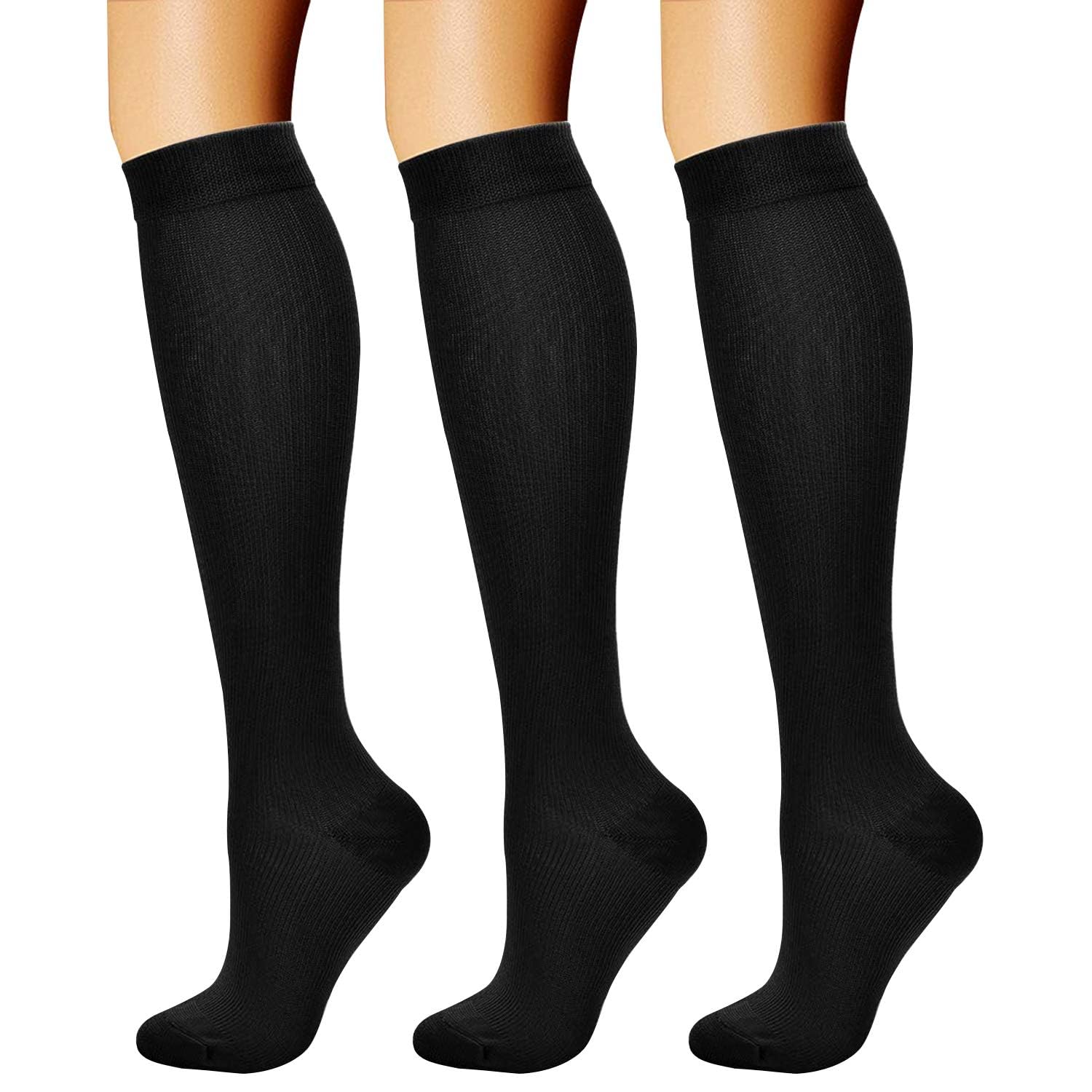
2. CHARMKING Compression Socks (3 Pairs)
Best Budget
Key Features
- Fit: Unisex
- Pack: 3 pairs
- Length: Knee-high
- Compression: 15-20 mmHg
- Price: Budget
If you have never worn a compression sock, the CHARMKING three-pack is where we start people. At 15-20 mmHg it is a graduated, mild squeeze — enough to feel like something is holding your calves, not enough to turn boarding into a wrestling match. It is also the least expensive way into the category here, with three pairs to rotate.
Softness is the surprise. The knit sits closer to a dress sock than to hosiery, which is exactly why we like it as a first pair: nothing about it feels clinical, and it goes on and comes off without the grunt-and-roll routine that firmer socks demand. The leg is long enough for taller frames, finishing just under the kneecap instead of sliding down the calf.
The ceiling is the pressure. If your ankles swell visibly by the end of a flight, or a clinician has pointed you toward 20-30 mmHg, this is a step below what you need. For everyone else, a mild pair you will keep on for the whole flight beats a firm pair that ends up in the seat pocket.
Pros
- Cheapest three-pack in this guide
- Soft knit that doesn’t feel clinical
- Easy to pull on and off
Cons
- 15-20 mmHg is mild for heavy swelling
Buy the CHARMKING three-pack if you have never worn compression and want a gentle, easy-on pair for a long flight without spending much to find out.
3. Physix Gear Compression Socks 20-30 mmHg
Best for Swollen Legs
Key Features
- Fit: Unisex
- Length: Knee-high
- Compression: 20-30 mmHg
- Price: Premium
The Physix Gear pair is among the firmest in this guide, and it has the strongest results on swelling and heavy-leg days of anything we covered. That is the trade: a 20-30 mmHg sock that holds its shape through a long travel day is not a sock you forget about for the first twenty minutes.
Once it is on, it stays where you put it — the cuff does not roll at the top and the leg does not shimmy down during a connection. Getting there is the work. This is a stiff sock that needs a proper pull over the heel, and if you are used to a 15-20 pair the first attempt will feel like a different garment entirely.
Our read is that this is the pair for someone who has worn compression before, knows their calf measurement, and wants a firm squeeze for a long-haul flight or a week of standing work at the other end. First-timers should start mild and work up.
Pros
- Firm 20-30 mmHg hold
- Strongest swelling and leg-fatigue results here
- Cuff stays put without rolling
Cons
- Sizing runs big and long
Choose the Physix Gear pair for legs that swell and ache on long flights — it delivers the firmest hold here, as long as you check the sizing before you order.
4. BLUEENJOY Copper Compression Socks (6 Pairs)
Best Six-Pack
Key Features
- Care: Machine wash
- Pack: 6 pairs
- Size: Large-X-Large
- Fabric: 85% nylon, 15% polyester
- Price: Midrange
Six pairs is the entire argument for the BLUEENJOY pack. On a two-week trip you can wear a fresh pair on every travel day and wash nothing in a hotel basin, and at home the rotation is what keeps a compression habit going when the laundry basket fills up.
We like it for exactly that: it turns compression into a routine instead of one precious pair. The knit is soft, machine washing is a relief after hand-wash-only socks, and the over-the-calf cut gives steady support through the calf. The copper in the fabric is a footnote for us — the six-pair rotation is the reason to buy.
The squeeze is gentler than the 20-30 pairs here, closer to a firm hug than a therapeutic hold, so it is the wrong pick if your legs swell hard on a flight. For ordinary travel legs and a full suitcase, six washable pairs are the better trade.
Pros
- Six pairs cover a two-week trip
- Machine washable
- Soft knit with steady calf support
Cons
- Calf band runs tight on wide calves
Buy the BLUEENJOY six-pack if you travel in long stretches and want a washable pair for every day rather than one pair you baby.
5. ACTINPUT Compression Socks (8 Pairs)
Best for Long Trips
Key Features
- Care: Machine wash
- Pack: 8 pairs
- Fabric: 85% nylon, 15% polyester
- Compression: 15-20 mmHg
- Price: Midrange
Eight pairs sounds like a gimmick until you are four days into a trip with no laundry access. This is the pack we point people toward for long itineraries: a pair for every flight day, a spare in the carry-on, and no midnight basin session. As a travel strategy it is more useful than one premium pair.
The sock itself is a graduated 15-20 mmHg knit, breathable, with reinforced stitching at the toe and heel. Two size options cover a wide range, and the L/XL takes a larger foot without crowding the toes. Nothing about it feels medical, which is part of why eight pairs get worn rather than saved.
The pressure is the boundary: 15-20 mmHg is mild, which makes this the right pack for healthy legs on a long trip rather than for pronounced swelling. If your ankles balloon on a flight, put the money into a 20-30 pair instead.
Pros
- Eight pairs for a long trip
- Graduated 15-20 mmHg support
- Breathable knit with reinforced toe and heel
Cons
- Heels wear through over time
We recommend the ACTINPUT eight-pack for long itineraries where laundry is not happening — eight mild, machine-washable pairs beat three firm ones you have to ration.
6. FITRELL Compression Socks 20-30 mmHg (3 Pairs)
Best Softer 20-30 Mmhg
Key Features
- Fit: Unisex
- Pack: 3 pairs
- Length: Knee-high
- Compression: 20-30 mmHg
- Price: Midrange
A 20-30 mmHg sock usually announces itself: dense, stiff, and a chore to get over the heel. The FITRELL pair is the exception in this group. The knit is soft, the sock goes on with far less fight than the rating suggests, and it reads like an ordinary knee-high once it is up.
On the leg it stays put, with no rolling at the top and no bunching behind the knee on a shorter calf. The band is the part to watch. On a wider calf it can feel tighter than the rest of the sock, which is a reason to get the sizing right rather than to fold the cuff down — a rolled band concentrates pressure in one spot and defeats the whole point.
That softness is why we point people here when a firm sock has felt like too much before. It is the gentlest route to a 20-30 rating in this guide, and for a six- or seven-hour flight it is the pair we notice least.
Pros
- Soft knit for a firm-rated sock
- Easier to pull on than other 20-30 pairs
- Stays up without rolling
Cons
- Pressure reads lighter than its 20-30 rating
- Heels and seams wear through
Pick the FITRELL three-pack if firm compression has felt like too much before — it is the softest route to a 20-30 rating in this guide.
7. Iseasoo Compression Socks (4 Pairs)
Everyday Mild Support

Key Features
- Care: Machine wash
- Pack: 4 pairs
- Size: Large-X-Large
- Fabric: 85% nylon, 15% polyester
- Price: Budget
Four pairs, four colors, and a sock that reads as a normal knee-high rather than medical equipment — that is the pitch, and it is a good one if you want compression you will still be wearing at dinner after you land.
The squeeze is moderate: enough to feel supported through a long sit, gentle enough to forget by the second hour. The knit is soft and the sock pulls on and off easily, which matters more on a trip than it does at home, when you can take your time.
The colors hold up in the wash — the black, gray, white, and pink read the same after a trip’s worth of laundering — and a pack that does not look like hosiery gets worn for more than flights. Ours went on beach walks and to breakfast.
Where it earns its place is exactly that: four pairs in the lowest price band here, in colors that do not look like a pharmacy purchase. If your trip ends at a wedding rather than a hiking trail, this is the one in the group that will not embarrass you.
Pros
- Four pairs in wearable colors
- Soft and easy on and off
- Machine washable
Cons
- Sizing runs large in the foot and calf
Consider the Iseasoo four-pack if you want mild compression that looks like an ordinary sock and comes in colors you will actually wear on the trip.
How We Tested Compression Socks for Long Flights
We started with roughly 30 listings and read the one- and two-star reviews first, since sizing complaints and cuffs that roll down show up there long before they show up in a product photo. From that pile we kept knee-high, graduated socks that came with an actual size chart rather than a one-size-fits-all claim, and we made sure both the 15-20 and 20-30 mmHg ranges were represented. That left 16 pairs, which we rotated through four months of testing.
On two long-haul flights and several shorter ones, we wrapped a soft tape around each tester’s ankle and calf before boarding and again after landing, then compared those numbers with how the legs actually felt. At home, the socks went to work: nine-hour desk days, a few hikes, one very long airport layover on a hard seat. We noted where seams landed against the toes, whether the heel pocket sat in the right place, and whether the top band dug in or slid down by midafternoon. Pairs also got pulled on at 5 a.m. in a dim hotel room, because that is when the difference between an easy sock and a wrestling match becomes obvious.
Every pair went through at least 15 wash-and-dry cycles following the care label, and we checked for pilling, thin spots at the heel, and cuffs that had gone slack. Multipacks got broken down to cost per pair, on the theory that three socks that lose their squeeze are worth less than one that holds. Comfort was judged in shoes rather than barefoot — the real pass was whether we forgot we had them on by the second hour.
How to Choose Compression Socks for a Long Flight
The pair that helps on a long flight is the one that fits your calf and stays up for the whole trip — the pressure rating matters, but fit is what decides whether the sock does its job or spends the flight in your bag.
Match the pressure rating to your legs
The two ratings in this guide are 15-20 mmHg and 20-30 mmHg. Mild 15-20 is what most travelers want: a graduated squeeze you notice as support and forget about by the second hour. Firm 20-30 is for legs that swell visibly, or for anyone a clinician has pointed that way.
The trap is buying the highest number you can find. A sock that is firmer than you need gets rolled down at the top or left in the suitcase, and neither does your legs any good. If you are new to compression, start mild and move up once you know how your legs respond.
Measure your calf, not your shoe size
Shoe size tells you how long your foot is; it says almost nothing about the calf, which is the part doing the compressing. Run a tape around the widest part of your calf, match that number to the maker’s chart, and use shoe size only as a tiebreaker. On the line between two sizes, take the larger one.
Wide calves need a maker that publishes a wide range, and not every one does. Our top pick prints its calf measurements and matching shoe sizes right in the listing, which is the single most useful thing a compression sock page can do.
Fabric, seams, and the long hours
You will wear these for hours, often in shoes that have already done a full day. Look for a breathable knit, a flat or cushioned toe seam, and enough room that your toes are not pressed together. Cushioning under the heel is a small luxury that pays off around hour eight.
Check the care label before you pack, too. A machine-washable pair gets worn again on the return leg, while a hand-wash-only pair needs a basin and a night to dry — worth knowing before you are standing in a hotel bathroom at midnight.
How many pairs your trip needs
Two pairs is the minimum for a week away: one on, one drying. Three lets you skip a night of laundry without thinking about it, and an eight-pair pack covers a two-week itinerary with a fresh pair for every flight day.
If you are flying once, buy one good pair and put the rest of the budget into getting the size right. If you fly often, the multi-packs here are how compression becomes a habit instead of a pair you save for special occasions.
Frequently Asked Questions
When should I put compression socks on for a flight?
At home, before you leave, or at the latest before you board. Feet start to swell long before the wheels come up, and pulling a firm sock over a heel in a seat with no legroom is the worst part of the whole exercise.
Put them on with dry feet, check that the band sits flat below the knee rather than bunched or folded, and wear them through the airport and the flight.
How tight should compression socks feel?
Snug and even from ankle to calf, with no tingling in your toes and no deep groove behind the knee. If the toe box presses your toes together or the band bites within twenty minutes, the size is wrong rather than the sock.
Take them off if your toes go numb or change color, and move up a size or down to a milder rating before your next flight.
How do I get a firm pair on without stretching the cuff?
Gather the whole leg of the sock down to the heel first, pull it over your foot, then work it up the calf an inch at a time. Pull from the fabric, never from the top band, which is the part that stretches out.
Sitting with your foot flat on the floor is easier than standing, and it gets quicker after the first few wears.
Final Verdict
We recommend the SB SOX 20-30 mmHg pair as the default for a long flight. It is firm enough to be worth wearing, and it is sold with the calf measurements that decide whether it fits — which is more than most of the category offers.
If you have never worn compression, start with the CHARMKING three-pack instead; 15-20 mmHg is a gentler first step, and three pairs let you find out whether you will actually keep them on. For legs that swell noticeably, the Physix Gear pair is the firmest squeeze here, provided you size it right.