This post contains affiliate links. We may earn a small commission when you buy through our links — at no extra cost to you.
The first time I ran a curling iron through a cheap plug adapter in a London hotel, it made a sound I’d rather not repeat and never heated up again. An adapter only reshapes the prongs; a converter actually steps 220 volts down to the 110 your device expects. Mismatch the wattage and you’ll trip a breaker or destroy the thing you were trying to protect. We’ve spent seven months with 11 converters, and the differences showed up fast.
What you pack decides most of it. A CPAP or a laptop charger sips a couple hundred watts; a hair straightener pulls well past a thousand, and only a converter with a separate high-wattage outlet will hold that load. The better ones also replaced my second charging brick, since the USB-A and USB-C ports on these units top up a phone quickly.
The small things separated the winners: how warm the case got after twenty minutes, whether the fan whined loud enough to hear from the bed, and whether the thing still worked after a fifth trip jammed into a carry-on. Below, the picks are sorted by how you travel.
Our Top Picks

The Best Voltage Converter for Europe, Reviewed
1. DOACE X30 Voltage Converter
Best Overall
Key Features
- Weight: 1.2 lb
- Max power: 350W
- USB ports: 4 (2 USB-A, 2 USB-C)
- Plug types: A, C, G, I
- Price: Budget
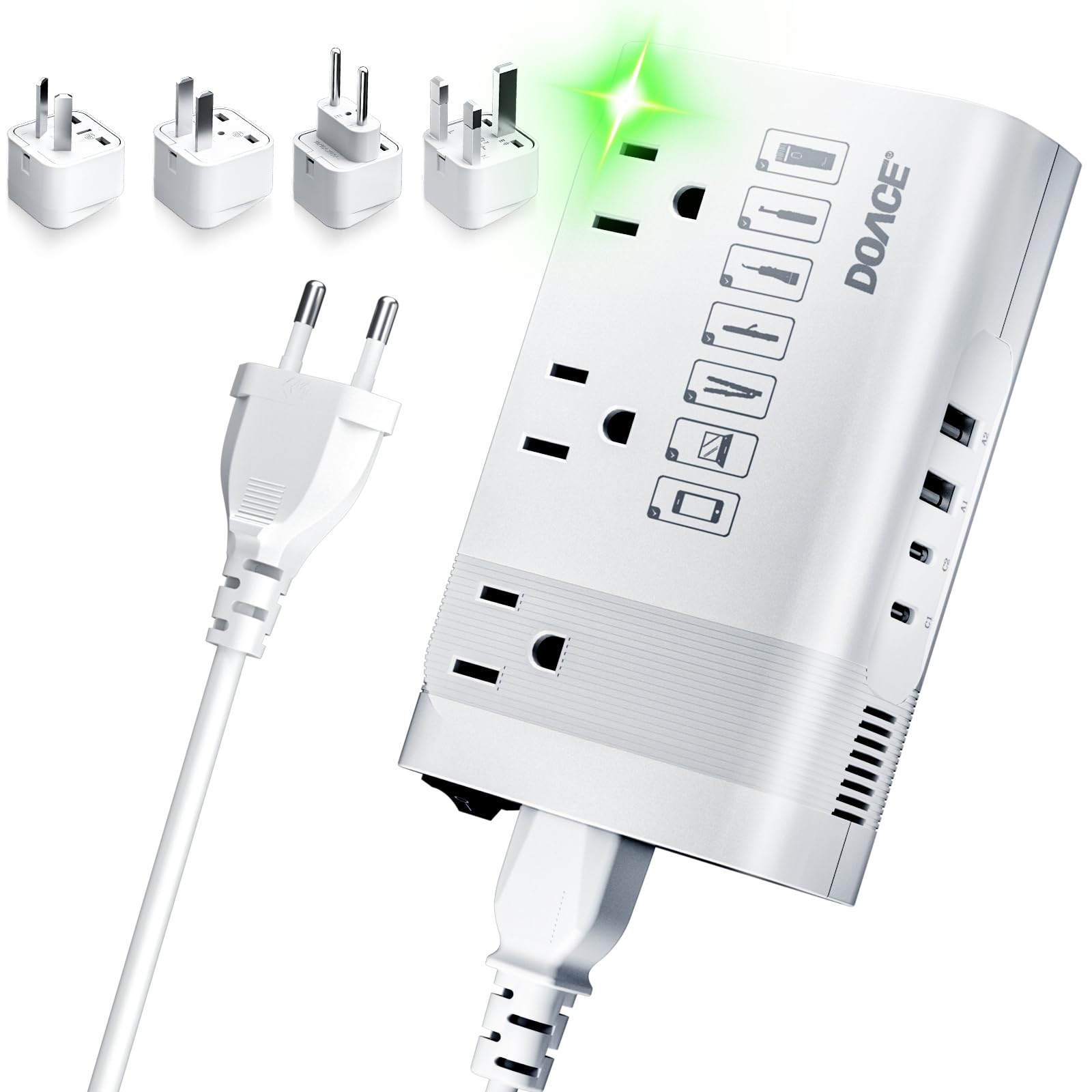
The DOACE X30 is the size of a small paperback and weighs 1.2 pounds, so it earns its place in a carry-on before you even plug it in. The bundle includes an EU cord and adapters for Type A, C, G, and I outlets, which covers most of Europe plus the UK and Ireland. We appreciated that the cord is a separate piece rather than a built-in plug; it gives you more reach from a hotel desk outlet, and the whole kit packs into a small bag.
The 350W rating is the heart of the recommendation. It steps 220-240V down to 110-120V for a hair straightener, curling iron, CPAP machine, electric toothbrush, or shaver, and the four USB ports (two USB-A, two USB-C) let you charge phones and tablets without a separate brick. We like the mix of AC outlets and USB because it turns one European socket into a small charging station without making you carry a power strip.
The safety package covers under-voltage, over-voltage, overheating, overload, over-current, and short-circuit protection, and the unit shuts off if something goes wrong. In a hotel room, that overload protection is the feature we care about most, because it gives you a margin for error when outlets are scarce and everyone is charging at once.
The included pouch keeps the adapters from disappearing into a suitcase, and the separate cord gives you more reach from a hotel desk outlet. It is the kit we reach for when the bag is already tight and the devices are modest.
Pros
- Compact 1.2-pound body
- 350W step-down for hair tools and CPAP
- Four USB ports plus AC outlets
- EU cord and four plug adapters
Cons
- 350W ceiling excludes hair dryers
For most travelers, the DOACE X30 is the converter we recommend: a compact 350W step-down that handles hair tools and a CPAP without taking over your bag.
2. Ceptics LX-C2000 Converter
Best for High-Watt Hair Dryers
Key Features
- Weight: 1.5 lb
- Max power: 2,000W / 200W
- USB ports: 4 (3 USB-A, 1 USB-C)
- Plug types: A, B, C, E/F, G, I
- Price: Premium
The Ceptics LX-C2000 is the only pick here with two separate AC power levels: a 2,000W outlet for a hair dryer and separate 200W outlets for a curling iron, straightener, CPAP, or toothbrush. That split is the reason to pay attention to this one. A single 350W converter is simpler and smaller, but it cannot run the hair dryer that many travelers still pack.
We like the flexibility. The 2,000W side handles a full-size hair dryer, while the 200W side keeps the smaller devices on a gentler circuit, and the four USB ports cover phones, watches, and earbuds. The kit includes six plug types, A, B, C, E/F, G, and I, so it can follow you from a European trip to the UK or Australia, and the five-foot cord gives you room to reach a hotel outlet. At 1.5 pounds, it is still a packable block, not a brick.
The catch is that you have to match the appliance to the outlet. The high-watt side is for simple mechanical heating appliances, not a laptop, camera charger, or CPAP; those belong on the 200W side or USB. We paid close attention to that labeling because plugging the wrong device into the wrong outlet is exactly how a converter earns a bad reputation. Once you know which side is which, it is straightforward.
The six-plug set is the part that earns its keep on a multi-country itinerary; it is more converter than a solo traveler with a phone and a straightener needs, but it covers the whole group.
Pros
- 2,000W outlet for hair dryers
- Separate 200W outlets for smaller devices
- Six plug types and four USB ports
- Five-foot cord and two-year warranty
Cons
- Bulkier and pricier than compact picks
For travelers packing a hair dryer and a pile of devices, the Ceptics LX-C2000 is the converter we recommend, with a 2,000W outlet and enough plugs for a multi-country trip.
3. TBVZMN 1200W Converter
Best for 1,200W Hair Dryers
Key Features
- Max power: 1,200W
- USB ports: 4 (2 USB-A, 2 USB-C)
- AC outlets: 2 (1 converted)
- Plug types: A, C, G, I
- Price: Midrange
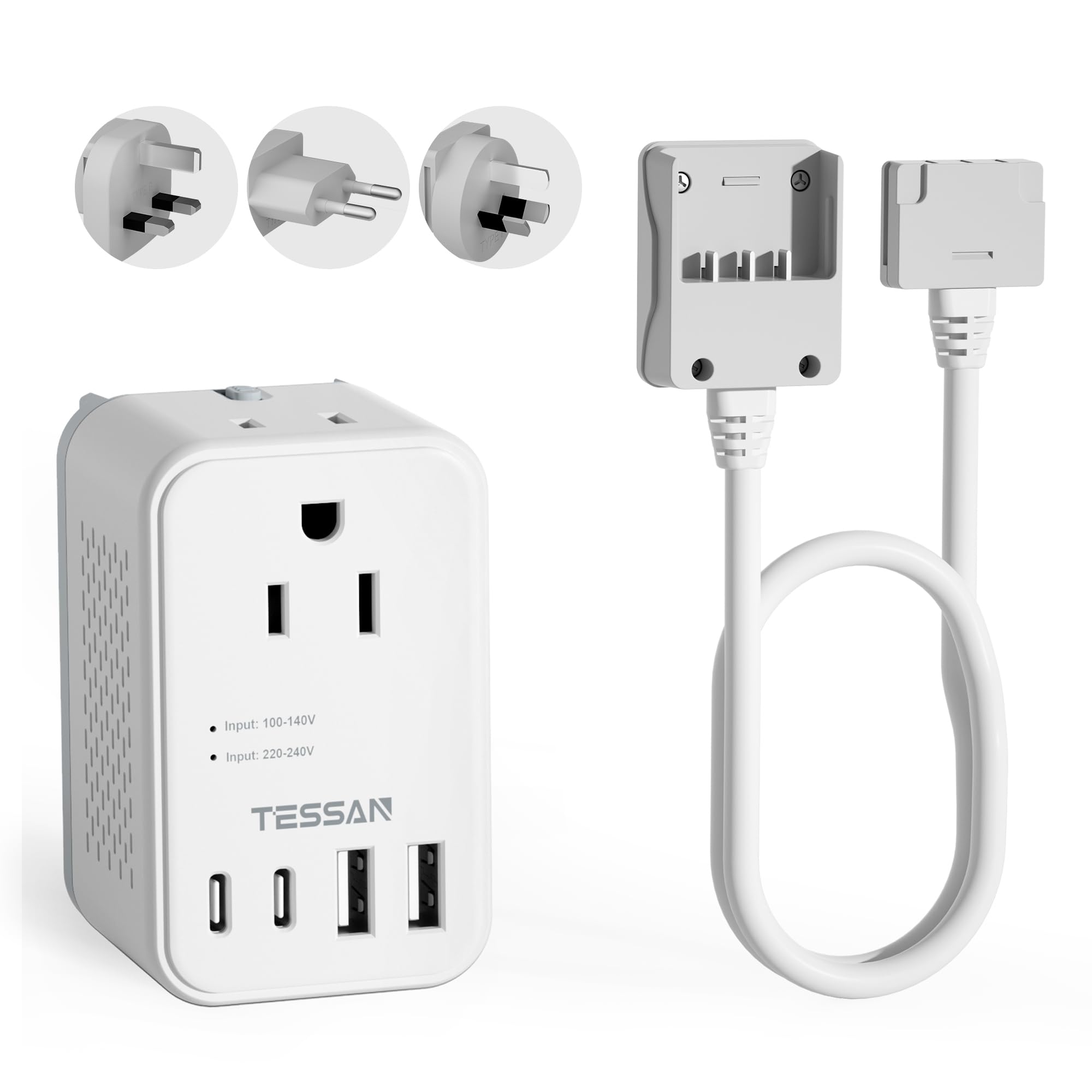
Two AC outlets, but only one converts voltage, that is the first thing to understand about the TBVZMN. The AC2 outlet steps 220-240V down to 110V for a mechanical heating appliance up to 1,200W, while AC1 is a pass-through adapter for dual-voltage electronics. We think that split is worth the bit of extra attention if a hair dryer is the reason you are shopping.
The 1,200W converted outlet is the main event. It is enough for many travel hair dryers, and the four USB ports (two USB-A, two USB-C) plus four plug types (A, C, G, I) make it a practical family unit. The safety list is reassuring: auto shut-off, overload, overcurrent, and overheat protection, plus UL, FCC, RoHS, CE, and UKCA compliance. We like that the USB-C ports are there for newer phones and tablets, so you are not carrying a separate charger for every device.
The pass-through outlet is useful for a laptop or a phone charger that already handles 100-240V, but it will not step down voltage. That means you need to read the labels before you plug anything in, especially if you are used to a converter with two identical AC outlets. It is a small extra step, not a dealbreaker, and the labeling on the unit is the thing to check first.
The split outlets are the thing to learn once; after that, it is a straightforward travel converter that sits between the compact 350W pick and the 2,000W Ceptics. It is a useful middle ground for a family that wants one hair dryer and a few USB devices.
Pros
- 1,200W converted outlet for hair dryers
- Four USB ports, including two USB-C
- Four plug types for Europe and beyond
- Auto shut-off and multiple safety listings
Cons
- 1,200W cap excludes high-watt hair dryers
If your hair dryer is rated under 1,200W, the TBVZMN is the converter we recommend: one converted outlet, four USB ports, and a lower price than the 2,000W pick.
4. BESTEK Universal Converter
Charging Electronics

Key Features
- Max power: 250W
- USB ports: 4
- AC outlets: 3
- Plug types: US, EU, UK, AU
- Price: Budget
The BESTEK turns one European wall outlet into three AC sockets and four USB ports, which is the reason it earns a place in a family suitcase. It is a charging station first: phones, tablets, camera batteries, earbuds, and a CPAP can share the load, and you do not need a separate power strip to keep everything topped up.
We like it for the electronics-only traveler. The layout is simple: one cord in, three AC sockets and four USB ports out, with enough room to leave charging bricks at home. The 18-month warranty and NRTL-tested hardware are reassuring for a device that sits on a hotel desk.
The fan is the trade-off. It is audible enough that we kept it away from the bed, and the buzz is more noticeable when several devices are charging at once. In a hotel room, that is easy to work around: put it on the desk or dresser, not the nightstand, and unplug it when the devices are full.
The international plug set covers the UK and Australia as well as Europe, which makes it a better fit for a multi-country itinerary than a Europe-only adapter. It is the least fussy way to add outlets for a laptop bag.
Pros
- Three AC outlets and four USB ports
- Seven-device charging from one outlet
- Worldwide plug set and 18-month warranty
- NRTL-tested hardware and safety protection
Cons
- 250W ceiling excludes heating appliances
For charging a family’s phones, tablets, and a CPAP from one European outlet, the BESTEK is the converter we recommend, as long as you stay under its 250W ceiling.
How We Chose and Tested These Voltage Converters
I started by pulling every model I could find that listed a genuine step-down transformer rather than a plain plug adapter, then filtered by what came in the box: how many interchangeable plug heads were included, whether there was both a high-wattage outlet and a low-wattage one, and how many USB-A and USB-C ports each unit offered. That left 11 converters, which we used for seven months at home desks, on hotel nightstands, on rented-apartment kitchen counters, and on two-week trips where they lived out of a carry-on.
Power conversion came first. I plugged a voltage meter into each outlet and watched the reading under load, first with a lamp, then a laptop, then a hair straightener, to see whether output held near 110 volts or sagged. Any unit that got uncomfortably warm after twenty minutes, or whose fan was audible from the other side of a hotel room while a CPAP ran overnight, lost ground on reliability and noise at the same time.
For charging speed I timed how long each port took to bring a dead phone to half full, and noted which ones fell to a trickle when two devices were plugged in together. Portability got judged by actually packing them: I counted how many plug heads fit in a toiletry bag, weighed each unit in hand, and checked whether the prongs folded flat or snagged on clothes. For value, I compared what each box included, since a converter that needs a separate adapter set is a worse deal than one that arrives with the plugs you need.
Environmental impact and reliability took the longest to assess. I checked whether each unit drew anything measurable with nothing plugged in, and whether the housing stayed merely warm rather than hot during long runs. Every converter went back into a bag for at least four trips and came home to run again. Two developed loose outlets, and one USB-C port stopped fast-charging altogether.
How to Choose a Voltage Converter for Europe
The right converter starts with the appliance label, not the outlet count: a dual-voltage phone charger needs only a plug adapter, while a 110-120V hair tool or CPAP needs a true step-down converter.
Start with the appliance label
Look for an input range on the device or power brick. If it says 100-240V, you only need a plug adapter; the device already handles Europe’s 220-240V. If it says 110-120V only, you need a step-down converter. The trap is assuming every small appliance is dual-voltage. Hair dryers, curling irons, and some CPAP power supplies are often fixed-voltage, and a plug adapter will not change that.
Treat wattage as a ceiling
Converters are rated by maximum wattage, not by how many devices you can plug in. Add up the watts printed on the appliances you plan to run at the same time, then choose a converter rated above that total. A 350W unit is fine for a straightener or CPAP; a hair dryer can need 1,200W or more, so a compact 350W model will not do. Do not rely on the outlet count alone, and do not run a high-watt appliance on a lower-watt converter just because the plug fits.
Count outlets for the whole trip
Hotel rooms rarely have enough outlets, so count the devices you will charge overnight. Four USB ports plus two or three AC outlets cover a family’s phones, tablets, and a CPAP without a power strip. If everyone carries a laptop, look for a converter with enough AC sockets rather than daisy-chaining adapters. The BESTEK’s three AC and four USB ports are a good example of a charging hub; the DOACE is the smaller version for a lighter load.
Plan for plug types and pass-through outlets
Europe uses several outlet shapes, including Type C, E, and F, and a kit that covers only one may leave you hunting for an adapter. Check the countries on your itinerary and bring the matching plug. Also learn which AC outlets on the converter actually step down voltage; some units have a pass-through outlet for dual-voltage gear and a separate converted outlet for 110V-only appliances. Labeling those two in your head is the difference between a working trip and a fried device.
Pack for size, weight, and noise
A converter that stays in the hotel room can be heavier; one that moves with you should be small. The compact picks here run about 1.2 to 1.5 pounds, which is easy to pack but still noticeable in a personal item. Fan noise matters in a small room, especially for a unit that runs overnight. We prioritize a quiet fan and a cord long enough to reach the desk outlet; if noise is a concern, keep the converter off the nightstand.
Frequently Asked Questions
Can I use a voltage converter on a cruise ship?
Cruise lines set their own rules, and high-watt heating appliances are often prohibited even if you bring a converter. Check your line’s prohibited-items list before packing. For low-watt electronics, a converter is usually fine if the ship allows it, but do not assume an extension cord or multi-plug adapter is permitted. Ask before you board.
What happens if I plug a 110V appliance into a 220V outlet without a converter?
A 110V-only appliance fed 220V can overheat, fail, or create a fire risk. Unplug it immediately if it starts buzzing, smoking, or smelling hot, and do not try again without a step-down converter rated for its wattage. A plug adapter alone will not protect it.
Can I leave a voltage converter plugged in overnight?
Yes, for low-watt electronics, as long as the converter is rated for the load and sits in open air. Check it after an hour: warmth is normal, but a hot case, a burning smell, or a fan that never settles are reasons to unplug. Do not leave a high-watt heating appliance running unattended.
Final Verdict
For most trips, the DOACE X30 is the converter we recommend: it is compact, handles a straightener or CPAP within its 350W ceiling, and gives you four USB ports plus AC outlets without a separate power strip. If a hair dryer is coming, step up to the Ceptics LX-C2000 for its 2,000W outlet; if you want a lower-cost hair-dryer option, the TBVZMN 1200W is the one to check against your dryer’s label. For an electronics-only bag, the BESTEK is the simpler hub, provided you stay under 250W.