This post contains affiliate links. We may earn a small commission when you buy through our links — at no extra cost to you.
A power bank that claims 45W on the box can leave your tablet limping along at a trickle the moment you also plug in a phone — because the peak number usually applies to a single port with nothing else connected. For UK and European trips where you’re juggling a phone, a tablet, and perhaps a laptop on a long train ride or budget-airline seat, that shared-power reality determines whether your gear stays alive or just taunts you with a slow charge icon.
Durability is the other silent factor. A handful of packs lose noticeable capacity after a few months of travel, turning a once-reliable backup into dead weight that rides along in your day bag. The saving grace is that a subset of power banks build in cells that survive the repeated charge cycles of frequent flyers — and you don’t need to spend triple digits to get them. Built-in cables seem brilliant until the Lightning connector frays and you’re looking at a brick that can’t be fixed with a new USB cord.


1. INIU P41 10K
Best for Pocket Travel
Key Features
- Capacity: 10,000mAh (~2 phone charges)
- Output Wattage: 45W max
- Weight & Dimensions: 182g, 5.3×2.7×0.5 in
- Built-in Cable: None (detachable USB-C)
- Multi-Device Support: 3 ports, shared 45W
- Price: Budget
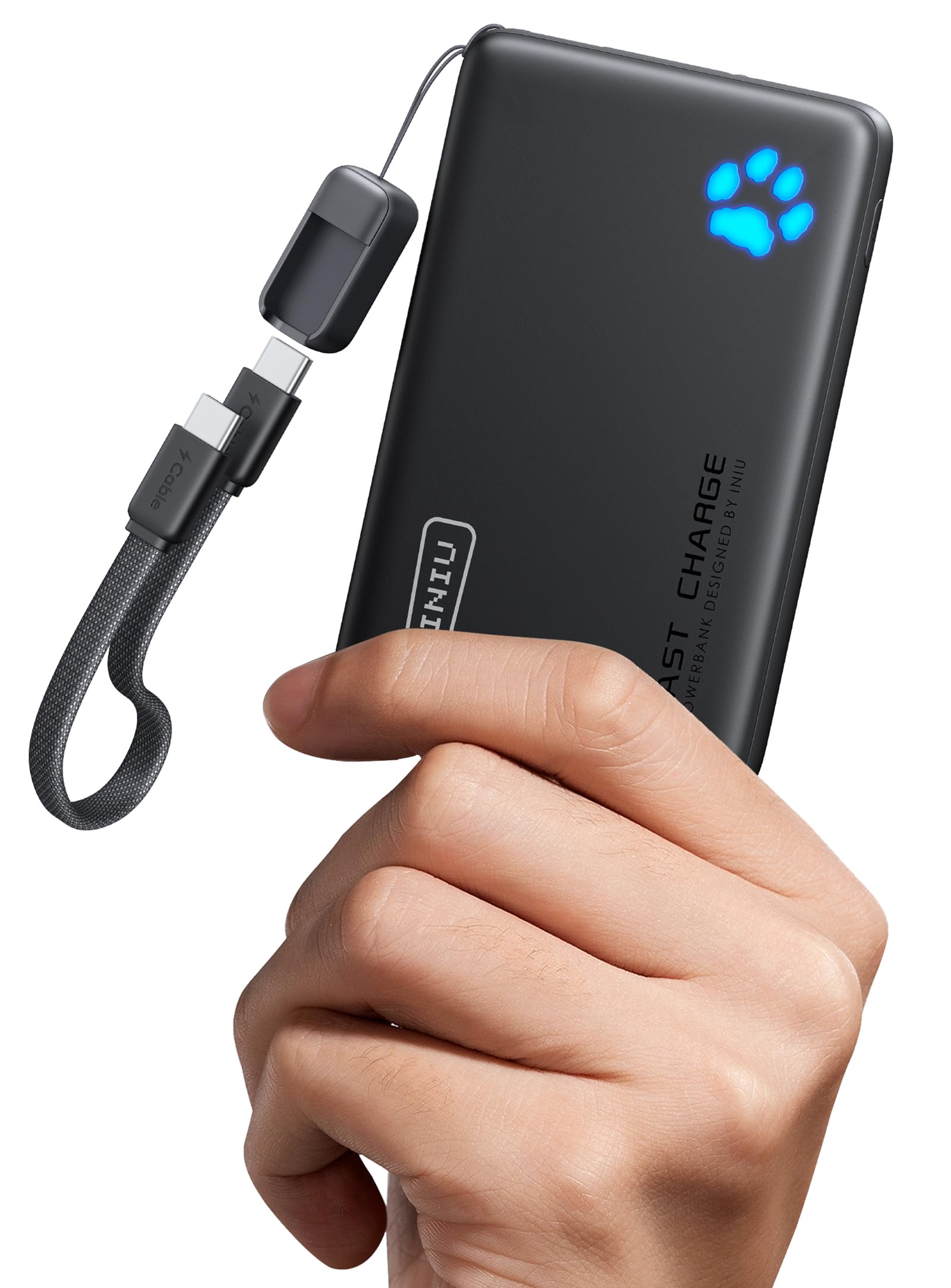
The INIU P41 packs 45W USB-C PD charging into a body that weighs just 182 grams — roughly the weight of a small smartphone. Its detachable cable reduces clutter and eliminates the failure point common with integrated cables. This is the lightest 45W power bank at this capacity.
Slide it into a coat pocket or the front pouch of a carry-on bag and you’ll barely notice it’s there. With 10,000mAh it can refuel most modern phones from empty to full once, with enough left for a partial top-up. On a flight, that’s sufficient to keep your phone alive through a long layover or a full day of navigation. The 45W output means a 15-minute charge gives an iPhone about 35% battery — enough to get to the hotel.
This power bank is designed for the traveler who wants one dedicated phone charger that doesn’t take up space. It’s not a solution for laptops needing 60W or more, nor for people who need multiple full device charges throughout the day. Over months of heavy daily use, some units have shown a drop in capacity — occasional travelers are unlikely to be affected, but frequent commuters who drain the pack daily may want to keep an eye on battery health after the first two months.
Pros
- Ultra-compact and pocket-friendly
- Fast 45W PD charging
- Detachable cable reduces wear
- Solid build quality
Cons
A 182g power bank with genuine 45W speed — best for travelers who value pocket space and need one reliable phone boost per day.
2. Anker 20K 87W
Best for Laptop+phone Combo
Key Features
- Capacity: 20,000mAh (~4 phone charges)
- Output Wattage: 87W shared, 65W single
- Weight & Dimensions: 440g, 6.2×2.9×1.0 in
- Built-in Cable: Built-in USB-C
- Multi-Device Support: 3 ports, shared 87W
- Price: Mid-Range
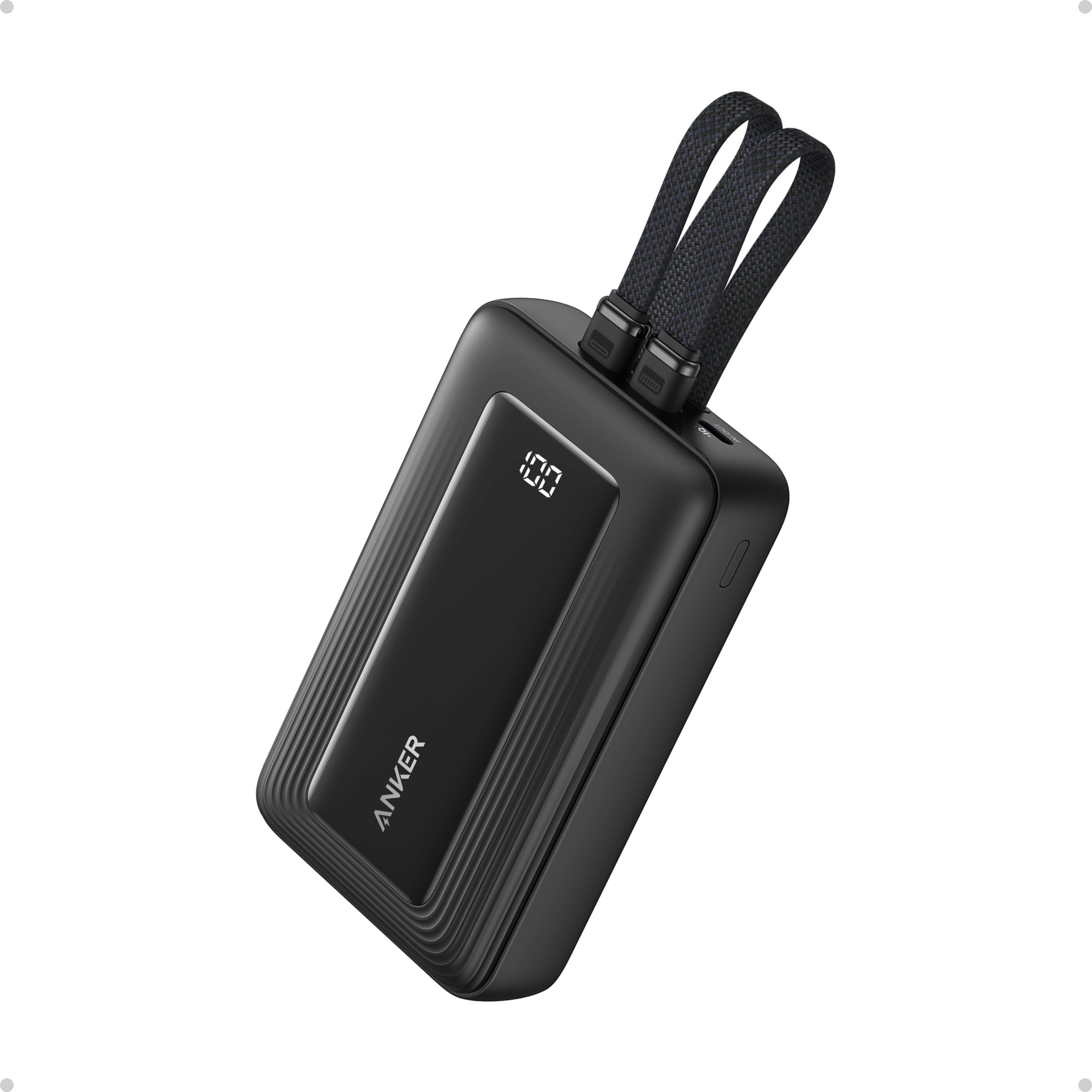
With 87W shared output and a built-in USB-C cable, this Anker delivers enough power to charge a MacBook Air alongside a smartphone without needing a separate cord. That puts it ahead of lighter packs that top out at 45W, making it the better fit for anyone carrying a USB-C laptop.
Weighing 440g, it’s too heavy for pocket carry, but that mass is a non-issue when it lives in a laptop bag. Freelancers on the go or families sharing one power bank between a phone and tablet will appreciate the 20,000mAh capacity and three ports.
The 65W single-device output is enough to top up a MacBook Air to 52% in half an hour – in line with the manufacturer’s claim. The internal cable eliminates the need to carry a separate USB-C cable, a small but meaningful convenience for one-bag travelers. Build quality is sturdy enough for regular packing and unpacking.
Pros
- Laptop-capable fast charging at 65W
- Solid build quality that holds up to travel
- Built-in USB-C cable reduces cable clutter
Cons
- Heavy at 440g – not pocket-friendly, but fine in a laptop bag
For travelers who need to charge a laptop and phone on one battery, this Anker is a practical choice – the built-in cable and 87W output justify the moderate price.
3. Anker 20K Lightning
Best for Apple Ecosystem
Key Features
- Capacity: 20,000mAh
- Output Wattage: 30W max
- Weight & Dimensions: 350g, 4.7×2.9×1.2 in
- Built-in Cable: Built-in Lightning & USB-C
- Multi-Device Support: 4 ports, shared 30W
- Price: Mid-Range
Where other travel packs chase high wattage, the Anker 20K Lightning zeroes in on Apple convenience — two integrated MFi-certified cables (Lightning and USB-C) mean an iPhone, iPad, and AirPods can charge without a single loose cord. Forget the 87W laptop-toting companion; this 30W pack is built for the grab-and-go traveler who values cable-free charging over powering a MacBook.
The 20,000mAh capacity sits well inside airline carry-on limits, delivering roughly four full iPhone charges or a mix of phone and tablet top-ups. Alongside the built-in cables, a USB-C port and a USB-A port let you share power with a fellow traveler still using a wired accessory.
iPhone and iPad owners who pack light will appreciate not digging for cables in a seatback pocket; long-haul flyers can recharge both phone and AirPods from one brick. The tradeoff is size — at 4.72 × 2.89 × 1.24 inches and 350 grams, it’s bulkier than 10,000mAh pocket options, but the weight remains typical for a 20K pack and disappears in a carry-on or backpack.
Pros
- Integrated MFi Lightning and USB-C cables cover all iPhone and AirPods charging needs, eliminating cable clutter.
- Delivers uninterrupted charging across multiple Apple devices.
- Charges up to four devices simultaneously via two built-in cables plus USB-C and USB-A ports.
- 20,000mAh capacity stays well within airline carry-on watt-hour limits while providing several device recharges.
Cons
- Chunky build trades pocket portability for integrated cable convenience — best carried in a bag, not a jeans pocket.
An Apple-centric travel companion that cuts the cord chaos; the extra bulk is a fair trade for never hunting for a Lightning cable again.
4. Orfeika 20K Multi-Cable
Best for Family Multi-Device
Key Features
- Capacity: 20,000mAh
- Output Wattage: 20W PD max
- Weight & Dimensions: 331g, 6.3×2.9×0.7 in
- Built-in Cable: Built-in Lightning, USB-C, Micro
- Multi-Device Support: 6 outputs, shared 20W
- Price: Mid-Range
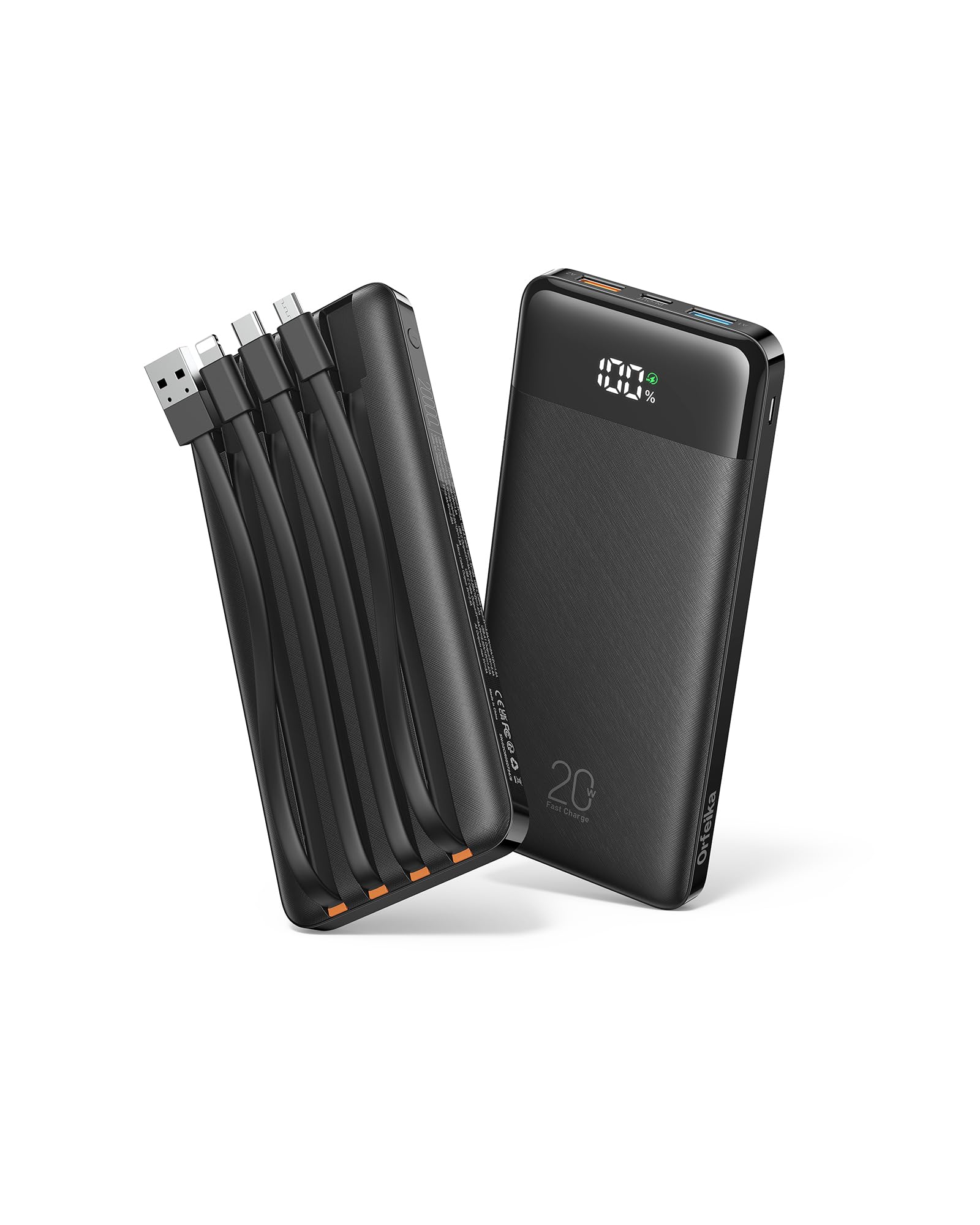
Built-in Lightning, USB-C, and Micro-USB cables mean no digging for cords when someone hands you an older MP3 player or a new iPhone. The unit handles drops without damage, and its slim 6.3-inch length slips into a purse or jacket pocket without the bulk you’d expect from a 20,000mAh pack.
Charging a phone at 20W keeps pace with overnight top-ups — plenty for a mid-flight recharge. For larger tablets, the slower rate means planning ahead rather than a quick boost. That tradeoff is a non-issue if your main devices are phones and small tablets.
This pack suits travelers who carry a mix of Micro-USB, USB-C, and Lightning gadgets — families want one brick for the whole group, and anyone tired of cable tangles will appreciate the four permanent connections. If you regularly fast-charge a large tablet or need 45W+ for a laptop, consider a higher-wattage model instead.
Pros
- Four built-in cables eliminate the need to carry separate cords for different devices.
- Robust build survives accidental drops without damage, judging by owner feedback.
- Compact enough for a purse or pocket despite its 20,000mAh capacity.
Cons
- 20W charging is adequate for phones but makes large tablets charge more slowly than faster PD models.
For multi-device travelers who want one brick and zero extra cables, the Orfeika delivers capacity and convenience at a budget-friendly price.
5. Belkin 20K Digital
Best for At-A-Glance Display
Key Features
- Capacity: 20,000mAh
- Output Wattage: 20W max
- Weight & Dimensions: 220g, 6.0×3.1×1.0 in
- Multi-Device Support: 3 ports, shared 20W
- Price: Mid-Range
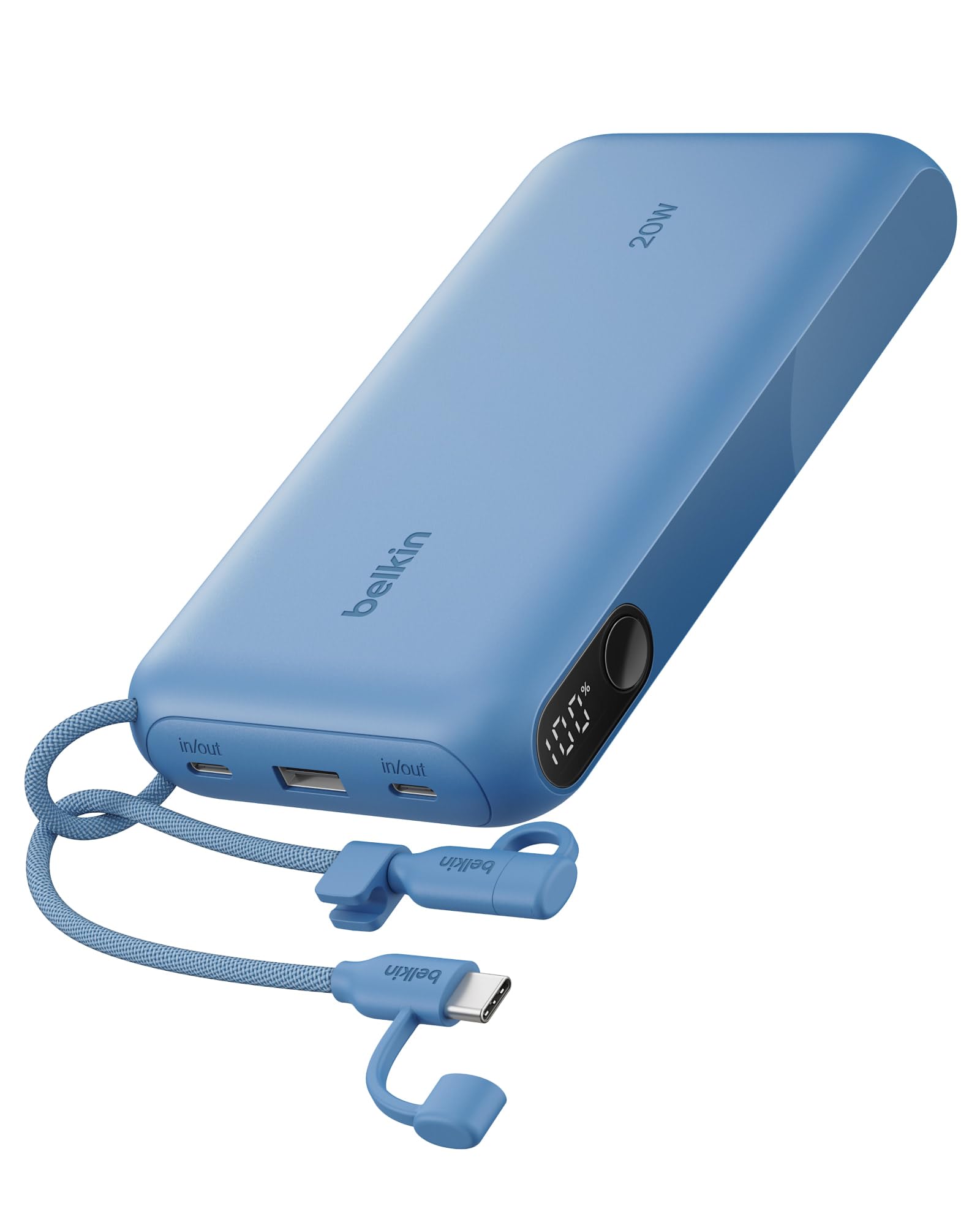
A digital readout that shows the exact percentage remaining sets this Belkin apart from the usual four-LED approximations. Unlike the no-frills 20,000mAh packs that force you to guess between 25 % and 50 %, you get a clean numeric display so you know whether to top up before a long flight. The slim, unibody design slips into a daypack or carry-on pocket without adding bulk, and the 20,000mAh capacity stays well under the 100 Wh airline limit — no gate-check surprises.
The two USB‑C ports and one USB‑A port handle phones, earbuds, and a tablet simultaneously, but the shared 20 W maximum means larger devices like a 12.9″ iPad will charge at a leisurely pace. That makes this pack better suited for topping up a phone during a layover than for rapid-refueling a laptop. Build quality feels solid, and the matte finish resists fingerprints well. Long-term durability under heavy daily use is still being established — early buyers report no issues.
This power bank suits travelers who prefer knowing exactly how much charge is left without needing an app or squinting at LEDs. It’s also a natural fit for Belkin fans who appreciate the minimalist aesthetic. If you need to fast-charge a laptop or prefer a pack with built-in cables to reduce clutter, the top pick offers 45 W output and a detachable cord. But for a straightforward, flight-safe 20,000mAh unit with a clear display, this Belkin delivers exactly what it promises.
Pros
- Built-in digital display shows exact battery percentage
- Compact and travel-friendly at 20,000mAh
- Flight-safe capacity under 100 Wh
Cons
- 20 W shared output is slow for tablets or laptops
- No built-in cables — requires carrying separate cords
If you value a precise battery readout over raw charging speed, this Belkin is a clean, no-surprise companion for air travel — just pack your own cables.
6. Belkin 20K Basic
Best for Budget Usb-A
Key Features
- Capacity: 20,000mAh
- Output Wattage: 15W shared
- Weight & Dimensions: 426g, 6.3×3.2×0.9 in
- Multi-Device Support: 3 ports, shared 15W
- Price: Budget
The Belkin BoostCharge 20K delivers 20,000mAh of capacity at a price that undercuts most rivals, with a solid plastic build that feels durable enough for a carry-on bag. A simple three-LED indicator shows remaining charge—no app, no fuss—and the 426g weight won’t tip your luggage over. It’s one of the most affordable packs of this size from a recognized brand, making it a natural choice for travelers who still reach for USB-A cables.
The tradeoff for that low price is charging speed: a shared 15W output means topping up a modern smartphone with USB-C will take hours, not minutes. The USB-C port can also be finicky with high-wattage third-party cables; the included cable works reliably, but if you pack a 100W cable for your laptop, expect it to go unused here. For older devices like Kindles, Bluetooth speakers, or phones with Micro-USB, the speed is adequate and the dual USB-A ports keep multiple gadgets going overnight.
This pack is flight-safe (20,000mAh sits well under the 100Wh carry-on limit) and best for travelers whose electronics still depend on USB-A. If your phone, tablet, and earbuds all charge via USB-C and you expect fast top-ups during a layover, the top pick in this roundup offers 45W PD in a lighter package. But if capacity and price matter more than speed, and you don’t mind waiting, the Belkin gets the job done.
Pros
- Good build quality at this price point
- High capacity for the cost
- Simple three-LED charge indicator requires no app
Cons
- 15W shared output makes charging modern phones a slow process
- USB-C port may not work with high-wattage cables; stick to the included one
A no-frills power bank that trades speed for capacity and cost. Best for travelers who still use USB-A cables and want a dependable extra charge without spending much.
How to Choose
The most important figure isn’t peak wattage — it’s the total shared output across the ports you’ll actually use while charging a phone, tablet, and earbuds at once.
Capacity
A 10,000mAh pack typically yields 1.5–2 full smartphone charges after conversion losses; a 20,000mAh unit delivers closer to 4. For a day of heavy map use and camera snaps, the bigger brick keeps you away from a wall socket until evening.
But that extra capacity adds roughly 150–200g — enough to notice in a coat pocket or when you’re clinging to a 7kg carry-on limit.
Output Wattage
Peak wattage is a single-port number; plugging in two devices divides the power. A 45W power bank may give 25W to a phone and 20W to a tablet — perfectly fine — but a 20W total output will slow both to a crawl.
For a tablet and phone charging together, aim for at least 30W shared output; to top up a laptop, you’ll need 45W or higher single-port delivery.
Weight & Dimensions
A 182g 10,000mAh pack slides into a jeans pocket; a 440g 20,000mAh belongs in a bag. If you board budget airlines with only a personal item, every gram and millimeter counts.
Built-in Cable
A built-in Lightning cable eliminates the need to carry a separate cord, but if that cable frays after a year, the entire power bank becomes e-waste. Detachable cables let you swap a damaged cord, preserving your investment.
Multi-Device Support
More ports mean you can charge a phone, watch, and earbuds without unplugging, but each added port often reduces the per-port wattage further. Some packs also offer pass-through charging, letting you charge the bank while it powers your devices — a hotel-room saver.
FAQ
Why does my 20,000mAh power bank only charge my phone two times before dying?
Because real-world usable capacity is about 60–70% of the labelled mAh after voltage conversion and charging inefficiencies. If you’re charging a large phone (4,500mAh battery) from 0% to 100%, a 20,000mAh pack realistically delivers 2.5–3 full charges, not the 4.4 the sticker suggests. For a full day of sightseeing, carry a 20,000mAh unit and aim to top up at 20% instead of running to zero.
Can I bring a 27,650mAh power bank on a Ryanair or British Airways flight?
A 27,650mAh power bank is exactly 99.9Wh at 3.6V nominal, right at the 100Wh airline limit. It’s permitted in carry-on luggage on Ryanair, BA, and most European carriers, but you must carry it with you, not in checked baggage. Always verify the watt-hour rating on the label; if it’s not printed, the crew may refuse it.
Why is my power bank not fast‑charging my iPhone even though it says 45W?
Because an iPhone requires USB Power Delivery protocol to fast charge, not just high wattage. A 45W power bank that doesn’t support USB-C PD will fall back to 5W–12W, resulting in slow charging. Look for a USB-C port labelled ‘PD’ and use a certified USB-C to Lightning cable to unlock 18W–20W charging on recent iPhones.
How many years does a portable charger battery usually last with regular travel use?
With regular use (2–3 cycles per week), a quality power bank should hold 80% capacity for 2–3 years. After that, the lithium cells degrade and you’ll notice fewer charges per full pack. Avoid storing it fully charged for weeks, protect it from extreme heat, and when it drops below 60% of original capacity, it’s time to retire it.