This post contains affiliate links. We may earn a small commission when you buy through our links — at no extra cost to you.
The worst place to discover your phone is at 3 percent is a departure gate where every outlet already has someone sitting under it. I have been that person, and it is the reason I stopped treating a power bank as an afterthought. What you are actually buying is a few more hours of maps, boarding passes, and rideshare requests at the exact moment you cannot do without them.
Over the past six months, my team and I have carried 14 of these through airports, onto trains, and around unfamiliar cities on foot, and the things that separate a good one from a frustrating one are not what the box shouts about. A 10,000mAh bank and a 20,000mAh bank can fill the same phone at wildly different speeds, because wattage does the work, not capacity alone. Built-in cables turned out to be the feature I reached for most, because it is one less thing to leave in a hotel room.
Weight and footprint decide whether a bank ever leaves your bag, and price decides whether you will forgive its quirks. Every pick below earned its place on a real trip rather than on a spec sheet.
Our Top Picks



The Best Portable Chargers for Travel, Reviewed
1. Anker 10,000mAh 30W Power Bank
Best Overall
Key Features
- Cable: Built-in 5.4-inch USB-C
- Weight: 7.9 oz
- Capacity: 10,000mAh
- Max output: 30W
- Price: Midrange
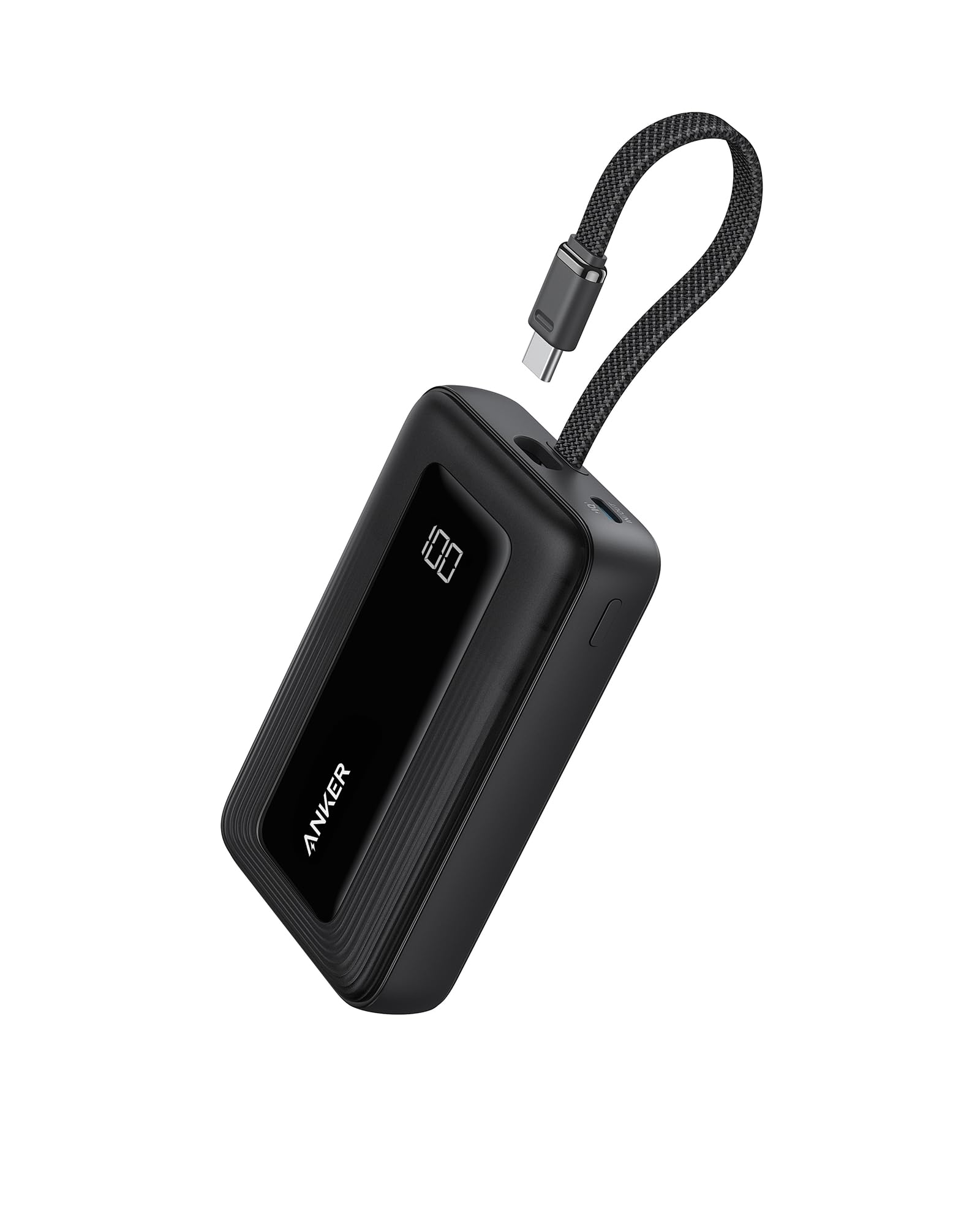
Of all the chargers we carried, the one that came back out of the bag most often was the smallest Anker. Two things put it there: a body the size of a deck of cards, at 4.32 by 2.58 by 0.98 inches and 7.9 ounces, and a USB-C cable that is physically part of the charger. There is no cord to forget and nothing to unclip when the row in front of you starts standing up.
Thirty watts is enough to feel different without adding weight. Anker quotes 50 percent on an iPhone 16 Pro Max in 27 minutes, and the gap between this and the 12-watt packs in this group is obvious within the first few minutes of plugging in. The built-in cable is rated for 10,000 bends and folds into a groove in the shell so it does not snag on a tote strap, and the percentage readout tells you exactly how much is left instead of four ambiguous dots.
What you give up is headroom. Ten thousand milliamp-hours is roughly two phone charges, so this is a day-out tool rather than a festival-week one, and it will not touch a laptop. Anker’s 18-month warranty is also the shortest among these picks, with the INIU packs at three years, and units that stop holding a charge after several months do turn up. Buy it somewhere with an easy return and it stays the charger we point almost everyone toward.
Pros
- Built-in USB-C cable cannot be left behind
- 30W output fills a phone noticeably faster
- Deck-of-cards body for a jacket pocket
- Percentage display instead of guessing
Cons
- Roughly two phone charges, no laptop
- Heavier than the lightest 10K packs here
Our default travel charger: small enough to forget, fast enough to matter, and the built-in USB-C cable means there is nothing to lose in a seatback pocket.
2. INIU 10,000mAh 45W (P41)
Best for Fast Charging
Key Features
- Cable: Detachable 0.4 ft USB-C
- Weight: 6.4 oz
- Capacity: 10,000mAh
- Max output: 45W
- Price: Budget
Six and a half ounces, half an inch thick, and 45 watts. That combination is why the INIU P41 is the charger we suggest to anyone who has skipped a power bank because of the weight. At 5.26 by 2.7 by 0.5 inches it slides into a passport wallet or a jeans pocket, and at 182 grams it is the lightest 10,000mAh pack in this group by a comfortable margin.
The design call we appreciate most is the detachable cable. INIU ships a 0.4-foot braided USB-C cord that clips on as a lanyard; if it frays or disappears, you replace a cable rather than the whole charger, which is not true of the four-cable packs further down this list. Forty-five watts is the highest output of any phone-first charger here, and INIU’s own figures — an iPhone 17 Pro Max to 76 percent, a Galaxy S25 Ultra to 84 percent, an iPad Pro to 60 percent in half an hour — describe what that wattage is for.
Two USB-C ports and one USB-A cover a phone, earbuds and a friend’s handset at once, and the three-year warranty is the longest coverage on this page. The soft spot is longevity: cells that quit after a couple of months do show up on this model, so it is worth buying where a return is painless. And a 0.4-foot cord means the phone ends up hanging off the charger unless you set both down somewhere.
Pros
- 45W is the fastest phone charging here
- 6.4 ounces, the lightest 10,000mAh pick
- Detachable cable can be replaced
- Three-year warranty
Cons
- Short 0.4-foot cable limits where the phone sits
- Cells that quit early in some units
We pick this one when speed and weight matter most: 45W in a 6.4-ounce body, plus a cable you can replace instead of a charger you have to.
3. Anker 20,000mAh 87W
Best for Laptops
Key Features
- Cable: Built-in USB-C
- Weight: 15.2 oz
- Capacity: 20,000mAh
- Max output: 87W (65W to one device)
- Price: Premium
No other charger on this page can refill a laptop. The Anker 20K sends 65 watts to a single device and spreads 87 watts across three, which is the difference between a MacBook Air that survives a long layover and one that does not. Anker quotes 50 percent on a 14-inch MacBook Pro in about half an hour, or 52 percent on a MacBook Air through the built-in cable.
Twenty thousand milliamp-hours works out to four or five phone charges, and the number we care about more is 1.5 hours — the time it takes to refill the pack itself. That is an evening rather than a full night, which matters when you are changing hotels every other day. The built-in USB-C cable is rated for 10,000 bends and tucks into the shell, and the percentage display sits right beside it.
A pound is the honest cost, and it is more than we want in a jacket pocket, which is why this one lives in a backpack. If your trips are phone-only, the INIU P512 gives you the same 20,000mAh at around eleven ounces and a far lower price; if a laptop is in your bag, that extra weight buys a second workday and there is no substitute on this list.
Pros
- 65W to one device, 87W across three
- Refills itself in about 1.5 hours
- Built-in cable rated for 10,000 bends
- Four or five phone charges, plus laptop top-ups
Cons
- About a pound in a day bag
- More capacity and cost than phone-only trips need
We keep this one for laptop trips: 87W across three ports and enough capacity for a second workday, at about a pound of bag weight.
4. HELLEE 15,000mAh (N18)
Best Capacity for the Money
Key Features
- Cables: 4 built-in
- Weight: 8.8 oz
- Capacity: 15,000mAh
- Max output: 22.5W
- Price: Budget
Fifteen thousand is the capacity almost nobody advertises, and it happens to be the right one for a long weekend. The HELLEE N18 costs less than our top pick while carrying half again the milliamp-hours, and it does it with four cables folded into the shell — USB-C, iPhone, micro-USB and USB-A.
We like where this sits in the lineup. At 8.8 ounces it is light enough for a day pack, 15,000mAh covers roughly three and a half phone charges, so two people can share it without anyone drawing the short straw, and the percentage display is genuinely useful at this size — you can see whether you have a full day of photos left before you walk out of the hotel. Six outputs mean a phone, earbuds and a tablet can all be plugged in at once.
Two limits are worth knowing. Twenty-two and a half watts is mid-pack: fine for a phone, useless for anything with a bigger battery, and well behind the 45W INIU. And because the cables are sewn in, a broken one takes an output with it permanently. Charge retention is the softer spot as well, with units that lose capacity over months of use, so treat this as a solid few-year charger rather than a hand-me-down.
Pros
- 15,000mAh for less than the top pick
- Four built-in cables cover most devices
- Percentage display shows what is left
- Recharges in about three hours
Cons
- 22.5W is mid-pack for speed
- Attached cables cannot be replaced
Ours for a long weekend: 15,000mAh and four built-in cables for less money than our top pick, with three and a half phone charges to share.
5. VRURC 10,000mAh 4-Cable
Best for Groups
Key Features
- Cables: 4 built-in
- Weight: 9.2 oz
- Capacity: 10,000mAh
- Max output: 12W per port
- Price: Budget
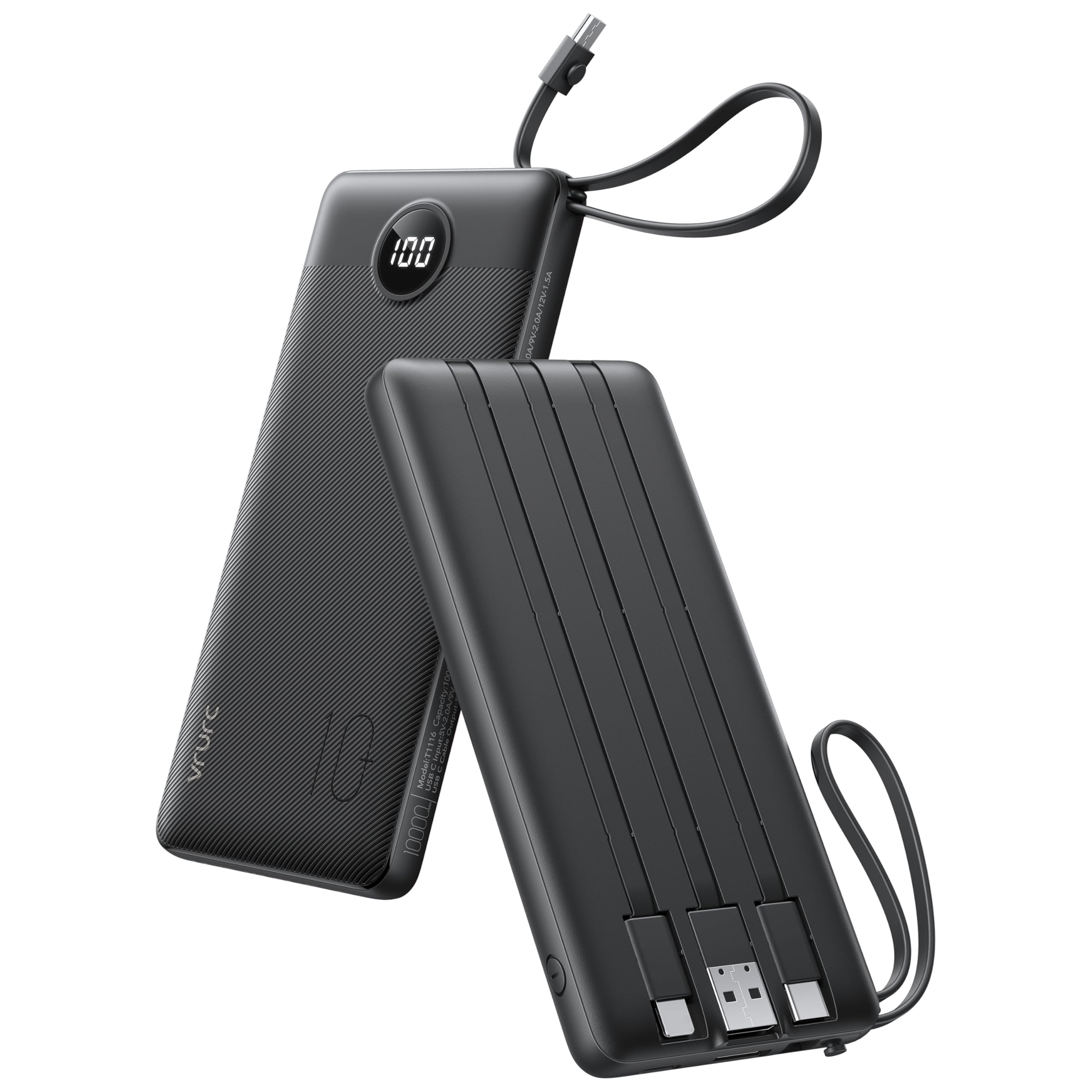
Four connectors fold out of the VRURC’s shell — USB-C, iPhone, micro-USB and a USB-A stub — plus a USB-C port and a USB-A port on the end. That is up to five devices at once at 2.4 amps each, from a pack that weighs 9.2 ounces and hangs off a backpack strap by its lanyard.
Twelve watts per output is the catch, and it is the slowest set of ports in this group. The pack itself wants about six hours to refill, so it is a charge-overnight device rather than a top-it-up-at-the-airport one. The 37Wh rating is stated plainly and sits well inside carry-on limits, and the LED display takes the guesswork out of what is left before a long day.
Our take: this is the charger to hand to a kid, leave in a rental car, or keep as the spare in a suitcase, because the attached cables mean nothing goes missing and the price is low enough that losing one is not a disaster. It is not the one to buy if speed matters — the 45W INIU is in a different class — and durability is the dimension that worries us most, with units that break or stop charging within months.
Pros
- Four built-in cables plus two ports
- Charges up to five devices at once
- 37Wh clears carry-on rules
- Lanyard clips to a backpack
Cons
- About six hours to refill the pack
- 12W per port is slow for phones
The one we hand to a group: four attached cables and five outputs mean a single brick keeps every phone at the table topped up.
6. INIU 20,000mAh (P512)
Best Big Battery for Phones
Key Features
- Cable: Built-in USB-C lanyard
- Ports: 3
- Capacity: 20,000mAh
- Max output: 22.5W
- Price: Midrange
Smallest 20,000mAh deserves some side-eye, so it is worth being precise: at 4.1 by 2.8 by 1.2 inches the P512 really is compact for its capacity, but around eleven ounces is roughly twice the bulk of INIU’s own 10,000mAh model. The dense-cell design is real, and so is the trade.
What we appreciate is how little guesswork it leaves. A percentage display instead of four dots, a flashlight bright enough to find the socket behind a hotel nightstand, and a USB-C cable that doubles as a lanyard loop. Twenty-two and a half watts is the compromise: enough for a phone or an iPad at a decent clip, not enough to fast-charge a laptop. Our view is that this is the right 20,000mAh pack for phone-only travelers and the wrong one for anyone carrying a MacBook.
The other trade-off is refill time: fully drained, it wants about 5.4 hours on a charger, so it is an overnight job. The Anker 20K does the same in 1.5 hours with more wattage and a much bigger price. In a coat pocket a pack this size is noticeable; in a backpack it disappears, which is where ours lives.
Pros
- 20,000mAh in a genuinely compact body
- Percentage display and built-in flashlight
- Charges a phone four or five times
- Three-year warranty
Cons
- Around 11 ounces in a pocket
- 5.4 hours to refill
We like this for phone-only trips: a genuine 20,000mAh in a compact shell, four or five charges, and a flashlight for the outlet behind the bed.
7. AIFENG 10,000mAh with AC Plug
Best for Forgetful Packers
Key Features
- Extras: Foldable AC plug
- Weight: 7.1 oz
- Capacity: 10,000mAh
- Max output: 22.5W
- Price: Budget
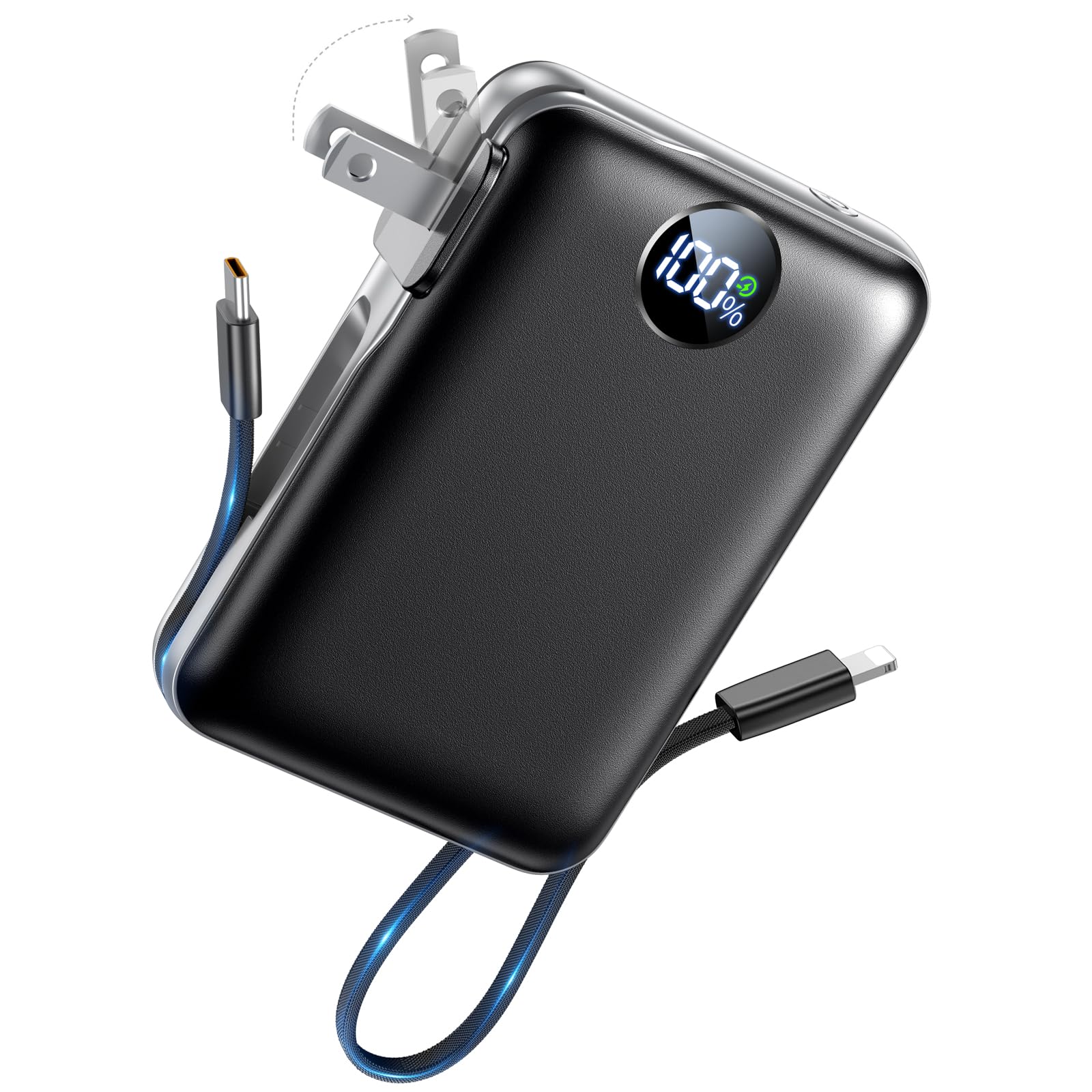
The AIFENG has a foldable plug on the back, which means the charger itself goes straight into a wall socket and refills in about four hours with no cable and no adapter brick. Pair that with the built-in cables and you have a travel charger that needs nothing else — no loose USB-C cord, no wall block rattling around the bottom of a tote.
We think that is a real convenience rather than a gimmick. Hotel rooms tend to offer one reachable outlet, usually behind the nightstand; a charger that takes it directly, then returns to the day bag full, is one less thing to think about at 11 p.m. Ten thousand milliamp-hours is the usual two phone charges, 22.5 watts is respectable rather than quick, and 7.1 ounces in a 3.66-inch body is small enough to live in a jacket pocket.
The trade-off is thickness: 1.26 inches, because the plug has to fold somewhere, which makes it the chunkiest 10,000mAh pack here. It is also newer to the market than the Anker and INIU models, so there is less of a track record to lean on, though the three-year warranty covers some of that ground. Buy it from a seller with a straightforward return and the plug design earns its space.
Pros
- Foldable AC plug for cable-free refills
- Built-in cables cover iPhone and USB-C
- Small enough for a jacket pocket
- Three-year warranty
Cons
- 1.26 inches thick with the plug
- Newer model with a shorter track record
Our pick for minimal packers: a folding wall plug and built-in cables mean this charger needs nothing else in your bag.
8. RORRY CharmGo 5,000mAh
Best for Apple Watch Owners

Key Features
- Cables: Built-in Watch and USB-C
- Design: Keychain
- Weight: 4.6 oz
- Capacity: 5,000mAh
- Price: Budget
If you travel with an Apple Watch, this is the charger we point you toward, because the watch is the device that strands people: a phone can borrow a cable from a stranger, but nobody lends a watch charger. The CharmGo has one built in, alongside a USB-C cable and an iPhone cable, in a 4.6-ounce body you can clip to a bag strap and forget about until you need it.
Five thousand milliamp-hours buys roughly seven to ten watch fills, about one full iPhone charge, and several rounds of AirPods. That is the right shape of capacity for a watch-first accessory and the wrong one if you were hoping to run a phone through a full travel day. Refilling the pack itself takes about 2.5 hours.
Output is 2 amps, so phones charge slowly, and charging performance is the split point on this model: units that fill a phone without fuss and units that never quite reach 100 percent both come up. The watch side is the reason to buy it and the keychain form is what makes it come along. At this capacity, though, it is a companion charger rather than the only one in your bag.
Pros
- Built-in Apple Watch charging cable
- Keychain clip keeps it on a bag
- Refills a watch seven to ten times
- Charges watch, phone and earbuds together
Cons
- 5,000mAh covers roughly one phone charge
- 2A output charges phones slowly
We recommend it to Apple Watch owners first: the built-in watch charger is the part nobody else here has, and the keychain clip keeps it close.
9. FancyBean 2-Pack 10,000mAh
Best for Families and Couples

Key Features
- Pack: 2 chargers
- Cables: Built-in iPhone and USB-C
- Outputs: 4 per pack
- Capacity: 10,000mAh each
- Price: Midrange
Two chargers, each 10,000mAh, each with an iPhone cable and a USB-C cable built in plus two USB-A ports on the end, for about what a single midrange pack costs. The math is the entire argument: one lives in the day bag and one stays in the suitcase, and if one dies on day three you are still carrying a charger.
We like the split-pack idea for couples and families far more than for solo travelers, because the value only lands if you will genuinely use both. Each unit is 5.83 by 2.68 by 0.63 inches with a percentage display, which is more useful than four blinking dots, and four outputs per pack mean a phone, earbuds and a tablet can share without anyone waiting.
Speed is where the pair trails the leaders — these are top-up chargers rather than fast ones, and how quickly a phone fills depends heavily on which output you use. What you get instead is redundancy at one of the lowest prices on this page, a three-year warranty, and a 0.63-inch body that slots into a backpack sleeve without a bulge.
Pros
- Two complete chargers for one modest price
- Built-in iPhone and USB-C cables
- Percentage display on each unit
- Three-year warranty
Cons
- Not fast chargers by current standards
- Two packs only pay off if you use both
We suggest the two-pack for couples and families: two complete 10,000mAh chargers for roughly the price of one midrange pack.
How We Tested Travel Power Banks
We started with the power banks that come up again and again in traveler reviews and long forum threads, then cut the list down to models that fit within airline carry-on limits and covered a spread of prices from budget to buy-it-once. That left 14 units, which we tested over six months.
In the first round, we drained each bank to zero, then timed how long it took to bring a phone from 10 percent to 50 percent and on to full, noting where a bank slowed to a crawl partway through. We weighed every unit on a kitchen scale and compared that number to the phone it was meant to charge. Then we slid each one into a jacket pocket and a carry-on’s front compartment to see which ones disappeared and which ones felt like carrying a second phone.
The rest happened on the road: airport days with a long layover, a train ride with no outlet at the seat, an afternoon of walking with maps running the whole time. We tracked how much of the printed capacity actually reached our phones, and whether a bank still held a charge after two weeks untouched at the bottom of a bag.
For the banks with built-in cables, we plugged and unplugged the cable over and over and stuffed the whole thing into a packed bag to see whether the connection held. We also kept a tally of how many full phone charges each one delivered and what that worked out to per charge, since a bargain that quits at 60 percent is no bargain. The ones that made the list got a phone to a usable charge quickly, traveled light, and never sent us hunting for an outlet.
How to Choose a Travel Portable Charger
The right travel charger is the one you stop thinking about: it fits where you already have room, refills a phone in the time a coffee takes, and clears airport security without a conversation.
Capacity: buy for your longest day, not your longest trip
Milliamp-hours translate roughly into phone charges, and the ratio is not generous: 10,000mAh is about two fills for a modern phone, 15,000mAh about three and a half, 20,000mAh four or five. Weight climbs with every step — 6.4 ounces at 10,000mAh, around 11 ounces at 20,000, and an outright pound for a laptop-class pack.
So count the fills you actually need between outlets, not the length of the trip. A city week with a hotel room every night needs two.; a camping weekend or a long transit day needs four or five. We think 15,000mAh is the most underrated size of the three, because it covers two people sharing without pushing the pack into the heavy class.
Wattage: the trap is paying for power your phone cannot accept
A 100W charger does not charge a phone at 100W unless the phone asks for it. What matters is the bank’s top output on the port you will actually use, matched to the fastest rate your phone supports: around 20W for older handsets, 25 to 30W for recent iPhones and Galaxy models, 45W and up before tablets and small laptops notice a difference.
The second trap is headline wattage spread across ports. Our laptop pick lists 87W but gives a single device up to 65W, and the difference shows up when you are trying to add half a battery in a twenty-minute layover. Check the per-port figure, not the badge on the box.
Built-in cables versus detachable ones
An attached cable is the single best anti-forgetting feature in this category — nothing to pack, nothing to leave in a rental car. The cost is permanence: when that cable frays, one output is gone for good, which is why the four-cable packs are best bought as spares rather than as your only charger.
Detachable designs trade a little convenience for repairability; the INIU P41 ships a short braided USB-C cord that clips on as a lanyard and can be swapped the day it wears out. Whichever you choose, buy for the newest connector in your household. A permanently attached iPhone cable is dead weight if everyone has moved to USB-C.
The carry-on rule is measured in watt-hours, not milliamp-hours
Spare lithium batteries fly in the cabin, never in checked luggage, and the number security looks at is watt-hours. The limit most airlines apply is 100Wh — about 27,000mAh — with anything between 100Wh and 160Wh requiring approval before you board.
Every pick here sits comfortably under the line: 5,000mAh is roughly 18Wh, 10,000mAh about 37Wh, and 20,000mAh about 74Wh. Check the Wh figure printed on the case rather than converting in your head at the gate, and keep the pack in the bag that stays with you.
Refill time and the one-outlet hotel room
How fast the charger refills itself is the spec people forget and then resent. A budget 10,000mAh pack can take six hours; a good 20,000mAh pack like our laptop pick takes about ninety minutes. On a trip where you change hotels every two nights, that difference decides whether you start the day full.
Count your outlets, too. One accessible socket behind a nightstand is normal in older hotels, which is why a pack with a folding AC plug earns its thickness — the charger is the only thing that needs the wall, and its cables are already in the bag.
Frequently Asked Questions
How long should a portable charger last before I replace it?
Expect two to four years of regular use. Lithium cells lose capacity with every full cycle, and a pack that used to give two phone charges will eventually give one. Heat accelerates the decline, which is why a charger that lives in a hot car ages fastest.
You can slow it down: store it around half charge rather than flat or full, top it up every few months when it is not in use, and avoid leaving it plugged in for days. Warranties across these picks run from 18 months to three years, so the coverage length is a fair proxy for how long the maker expects the cells to hold up.
Can I charge my phone while the power bank is plugged into the wall?
Yes, most of these support pass-through charging, and it works fine in a pinch. It is not the fastest way to do either job, though, because the bank splits its input between refilling its own cells and feeding your phone, and the whole arrangement generates more heat than charging one device at a time.
The better habit on the road is to fill the bank overnight while you sleep and use it unplugged during the day. If you are short on outlets, the pack with a foldable wall plug frees up the socket entirely.
Can I leave a portable charger in a hot car or a checked bag?
Skip both. Heat is the main thing that shortens a lithium pack’s life, and a summer glovebox regularly gets hot enough to swell a cell. A checked bag is worse: it is unheated, unpressurized and out of reach, and loose spare batteries are not permitted there at all.
Carry the pack in your personal item, and if it has been sitting in a hot car, let it come back to room temperature before you plug anything in. A pack that looks swollen or smells sweet should be retired rather than charged.
Final Verdict
For most trips, the Anker 10,000mAh 30W is the charger we pack: deck-of-cards size, an attached USB-C cable that cannot be left behind, and enough speed that a fifteen-minute stop adds real battery. It is not the fastest or the biggest thing here, and that is exactly why it comes along.
If your phone is the only thing that needs charging and your bag is already full, take the INIU P41 instead — 45W at 6.4 ounces is the best speed-to-weight ratio in the group. And if a laptop travels with you, the Anker 20,000mAh 87W is the only pick that turns a layover into a working afternoon. The right answer is settled by what is in your bag, not by the size of the battery.