This post contains affiliate links. We may earn a small commission when you buy through our links — at no extra cost to you.
The moment you’re folding a stroller one-handed at airport security while your toddler tries to wiggle free is when an umbrella stroller either earns its keep or becomes one more thing to carry. The right one folds small enough for a trunk, rolls over terminal carpet and cracked sidewalks without rattling your teeth, and feels sturdy when a squirmy kid leans over the side. It won’t replace a full-size stroller, but it fixes the daily friction of travel: the awkward carry, the slow fold, the bag that never quite fits.
We spent six months with 12 umbrella strollers, living with them from airport terminals to theme park queues to neighborhood errands. I folded and unfolded each while holding a toddler, lifted them into trunks, and noted whether the canopy stayed put or the handle height left me kicking the rear wheels. Value and build quality varied widely, and a pretty pattern never made up for a fussy fold. What mattered most was a true one-hand fold, a compact footprint, and a frame light enough to carry up a curb.
Our Top Picks


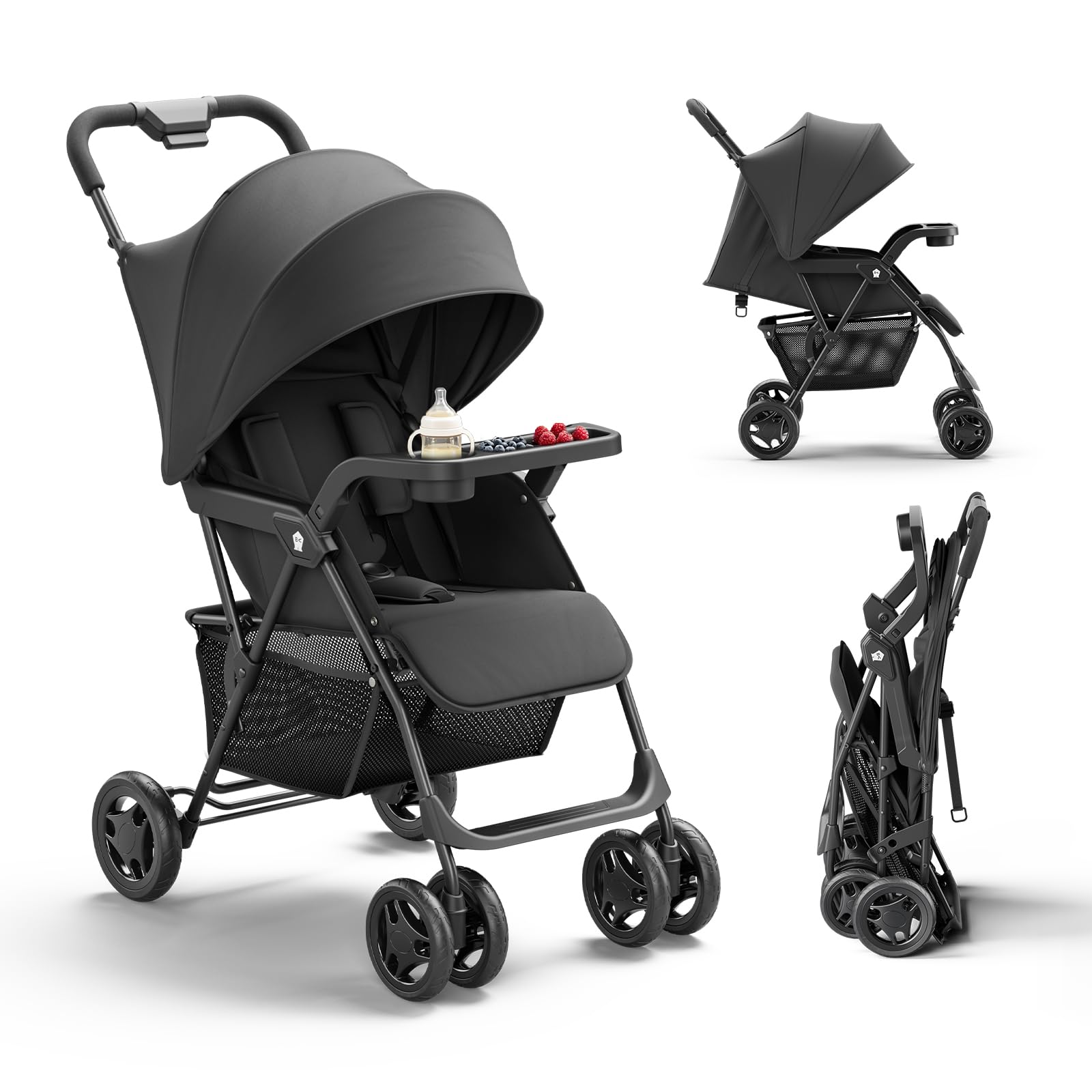
The Best Umbrella Strollers for Travel, Reviewed
1. Dream On Me Aero
Best Overall
Key Features
- Weight: 7.2 lb
- Harness: 3 point
- Folded size: 40.6 x 7.7 in
- Weight limit: 33 lb
- Price: Budget
Seven and a quarter pounds is the entire pitch, and it is the number that matters at the end of a terminal, with a carry-on in one hand and a toddler in the other. This is a stroller you can grab by the frame and keep walking with. The fold is genuinely one-handed: the right-side latch releases the frame, it collapses into a long, narrow bundle, and the latch holds it shut instead of springing open the moment you set it down in a trunk.
For the money, the build is the surprise. A steel frame, 300D polyester on the seat and canopy, dual rear brakes you set with a toe, and a three-point harness with adjustable straps — the corners that usually get cut on a stroller this light are all still here. The canopy lifts off entirely when you want to see your kid, and cleanup is a damp cloth rather than a removable cover and a washing machine. We kept reaching for it for errands, which is not what we expected from an airport stroller.
The catch is the push. The handles sit low, and parents of even average height end up reaching down to the bar; if you are tall, budget for a hunched walk or look at the G-Luxe instead. That is the trade for a frame this light at this price, and for twenty minutes in a terminal it is a fair one.
Pros
- 7.2 pounds with a steel frame
- One-hand fold that latches shut
- Wipe-clean 300D fabric and removable canopy
Cons
- Small canopy shades a face, not a lap
- Seat runs small for older toddlers
We recommend the Aero as the travel stroller for anyone flying with a toddler on a tight budget — it is the lightest and easiest to fold here, provided the low handles suit you.
2. Chicco Liteway
Best for Full Days
Key Features
- Weight: 17.5 lb
- Harness: 5 point
- Recline: 4 positions
- Weight limit: 40 lb
- Price: Midrange
Not every trip is three connections and a sprint to the gate. Some are a rental car, a hotel pool, and four hours in a theme park, and that is the trip where the Liteway earns its keep. It is nearly ten pounds heavier than our top pick, 17.5 pounds against 7.2, and it is the one we point to when the day runs long.
The recline is the reason to carry the extra weight. Four positions, adjusted with one hand, plus an adjustable leg rest, which is enough to lay a tired toddler back mid-afternoon without breaking stride. Rear-wheel suspension takes the chatter out of sidewalk seams, the front wheels swivel, and the canopy carries a peek-a-boo window and UPF 50+ fabric. There is a real basket underneath and a cup holder that comes off for cleaning — small things that add up over six hours out.
The fold is a three-dimensional one with an automatic storage latch and a carry handle, and it works with the canopy still attached, which is the difference between stowing it in a rental-car trunk and fighting with it. At this weight it is a deliberate two-hand lift up a subway staircase, and the carry handle is what makes that tolerable.
Pros
- Four-position recline adjusted with one hand
- Rear-wheel suspension and swivel front wheels
- Fold works with the canopy attached
- Basket and removable cup holder included
Cons
- Plastic tires chatter on cobblestones
The Liteway is our pick when the stroller has to cover a whole day, not just a flight — the recline and suspension are worth the extra weight if you are not hauling it up stairs.
3. UPPAbaby G-Luxe
Best Premium
Key Features
- Canopy: UPF 50+
- Weight: 16 lb
- Folded size: 32 x 10 in
- Weight limit: 50 lb
- Price: Premium
The G-Luxe is the one here built for years rather than for one trip: an aluminum frame, a two-year warranty once you register it, and a seat that holds a child up to 50 pounds, which is big-kid territory the budget umbrellas never reach.
Comfort is where the money goes. A one-handed recline and an adjustable leg rest let a toddler lie back without you stopping, the five-point harness has quick-release buckles, and the extra-large multi-panel canopy is UPF 50+ — real coverage rather than the token hood on a cheap stroller. There is a cup holder and a basket rated to 10 pounds.
We noticed the details that make it easy to live with: it stands on its own when folded, so you are not bending to pick it up off a bus floor, and the carry strap puts the 16 pounds over your shoulder instead of in your hand. It also feels like a stroller that will still be in service when a second child needs it, which is the whole argument for the price.
The push handle runs high. If you are on the shorter side, you will spend the day reaching up for it, so try one in person before you commit to a stroller at this price.
Pros
- Holds a child up to 50 pounds
- Extra-large UPF 50+ canopy and one-hand recline
- Stands folded, with a shoulder carry strap
Cons
- Basket holds only 10 pounds
- Fold takes practice to learn
Buy the G-Luxe if you want one stroller to last: it is the best-built pick here, with room for a 50-pound kid and a canopy that actually covers them.
4. Mamazing Travel Stroller
Best for Naps
Key Features
- Weight: 13.7 lb
- Harness: 5 point
- Recline: Near-flat, multi-position
- Weight limit: 50 lb
A near-flat recline and a snack tray are the two features that define the Mamazing, and on a theme-park day they are worth more than anything on the spec sheet. The seat reclines through multiple positions toward flat, and the tray — removable, with a cup holder and a snack well — sits exactly where a toddler’s hands already are.
The canopy is the other piece worth pointing out: expandable, UPF 50+ rated, with a mesh peek-a-boo window, which is the combination you want for a stroller that will be parked in the sun for an afternoon while you eat lunch.
On the move it is an easy push — a padded one-hand steering handle, swiveling front wheels, and six wheels in total, more contact with the ground than the four-wheel umbrellas here offer. The five-point harness adjusts for height, and the seat is rated to 50 pounds, so it will carry a bigger preschooler than the cheap picks will.
Where it lands for us: this is the stroller that removes the most friction from a long day out. Naps happen, snacks happen, and the sun stays off — three problems the stripped-down umbrellas leave you to solve with a jacket and a muslin. If your trip is mostly transit, our top pick does that job for far less; for a park day, the Mamazing earns its place.
Pros
- Near-flat multi-position recline for naps
- Removable snack tray with cup holder
- Expandable UPF 50+ canopy with peek-a-boo window
- 50-pound limit and five-point harness
Cons
- 13.7 pounds to carry one-handed
For days that stretch past nap time, the Mamazing is the one we reach for — the near-flat recline and snack tray are the most useful features here for a theme park afternoon.
5. Cosco Character Umbrella
Best for Quick Trips

Key Features
- Weight: 7.7 lb
- Harness: 3 point
- Folded size: 13 x 22 x 37 inches
- Weight limit: 40 lb
- Price: Budget
The handles sit low on this one, and anyone much past average height will walk slightly hunched, however good the flamingo print looks. That is the trade for a stroller that weighs 7.7 pounds and folds into a long, flat umbrella bundle you can drop behind a car seat.
What it does well is the short trip. The covered handles give you a decent grip, the canopy adjusts for a little shade, and the seat is a simple sling a toddler can climb into without help. Cute matters more than it should here: the character print is why a 2-year-old who has refused every other stroller will sit down in this one, and we think appearance is the strongest thing about it in this set.
Sizing is the other thing to check first. The seat is shallow, and a tall 2-year-old looks crowded in it well before the 40-pound limit comes into play — this is a stroller that fits the toddler years and not a day past them. For a walk to the corner or a run through an airport, that is the whole job.
Pros
- 7.7 pounds with a compact umbrella fold
- Character print gets reluctant toddlers seated
- Covered handles and adjustable canopy
Cons
- Three-point harness only
- Wheels do not swivel easily on rough ground
It is the stroller for a toddler who will not sit in anything boring, or for the trunk as a second stroller — check the low handles against your own height first.
6. CoComelon Umbrella Stroller
Best for Small Toddlers

Key Features
- Weight: 5 lb
- Harness: 3 point
- Folded size: 43.75 x 7 x 5 inches
- Weight limit: 33 lb
- Price: Budget
Five pounds, and a watermelon-print canopy a toddler will spot across a parking lot. The weight is the travel headline — it is the lightest stroller here — but the print is what actually solves a problem, because a child who wants to sit in this stroller is a child you are not carrying through an airport.
The rest is honest, inexpensive stroller engineering, and most of it is better than the price suggests. A three-point harness with adjustable tension, toe-tap locking rear brakes, a canopy that slides on and locks at both sides, and a fold that collapses into a long, thin package — 43.75 inches of it — that lies flat in a trunk. Assembly is a short sequence: unfold, push the front wheels on, clip the canopy into both sides.
Where it runs out, in our experience, is a long day. The seat is small enough that a big 2-year-old fills it, and the light frame telegraphs pavement in a way a heavier stroller does not. For a terminal, a mall, or a walk to the corner, none of that matters; for an afternoon at a zoo, bring the bigger stroller.
Pros
- Lightest stroller here at 5 pounds
- Canopy slides on and locks for shade
- Toe-tap locking rear brakes
- Folds into a long, flat bundle
Cons
- Canopy position leaves legs in the sun
- Plastic wheels catch on rough ground
If your toddler fights the stroller, this is the least expensive way to win that fight — plan on short trips and a child comfortably under 33 pounds.
7. Dream On Me Rover
Best for Hot-Weather Outings

Key Features
- Weight: 9.5 lb
- Harness: 3 point
- Folded size: 34 x 10 x 12 inches
- Weight limit: 33 lb
- Price: Midrange
Mesh is the detail that sets the Rover apart. The seat and back are air-through mesh rather than polyester, which in a Florida August, a July theme park, or a bus with no air conditioning is the difference between a sweaty toddler and a comfortable one. The canopy comes off entirely, so you can open the whole seat to the breeze.
It is also a better ride than the mid-tier position suggests. Front wheels with suspension and six-inch rear wheels roll over sidewalk seams and curb cuts that stop the tiny-wheeled umbrellas, there is a cup holder for the adult, and a stainless steel frame underneath it all. At 9.5 pounds it is light enough to lift with one hand, and it still feels planted when you push — a balance we did not expect at this weight.
The catch is size. The Rover sits low and the seat runs short, so a child in the upper half of the toddler range looks folded into it, and a tall parent will notice the push height. Measure the seat back against your own kid before you buy: this is a stroller built for the one-to-two-year-old window rather than the whole run to 33 pounds.
Pros
- Breathable mesh seat for hot weather
- Front suspension and six-inch rear wheels
- Removable full canopy and cup holder
Cons
- Three-point harness only
Mesh is the reason to pick the Rover — in a hot destination it is the coolest seat here, and the front suspension keeps pavement from rattling a sleeping toddler.
How We Tested Travel Umbrella Strollers
We started with a broad scan of current umbrella strollers and narrowed the field by the things that make travel easier: a true one-hand fold, a folded footprint that fits a trunk or closet, a weight I could lift with one hand, a canopy, a harness, and either a recline or some storage. That left 12 strollers, which we used for six months.
In airport terminals, theme parks, and on neighborhood errands, we folded and unfolded each stroller while holding a toddler on one hip or a weighted bag when testing alone, then noted whether it stood once closed. We weighed each on a luggage scale, lifted it into car trunks and back seats, and carried it by its handle or strap through security lines and parking lots. On the move, we pushed over carpet, tile, curb cuts, and cracked sidewalks and watched for rattles, frame flex, and front wheels that wandered.
We also loaded a 25-pound sandbag into each seat and had a 5-foot-10 and a 6-foot-2 tester push it to check handle height and toe kicks. We adjusted canopies with a child seated, checked whether peek-a-boo windows stayed visible, reclined seats for pretend diaper changes and naps, and filled storage baskets and cup holders to see what tipped or spilled. At the end, we compared fabric and frame wear, cleaned the seats, and compared what each stroller included with what it cost.
How to Choose an Umbrella Stroller for Travel
The best travel stroller is not the one with the most features — it is the one you can fold with one hand while holding a toddler with the other, then carry up a jet bridge without thinking about it.
Weight Is Only Half of the Carry
A 7-pound umbrella and a 17-pound compact feel identical in a car trunk and nothing alike on a subway staircase with a diaper bag on one shoulder. Before you shop, list the carries your trip actually involves — stairs, a bus step, an airport shuttle, the walk from parking — and buy for the worst one instead of the average.
Folded shape matters as much as the number on the scale. A long, thin umbrella fold slides behind a seat or into a closet corner, while a boxier fold needs floor space a hotel room may not have. Our top pick collapses to 40.6 inches long and just 7.7 wide, which is why it vanishes into a trunk next to the suitcase.
The Fold Has to Work With One Hand
The moment that decides whether you like a travel stroller is the jet bridge: a toddler on your hip, a bag on your shoulder, and a line behind you. A fold that needs two hands and a foot is fine in your driveway and miserable there. Look for a one-hand release plus a latch that holds the frame shut once it is collapsed, so it does not spring open when you set it down.
Practice at home before the trip, and check whether the folded stroller stands on its own — the G-Luxe does, which spares you bending over on a bus — or whether it relies on a shoulder strap instead.
Match the Handle to You and the Seat to Your Child
Handle height is the specification shoppers skip and then regret. Our picks run from low-slung, like the Aero and the Cosco, to a tall push on the G-Luxe, and a few inches decide whether a long walk is comfortable or a backache. Stand with your arms relaxed and notice where your hands fall; a handle more than a couple of inches below that has you leaning all day.
For the child, the weight limit is a ceiling rather than a forecast. Kids outgrow seat depth and shoulder room long before they reach 33 or 50 pounds, so check seat height and canopy clearance for a tall toddler, and prefer a five-point harness over a three-point one for a child who wriggles.
Recline and Canopy Decide How Long the Day Runs
If your trip includes a nap that will not happen in a bed, a reclining seat is the feature worth paying for. A near-flat multi-position recline like the Mamazing’s, or a four-position backrest adjusted with one hand like the Chicco’s, keeps a sleeping toddler asleep while you keep moving. Umbrella strollers with no recline are for children who still nap in a crib.
Canopy coverage is the other half of the equation. Look for sun-rated fabric and a hood that pulls forward over the knees; a small canopy shades a face and leaves legs in the sun, which turns into a sunscreen argument every hour.
Wheels, Tires, and Brakes
Small wheels are the price of a small fold. Four-inch wheels catch in cobblestone gaps and cracked sidewalk; six- or seven-inch rear wheels and a little front suspension roll over them. If your trip means old cities, gravel paths, or theme-park pavement, that matters more than an ounce of weight.
Check that the brakes are a toe-tap pair at the rear rather than a single lever, and that the front wheels swivel and lock. A locked front pair is what keeps you tracking straight down a long concourse or across a sloped station floor, and plastic tires are the first thing to notice on a rough surface.
Frequently Asked Questions
Can I take an umbrella stroller through airport security?
Yes. A stroller goes through the X-ray like a carry-on, so fold it, send it through, and reassemble it on the other side. At the gate, ask the counter for a gate-check tag and leave the stroller folded at the jet bridge; it comes back to you on the jet bridge at your destination.
Confirm the policy with your airline before an international flight, since some carriers have their own weight and size rules for gate-checked strollers.
How old does a child need to be for an umbrella stroller?
Old enough to sit up unsupported, which for most children is around six months. These are seats and harnesses, not beds, and the models without a recline are for a child who can hold themselves upright for the length of a walk.
Check the seat’s stated minimum age and the weight limit together. The picks here run from 33 to 50 pounds, and a child who cannot sit steadily needs a reclining stroller with a full harness instead.
Do I need a travel bag for a stroller?
A bag is cheap insurance if the stroller will be gate-checked or sent into the hold. It keeps the fold latch from catching on a conveyor, keeps grease and grit off the fabric, and gives you a handle when the frame is slippery.
Put a luggage tag on the bag with your name and flight number, and fold the stroller the way the airline asks before you hand it over.
Can an umbrella stroller be my only stroller?
For a child past the newborn stage in a walkable neighborhood, sometimes yes — but go in knowing what you give up: a recline for naps, a large basket, and a cushioned ride over rough pavement.
Most of the picks here work best as the second stroller that lives in the car or the travel bag. If it will handle daily duty, choose one of the reclining models and check the push handle against your own height first.
Final Verdict
The Dream On Me Aero is what we hand to most travelers: 7.2 pounds, a fold you can work with one hand while holding a child, a steel frame, and a price that leaves room in the budget for the rest of the trip. It is the easiest stroller here to carry and the easiest to live with at a gate.
If your days include a nap and a theme park rather than a connection, the Chicco Liteway‘s recline and suspension justify carrying ten more pounds. If you want one stroller to last through a second child, the UPPAbaby G-Luxe is the one worth the money.