This post contains affiliate links. We may earn a small commission when you buy through our links — at no extra cost to you.
I love an old cobblestone street as much as anyone — until a stroller’s front wheels drop into the gap between two stones and the whole thing stops dead. That jolt is the problem in miniature: most travel strollers are built for smooth floors and airplane aisles, not for 200-year-old paving. The right one rolls over the seams instead of catching them, has enough give in the frame that the bumps don’t travel straight into your kid, and folds with one hand while the other hand is holding a toddler on a crowded corner.
My team and I spent the past seven months pushing 12 travel strollers over the same half-mile of brick sidewalk, cobblestone, and torn-up asphalt near our office, then folding and carrying every one of them through airport gates, onto trains, and up the stairs of walk-ups.
One thing worth knowing before you shop: the lightest strollers are usually the twitchiest, and a model with no suspension sends every stone straight into the seat. Weight, folded size, and ride quality pull against each other, so there’s no single winner here — just a short list I’d happily take on a trip.
Our Top Picks


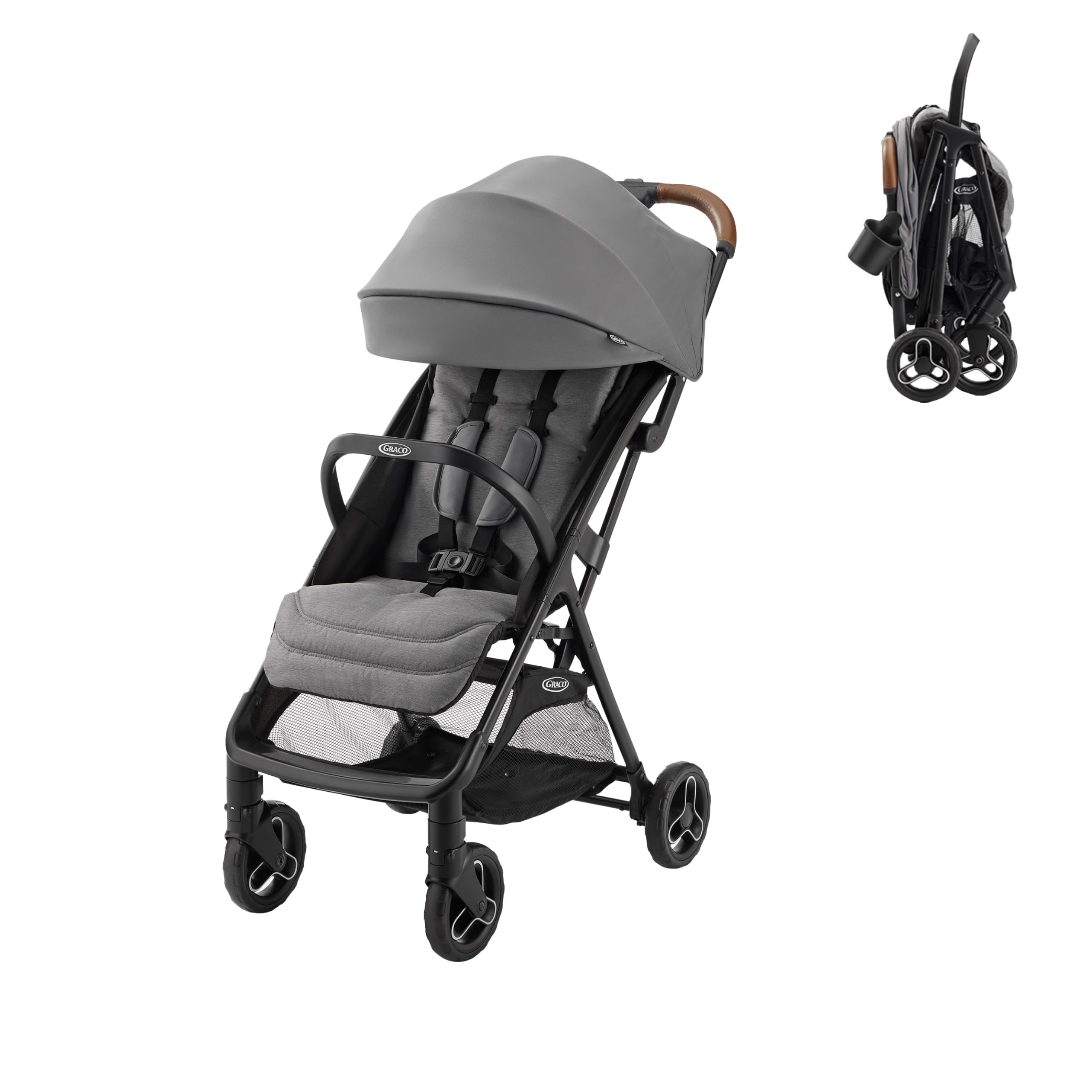


The Best Travel Strollers for Cobblestone Streets, Reviewed
1. Mompush Jeto
Best Overall
Key Features
- Weight: 10.1 lb
- Wheels: 5.3 in rear, 4.9 in front
- Suspension: Yes
- Folded size: 20.5 x 17.3 x 7.1 in
- Price: Budget
The Jeto is the only stroller here that promises a cobblestone-ready ride, and the hardware backs up the wording: 5.3-inch rear wheels, 4.9-inch front wheels, and suspension on a frame that weighs just over 10 pounds. That is the combination we want for a trip where the pavement changes from airport tile to old stone without warning.
That wheel-and-suspension package is why it earns the top spot. Small hard wheels turn a cobblestone street into a jackhammer; the Jeto’s larger wheels and suspension give it the best chance of staying composed in this set. We also appreciate the one-second fold and the 20.5 x 17.3 x 7.1-inch folded package, which is easy to stash in a trunk or carry up a few steps.
The 40-pound weight limit is the main spec to check. It is lower than several strollers here, so a heavy 4-year-old may outgrow it before the frame gives out. For a toddler and a light day bag, that is a fair trade for the lighter carry and the smoother ride.
Pros
- Suspension and larger wheels for cobblestones
- About 10 pounds with one-hand fold
- Compact folded package
Cons
- No newborn recline
For toddler travel over cobblestones, the Jeto is our default: about 10 pounds, a one-hand fold, and the most cobblestone-specific wheel-and-suspension setup here.
2. Joie Nutmeg
Best for Bumpy Streets
Key Features
- Weight: 16.3 lb
- Wheels: 8.25 in rear, 6.25 in front
- Recline: Near-flat
- Folded size: 12 x 19.5 x 30.5 in
- Price: Premium
At 16.3 pounds, the Nutmeg is the heaviest stroller we are recommending, and we are recommending it anyway. The 8.25-inch rear and 6.25-inch front wheels are the largest in this group, and the front swivel wheels lock at the push of a button when the ground turns rough. That is the hardware that makes a bumpy street feel less like a washboard.
The near-flat recline is the other reason it stands out. It is a true newborn option, with a 5-point harness and a 50-pound weight limit that gives it a longer runway than the Jeto. The one-hand fold and compact package are good for a full-feature stroller, but this is still a stroller you push more than you carry.
We like it for a trip where comfort and rough-ground stability matter more than shaving pounds off the carry. The ride and the newborn seat are worth the extra heft, especially if your days start and end at a hotel elevator rather than a fifth-floor walk-up.
Pros
- Largest wheels here for rough ground
- Near-flat newborn recline
- One-hand fold and 50-lb limit
Cons
- Shallow storage basket
For newborns and rough pavement, we think the Nutmeg’s big wheels and near-flat seat justify the heavier carry.
3. Graco Ready2Jet
Best All-Wheel Suspension
Key Features
- Weight: 13.2 lb
- Max weight: 50 lb
- Suspension: All-wheel
- Folded size: Less than 43.5 x 12 x 8 in
- Price: Midrange
All-wheel suspension is the feature that separates the Ready2Jet from the ultralight pack. Graco pairs it with rubber tires and a 13.2-pound frame, then adds a one-hand automatic fold that leaves the stroller standing on its own.
We think that is the right mix for a travel stroller that will spend as much time on brick sidewalks and airport trains as on cobblestones. The suspension takes the edge off uneven pavement, and the self-standing fold is a small thing that matters when you are holding a coffee and a boarding pass. It also accepts Graco SnugRide infant seats, which makes it the pick for a family already in that ecosystem.
The seat reclines for naps, but it is not a near-flat newborn bed; plan on the car-seat connection for a newborn or wait a few months. For a toddler and a parent who wants suspension without a premium price, it is a strong middle path.
Pros
- All-wheel suspension
- Self-standing one-hand auto fold
- Accepts Graco SnugRide seats
Cons
- Car-seat lock can take several tries
When you want all-wheel suspension and a Graco car-seat connection, the Ready2Jet is our most practical midrange choice.
4. Mamazing Ultra Air
Best Ultralight
Key Features
- Weight: 11.6 lb
- Wheels: 6 in rear, 5.5 in front
- Max weight: 50 lb
- Folded size: 22 x 19.3 x 11 in
- Price: Midrange
The Ultra Air makes its case with a carbon fiber frame that weighs 11.6 pounds and a fold you can work with one hand while a toddler hangs on the other. For air travel, that is a persuasive combination.
The 50-pound weight limit is higher than the Jeto’s, and the 22-pound basket is unusually generous for a stroller this light. We also like the included travel bag and the 5-point harness. The folded package is 22 x 19.3 x 11 inches, which is compact for a trunk but not the smallest here.
For cobblestones, the Ultra Air is a compromise. The EVA wheels are 6 inches in back and 5.5 inches in front, and there is no suspension, so a long stretch of rough stone will rattle through the frame. We still recommend it for travelers who need the lightest possible carry and will use it mostly on airport floors and smooth city centers.
Pros
- 11.6-pound carbon frame
- One-hand fold and 50-lb limit
- Generous 22-pound basket
Cons
- Carry strap durability is a weak point
The Ultra Air is our air-travel specialist: 11.6 pounds, a one-hand fold, and a 50-pound limit, as long as cobblestone stretches stay short.
5. Mompush Lithe V2
Best for All-Day Outings
Key Features
- Weight: 17.4 lb
- Wheels: 5.5 in rear, 4.9 in front
- Recline: 175 degrees
- Folded size: 21.26 x 11.2 x 26.9 in
- Price: Midrange
A snack tray sounds like a small thing until you are three hours into a theme park day and the crackers are in the basket instead of within reach. The Lithe V2 builds a full-day kit around that idea: a removable tray, a 175-degree near-flat recline, and a UPF 50+ canopy.
The fold is quick once you learn it, and the near-flat seat is the reason to consider it over the Jeto if naps are part of your day. It also comes with a travel bag and rain cover, which is a useful kit for a trip where the weather changes.
We like it best as a home-base stroller for a trip with lots of stops, not as the one you carry up five flights. At 17.4 pounds it is the heaviest pick here, and the 5.5-inch rear wheels do not have suspension, so it is better on smooth promenades and mild cobbles than on rough stone. If your itinerary is mostly museums and cafes, that is a fair trade for the tray and the recline.
Pros
- 175-degree recline for naps
- Removable snack tray and cup holder
- Travel bag and rain cover included
Cons
- Small 4.4-pound basket
We like the Lithe V2 as a home base for long days with a napping, snacking toddler, provided you are not carrying it far.
6. Jeep Altitude
Best for Pavement-Heavy Trips

Key Features
- Weight: 16.6 lb
- Max weight: 50 lb
- Suspension: 4-wheel
- Folded size: 12.5 x 19 x 29 in
- Price: Budget
The Altitude is the budget route to four-wheel suspension: 5.5-inch front and 6-inch rear EVA tires, a one-hand auto fold, and a 16.6-pound frame. We like that combination for pavement-heavy trips.
The fold is genuinely compact for a stroller with this much seat, and the 50-pound limit gives it more growing room than the Jeto and Lithe. The adjustable footrest and multi-position recline are useful for a growing toddler, and the leatherette handlebar is a nicer touch than the price suggests.
For theme parks, airport concourses, and city sidewalks, it is a lot of stroller for the money. The ride is tuned for pavement and smooth urban terrain, so deep, uneven cobblestones will still come through the frame. We see it as the value pick for families who want suspension and a compact fold without paying premium money.
Pros
- Four-wheel suspension at a budget price
- One-hand auto fold
- 50-pound limit and adjustable footrest
Cons
- Canopy coverage is modest
The Altitude is our value pick for pavement-heavy trips, with four-wheel suspension and a compact auto fold.
7. gb Pockit+ All-Terrain
Smallest Packed Size

Key Features
- Weight: 10.4 lb
- Wheels: 4.7 in front and rear
- Max weight: 55 lb
- Folded size: 13.4 x 7.9 x 16.5 in
- Price: Midrange
If your travel day hinges on fitting the stroller into an overhead bin, the Pockit+ All-Terrain is the one to beat: 13.4 x 7.9 x 16.5 inches folded and 10.4 pounds.
The 55-pound limit is the highest here, and the two-step fold collapses into a package that disappears into a trunk or a closet. It is not a one-hand operation, though, so plan on setting your bag down at the gate.
The all-terrain name deserves a caveat. The wheels are 4.7 inches and made of plastic and EVA, so cobblestones will come through as vibration rather than disappearing under a suspended ride.
We still see the appeal for a city trip with lots of stairs and tiny trunks: it is the smallest folded package here, and it is light enough to carry in one hand. Just do not expect it to turn rough stone into smooth pavement.
Pros
- Smallest folded package here
- 10.4 pounds with a 55-pound limit
- Light enough to carry in one hand
Cons
- 3-point harness
- Support band durability
When the folded package has to be as small as possible, the Pockit+ All-Terrain is the one we reach for, with the caveat that its ride is firm on stone.
8. Dream On Me Aero
Best for Short, Light Trips

Key Features
- Weight: 7.2 lb
- Wheels: 4.1 in front and rear
- Max weight: 33 lb
- Folded size: 40.6 x 7.7 in
- Price: Budget
At 7.2 pounds, the Aero is the lightest stroller here by a wide margin. It is also the least expensive, which makes it tempting as a just-in-case stroller for short trips.
The steel frame and one-hand fold are welcome at this weight, and the dual brakes are easier to trust than a single pedal. The 33-pound limit and 4.1-inch wheels tell you what kind of stroller this is: a short-hop specialist, not an all-day cobblestone cruiser.
For quick errands, a taxi transfer, or a backup kept in the trunk, that light carry is the whole point. It sets up fast and takes up little space, and the simple canopy is enough for a dash between buildings.
We see it as a backup stroller that lives in the trunk or a grandparent’s closet, not the one you pack for a cobblestone-heavy week. If your trip is mostly airports, taxis, and smooth sidewalks, the low weight is worth the smaller wheels.
Pros
- 7.2-pound frame
- One-hand fold with dual brakes
- Lowest price in this group
Cons
- Minimal canopy
- Short handle for taller parents
The Aero is the lightest backup stroller here, and we recommend it for short trips where every pound counts.
How We Tested Travel Strollers on Cobblestone
We started by pulling every lightweight travel stroller we could find and checking each one’s folded dimensions against the published overhead-bin sizes for the major U.S. airlines. That narrowed things to 12 models that folded small enough to carry on, weighed under roughly 15 pounds, and sat in the middle of the market. Over seven months, each one covered the same half-mile loop: a brick sidewalk, a cobblestone square, a stretch of cracked asphalt, a gravel park path, and four curbs.
Maneuverability and sturdiness came first. We pushed each stroller one-handed with a full coffee in the other and noted which ones wandered on the stones and which tracked straight through a narrow shop doorway. After every run we checked the joints for wobble, the fabric for scuffs, and whether the frame still felt tight after being gate-checked and tossed in a trunk.
For foldability, we timed the one-hand fold, then did it again while holding a 25-pound toddler on one hip and again at the gate with a boarding pass in my teeth. Folded, each stroller had to stand on its own, slide into an overhead bin we’d measured beforehand, and roll down a jet bridge without clipping the sides. We also clicked an infant car seat into every model that claimed compatibility and noted how much wrestling the adapters took.
Every stroller went on a luggage scale and then got carried up three flights of stairs. We loaded the under-seat basket with a diaper bag, two water bottles, and a bag of groceries to see what fit and whether we could still reach it with the seat reclined. For stability, we hung a loaded tote from the handlebars and backed each one off a curb to see if it wanted to tip. Value came down to what actually arrived in the box — travel bag, rain cover, canopy coverage — and whether the harness and recline could be worked with one hand.
How to Choose a Travel Stroller for Cobblestone Streets
The stroller that handles cobblestones best is not automatically the smallest one; it is the one that keeps its wheels in contact with uneven ground while staying light enough to carry through a gate.
Start With the Wheels and Suspension
Small, hard wheels are the main reason a travel stroller rattles on old stone. Look for wheels at least in the 5.5- to 6-inch range, a little give in the tire, and either suspension or a front wheel that locks straight for rough stretches. The Mompush Jeto is the clearest example here: 5.3-inch rear wheels, 4.9-inch fronts, and suspension in a package around 10 pounds. The Joie Nutmeg goes further with 8.25-inch rear wheels, but it adds several pounds. Do not trust an all-terrain label without checking the wheel size.
Match the Fold to the Trip
A one-hand fold matters most when you are alone with a child, a bag, and a boarding pass. A two-step fold can still be fine if you have a travel partner or a trunk to load. Check the folded dimensions against your airline’s carry-on guidance, and remember that overhead-bin fit varies by aircraft. The Graco Ready2Jet’s automatic self-standing fold is the easiest here for a hands-full moment; the gb Pockit+ All-Terrain wins on pure packed size.
Decide Whether You Need a Newborn Seat
If you are traveling with a newborn, a near-flat recline and a 5-point harness are worth prioritizing over the smallest fold. The Joie Nutmeg and Mompush Lithe V2 both recline close to flat; the Jeto and several ultralights start at 6 months. If you already own a compatible infant car seat, a stroller that accepts it can cover the newborn stage without a second seat.
Weigh the Carry Against the Comfort
Every pound you save tends to cost something in wheel size, seat padding, or storage. If you will lift the stroller onto buses, up stairs, or into an overhead bin, stay near 10 to 12 pounds and accept a smaller basket. If the stroller will live in a trunk and roll mostly on paved paths, a 16- to 17-pound model buys a plusher seat and more storage. The Lithe V2 is the comfort-first example; the Dream On Me Aero is the carry-first extreme.
Check the Parts That Wear First
On a travel stroller, the carry strap, folding latch, wheel forks, and brake pedals take more abuse than the frame. Look for a stated warranty and available replacement parts, and check the straps and latches before a trip. A lightweight umbrella stroller can be fine for short hops, but its small wheels and simple harness are not the best match for a week of rough stone.
Frequently Asked Questions
How do I keep a lightweight stroller from tipping on uneven streets?
Keep the heaviest bag in the under-seat basket, not on the handlebar. A diaper bag hanging from the grips changes the center of gravity fast, especially when the stroller is empty or the child leans to one side. Set the brake whenever you stop, and if you routinely carry a lot, choose a stroller with a higher basket limit rather than adding a handlebar hook.
What should I do if a stroller wheel stops swiveling on a trip?
Check the wheel fork for hair, grit, or tar before you force it. Wipe the fork, spin the wheel, and make sure the brake pedal is not half-engaged. If the front wheels have a lock, release it for city walking and lock it only for gravel or a straight rough stretch. If it still drags, ask the manufacturer for a replacement wheel instead of bending the fork.
Do I need a travel bag to gate-check a stroller?
A bag protects the folded stroller from grime and baggage-handling scuffs, but it does not guarantee airline acceptance. Check your airline’s folded-size limit before departure; if the stroller is going in the overhead bin, you may not need a bag at all. Use one if you plan to gate-check, and confirm whether the manufacturer requires it to keep the warranty valid.
Final Verdict
Most travelers should start with the Mompush Jeto. It is the lightest stroller here that pairs larger wheels with suspension, and the one-hand fold makes it manageable at a gate or on a bus. It gives up newborn recline and a generous basket, so it is the toddler-and-light-bag choice rather than the do-everything choice.
If you need a near-flat seat for a newborn or the largest wheels in the set, the Joie Nutmeg is worth the extra weight. If you want all-wheel suspension and a Graco car-seat connection, the Ready2Jet is the better fit. Those two cover the trips the Jeto cannot.