This post contains affiliate links. We may earn a small commission when you buy through our links — at no extra cost to you.
The trip was going fine until bedtime. A rented condo, a toddler who had decided the portable crib was a personal insult, and forty minutes later she was asleep on a nest of blankets on the floor. That’s what a toddler travel bed is for, but the good ones do more than give a kid somewhere to land: they hold air until morning, keep a sleeper off the carpet, and pack small enough that you actually bring them.
We’ve spent nine months with 12 of them — inflatables with built-in bumpers, folding cots, foam sandwich beds — and the same pattern keeps showing up. The pump decides whether you’ll use it: a bed that takes fifteen minutes of hand pumping at the end of a travel day stays in the trunk. Bumper height and packed footprint come next.
Most cost less than a night in a hotel, which is the bar I hold them to. Below are the ones that survived being jumped on, dragged through airports, and slept in by a kid who rolls.
Our Top Picks


The Best Toddler Travel Beds, Reviewed
1. Hiccapop Inflatable Travel Bed
Best Overall
Key Features
- Weight: 8 lb
- Bumpers: 4-sided
- Dimensions: 62 x 39 x 12 in
- Weight capacity: 310 lb
- Price: Premium
The four-sided bumper is the first thing we noticed, and it changes the bedtime routine. Instead of a token pillow at the edge, the Hiccapop gives you a continuous wall on all four sides; in our testing, a 2-year-old rolled into it and stayed asleep. The sleep surface is 62 by 39 inches, roomy for a toddler without taking over a spare room.
The electric pump fills the bed quickly, and the whole thing packs into the included bag at 8 pounds. The 310-pound capacity is more than a toddler needs, but it makes the bed feel stable when a sibling climbs in for a story. It fits standard crib sheets, which is one less thing to buy for every trip.
Any inflatable can develop a leak at a seam or valve, so give a new one a trial night at home and store it loosely rather than folded tight. That is true of every air bed here, not just this one. The Hiccapop’s extra-tall bumpers and longer rails give a restless sleeper more feedback before they reach the edge.
The bed we kept coming back to was the one that needed the least bedtime negotiation: no pillow wall to rebuild, no special sheets, no wrestling match with a cover. That is worth more than a lower sticker price when you are already off routine.
Pros
- Four tall bumpers contain active sleepers
- 310-lb capacity and a 62-inch surface
- Fits standard crib sheets
- Packs to 8 lb with a pump
Cons
- Pump is US-only
The Hiccapop is our default pick for most families: four tall bumpers contain active sleepers, and the 8-pound packed weight is easy to live with.
2. Regalo My Cot
Best No-Inflate Option
Key Features
- Setup: No assembly
- Weight: 6.3 lb
- Dimensions: 48 x 24.5 x 9 in
- Weight capacity: 75 lb
There is no pump to lose and no valve to babysit. The Regalo is a toddler cot that unfolds like a camping cot, with a canvas sleeping surface stretched over a metal frame; we set it up in a spare bedroom while holding a bag in the other hand. At 48 by 24.5 inches, it is narrower than the inflatables, and the sleep surface sits low to the floor.
That low, open shape is the point. A toddler who stays put can climb in and out without a bumper, and the cot folds down for closet storage. The 75-pound limit is fine for most 2- to 4-year-olds. We found the canvas taut enough for a folded blanket to take the edge off; without one, a light sleeper may feel the frame.
The Regalo is not a trampoline: the corner plugs are the first thing to check if kids start standing on it. For a grandparent who wants a no-inflate bed for short visits, that is the main boundary to know.
Pros
- No pump or inflation
- Folds compactly for storage
- 75-lb capacity
Cons
- No rails to stop a roller
For no-pump sleepovers, the Regalo is the one we grab: it unfolds in seconds and suits a toddler who stays put.
3. EnerPlex Kids Travel Bed
Best Wide Inflatable
Key Features
- Pump: 120V electric
- Weight: 12.5 lb
- Dimensions: 66 x 44 x 13 in
- Weight limit: 150 lb
- Price: Midrange
Forty-four inches is the number that matters here. The EnerPlex is wider than the Hiccapop and the Sleepah, and the extra width shows up when a toddler sprawls sideways or wants a stuffed animal in bed. The 13-inch thickness gives it a plush feel, and the built-in bumper runs around the perimeter rather than sitting on top like a separate rail.
The 120V pump fills it fast, and the bed takes standard crib sheets. The 150-pound limit is lower than the Hiccapop’s, but it is plenty for a toddler or young preschooler. The extra width also gives you room to sit beside a child at bedtime without perching on the edge.
Deflation is the caveat with this one. Give it a trial night at home before you rely on it for a hotel stay, and keep it away from sharp toys and rough floors. For a child who needs room to spread out, the wider surface is worth the trade-off.
Pros
- 44-inch width suits sprawlers
- 13-inch thickness feels plush
- Built-in perimeter bumper
- Fits standard crib sheets
Cons
- 12.5 lb is heavy for flights
We reach for the EnerPlex when a child needs more width; the 44-inch surface and 13-inch thickness feel generous, and the 120V pump fills it fast.
4. Intex Kidz Travel Bed
Best Budget Pick
Key Features
- Ages: 3 to 6 years
- Pump: Hand pump
- Dimensions: 66 x 42 x 10 in
- Weight limit: 50 lb
- Price: Budget
The hand pump is the first thing you notice, and it is the main reason this bed costs less than the electric-pump picks. It takes steady work to fill both chambers, so it is not the bed to choose if you are setting up after bedtime in a dark hotel room. What you get for that effort is a 66 by 42-inch surface, a removable mattress, and a carry bag.
The removable mattress is the detail we appreciate most: it lifts out of the inflatable frame, which makes drying and sheet changes easier than wrestling a fitted sheet around a single-piece air bed. The 50-pound limit is the catch. For a small 3- or 4-year-old on occasional trips, that is a fair budget trade.
The set includes a repair patch, which is useful for any inflatable. Give it a trial night at home and keep it away from rough floors. The Intex is the least expensive bed here; it is also the one that asks the most setup patience.
Pros
- Budget-friendly first inflatable
- Removable mattress simplifies cleaning
- Includes hand pump and repair patch
Cons
- Air retention can be inconsistent
We see the Intex as a low-cost first inflatable for a small toddler on occasional trips.
5. QPAU Tent Travel Bed
Best Play Bed
Key Features
- Ages: 3 and up
- Tent: Detachable
- Weight: 9.3 lb
- Sleep area: 78 x 43 in
- Price: Budget
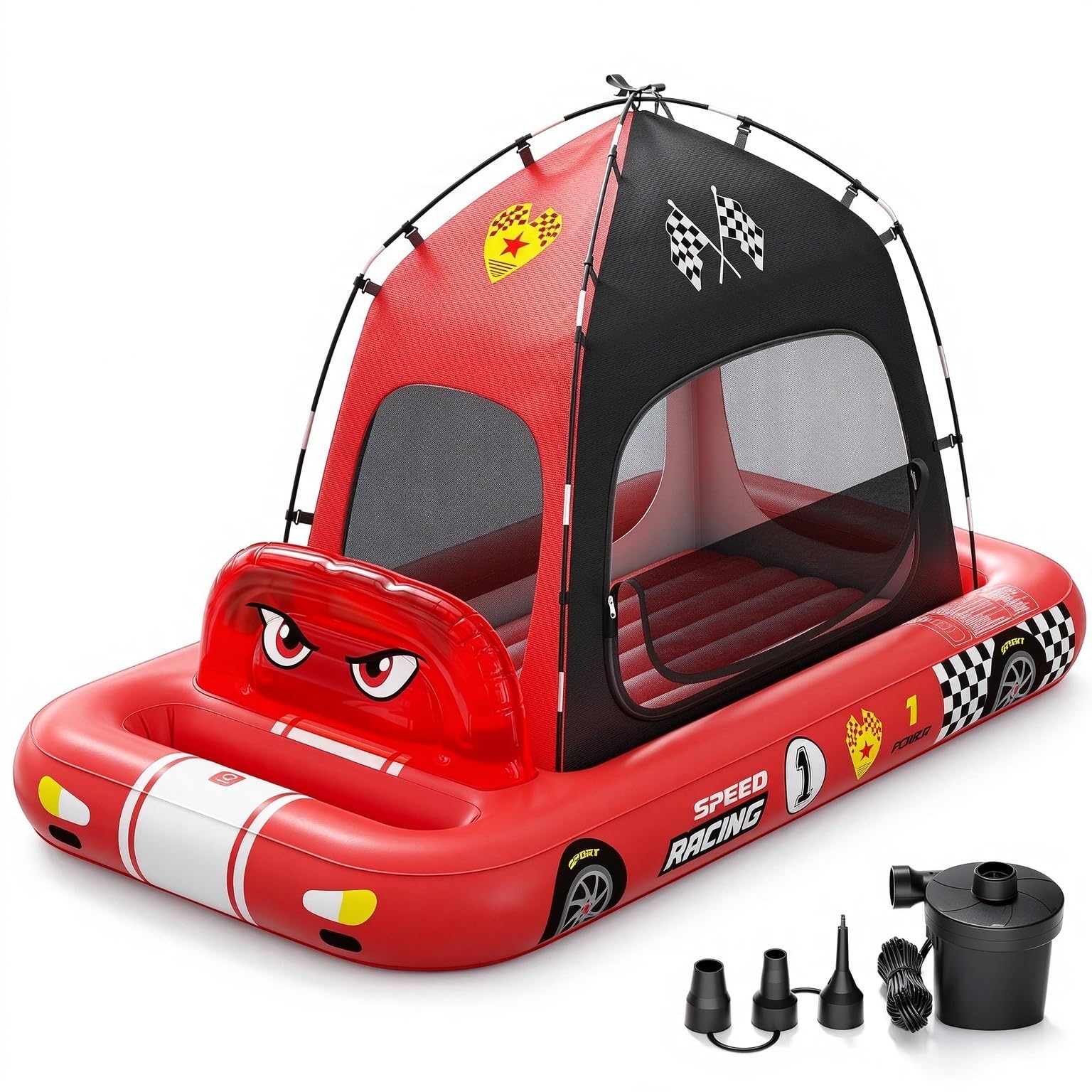
The tent is not a gimmick if your child is nervous about a new room. It attaches over the mattress and gives a toddler a little cave to crawl into; the race-car shape gives them a reason to get in. We set it up in a living room before a trip, and the bed became a play space before it became a sleep space. For a preschooler who needs coaxing, that is the best trick in this group.
The mattress itself is 78 by 43 inches, the biggest footprint here, so it is a play-and-sleep bed rather than a compact travel solution. The electric pump and carry bag make setup easy, and the raised edges help define the sleep area. The age rating starts at 3, so this is not the bed for a 2-year-old.
Pros
- Detachable tent makes new rooms less scary
- Large 78 x 43 play area
- Electric pump and carry bag
- Race-car shape appeals to kids
Cons
- Tent adds pieces to keep track of
For a preschooler who needs coaxing into bed, we pick the QPAU: the tent and race-car shape make an unfamiliar room feel like play.
6. Sleepah Travel Bed Set
Best for Grandparent Setups

Key Features
- Weight: 9 lb
- Included: Pump, pillow, case, patch
- Dimensions: 61 x 40 x 12 in
- Weight limit: 300 lb
- Price: Midrange
The Sleepah is the closest thing to a travel-bed starter kit: the inflatable bed, electric pump, pillow, carry case, and patch kit all arrive together. For a grandparent who does not want to hunt for a pump and a crib sheet at bedtime, that bundle is the appeal. It is a sensible one-box buy, even if it is not our overall pick.
At 61 by 40 inches and 300 pounds, it sits between the Hiccapop and EnerPlex on size and capacity. It takes standard crib sheets, and the three bumpers leave an open side that is easy to climb through. Give it a trial night at home for air retention, and keep the patch kit handy.
Pros
- Complete kit includes pump, pillow, and case
- 300-lb capacity
- Fits standard crib sheets
- Three bumpers ease entry
Cons
- Open side is less enclosing
We like the Sleepah as a one-box grandparent kit: the pump, pillow, case, and crib-sheet fit remove the scramble.
7. Liftoza Sandwich Travel Bed
Best for Quiet Floor Sleeps

Key Features
- Weight: 5.8 lb
- Assembly: None required
- Material: Foam with washable cover
- Dimensions: 54 x 25 x 7 in
- Price: Premium
After a week of inflatables, the Liftoza is a different kind of travel bed: no pump, no valve, no midnight top-off. The foam core unfolds from its sandwich shape and is ready to use, and the cover is machine washable. For a toddler who hates the bounce and noise of an air bed, that is a real advantage.
The 54 by 25-inch surface is the catch. It is narrower than every inflatable here, and the 7-inch foam is soft rather than firm. A small 2- or 3-year-old can sleep on it comfortably; a bigger 5-year-old may feel the floor through the foam.
The Liftoza also takes up less visual space than a tent bed and has no cords or pump to pack. If your child needs a firm, wide surface, the Hiccapop or EnerPlex is the better call. For a small sleeper and a no-fuss trip, the foam bed is the one we reach for when we want silence.
Pros
- No pump or inflation
- Machine-washable cover
- Quiet foam surface
- 5.8 lb packs light
Cons
- Cover is not waterproof
For a toddler who fights air mattresses, we choose the Liftoza: the foam core needs no pump and the cover is washable.
How We Tested Toddler Travel Beds
We started by pulling every toddler travel bed we could find that had a raised edge or bumper, a stated weight limit, and some way to carry it, then narrowed by packed size and price until we had 12 to test — inflatables, a folding cot, and a foam sandwich-style floor bed. Each one spent nine months in rotation: naps at home in the guest room, overnights at Grandma’s, two hotel stays, a week in a rental, and a tent in the backyard.
Every bed got inflated and deflated at least a dozen times, with a stopwatch on the pump and on the pack-down, and once with a toddler hanging off my leg, because that’s how it actually happens. We inflated each one on a Friday night and checked firmness at bedtime, at 2 a.m., and again in the morning to see which ones softened overnight. Then we watched kids get in and out: whether a 30-pound sleeper rolled against the bumper or over it, whether sheets stayed on the mattress, and whether a valve or a seam poked anyone in the back.
Durability got the least gentle treatment. Beds were jumped on, folded and unfolded well past the recommended count, stuffed into trunks, and left inflated for days in a warm car, and we noted slow leaks, stretched seams, torn carry bags, and pumps that lost pressure. Before packing each one away we measured and weighed it, then checked whether it fit a duffel, a carry-on, and a trunk with a week’s luggage already in it.
How to Choose a Toddler Travel Bed
Start with how your child sleeps and how you travel; the label on the box matters less than containment, setup, and packed size.
Match the Bed to Your Child’s Sleep Style
A toddler who rolls in every direction needs a different bed from one who sleeps in the same spot all night. Four-sided bumpers, like the Hiccapop’s, give a restless sleeper a soft wall on every edge. A three-sided bed is easier to climb into but leaves one side open. A low cot or foam floor bed suits a child who stays put and dislikes the bounce of an air mattress.
We put containment first because it is the thing you cannot fix at bedtime. A thin blanket under a cot can soften the surface, but it cannot make up for a missing fourth wall. Look at the shape of the bed and your child’s sleep habits before you compare pumps or colors.
Check Weight Limits and Usable Size
The weight limit is the quickest way to rule out a bed. The Intex tops out at 50 pounds, the Regalo at 75, and the EnerPlex at 150; the Hiccapop and Sleepah are rated for 300 pounds or more. A 40-pound 4-year-old has room to grow in most of these, but a tall 6-year-old will be cramped on a 50-pound bed.
Length and width matter more than the packed measurement. A 48-inch cot is fine for a small toddler but short for a tall preschooler; a 66- to 78-inch inflatable gives more room to sprawl. Check the sleep surface, not the size of the carry bag.
Decide How Much Setup You’ll Tolerate
Electric pumps are the difference between a bed that goes up in under a minute and one that takes steady hand-pump work. The Hiccapop, EnerPlex, QPAU, and Sleepah include electric pumps; the Intex uses a hand pump, which is the trade-off for its low price. If you often arrive after bedtime, pay for the electric pump.
Air retention is the other half of setup. Inflatables can lose air at seams or valves, so give a new bed a trial night at home and keep a repair patch handy. A cot or foam bed avoids that problem entirely, but gives up the cushioned, contained feel some toddlers need.
Pack for the Trip You Actually Take
Packed weight ranges from about 5.8 pounds for the Liftoza to 12.5 pounds for the EnerPlex, and that difference matters on stairs, trains, and flights. A bed that fits standard crib sheets is easier to launder and remake; the Hiccapop, EnerPlex, and Sleepah all take them. The Intex uses a removable mattress and a hand pump, so it is a better fit for car trips than air travel.
Measure the floor space before you leave. A 78-inch QPAU or a 66-inch inflatable can dominate a small hotel room, while a 48-inch cot or 54-inch foam bed tucks into a corner. If you are flying, treat the bed as checked luggage and confirm the airline’s rules for bulky items.
Frequently Asked Questions
Can a toddler travel bed replace a crib or pack-and-play?
For a toddler who has outgrown a crib and can sleep on a low bed, yes; these beds are designed for trips and sleepovers, not as a permanent crib replacement. Follow the maker’s age and weight limits. If your child still climbs out of a crib or needs full containment, a pack-and-play is the safer choice for now.
How do I keep an inflatable bed from sliding on a hotel floor?
Put a thin rubber bath mat or a piece of non-slip rug pad under the bed; it grips tile and hardwood without adding a soft layer that can bunch up. Avoid placing the bed against a heater or a sharp furniture edge. On carpet, the bed usually stays put without help.
What if my toddler won’t sleep on a travel bed?
Set it up during the day and let your child play in it; use the same crib sheet and bedtime routine you use at home. Plan a trial night at home before a trip. A familiar pillow and a small favorite toy do more than a new character bed. If your child is used to a crib, give them a few days to warm up to the open surface.
Final Verdict
The Hiccapop is the bed we recommend first because it gets the fundamentals right: four tall bumpers, a roomy 62-inch surface, standard crib-sheet fit, and an 8-pound packed weight. It is not the cheapest inflatable here, but it is the one that needs the least improvisation at bedtime.
If your child sleeps still and you want no pump at all, the Regalo My Cot is the simpler answer. If you need a wider surface and have a car, the EnerPlex is the better fit.