This post contains affiliate links. We may earn a small commission when you buy through our links — at no extra cost to you.
There’s a particular kind of tired that only happens at 35,000 feet: the cabin lights are down, there are four hours left, and your head has started its slow slide toward a stranger’s shoulder. A travel pillow is supposed to prevent exactly that, and most of them don’t — the foam flattens by hour two, the U-shape shoves your chin forward, and you land feeling worse than when you boarded.
I’ve flown with these things wedged under my arm for years, and over the past four months my team put 14 of them through red-eye flights, cross-country hauls, and the odd office nap. The pattern is consistent: softness and support are not the same thing, and the squishiest pillow is usually the first to quit. What separates the good ones is foam that springs back, head support that stops the bob-and-jerk, and a strap or tether that anchors the whole thing to your seat. Size and packability decide whether it actually travels with you — and at these prices, value is less about the tag than about how many flights it survives.
The picks below are the ones we’d carry on again, sorted by who they suit best.
Our Top Picks


The Best Travel Pillows for Long Flights, Reviewed
1. MLVOC Travel Pillow Kit
Best Overall
Key Features
- Kit: Eye mask, earplugs, carry bag
- Fill: Memory foam
- Cover: Removable, machine washable
- Weight: 9.6 oz
- Price: Midrange
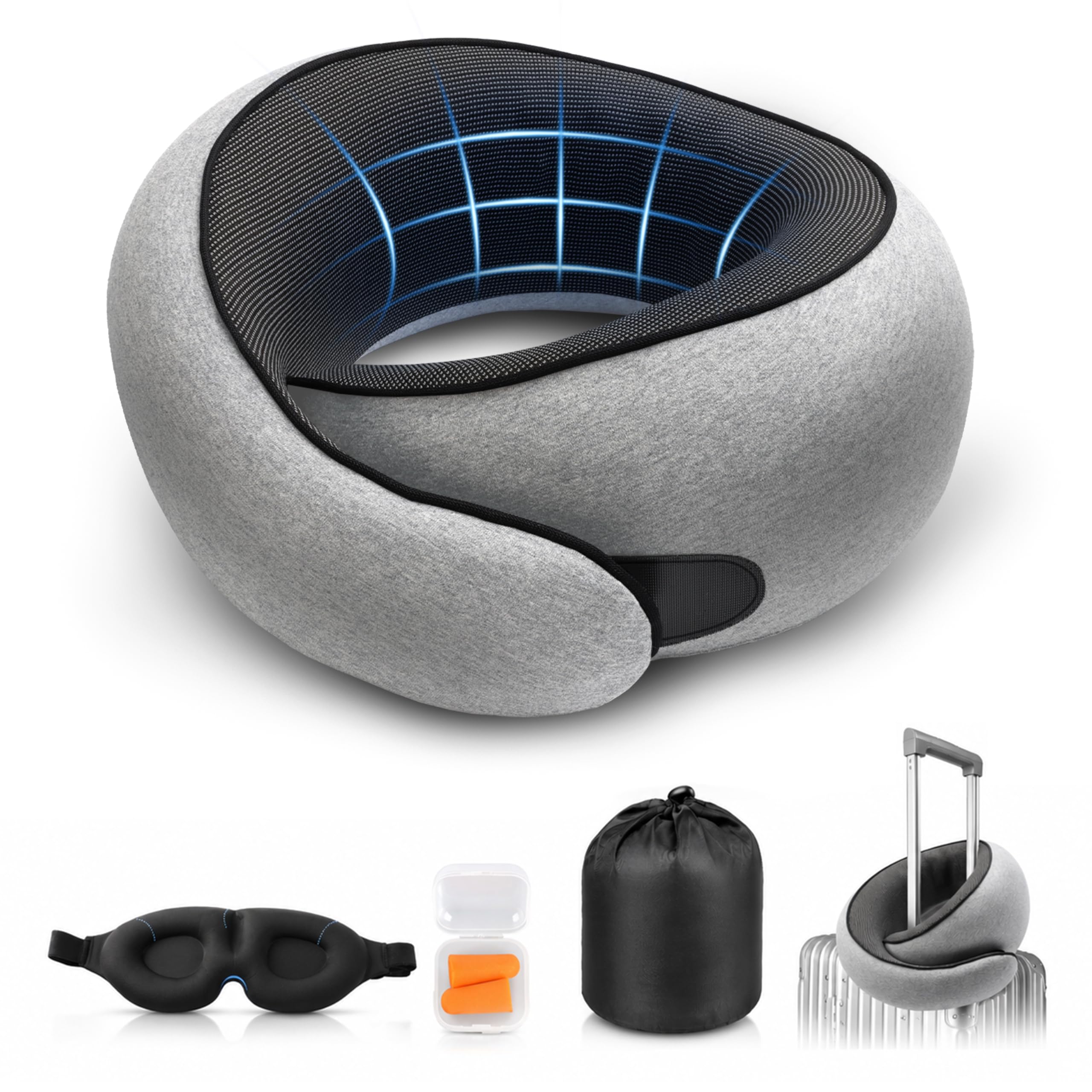
Four things arrive in the box: the pillow, a contoured eye mask, a pair of earplugs, and a drawstring bag. That kit is a real part of why this is the one we take on a long flight, because you are not assembling a sleep setup out of three separate orders the week before you leave. The pillow earns it too. The collar curves up under the jaw and a rope lock pulls the two ends snug, so there is something solid to rest against when your head starts to go.
The fill is memory foam, and what we watched for was whether it kept holding after a few hours in a seat. It does: the foam is soft against the cheek but springs back instead of staying squashed, so the support is still there when you wake up somewhere over the ocean. That rebound is the difference between a pillow you rearrange every twenty minutes and one you forget about.
Fit is the one place it asks something of you. The collar is tall, and on a shorter neck it can push the chin up instead of cradling it. Loosen the rope lock and wear the pillow lower, with the curve resting on the shoulders rather than under the jaw, and it settles down. If your neck is on the narrow side, that adjustment matters more than any feature on this list.
The cover unzips and goes in the wash, which counts for more than it sounds after a red-eye. The mask is cut with sockets so fabric stays off your eyelids instead of pressing on your lashes, and on a night flight that is the difference between wearing it and pulling it off halfway across.
Pros
- Kit includes eye mask, earplugs, and bag
- Rope lock snugs the collar to your neck
- Foam springs back instead of flattening
- Cover unzips and machine washes
Cons
- Tall collar crowds shorter necks
Our default for a long flight: firm chin support, a rope lock you can snug down, and a whole sleep kit in one purchase.
2. Everlasting Comfort Upgraded Pillow
Best for Side Sleepers
Key Features
- Fill: Memory foam
- Size: Large
- Cover: Removable, machine washable
- Firmness: Medium
- Price: Premium
Window seat, head against the plastic panel, ear on the seat back within an hour — that is the sleeper this pillow is built for. The Everlasting Comfort is designed to be turned: put the high side on the shoulder you are leaning toward and let the foam carry your head, or rotate it the other way and lean into that side instead. On the aisle you can wear it flat and it behaves like a normal collar.
Of the pillows here, this is the one that adapts to the most sleeping positions, and that is why it sits at the premium end of the list. The foam is medium-firm — soft enough against the jaw that you don’t feel strapped into a brace, dense enough that it doesn’t collapse under a heavier head. We also appreciated that the cover comes off and goes in the machine, though the foam itself does not, so plan on washing the cover only.
The trade-off is bulk. This is a big pillow, and it eats real room in a carry-on unless you squash it down and carry it separately. It also costs more than most of the field, which is easier to accept if you fly often enough to keep it packed in the same bag between trips.
Pros
- Rotates to support either side of the head
- Medium-firm foam holds its shape
- Removable cover is machine washable
Cons
- Takes up real room in a bag
The pick for anyone who ends up asleep against the window: rotate the cushion to the side you lean toward and it takes the weight.
3. BCOZZY Travel Neck Pillow
Best for Chin Support
Key Features
- Care: Whole pillow machine washable
- Fill: Polyester fiberfill
- Carry: Bag with snap loop
- Neck fit: Fits necks up to 16 in
- Price: Premium
Head-drop is what ruins a night flight. You drift off, the chin hits your chest, and you are awake again. BCOZZY’s answer is a pillow that overlaps itself: the two arms cross in front, so there is cushion under the chin and cushion behind the neck, and the head stops going anywhere in a hurry.
What we ended up liking most is the flexibility. There are three ways to wear it — arms under the chin, folded for side support, or rotated for a bit of both — and moving between them mid-flight takes a second, which is not true of the molded collars here. The filling is a bounce-back polyester rather than foam, so it molds and squashes instead of holding a fixed shape, and we preferred the microsuede face against skin to the fleece side.
Sizing is the part to get right before you order. The large fits necks up to 16 inches, and above that you want the X-Large; a collar that is too small for your neck turns into a scarf. The whole pillow goes in the washing machine, which almost nothing else here manages, and the snap loop hangs it off a bag handle.
What it will not do is hold a head rigidly. The filling is soft and gives under weight, so a traveler who wants firm, unyielding support against a window will find it too yielding. For the forward-drooping sleeper who mostly needs the chin stopped, that softness is exactly the point.
Pros
- Overlapping arms block forward head drop
- Three wearing positions, quick to change
- The entire pillow is machine washable
Cons
- Filling is too soft for firm-support fans
The pillow we hand to anyone whose head flops forward the moment they nod off: the overlapping arms give the chin somewhere to land.
4. Cabeau Evolution S3
Best Seat-Strap Design
Key Features
- Fill: Dual-density memory foam
- Cover: Removable, machine washable
- Packed size: Compresses to 1/3
- Seat straps: Attach to seat or headrest
- Price: Premium
The straps are the whole idea. Where the BCOZZY wraps around your neck and stays there by itself, the Cabeau ties to the seat: two straps loop around the headrest and hold the pillow in place, so when you shift position the pillow shifts with you instead of ending up behind your shoulder. On a long-haul seat with a proper headrest, that is the difference between support that lasts and support you keep rebuilding.
The foam is dual-density — firmer at the back where the head presses, softer at the sides — and the shape rides higher on the sides than a standard U, which is what checks the sideways roll. It compresses to about a third of its size in the carry case, and the case clips to a bag. The cover is removable and moisture-wicking, a small thing that matters on a warm cabin.
We rate it for long flights on seats where you have something to strap to, and less so elsewhere: the setup assumes a headrest with room to wrap, and on a thick or winged one the strap can come up short. That reservation matters because the straps are the reason to choose this over a plain collar at all.
Pros
- Seat straps stop the pillow sliding away
- Compresses to a third in its case
- Higher sides check sideways head roll
Cons
- Straps need a headrest to wrap around
For the sleeper who shifts all night: the straps anchor it to the headrest so the pillow can’t slide out from under your jaw.
5. Sunany Inflatable Travel Pillow
Best for Packing Light
Key Features
- Kit: Eye mask, two earplugs, bag
- Fill: Air
- Valve: 2-in-1 inflate and deflate
- Price: Premium
Packed down it is a flat bundle in its own pouch, and that is the point — nothing else in this guide disappears into a personal item the way this one does. A two-part valve handles the air: the upper valve is one-way, so you can top it up without losing what is already in there, and the lower one dumps it fast when you are done.
The design is why it works. Rather than propping your chin up, it gives you somewhere to put your face: you lean forward, rest your forehead and cheeks in the cutouts, and sleep the way you would on a desk. On a night flight that forward fold is more restful than fighting a collar, and we got longer stretches of sleep out of it than out of any U-shape here. It also works resting on a tray table if the seat in front is not reclined into your knees.
Two things to know. It is air, so it feels firmer and hollower than foam, and you tune it by adding a breath or letting some out. And on some flights you may be asked to deflate it before landing, which takes seconds but is worth expecting rather than discovering. The eye mask and earplugs that come with it are a fair bonus, not the reason to buy.
Pros
- Packs smaller than any foam pillow here
- Supports a forward-leaning sleep
- Fast to inflate and deflate
Cons
- Air fill feels hollower than foam
- May need deflating before landing
For a carry-on with no room to spare: it inflates in seconds, packs tiny, and lets you sleep folded forward instead of propped up.
6. Dot&Dot Twist Memory Foam Pillow
Best Bendable Pillow
Key Features
- Fill: Memory foam over bendable rod
- Cover: Machine-washable cotton
- Length: 26 in
- Weight: 16 oz
- Price: Midrange
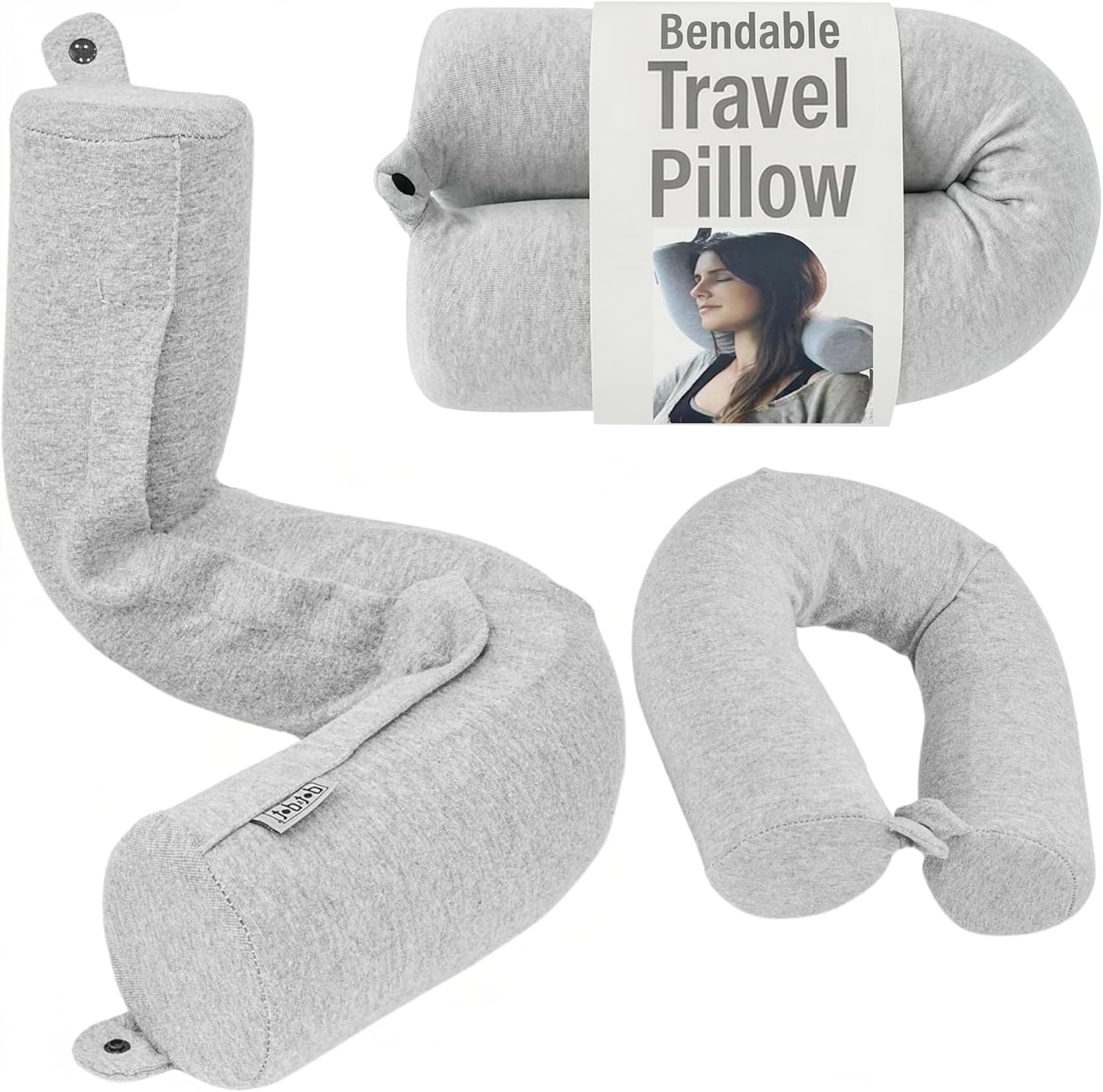
A bendable roll with a rod through the middle looks strange sitting next to the molded collars here, and it is the pillow we keep reaching for when nothing else sits right. Bend it into a U, hook one end under the chin, drape it over a shoulder — the rod holds whatever shape you put it in, so the support goes where your head actually falls.
Where it earned its place is on trips where we wanted more than neck support. The same roll folds into a lumbar cushion against a thin seat, or a pad under an elbow on a shared armrest, and no other pick here covers that ground. On a long train it doubles as a pillow you can wedge against the window frame.
The cover is cotton and washes, the foam is firm rather than squishy, and at 16 ounces it is light enough to carry slung over a shoulder. What it does not do is shrink. At 26 inches it will not compress into a pouch, so it rides on top of the bag rather than inside it, which is the price of the adjustability.
One caveat after steady use: the joints in the rod loosen over time, and the roll stops holding a tight bend the way it did when it was new. It still works, it just sags a little. We would rather have a pillow that starts out able to do six jobs than one that does a single job perfectly, and this is the one in the guide that does the most.
Pros
- Bends into almost any support shape
- Works for neck, back, and elbow
- Washable cotton cover
Cons
- Long roll will not compress for packing
For the traveler who never finds the right shape: bend the 26-inch roll into a chin rest, a side prop, or a lumbar cushion and it holds.
7. Purroch G-Shape Travel Pillow
Best Firm Support
Key Features
- Kit: Eye mask, earplugs, storage bags
- Fill: High-density memory foam
- Cover: Removable, machine washable
- Fabric: OEKO-TEX Standard 100
- Price: Premium
Purroch is the only pillow here whose cover fabric carries OEKO-TEX Standard 100 certification, meaning it has been tested for harmful substances. Against your face for six hours, that is not nothing, and it matters more if your skin reacts to synthetic finishes or if the pillow is going to be handed to a kid on the next trip.
The shape is a G rather than a U. The foam comes up around the jaw and back down toward the shoulder, so the head cannot roll forward or sideways without meeting cushion, and there is no gap at the front for your chin to drop into. It is high-density slow-rebound foam, and it feels firmer and more deliberate than the soft collars here — closer to a neck brace than a pillow, in a good way.
That firmness is both the reason to pick it and the reason to skip it. If you want a pillow that holds a position and stays there, this is the one; if you want something to squish against a window and forget about, the BCOZZY is softer and cheaper. The kit is generous for the money — an eye mask with 3D sockets, earplugs, and two storage bags — and the cover unzips for washing.
Pros
- Certified skin-friendly cover fabric
- Firm G-shape holds the jaw steady
- Comes with mask, earplugs, storage bags
Cons
A firmer, more structured pillow for travelers who want the jaw held steady, with certified fabric resting against the skin.
8. SAIREIDER Travel Pillow
Best for Tight Budgets

Key Features
- Fill: Memory foam
- Cover: Removable, machine washable
- Closure: Two snaps
- Dimensions: 11.8 x 11.4 x 3.9 in
- Price: Budget
Nothing about this pillow is clever, and that is most of its appeal. It is a classic memory-foam horseshoe with a removable polyester cover, two snaps at the front, and a soft shell — no rope lock, no eye mask, no bag. You pull it out of a tote and put it on.
The foam is genuinely soft, noticeably softer than the firm collars in this guide, and the cover comes off for washing, which is more than some budget pillows manage. The two snaps are the only adjustment, so you get two settings rather than a continuum, and the tighter one is snug on most adult necks.
Size is the catch. It runs small and thin, and on a larger frame the fill is shallow enough that it stops being support and starts being a scarf. The dimensions are a standard 11.8 by 11.4 by 3.9 inches, so this is not a case of a listing hiding a tiny pillow; it is a trim collar by design, and it fits smaller adults and kids better than it fits broad shoulders.
Where that leaves it: a spare to keep in the car or the carry-on, a second pillow for a child on a road trip, and a low-cost way to find out whether a collar works for you at all before spending on a shaped one. For a red-eye in economy, we want more support than this gives, and the MLVOC is the reasonable step up.
Pros
- Softer foam than most collars here
- Cover unzips for machine washing
- Two front snaps hold it closed
Cons
- Runs small and thin for larger adults
The simplest pillow here: soft memory foam, a washable cover, two snaps, and no kit — enough for a nap, not a full night upright.
How We Tested the Best Travel Pillows for Long Flights
We started with a long list of the travel pillows shoppers actually buy — bestsellers, cult favorites, and a few inflatables for contrast — then cut anything that showed up repeatedly with the same complaints: foam that went flat, covers that couldn’t be washed, straps that didn’t fit the seat backs people described. Fourteen made it through, and we used each one for four months.
Testing happened where the pillow lives: window seats on red-eyes, middle seats on cross-country flights, a passenger seat on a nine-hour drive, and a desk chair during lunch-break naps. On each flight I settled in for at least two hours and paid attention to whether my head drifted, whether my chin got pushed forward, and whether I had to keep re-fluffing. Pillows with seat straps got a harder look — I clipped them to armrests and seat-back brackets and noted whether the strap held or slid loose.
Back home, I stuffed each pillow into its carry bag and timed how long it took, then compared the packed dimensions against the personal item I actually fly with. I pressed a thumb into every foam sample and counted how long it took to spring back, which told me more about longevity than the initial feel did. Washable covers went through two machine cycles to see if they pilled or shrank, and the bundled eye masks and earplugs were tested on a daytime flight to see whether the mask really blocked cabin light. Four months in, we noted which ones still looked and felt like new — that’s the closest thing we have to a value measure.
How to Choose a Travel Pillow for Long Flights
A long flight tests whether a pillow can hold your head against gravity for hours, so choose by the position you actually fall asleep in and how much room you have, not by how plush it looks in the photo.
Match the shape to your sleep position
Three kinds of sleeper end up on a night flight, and they need three different pillows. If your head drops forward, you want something under the chin: overlapping arms like the BCOZZY’s, or a raised chin shelf like the MLVOC’s. If you tip sideways into the window, a tall-sided or rotatable collar like the Everlasting Comfort takes the weight off your ear. If you curl forward onto your knees, an inflatable face cradle is the only design that gets there.
The classic horseshoe is the one most people buy first, and it is the least useful of the three: a neck pillow that only pads the back of your neck does nothing about the chin dropping, which is what actually wakes you up.
Fit matters more than fill
A pillow only works if it closes around your neck at the right height. Too tall and it pushes your chin up; too loose and your head rolls around inside it. BCOZZY publishes its sizing — the large fits necks up to 16 inches, with X-Large above that — and that is the number to compare against your own measurement, taken around the base of the neck with a tape.
When you land between sizes, take the lower collar with an adjustment you can tighten rather than trusting a listing that calls itself universal. A collar sitting on your shoulders supports a head; one riding up under the jaw just tilts it back.
Memory foam, fiberfill, or air
Foam is the default for a reason: it holds a shape, so the support is still there in hour six. It also does not compress much, which is why foam pillows need a bag and a firm squash to travel. Fiberfill, the BCOZZY’s filling, molds more softly and can be washed whole, but it gives under a heavy head. Air packs smallest of all and lets you tune firmness with a breath, at the cost of a hollower feel and a valve to manage.
For a multi-hour flight our order is foam first, fiberfill for side sleepers who want softness, and air when space is the deciding factor.
Plan for the bag and the trip home
Look at what the pillow does when it is not on your neck. A compression case and a luggage clip keep a bulky collar out of your bag — the Cabeau compresses to about a third of its size. A long bendable roll like the Dot&Dot does not compress at all at 26 inches, so it rides on top of the bag. Weight separates them too: the MLVOC is 9.6 ounces, the Dot&Dot a pound.
If you travel with a personal item only, the inflatable wins by a wide margin. Otherwise pick the support you want and make room for it.
Frequently Asked Questions
Why did my memory foam travel pillow arrive flat?
Most foam pillows ship vacuum-sealed, so they look thin and wrong straight out of the package. Unzip the cover, work the foam apart with your hands, and give it a few hours out of the wrap so air can get back into it.
Do that before your trip rather than at the gate. If the pillow still looks collapsed after a day of sitting out, send it back while the return window is open.
How do I keep a travel pillow from slipping off while I sleep?
Use the closure, and set the pillow before you recline. Snaps, rope locks, and chin clasps are what hold a collar in place once your head tips — the SAIREIDER uses two front snaps, the MLVOC a rope lock, the Cabeau a chin clasp plus seat straps.
Sit up, position the pillow with your chin supported, close it, then lean back into it. Closing it last is the part people skip.
Can I wash a memory foam travel pillow?
Wash the cover, not the foam. Memory foam breaks down in a washer and a dryer, which is why most of these have a zip-off cover; the BCOZZY is the exception here because its fiberfill filling lets the whole pillow go in the machine.
Unzip and wash the cover after each trip, and spot-clean the foam with a damp cloth and mild soap.
Final Verdict
Buy the MLVOC if you want one pillow that covers a long flight. The chin support is real, the rope lock keeps the collar where you put it, and the eye mask and earplugs mean you are not placing three separate orders before you leave.
Spend more only for a specific reason: the Everlasting Comfort if you sleep tilted against the window and want the cushion rotated to that side, the Cabeau if your seat has a headrest worth strapping to, or the Sunany if your personal item is already full. Otherwise the extra money buys materials and hardware, not more sleep.