This post contains affiliate links. We may earn a small commission when you buy through our links — at no extra cost to you.
A power bank with a built-in cable promises to banish cable clutter from your carry-on, but too often it unravels when you hit airport security or the cord frays after a few uses. Many high-capacity models exceed the 100Wh flight limit, and some integrated cables fail long before the battery does.
This guide identifies power banks that actually meet UK and European airline limits, use cables built to last, and deliver real-world capacity. From 10,000mAh models that charge your phone twice to 20,000mAh workhorses that keep laptops running, every pick is carry-on legal and travel-tough.
Because a built-in cable is both a convenience and a single failure point, we prioritised models with cables tested for 10,000+ bends or backed by solid warranties. No more tangled cords or security surprises.



1. Anker Nano 3‑in‑1 with Wall Plug
Best for Space-Saving All-In-One
Key Features
- Capacity: 10000mAh
- Max Output: 30W
- Cables: USB-C only
- Weight: 8.8 oz
- Price: Mid-Range
The Anker Nano 3‑in‑1 combines a 10,000mAh battery, a foldable AC wall plug, and a built‑in USB‑C cable into a single 8.82‑ounce package. This design eliminates the need to carry a separate charger and cable, making it a straightforward choice for anyone who wants to grab one thing and go. The 30W output charges an iPhone 15 Pro to 50% in about 25 minutes, matching the speed of many dedicated wall adapters.
In practice, the compact footprint fits easily into a jacket pocket or the front pocket of a carry‑on bag. The foldable plug lets you recharge the power bank itself without a cable, and you can charge both the bank and a phone simultaneously when it’s plugged into the wall. The built‑in cable is short but practical for close‑range use at a desk or nightstand.
This is best for frequent flyers and daily commuters who prioritize packing minimal gear. iPhone 15 and 16 users will appreciate the USB‑C direct compatibility and fast charging. Keep in mind that the 10,000mAh capacity delivers roughly one full recharge for most phones, so it’s not suited for multi‑device days or extended trips without access to an outlet. The integrated USB‑C cable and internal components can show wear over months of heavy use; Anker’s 18‑month warranty covers such cases, so it’s wise to register your unit and keep the purchase record handy.
Pros
- All‑in‑one wall charger, power bank, and USB‑C cable in a single device.
- 30W two‑way charging delivers fast top‑ups for compatible phones.
- Compact and light enough for pocket or small bag carry.
- Foldable wall plug enables cable‑free recharging of the bank itself.
Cons
- Integrated USB‑C cable may wear over extended daily use; warranty support is available for early failures.
Travelers who want to carry exactly one charger instead of three will find this Anker a capable space‑saver, provided they only need a single phone recharge per day and treat the integrated cable with care.
2. UGREEN Nexode 20K 45W
Best for Value High Capacity
Key Features
- Capacity: 20000mAh
- Max Output: 45W
- Cables: USB-C only
- Weight: 1.03 lb
- Price: Mid-Range
The UGREEN Nexode matches the 45W charging speed of more expensive rivals, and its 20,000mAh capacity can top up an iPhone 16 Pro nearly four times — all at a mid-range price. The built-in braided USB-C cable eliminates the need for a separate charging cord and doubles as a carrying strap for quick grab-and-go trips.
The cable feels sturdy and stays attached during daily commutes or hotel stays. The 45W input lets the bank itself recharge quickly from a wall adapter — under two hours with a compatible charger. This capability comes with a size cost: at just over a pound, the Nexode is one of the heavier 20,000mAh banks. The weight is noticeable in hand and makes pocket carry unrealistic.
This power bank suits travelers who prioritize high capacity and fast charging over portability — those already carrying a backpack or duffel will appreciate the built-in cable and the ability to charge multiple devices simultaneously. If you need a slim battery that slips into a jeans pocket, the weight becomes a significant tradeoff. The integrated cable is a convenience for users who don’t want to pack extra cords, but the bank itself is strictly a bag-only accessory.
Pros
- 45W charging speed that keeps pace with premium brands at a lower price
- 20,000mAh capacity provides multiple full charges for most phones
- Built-in braided USB-C cable doubles as a carrying strap — no separate cable needed
Cons
- At over a pound, this power bank is strictly a bag-carry item — too heavy for comfortable pocket use
If you need a high-capacity power bank with a built-in cable and don’t plan to carry it in a pocket, the UGREEN Nexode delivers flagship-level charging performance at a budget-friendly price.
3. HELLEE 15K Multi‑Cable
Best for Multi-Cable Budget
Key Features
- Capacity: 15000mAh
- Max Output: 22.5W
- Cables: USB-C, Lightning, Micro, USB-A
- Weight: 7.05 oz
- Price: Budget
The HELLEE 15K is built around one idea: carry one cable‑free battery that works with every device you own. Its four built‑in cables – USB‑C, Lightning, Micro, and USB‑A input – mean you can charge a friend’s iPhone, your Android phone, and an older MP3 player without digging for adapters. This makes it a more practical choice for mixed‑device households than the top pick’s wall‑plug hybrid, which prioritises space‑saving over universal coverage.
This bank suits budget‑conscious travellers and families who don’t want to manage a tangle of cables. The 22.5W maximum output is adequate for overnight charging or midday top‑ups, but if you own a phone that supports 30W or 45W charging, you’ll notice the slower speed. For users who exclusively use USB‑C devices and want the lightest possible pack, a simpler single‑cable model would be a better fit.
Despite the 15,000mAh capacity, the HELLEE remains notably slim and light at 200g – it slips into a jacket pocket without weighing you down. It delivers about two full charges for most smartphones, and the price per milliamp‑hour is hard to beat among multi‑cable power banks.
Pros
- Four built‑in cables cover Lightning, USB‑C, Micro, and USB‑A devices without any adapters.
- Slim and lightweight for a 15,000mAh battery – easy to carry in a pocket or small bag.
- Budget‑friendly price per milliamp‑hour – often half the cost of comparable multi‑cable banks.
Cons
- 22.5W max output – modern flagship phones may charge slower than with 30W+ power banks.
- Extra built‑in cables add weight and bulk if you only charge USB‑C devices – a single‑cable bank would be lighter.
The HELLEE 15K is the right choice if you need one battery that charges any portable device without extra cables and at a low cost. Accept the 22.5W speed limit and you get outstanding versatility.
4. TORRAS Slim Magnetic 10K
Best for Ultra-Slim Magnetic
Key Features
- Capacity: 10000mAh
- Max Output: 22.5W
- Cables: USB-C only
- Weight: 4.65 oz
- Price: Mid-Range
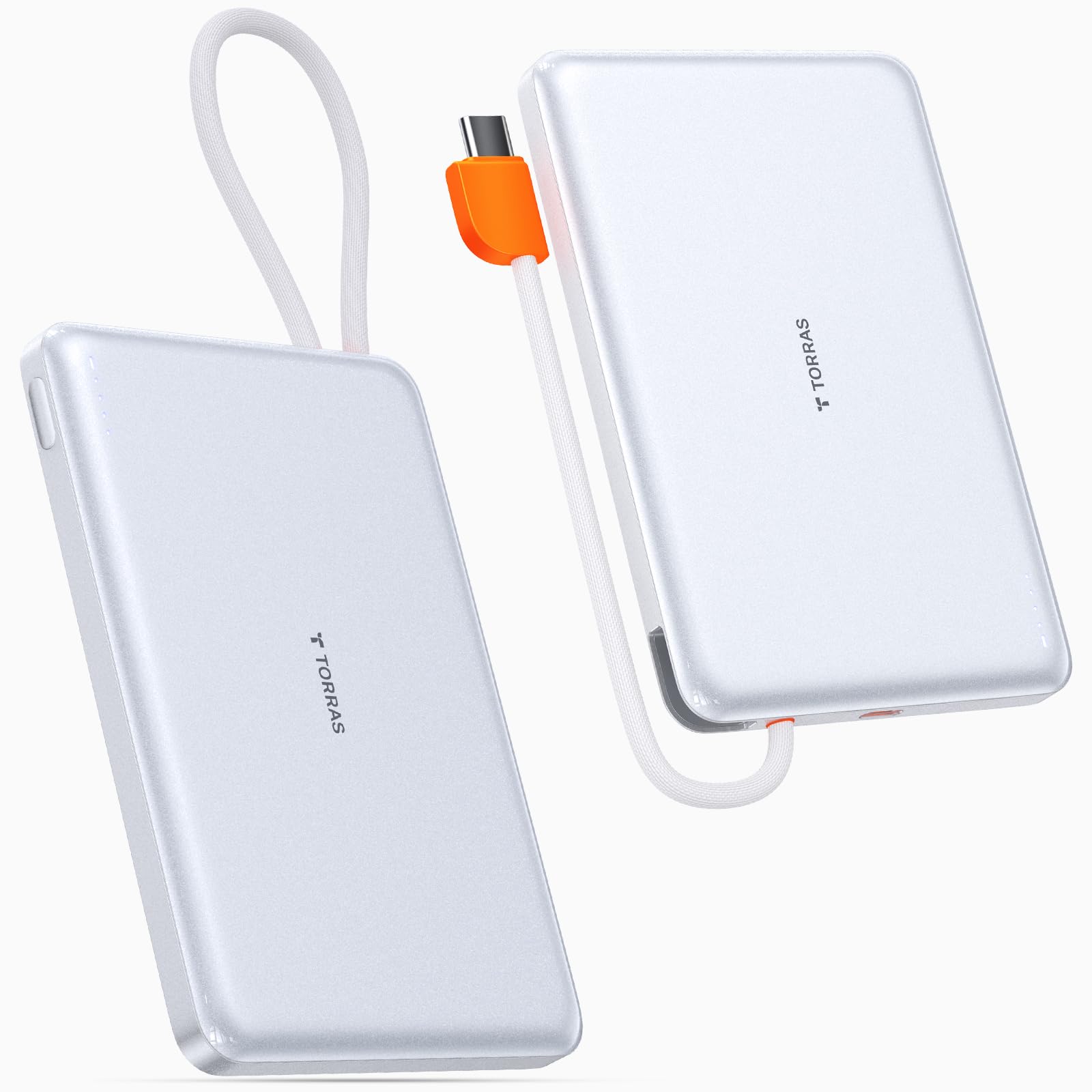
At just 0.59 inches thick and 4.65 ounces, the TORRAS is barely thicker than an iPhone itself. It snaps firmly onto any MagSafe phone without adhesives, and the built-in USB-C cable loops around the body to secure magnetically, functioning as a clever carrying strap. Unlike the wireless magnetic bank that adds a kickstand and Qi coil, this model strips down to pure wired power delivery, shaving off bulk while keeping a full 10,000mAh capacity. The result disappears in a front pocket.
That slimness comes with a trade-off: charging speed. The 22.5W USB-C output can provide a quick top-up, but under sustained load the speed may fluctuate and the unit can run warm. This makes the TORRAS a natural fit for iPhone-using urban commuters who top off briefly throughout the day, rather than heavy-duty users who need multiple full-speed charges. It won’t attach magnetically to Android phones without a special case, so it’s firmly an iPhone accessory.
The integrated cable never leaves the bank; it wraps around and tucks away, so you never fumble for a cord. When you need a traditional wired charge for a second device, it’s right there, yet the magnetic attachment lets you go completely cable-free for iPhone top-ups. The bank itself recharges through the same USB-C cable, meaning you manage just one cord.
Pros
- Exceptionally slim and light — disappears in a pocket
- Strong magnetic attachment keeps the bank securely on an iPhone without adhesive
- Built-in USB-C cable wraps around magnetically, doubling as a carrying strap — no loose cord to carry
Cons
- Charging speed can be inconsistent and the bank may get warm during extended use
A fashion-conscious iPhone companion that solves the cable-clutter problem with an ingenious wrap-around design, provided you value pocketability and magnetic attachment over sustained peak charging speeds.
5. Anker 20K 87W Laptop Charger
Best for Laptop Power Users
Key Features
- Capacity: 20000mAh
- Max Output: 87W (65W laptop)
- Cables: USB-C only
- Weight: 0.97 lb
- Price: Premium
Charging a 14-inch MacBook Pro to 50% in under 40 minutes from a 20,000mAh battery that slips into a flight bag sets this apart from every pocket-sized alternative. The 65W single-port USB-C output delivers enough sustained wattage to keep a laptop alive during long meetings, while the slimmer option in this set focuses on phone and tablet top-ups via a foldable wall plug. For anyone who needs a full workday of laptop power without hunting for an outlet, the difference is immediate.
The built-in USB-C cable is rated for over 10,000 bends — a detail that matters when it’s your only cable between flights. You can run a laptop from it, a phone from the second USB-C port, and earbuds from the USB-A simultaneously, sharing 87W across all three. That means a dead phone gets a meaningful boost even as your laptop charges, and you aren’t juggling dongles.
The weight of 0.97 lb makes this a bag-carry accessory, not a pocket backup. Digital nomads who travel with a laptop sleeve or shoulder bag will barely notice the heft; the tradeoff is raw multi-device capacity that no ultralight bank can offer. If you carry a MacBook daily and want one battery that handles the laptop, phone, and tablet without a separate cable, this is the clear choice.
Pros
- Charges a 14″ MacBook Pro to 50% in under 40 minutes via 65W output — laptop-level refueling on the go.
- Powers phone, tablet, and laptop simultaneously using built-in USB-C cable, a second USB-C, and USB-A, sharing 87W.
- Built-in USB-C cable withstands over 10,000 bends, eliminating worry about cable wear or failure.
Cons
- At nearly a pound (0.97 lb), it demands a laptop bag — pocket carry isn’t practical.
For digital nomads and road warriors who carry a laptop daily, this is the single battery that handles everything — just keep it in your bag.
6. Orfeika 20K Multi‑Cable
Best for Universal Cable Coverage
Key Features
- Capacity: 20000mAh
- Max Output: 20W
- Cables: Lightning, USB-C, Micro, USB-A
- Weight: 0.73 lb
- Price: Mid-Range
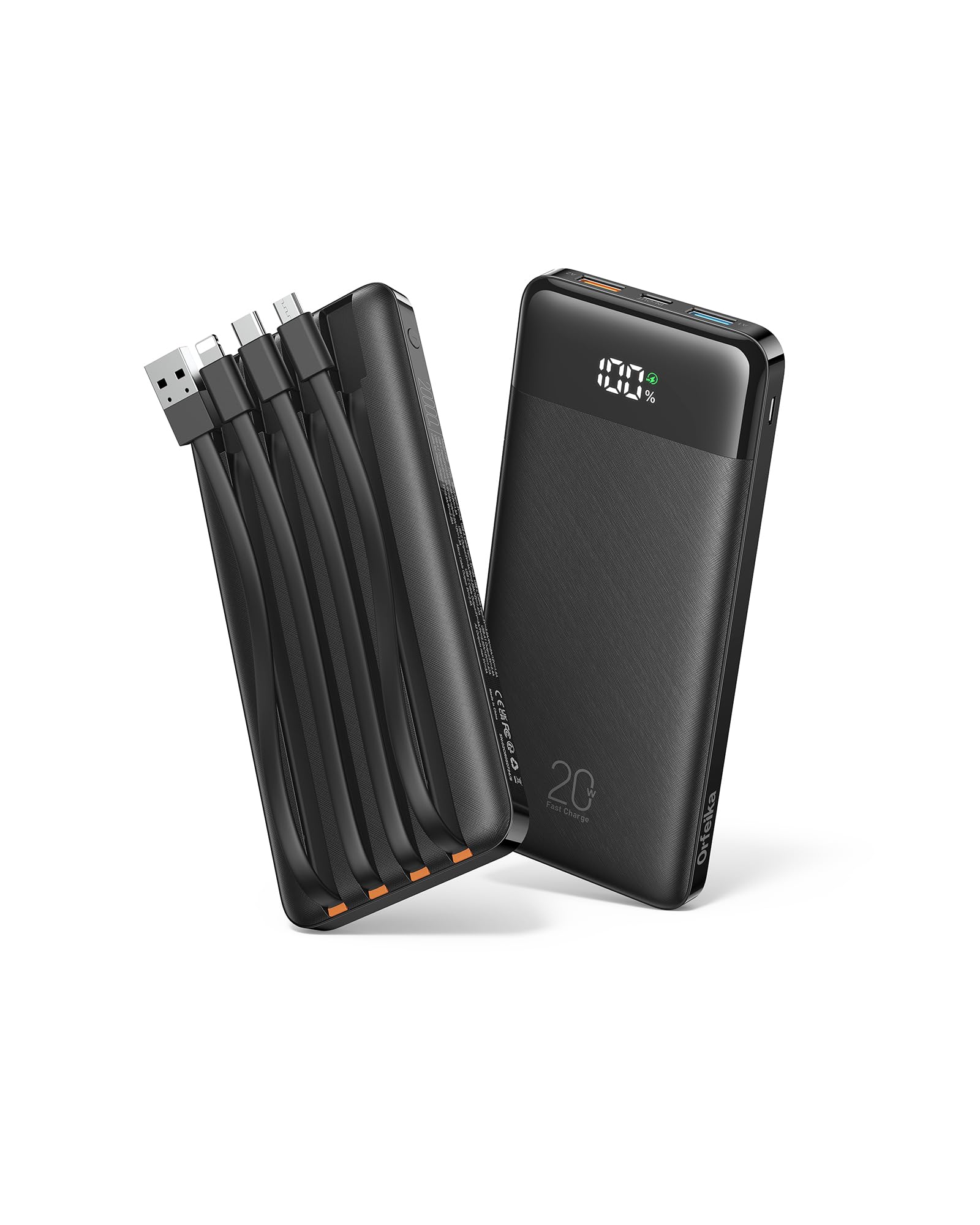
The Orfeika packs four built-in cables — Lightning, USB-C, Micro-USB, and a USB-A input — alongside two extra ports, allowing up to six devices to charge at once. Unlike the top pick that merges wall charger and battery, this bank focuses entirely on cable universality. All cords are integrated and tuck flush against the body, so you never hunt for a loose cable. The 20,000mAh capacity translates to roughly 4-5 full smartphone charges, and its 77Wh rating slips under the 100Wh FAA limit, making it flight-ready without paperwork.
The core audience is households juggling Lightning iPhones, USB-C Androids, and older Micro-USB gadgets like headphones or e-readers. Group travelers who need one power source to charge multiple devices simultaneously will appreciate not carrying a bag of adapters. The slim fire-retardant shell adds durability for life in a backpack or suitcase.
The 20W maximum output — the lowest among our 20K recommendations — means newer flagship phones won’t reach full speed. An iPhone 15 Pro or Galaxy S24 will charge at a slower rate, adding maybe an hour to a full top-up compared to a 30W bank. That’s acceptable for overnight charging or slower-paced days, but less ideal if you rely on quick airport top-offs. The weight of 0.73 pounds is noticeable in a pants pocket, though it feels slimmer than many 20K units and rides comfortably in a bag.
Pros
- Four built-in cables (Lightning, USB-C, Micro, USB-A input) eliminate the need for any adapters or spare cords.
- Slim fire-retardant shell and 77Wh capacity keep it under the 100Wh flight limit for worry-free air travel.
- Competitive mid-range pricing for a 20K capacity bank that covers every common charging port.
Cons
- 20W max output may charge flagship phones slower than 30W+ banks — a trade-off for cable variety.
- Weight of 0.73 pounds makes pocket carry conspicuous; better suited for bag or backpack use.
If your family still juggles Lightning, USB-C, and Micro-USB devices, this single bank removes the cable clutter — just don’t expect a 30-minute flagship top-off.
7. Belkin 10K Dual‑Cable
Best for Dual-Cable Pass-Through

Key Features
- Capacity: 10000mAh
- Max Output: 23W
- Cables: USB-C, Lightning
- Weight: 0.64 lb
- Price: Mid-Range
The Belkin BoostCharge Plus ditches the cable scramble with both Lightning and USB‑C built right in, and its pass‑through charging tops up the bank and your device from a single wall adapter overnight—ideal for minimalist travel kits. The compact body slides into a pocket without a second thought. Real‑world use reveals two trade‑offs: the 23W output can feel sluggish when charging two phones simultaneously, and long‑term reliability isn’t a given—occasional units lose their ability to hold a charge after months of light use. If grab‑and‑go simplicity for occasional trips matters more than years of daily service, the convenience is real. For a bank you’ll lean on every day, the top pick’s more consistent endurance record is worth carrying one separate cable.
Pros
- Integrated Lightning and USB‑C cables mean no adapters needed for most phones.
- Pass‑through charging lets you recharge the bank and your device from a single outlet overnight.
- Compact, lightweight build slips easily into a pocket or bag.
Cons
- Charging speed can feel slower than the 23W label, especially when powering two devices at once.
- Long‑term charge retention can decline; occasional units may stop holding a charge after months of use.
This bank fits occasional travelers who want cable‑free simplicity for short trips and can accept a shorter lifespan in return. Daily commuters should look to the top pick for a more durable everyday companion.
How to Choose
Before you compare capacity or cables, confirm the power bank’s watt-hour (Wh) rating falls under 100Wh so it’s legal on European flights.
Capacity
A 10,000mAh bank typically delivers 60-80% of that in real-world charges due to voltage conversion losses, so it might only refill a modern phone once. For a full day of navigating and photo-taking, a 15,000-20,000mAh model is safer.
Larger numbers aren’t always better: a 50,000mAh unit exceeds the 100Wh airline limit and can’t fly. Match capacity to your trip length and always check the Wh label.
Max Output
Wattage determines charging speed. A 20W bank will slowly top up a flagship iPhone, while a 30-45W bank can hit 50% in under 30 minutes. Laptops need at least 45W, and 65W is ideal for fast MacBook charging.
Higher output can generate more heat and slightly strain the battery over time, but for travel the trade-off is worth it. Just ensure both the cable and port support Power Delivery (PD) for the fastest speeds.
Cables
A built-in cable eliminates clutter, but it also becomes a single failure point. If that cable frays, the entire bank is useless. Look for cables tested to 10,000+ bends or brands offering at least an 18-month warranty.
Multiple built-in cables (USB-C, Lightning, Micro) cover everyone in a family or group, but add thickness. Choose dual-cable models if you regularly carry both iPhone and Android, and stick to USB-C-only if all your devices use it.
Weight
Capacity and heft go hand in hand. Models over 300g (0.66 lb) are comfortable only in a bag, not a pocket. A compact 10,000mAh bank can slip into a jeans pocket, while a 20,000mAh laptop-class charger lives in a backpack.
For city breaks and day trips, 200g (7 oz) or less keeps you nimble; for multi-day hikes or laptop use, accept the extra bulk.
Durability
Beyond bend ratings, real-world battery lifespan matters. Some units lose capacity or stop working after a few months of regular use. Choose brands with proven warranties and avoid models with consistent reports of early failure.
The built-in cable’s anchor point is a common weak spot; if it feels stiff or looks thin, it may crack. A design that allows easy cable replacement—or at least a solid warranty—gives you a way out.
FAQ
Can I take a 20000mAh power bank on a plane in Europe?
Yes, a typical 20,000mAh pack is about 74Wh, well under the 100Wh limit, so it’s allowed in carry-on and checked luggage (though airlines prefer carry-on for lithium batteries). Always verify the Wh on the label, but standard 20K units are safe for European flights.
Why won’t my power bank with built‑in cable fast charge my iPhone?
Fast charging depends on both the bank’s output wattage and your iPhone model. Many built-in cable banks cap at 20W or less, while newer iPhones need 30W or 45W for maximum speed; a damaged or low-quality cable also throttles the charge. Check the PD rating and ensure the integrated cable supports USB-C Power Delivery.
How many times will a 10000mAh power bank actually charge an iPhone?
A 10,000mAh bank typically delivers 60-80% of its labelled capacity after conversion losses, so it provides about one full charge for a modern iPhone, not two as often assumed. For a full day away from outlets, a 15,000-20,000mAh bank is a safer bet.
Is a power bank with a built‑in cable better than using a separate cable for travel?
Built-in cable banks remove the need to pack a separate cord, which is handy for grab-and-go travel, but they create a single failure point—if that cable frays, the whole device becomes unusable. For frequent flyers, choose a model with a cable tested for thousands of bends and a long warranty, and consider tucking a tiny backup cable in your bag.