This post contains affiliate links. We may earn a small commission when you buy through our links — at no extra cost to you.
The worst place to watch your phone hit 1 percent is a departure lounge where every outlet is already claimed. A power bank solves that, with one catch most people learn at the security line: it has to ride in your carry-on, not your checked bag, and most airlines cap them near 100 watt-hours. So the real question isn’t which one has the biggest number on the box — it’s which one you’ll actually remember to pack.
My team and I have spent the past six months carrying 12 of them through airports, commuter trains, and long weekend drives, and the differences show up in small places. Built-in cables save you from the cord you always forget, though length matters once your phone is in a seatback pocket. Charging speed and battery life rarely match the box — expect roughly two-thirds of the advertised capacity in real charges, and the cheapest pack per milliamp-hour isn’t automatically the best deal. The ones below are the packs that earned a permanent spot in my carry-on.
Our Top Picks


The Best Usb-C Power Banks for Travel, Reviewed
1. INIU 20,000mAh (P512)
Best Overall
Key Features
- Size: 4.1 x 2.8 x 1.1 in
- Output: 22.5W
- Weight: About 11 oz
- Capacity: 20,000mAh
- Price: Midrange
Twenty thousand milliamp-hours in a shell that measures 4.1 by 2.8 by 1.1 inches is the whole argument for this pack. Most batteries this size are slabs that claim a corner of your day bag for the entire trip; this one drops into a jacket pocket or the front pocket of a personal item and stays out of the way until the phone starts to die. Capacity without a brick in your bag is why it leads this list.
What we kept coming back to is how it handles a long weekend. Two phones, a set of earbuds and a tablet get through three days on one charge, and the percentage readout on the face tells you how much is left instead of blinking four LEDs at you. The USB-C cable is built into the body and doubles as a lanyard, so there is nothing loose to lose in a hotel room, and the USB-A ports let someone else plug in at the same time.
Charging speed lands where most phones want it: 22.5W pushes an iPhone or a Galaxy to roughly two-thirds in about half an hour. What it will not do is run a laptop. Against a MacBook or a Windows ultraportable, 22.5W barely keeps pace with what the machine draws, and a long session inside a bag ends with a warm pack and a flat laptop.
There is also a flashlight built into the end, which sounds like filler until a hotel room loses power at two in the morning and you need to find the door. It is a small thing. It is also the kind of small thing that decides which pack gets packed.
Pros
- 20,000mAh in a genuinely small shell
- Built-in USB-C cable doubles as a lanyard
- Percentage display instead of vague LEDs
- Three-year warranty
Cons
- About 11 oz, noticeable in a pocket
- Roughly 5.4 hours to refill
For most trips this is the power bank we recommend: 20,000mAh in a genuinely pocketable body, a built-in cable you cannot forget, and the longest warranty here.
2. Anker 20,000mAh 87W (A1383)
Best for Laptops
Key Features
- Output: 87W total, 65W single
- Weight: 15.2 oz
- Capacity: 20,000mAh
- Recharge time: 1.5 hours
- Price: Premium
Everything the top pick cannot do lives in this one. The Anker moves 87 watts across three devices, with 65 watts to any single port, which is enough to put a working charge into a 14-inch MacBook Pro or to run a tablet and two phones at once. If a laptop comes on the trip, this is the pack the rest of the list gets measured against.
It also refills in about 1.5 hours, faster than anything else here, provided the charger you pair with it can deliver 65W or more. The built-in USB-C cable is rated to 10,000 bends, and the readout gives you a percentage rather than a row of lights, which matters more on a pack this big because the stakes of walking out under-charged are higher.
At 15.2 ounces and 6.2 by 2.9 by 1 inch it is closer to a paperback than a phone. That is the price of 20,000mAh and 87 watts in one body, and it is a fair trade on a trip where the alternative is a laptop that dies during a layover. On a weekend where the laptop stays home, you carry those ounces for nothing.
Our one reservation is longevity. An 18-month warranty is thinner coverage than INIU gives on packs that cost far less, and a battery at this price should be backed longer. It is a reservation rather than a dealbreaker, because the wattage is the reason to buy and nothing else here delivers it in a body this small.
Pros
- 65W to a single device runs a laptop
- Refills in about 1.5 hours
- Built-in cable rated to 10,000 bends
- Percentage readout, not LEDs
Cons
- 15.2 oz is heavy for a day bag
The travel pack for anyone carrying a laptop: 65W to a single device, a 1.5-hour refill, and enough capacity to get a MacBook through a connection.
3. Anker Nano 3-in-1 (A1637)
Best All-In-One
Key Features
- Output: 30W
- Weight: 8.82 oz
- Built-in: USB-C cable and wall plug
- Capacity: 10,000mAh
- Price: Premium
The plug is the point. Fold out the prongs and this becomes a 30W wall charger that tops itself up; fold them away and it is a 10,000mAh battery with a USB-C cable built into the side. We think that is the most useful trick in this group for one-bag travel, because the charger you do not have to pack is the one you cannot leave in a hotel room.
The body is 4.25 by 2.01 by 1.22 inches and 8.82 ounces, small enough to live in a sling bag next to a passport. Thirty watts runs in both directions, so an iPhone 15 Pro takes roughly two full charges from it, and a second device can draw from the spare USB-C port while the cable handles the first. In a café with one free outlet, that is the difference between charging your phone and charging your phone plus the pack.
The violet colorway turns out to be more practical than it looks. In a black-lined backpack it is the one object you can locate by feel at the bottom of the bag, which is exactly when you need a charger.
The trade is capacity and money: it costs more than several 20,000mAh packs here, and 10,000mAh is a weekend of phone charging rather than a week. Because the cable is built in and not detachable, a damaged cord retires the whole unit. For a short trip with one phone, that is a trade we take without much thought.
Pros
- Foldable plug replaces a wall charger
- Built-in USB-C cable
- 30W in both directions
- Light enough for a sling bag
Cons
- Costs more than several 20,000mAh packs
- Fixed cable retires the unit if it fails
The one-bag answer: a foldable wall plug and a built-in USB-C cable mean you leave the charger at home and still land with a full battery.
4. INIU 10,000mAh 45W (P41)
Best Ultralight
Key Features
- Ports: 3
- Output: 45W
- Weight: 6.4 oz
- Capacity: 10,000mAh
- Price: Budget
Half an inch thick and 6.4 ounces puts this in a different category from everything else on the list: it is a pack you can leave in a jacket pocket and forget about until the phone hits 10 percent. The 10,000mAh cell is the ordinary part. The 45W output is what is unusual at this size and weight.
Forty-five watts gets an iPhone 17 Pro Max to roughly three-quarters in half an hour, and it is enough to give an iPad Pro a real top-up, which most packs this light cannot manage. Three outputs let you run a phone and earbuds together, and the USB-C cable is detachable rather than fixed, a 0.4-foot braided one that clips on as a lanyard. We prefer that to a captive cord: the cable is the part that fails first on a travel battery, and this one can be replaced for a few dollars.
This is the pack for a phone-only trip, a commuter bag, or a second pack that lives in a camera bag. If you are carrying a tablet and a laptop for a week, the 20,000mAh picks make more sense and you will want their extra capacity more than you will want this one’s thinness. For the trip where every ounce is argued over, it is the easy answer.
Pros
- 6.4 oz and half an inch thick
- 45W output from a 10,000mAh pack
- Detachable cable can be swapped out
- Three-year warranty
Cons
- Short 0.4 ft cable keeps the phone on top
- Some units quit after a few charges
The pack that disappears into a jacket pocket, and the only 10,000mAh model here with the wattage to top up a tablet as well as a phone.
5. Baseus 20,000mAh 45W (E00311)
Best Value 20,000Mah
Key Features
- Ports: 4
- Output: 45W
- Capacity: 20,000mAh
- Built-in cables: Two USB-C
- Price: Midrange
Four devices from one brick, two of them on cables that are already attached. The Baseus carries two built-in USB-C cables that interlock into a carry loop, plus a separate USB-C port and a USB-A port. At 4.3 by 2.6 by 1.2 inches with 45W on tap, it is the pack for the car ride or the hotel room where everyone’s phone is dead at once.
The value argument is easy to make: 20,000mAh and 45W for less than most of the 10,000mAh packs here, with a two-year warranty and a display that shows the exact percentage. We think it is the best second pack on this list for a couple or a family, because two people can charge at once without anybody hunting for a cable in a bag.
Longevity is the soft spot. Battery life is inconsistent enough that some units stop taking a charge within a couple of months, which is the kind of failure that shows up after a return window closes, and the two-year warranty is the backstop. Both built-in cables are also USB-C, so anyone still carrying a Lightning iPhone needs their own cord for the USB-A port.
Pros
- Two built-in USB-C cables
- Charges four devices at once
- 45W output
- Two-year manufacturer warranty
Cons
- Some units stop charging within months
- No Lightning cable built in
The pack to buy when several people are traveling on one battery: two attached USB-C cables, four outputs, and 45W for less than most 10,000mAh picks.
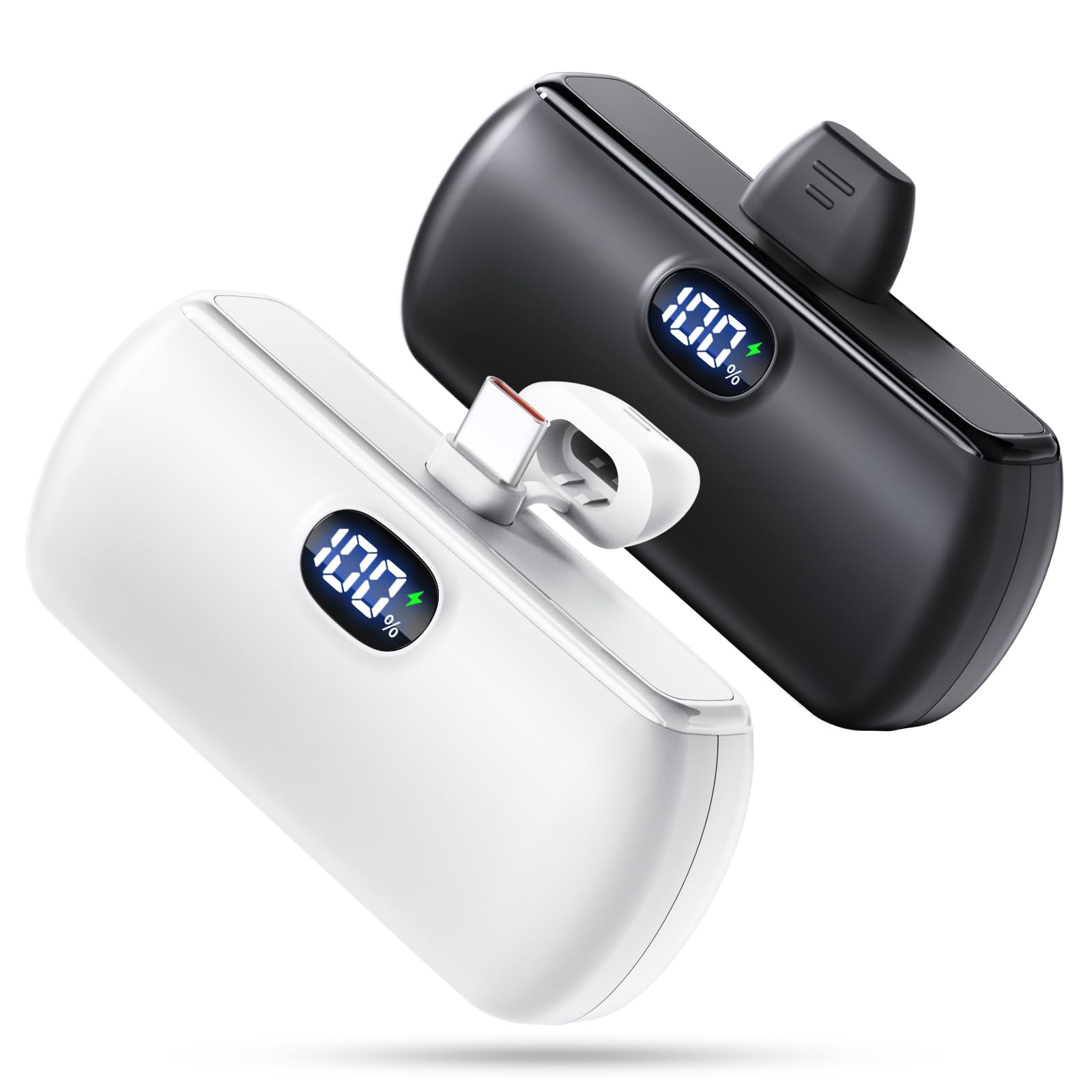
6. Hamcoc 5,000mAh 2-Pack (Z6)
Best Pocket Backup
Key Features
- Output: 22.5W
- Weight: 3.36 oz
- Display: LCD percentage
- Capacity: 5,000mAh each
- Price: Midrange
At 3.2 by 1.4 by 1.1 inches and 3.36 ounces, one of these is roughly a thick lipstick tube, and it plugs straight into the phone through a built-in connector with no cable at all. That is the entire case for it: a power bank that fits a jeans pocket and never gets left behind in a hotel safe.
5,000mAh is about one full charge for an iPhone 15 or 16, and the LCD shows the exact percentage, which is more than most packs this size bother with. Pass-through charging means one outlet overnight refills the pack and the phone together, so a single adapter in a hotel room covers both.
Two of them is the real pitch. One lives in a day bag, the other in a jacket or a carry-on, and between them you get roughly what a 10,000mAh pack offers, in a form you will actually keep with you instead of leaving in the room.
The split works better than we expected. The honest limit is that 5,000mAh is one charge, not two, so treat the pair as a 10,000mAh pack you can break in half rather than as a week’s worth of power. For a theme-park day, a commute, or a long walk with the map running, that reframing is exactly right.
Pros
- 3.36 oz and lipstick-sized
- Plugs into the phone with no cable
- Two units double your backup
- LCD shows exact percentage
Cons
- About one phone charge per unit
The pair we hand to someone who wants a charger in a pocket rather than a brick in a bag: two 5,000mAh packs, each about one full phone charge.
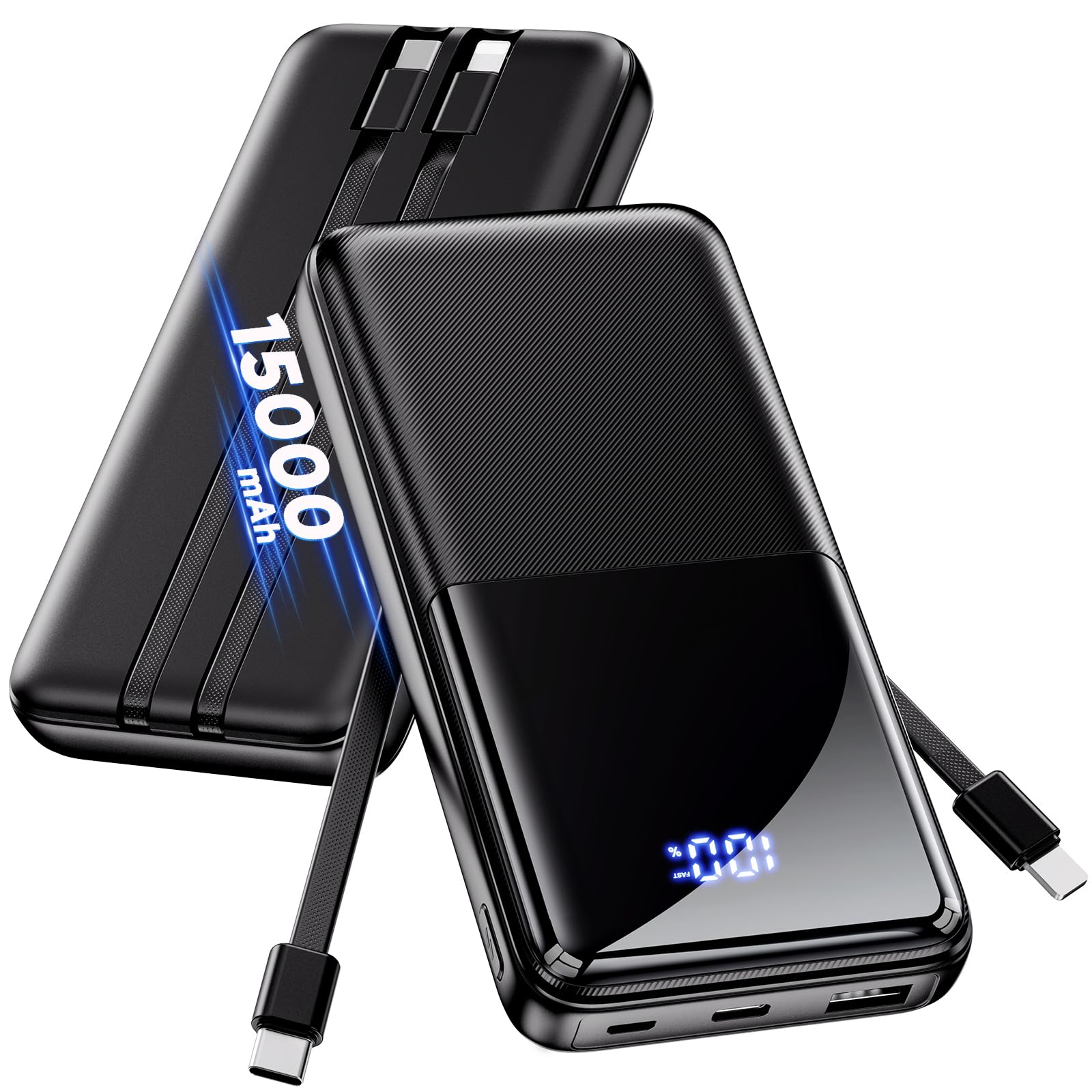
7. CFIAI 15,000mAh (PB-08)
Best for Mixed-Device Groups
Key Features
- Output: 22.5W
- Capacity: 15,000mAh
- Warranty: 3 months
- Built-in cables: USB-C and Apple
- Price: Budget
Two cables are built into the back of this one: USB-C and the older Apple connector. That is the difference between a pack that helps a whole group and one that only helps the Android half, and it makes this the least expensive route here to covering both kinds of phone. We were struck by how much that simplifies a shared rental car or a shared hotel room.
15,000mAh sits between the pocket packs and the 20,000mAh workhorses, and it arrives in a flat 5.9 by 2.7 by 0.7 inch body with a digital display. 22.5W fast charging covers phones and a tablet, five ports let four devices plug in at once, and the built-in cables are the ones you will reach for first.
The warranty is three months, the shortest here by a wide margin, so treat the low price as buying a pack and not a promise. Charging also gets inconsistent over time, with some units refusing to take a charge after a handful of uses. As a spare that lives in a glovebox or a desk drawer, both are acceptable risks. As the pack you depend on for a two-week trip, they are not.
Pros
- USB-C and Apple cables built in
- 15,000mAh in a flat body
- Four devices at once
- The cheapest pick in this group
Cons
- Three-month warranty
- Some units stop charging after a few uses
The cheap way to keep a mixed group charged: a built-in USB-C cable and a built-in Apple connector, with a warranty short enough to think about.
8. Belkin 10,000mAh 20W (BPB021)
Best for Phone-Only Travelers

Key Features
- Size: 4.05 x 2.51 x 0.95 in
- Output: 20W
- Capacity: 10,000mAh
- Warranty: 2 years
- Price: Budget
Twenty watts is the least power in this group, and it is the first thing to know: this Belkin fast-charges a phone and does very little for a tablet and nothing at all for a laptop. If your travel kit is a phone and a pair of earbuds, that ceiling rarely matters.
What the money buys instead is simplicity. A 10,000mAh pack at 4.05 by 2.51 by 0.95 inches, an integrated USB-C cable, a second USB-C port for someone else’s phone, and an LED indicator rather than a percentage. The two outputs share 15W when both are in use, so plugging in a second device slows the first.
Two years of warranty is the real argument, matched in this group only by Baseus, on a pack that costs less than most of the others. We minded the 20W less than we expected, because a phone still gains most of a charge over a long lunch. For a plain, dependable backup that lives in a work bag and comes out twice a week, that combination is the whole pitch.
Pros
- Two-year manufacturer warranty
- Integrated USB-C cable plus a spare port
- Small enough for a pocket
Cons
- Short built-in cable keeps the phone against the pack
A plain, honest 10,000mAh pack for phone-only travel, sold on a two-year warranty rather than on speed.
How We Tested USB-C Power Banks for Travel
I started by pulling every USB-C power bank I could find that was rated flight-safe, then filtered by capacity, port layout, price, and whether the cable was genuinely attached to the pack rather than a loose dongle in the box. That left 12 units, ranging from 5,000mAh pocket packs to 20,000mAh models with enough output to revive a laptop. Six months of testing followed, and almost none of it happened at a desk: these went through security lines, into commuter backpacks, into a rental car on a long drive, and to a theme park where the group chat flattened everyone’s battery by noon.
Charging speed and battery life I measured instead of trusting. I drained each bank completely, then timed how long it took to bring an empty phone to 50 percent and how many full phone charges it delivered before dying, with a small USB-C meter inline to watch the wattage actually going in. The advertised capacity was consistently optimistic compared with what the phone received.
Portability I judged on my own shoulder. Every pack got weighed, slipped into a jacket pocket for a full day, and carried in a tote next to keys and a water bottle to see whether the shell scuffed and the attached cable frayed at the strain relief. I also ran a tape along each built-in cable and checked whether it could reach from a seatback pocket to the tray table, which is the point where cable length stops being a spec and starts being a problem.
Durability got its own abuse: a waist-high drop onto tile, a week loose in a bag with a laptop, and one tumble off an airport chair that I’d like to call intentional. Value came last, and I compared what each pack cost against the wattage it actually delivered rather than what the listing promised.
How to Choose a Usb-C Power Bank for Travel
The right travel power bank is the one whose capacity you will actually carry all day, because a 20,000mAh brick left in the hotel room helps nobody.
Capacity and Weight: Finding the Travel Sweet Spot
A 10,000mAh pack gets most phones through two charges, which covers a long day of maps, photos and boarding passes. Step up to 20,000mAh and you get roughly double that, enough for a phone plus a tablet across a long weekend, at about twice the weight. The label is the cell’s capacity, not what reaches your phone: converting and pushing power across a cable loses a chunk of it, so plan on noticeably less than the number suggests.
Everything we recommend is comfortably under the airline ceiling, so capacity is a comfort question rather than a permission one. Pick 20,000mAh if the pack lives in a personal item; pick 10,000mAh or less if it lives in a pocket.
What Wattage Actually Buys You
Output watts decide which devices a pack can help. Around 20W fast-charges a phone and little else. Thirty to 45W adds tablets and gets a phone to a useful charge in under half an hour. Sixty-five watts and up is laptop territory, and if the laptop stays home you are paying for weight and heat you do not need.
Input matters just as much as output. A 20,000mAh pack that needs five hours to refill is fine overnight and useless on a layover, while one that refills in about 1.5 hours turns a coffee stop into a full battery. Match the pack’s input rating to the wall charger already in your bag, or the numbers on the box never happen.
Built-In Cables and the One-Bag Question
A built-in cable is the feature that most changes how a portable charger gets used, because a cable left at home turns a battery into a paperweight. Fixed cables are the most convenient and the most fragile: when the cord frays, the pack retires with it. Detachable cables lose a little convenience and can be swapped for a fresh one.
If you want to stop packing a wall charger entirely, the all-in-one designs do both jobs with a foldable plug built into the body. The Anker Nano 3-in-1 is the pick we reach for there, and it is worth its premium on a short trip with one phone.
Ports, Displays, and Warranty Length
Two ports cover a phone and earbuds. Three or four matter when you are charging for a group, and a pack with a built-in cable effectively gains a port for free. A percentage readout beats four blinking LEDs for the same reason a fuel gauge beats a warning light: it tells you whether you have one charge left or three.
Warranty is where these packs differ most, and it is the cheapest insurance on a battery that lives in a bag. Coverage across the ones we recommend runs from three months to three years, so it is worth checking before you buy on price alone.
Frequently Asked Questions
Can I put a power bank in a checked bag?
No. Spare lithium batteries have to travel in the cabin, so keep the pack in your carry-on rather than the bag you hand over at the counter. Size matters too: packs up to 100Wh, roughly 27,000mAh, are the standard carry-on allowance, and anything between 100Wh and 160Wh needs the airline’s approval before you fly. Every pick here sits under that line.
Will a USB-C power bank charge my iPhone?
Every iPhone from the 15 onward takes a USB-C cable, so a USB-C pack charges it directly with no adapter. An older Lightning iPhone needs a USB-C to Lightning cable, which almost none of these packs include, and the CFIAI is the one pick here with a built-in Apple connector. Check which port your phone has before you assume the built-in cable covers it.
What should I do if a power bank gets hot or starts to swell?
Warm is normal during fast charging; hot enough that you want to set it down is not. Unplug it, let it cool away from anything flammable, and stop using it entirely if the case has begun to bulge, since a swelling cell cannot be repaired and is a fire risk. Take it to a household hazardous waste site or a battery recycler instead of the trash.
How should I store a power bank between trips?
Leave it around half charge rather than full or empty, keep it out of a hot car and off a sunny windowsill, and top it up every few months so the cells do not drift down to nothing. A pack that sits at 100 percent on a shelf loses capacity faster than one stored at 50, and heat does more damage than either.
Final Verdict
Buy the INIU 20,000mAh if you want one pack that handles a long weekend without a second thought. It wins on the ratio that matters most for travel, real capacity in a body that fits a day bag, and the built-in cable and three-year warranty settle the rest.
If a laptop comes along, the Anker 87W is the upgrade that earns its extra weight. If the goal is to leave the wall charger at home entirely, the Anker Nano 3-in-1 does both jobs in one 8.82-ounce body.