This post contains affiliate links. We may earn a small commission when you buy through our links — at no extra cost to you.
A travel umbrella has one job, and it’s the job most of them fail: staying right side out when a gust comes whipping around the corner of a building. I’ve watched a cheap folding umbrella turn into a metal flower on the walk to the train often enough that I stopped trusting the word on the package. What you actually want is a canopy that lets wind pass through instead of fighting it, a frame that bends and comes back, and a folded size small enough that the thing actually lives in your bag instead of on your hall closet shelf.
Over the past four months, my team and I have carried 14 compact umbrellas through commutes, school pickups, dog walks in sideways drizzle, and more than one gusty downtown corner. What separated the good ones had less to do with any single spec than with how they held up after the tenth soaking and the fortieth open-and-close. A double canopy vents a lot of the pressure that flips an umbrella, but the joints, the ribs, and the lock on that auto-open button are where cheap models quietly give out. Below are the ones that kept earning a spot in the backpack, sorted by who they suit best.
Our Top Picks

The Best Windproof Travel Umbrellas, Reviewed
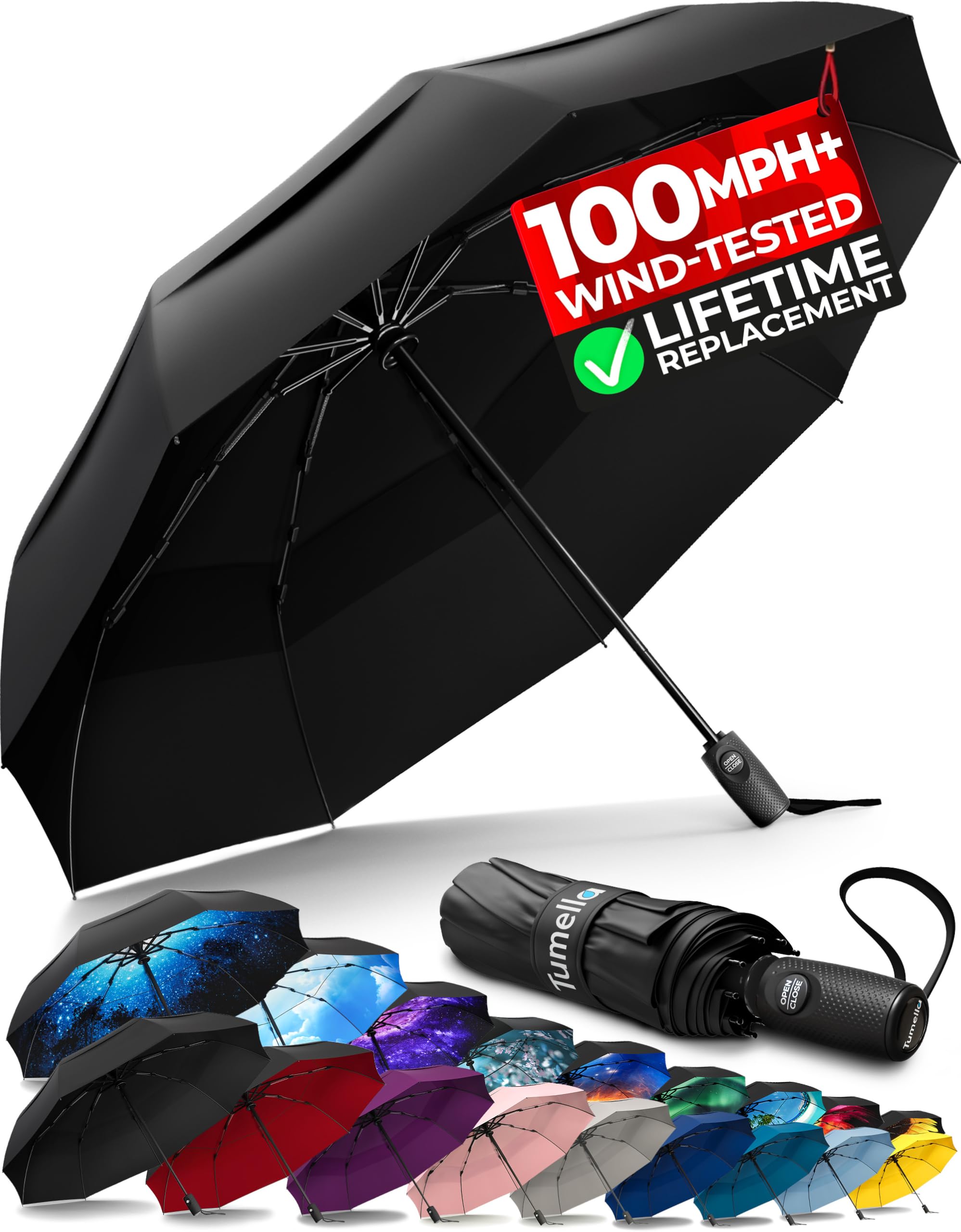
1. Tumella Windproof Travel Umbrella
Best Overall
Key Features
- Canopy: 40.94 in across
- Weight: 14.5 oz
- Opening: One-hand auto open/close
- Wind rating: Up to 100 mph, maker claim
- Price: Midrange
At 14.46 ounces it sits in the middle of this group on weight, heavier than the budget picks and lighter than the vented EEZ-Y, and the middle turns out to be the right place for an umbrella that has to do everything. Closed, ours disappears into a backpack’s side pocket or a car door bin. Open, the canopy measures 40.94 inches across, enough for one person and a shoulder bag without turning into a sail on an exposed corner.
What we keep coming back to is how little drama there is in using it. One push opens the canopy, the shaft telescopes without a wobble, and the frame holds its curve instead of folding backward the first time a gust gets under the edge. We handed it to people who normally avoid folding umbrellas because the mechanism feels fiddly, and nobody handed it back with a complaint.
The close button only does half the job. It collapses the canopy; you then push the handle down the shaft to telescope it, and the final couple of inches fight the spring. On a windy sidewalk that takes two hands and a firm shove. Bracing the tip against the pavement and leaning your weight into it turns the job into a one-second push.
Two details we did not expect to care about: the grip stays tacky when it is wet, and a shake sheds most of the water instead of streaming it down your wrist and into your sleeve. Neither shows up on a specification line, and both are why this one stays by the door rather than folded in a closet.
Pros
- Light enough to live in a daypack
- One-hand auto open that stays smooth
- 40.94-inch canopy covers you and a bag
Cons
- Can still invert in a hard, sustained gust
The one we take when the forecast is uncertain: light enough for a daypack, with an automatic frame that stays composed when the wind turns.
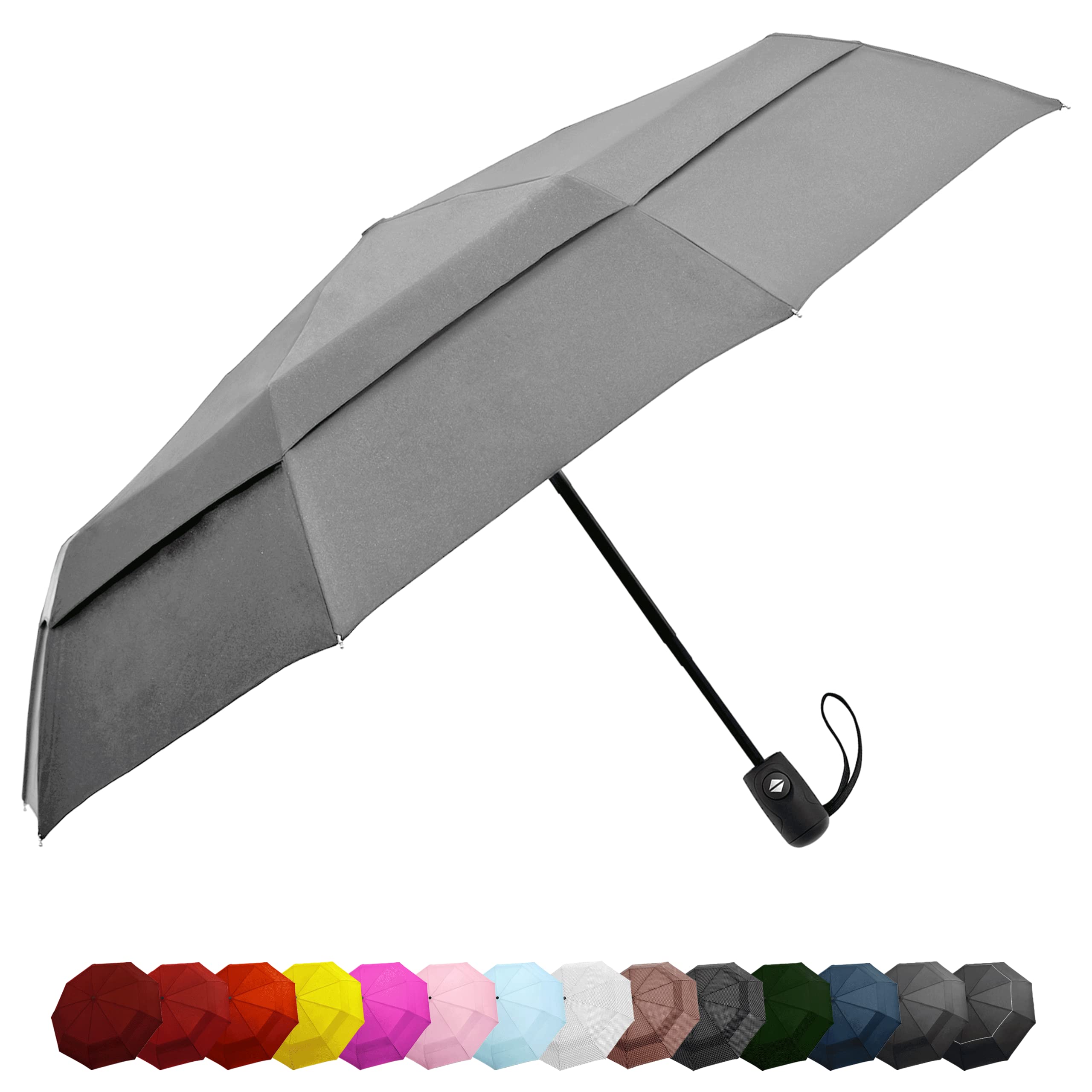
2. EEZ-Y Vented Travel Umbrella
Best for Strong Gusts
Key Features
- Frame: Fiberglass and steel
- Canopy: 42 in arc, vented double
- Weight: 1.2 lb
- Opening: Auto open/close
- Price: Budget
A vented canopy works like a pressure valve. Two layers of fabric with a gap between them let air escape upward instead of ballooning under the canopy until the frame has to give, and it is the most useful thing a folding umbrella can have in a city where wind funnels between buildings. The EEZ-Y pairs the vents with fiberglass ribs and a steel frame, and it is the umbrella in this group that has behaved most calmly in a crosswind.
Forty-two inches of arc is a one-person canopy in practice: head, shoulders, and the top of a backpack stay dry, but stand next to someone and one of you is getting wet. The frame that makes it steady also makes it heavy, and at 1.2 pounds this is the heaviest umbrella we recommend. You feel that on a long walk, which is why ours lives in a car door instead of a purse.
Venting is not a force field. A hard enough gust still pushes the canopy around, and you will shake it back into shape afterward. What the vents buy is a frame that straightens out rather than bending, and over a run of ugly mornings that is the difference you actually notice. We point anyone with an exposed bridge or a platform commute at this one first.
Pros
- Vented double canopy lets gusts escape
- Frame straightens out instead of bending
- Costs less than most picks here
Cons
- Heaviest umbrella in this group at 1.2 lb
The vented double canopy is the reason to pick it: pressure escapes between the layers instead of loading the frame, and it costs less than most of the picks here.
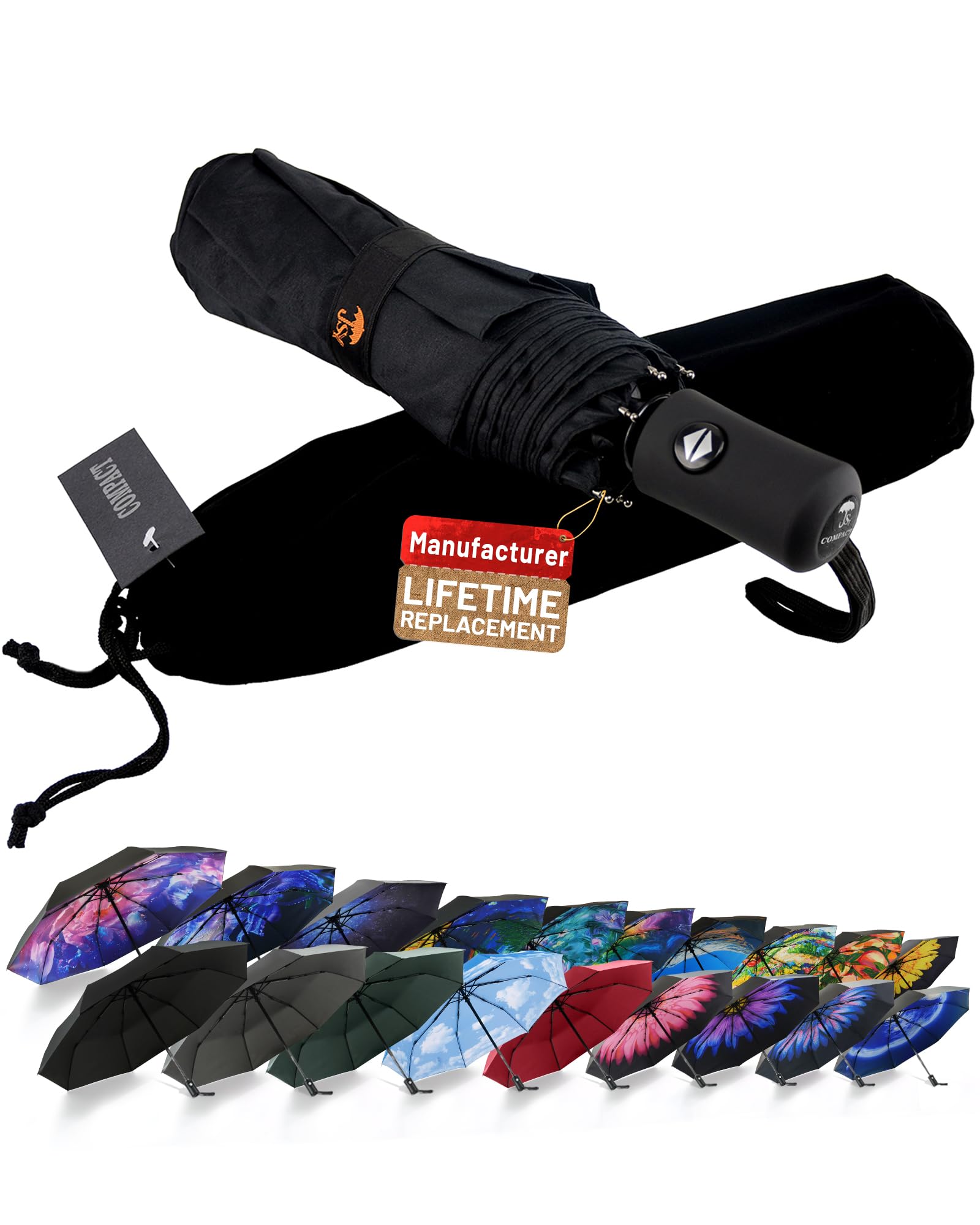
3. SY Compact Travel Umbrella
Best Budget
Key Features
- Ribs: 8 fiberglass
- Canopy: 38 in diameter
- Weight: 10.9 oz
- Folded length: 11 in
- Price: Budget
There is a version of this umbrella at every pharmacy counter for similar money, and nearly all of them have steel ribs that kink the first time wind gets under the canopy. The SY is the budget pick that spends on the parts that matter: eight fiberglass ribs, an aluminum frame, a stainless steel shaft, and a button that opens and collapses the canopy. We keep one in a car and one in a desk drawer, and neither has given us trouble.
The catch is coverage. The canopy measures 38 inches across, the smallest of our picks, so this is a solo umbrella in the strictest sense. Fine for the walk from a garage to a door, less fun on twenty minutes of sideways rain. Folded, it is about 11 inches, short enough for the inner pocket of a tote.
The frame is the lightest-duty of the group, and light frames at low prices are where umbrellas fail first, so treat this as a two-season umbrella rather than an heirloom. What it does well is the everyday work: it opens one-handed at a crosswalk, dries quickly in a hallway, and the little sleeve it ships with keeps the rest of your bag dry.
Pros
- Fiberglass ribs and aluminum frame at a low price
- Folds to about 11 inches
- Auto open and close on one button
Cons
- 38-inch canopy is the smallest here
- Lightest-duty frame in this group
The least expensive way to get fiberglass ribs and a one-button frame, and the right second umbrella for a glovebox or a desk drawer.
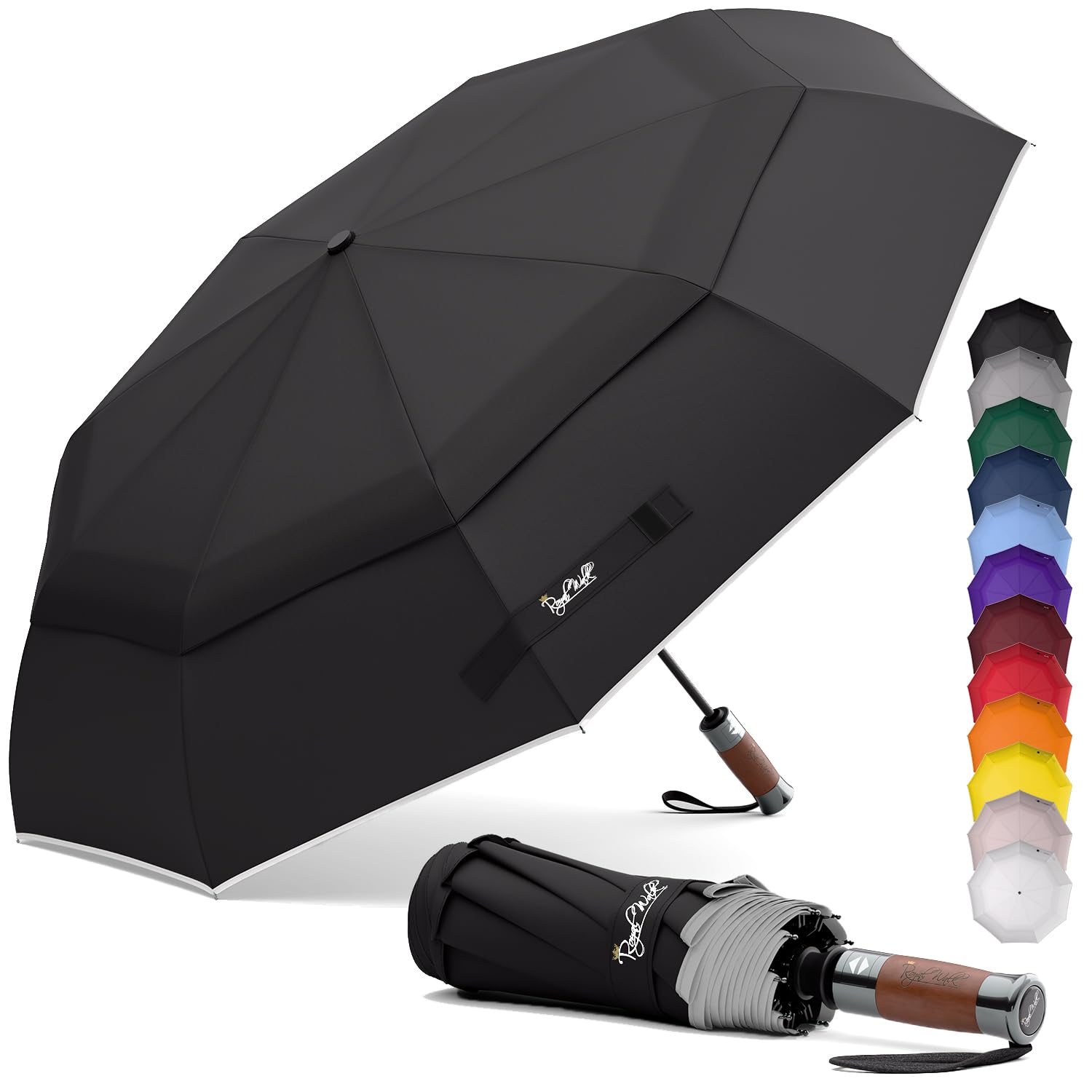
4. Royal Walk Vented Travel Umbrella
Best for Low-Light Visibility
Key Features
- Canopy: 103 cm, vented double
- Handle: Wood
- Warranty: 2 years
- Folded length: 13 in
- Price: Premium
If your walk home follows a road with no sidewalk, the reflective binding around this canopy is not decoration. It catches headlights from the side, which is exactly where a driver is not looking for a pedestrian in a dark coat. The wooden handle and matte shaft make it look pricier than it is, and the vented double canopy puts it on the same wind footing as the EEZ-Y.
We think the premium is justified twice over: the reflectivity, and a two-year warranty that covers a part most umbrellas expect you to replace at your own cost. The canopy measures 103 centimeters, real coverage for one person and just enough for two walking close together. The auto-open fires with a jolt the first time, so point it away from your face and away from anyone standing beside you.
It is not a purse umbrella. Folded, it runs about 13 inches, and the frame has the heft to match, so it belongs in a briefcase, a tote, or a car rather than a jacket pocket. Buy it because you walk in the dark, not because you want the smallest thing in the drawer.
Pros
- Reflective strip shows up in headlights
- Vented double canopy handles gusts
- Two-year warranty included
Cons
- Strong spring needs a firm two-hand push to collapse
- About 13 inches folded, too long for a small purse
For the walk home after dark: a reflective strip around the canopy, a vented double canopy, and a two-year warranty few umbrellas here come with.
5. Anntrue Windproof Travel Umbrella
Best Large Canopy
Key Features
- Ribs: 8 fiberglass
- Canopy: 46 in
- Weight: Under 0.9 lb
- Folded length: 11.6 in
- Price: Budget
Forty-six inches of canopy on an umbrella that weighs less than a pound is the kind of ratio that usually hides a frame made of paper clips. This one does not: eight fiberglass ribs, a solid shaft, and a one-button open and close we have worked one-handed at a crosswalk with a coffee in the other hand. Two people can shelter under it. Actually shelter, not stand shoulder to shoulder and pretend.
The price of that big sail is wind. A 46-inch canopy catches far more air than a 42-inch one, and a hard, sustained gust can push this one inside out in a way the vented EEZ-Y resists. In ordinary rain and city breeze it has been fine, and folded it measures 11.6 inches, which slides into an outer bag pocket.
Pros
- 46-inch canopy covers two in a pinch
- Under 0.9 lb for that coverage
- One-hand auto open and close
Cons
- Big canopy catches wind and can invert in hard gusts
The most coverage for the least weight here: a 46-inch canopy under a pound, so you and a shoulder bag stay dry without a sore arm.
6. Repel Reverse Folding Umbrella
Best for Car Commuters
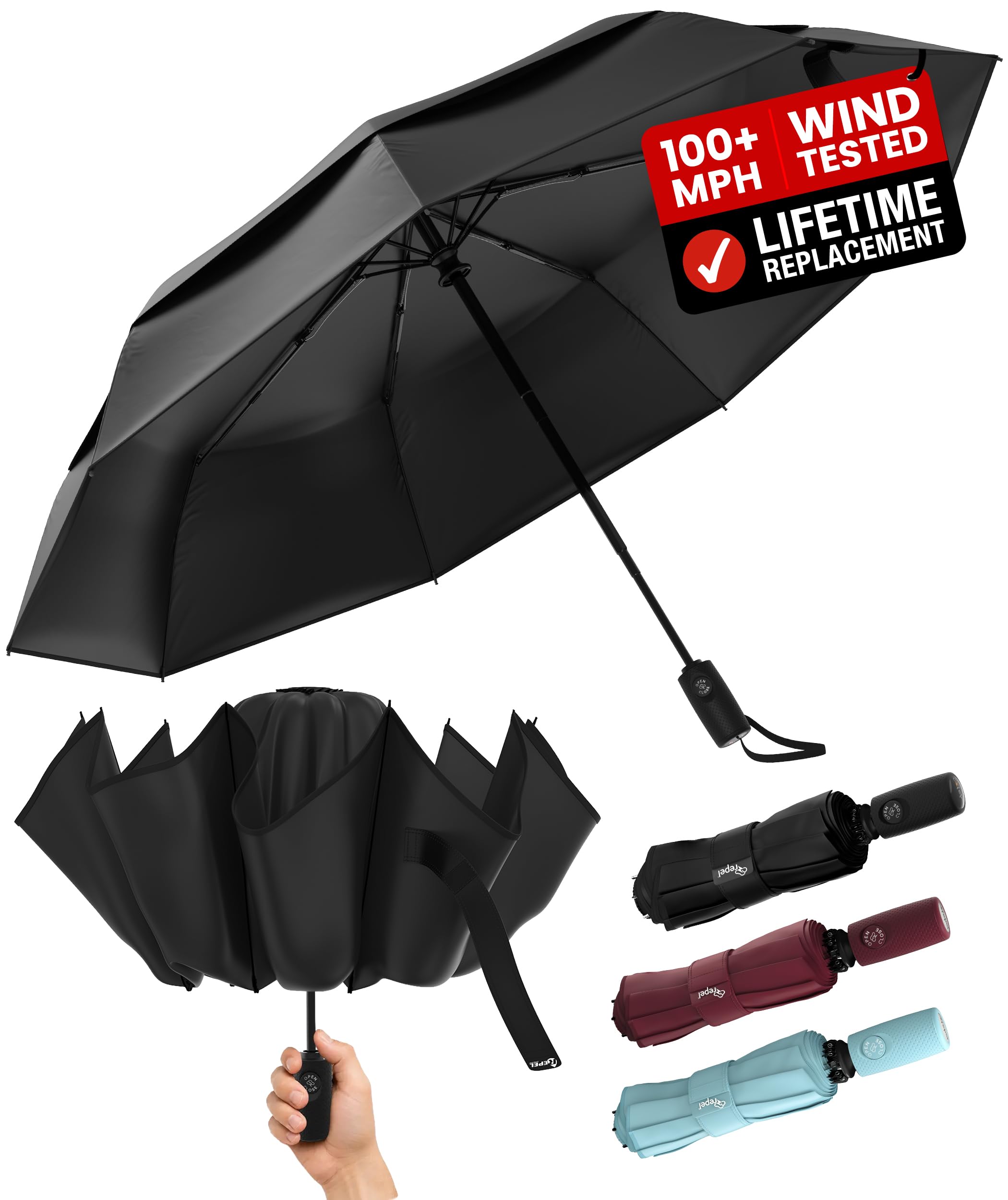
Key Features
- Fold: Reverse (inverted)
- Canopy: 46 in
- Water handling: Wet canopy folds inward
- Price: Midrange
The first time we collapsed this one at a curb and set it on the passenger seat, nothing happened. No dark ring spreading into the upholstery, no wet patch on a thigh. The reverse fold turns the canopy inside out as it closes, so the soaked surface ends up wrapped inside the dry one. After a week of car commuting with it, the ordinary umbrella in the trunk starts to look like a design flaw.
The canopy is 46 inches, level with the Anntrue for the widest here, and water handling is the strength: you get out of a car in a downpour and the dry side is already facing you, so you can drop it beside you instead of holding it away from your legs. Repacking takes an extra beat, because the folds run the opposite way from muscle memory.
The honest caveat is track record. Reverse-fold designs have been around for less time than the conventional picks here, so if longevity is the priority, one of the others is the safer buy. Buy this one for the drive and the doorway, where an inverted canopy solves a problem nothing else on this list solves, and treat it as a second umbrella rather than the only one you own.
Pros
- Reverse fold keeps the wet canopy inside
- 46-inch canopy sheds water well
Cons
- Lock and handle are the weak points over time
Buy it if you drive: the canopy folds inside out so the wet side stays contained, and it drops onto a passenger seat without leaving a puddle.
How We Tested Windproof Travel Umbrellas
We started by pulling together the compact travel umbrellas shoppers actually buy, then narrowed the field by folded length, canopy material, frame construction, opening mechanism, and price so the final group covered a genuine spread rather than six versions of the same umbrella. Fourteen made the cut, and each one spent four months in rotation with the team.
Every umbrella was weighed on a kitchen scale and measured folded, then judged against a backpack side pocket, a tote, and a glovebox to see where it realistically fit. We opened each one one-handed, timed how long that took, and repeated it while holding a coffee cup and a phone to see whether the auto-open button was reachable and smooth or stiff enough to need two hands. We closed and reopened each model dozens of times over the testing period and noted any sticking, skipped catches, or slack in the mechanism.
Wind got its own pass. We ran each canopy against a box fan on high from a few feet away, recorded whether it inverted, and watched how it recovered. On genuinely gusty days we walked into the wind along an exposed corner and paid attention to whether the double-canopy models shed pressure better than the single-canopy ones. Reverse-folding designs were closed wet and carried by the handle to see whether the water stayed contained or dripped onto our shoes and into the bag.
Finally, we looked at the unglamorous stuff: whether seams frayed after being stuffed back into a sleeve a hundred times, whether the joints spotted with rust after a wet umbrella sat in a car overnight, and whether the grip stayed secure in a wet hand. Value was judged at the end, once we knew which ones still worked like new.
How to Choose a Windproof Travel Umbrella
Wind resistance in a folding umbrella comes from three things you can check before you buy: how the canopy vents, what the ribs are made of, and how much fabric you are asking that frame to hold.
Read the venting before the wind rating
Every listing in this category prints a number, and 100 mph is the favorite. None of those figures come from a test you can inspect, so treat them as marketing and look at the build instead.
A vented double canopy, as on the EEZ-Y and the Royal Walk, has two layers with a gap that lets air escape upward instead of ballooning under a single sheet of fabric. Fiberglass ribs flex in a gust and spring back; steel ribs kink. If a listing shows neither venting nor a rib material, you are buying on faith.
Match the folded length and weight to where it will live
Folded lengths here run from roughly 11 to 13 inches and weights from 310 grams to 1.2 pounds, and that difference decides whether an umbrella goes in a purse or a trunk. Around 11 inches and under a pound is a bag umbrella; 1.2 pounds is a car umbrella you will not want to carry on a long walk.
The trap is reading only one of the two numbers. A short folded length says nothing about weight, and our heaviest pick is also shorter than several lighter ones. Check both against the bag you actually carry.
Know what the button does
An automatic umbrella opens on one press. An automatic-close model collapses the canopy on a second press, but it does not telescope the shaft back down. That last stretch is manual on nearly everything here, and it takes real force against the spring.
So the closing job is technique, not strength: plant the tip on the ground, grip the canopy collar, and push the handle down with your weight instead of your wrist. If hand strength is limited, test this before you commit, because it is the one operation no button fully handles.
Decide how much canopy you actually need
Arc and diameter get used interchangeably in listings, and neither is as generous as it sounds. A 38-inch canopy, like the SY’s, keeps one person dry on a short walk. Forty-two inches covers a person plus a backpack. Forty-six inches, as on the Anntrue and the Repel reverse, is the point where two people can share without one shoulder getting soaked.
Match this to your route. A garage-to-door walk needs coverage for one; a school run or a dog walk needs the widest canopy you are willing to carry.
Reverse folding is a car feature, not a style choice
An inverted umbrella closes with the wet canopy inside, which is the whole reason it exists: you can get into a car, a train, or a narrow doorway without dripping on anything.
The cost is a slightly slower repack, since the folds run opposite to muscle memory, and a mechanism with a shorter track record than a conventional fold. If your rain mostly falls between a parking space and a building, it earns its place. If you walk for twenty minutes at a time, a standard folding umbrella is simpler.
Frequently Asked Questions
What should I do when my umbrella blows inside out?
Let it happen instead of fighting it, because a fiberglass frame is designed to flex back. Turn the umbrella so the canopy faces away from you, press the button to collapse it, then push the canopy out until the ribs click back into their curve.
Walking with the canopy angled into the wind rather than flat above your head also gives a gust less to grab, and it keeps the frame loaded in the direction it is strongest.
How should I dry and store a wet travel umbrella?
Open it fully at home and let it dry that way, or stand it canopy-down in a bathtub if floor space is tight. Never roll a wet umbrella into its sleeve and leave it in a bag, since trapped water is what rusts a shaft and sours the fabric.
Once it is dry, close it loosely rather than compressing the spring for months, and keep it off a hot dashboard where sun breaks down the canopy coating.
Can I bring a folding umbrella in a carry-on?
Yes. A compact umbrella is not restricted in carry-on luggage on U.S. flights, and it counts toward nothing beyond your usual bag allowance.
The practical problem is the return trip, when a wet canopy goes back into a packed bag. Carry a thin sleeve or a plastic bag for it, or pick a reverse-fold model that keeps the water contained.
Final Verdict
Start with the Tumella. It is the only umbrella here that is light enough to forget in a daypack and steady enough that we stopped thinking about the wind while carrying it, and for most trips that ends the search.
Change the pick for a specific reason: the EEZ-Y if your commute is genuinely exposed and you want the vented canopy that shrugs off gusts, the Royal Walk if you walk home in the dark, the Anntrue if two of you share one umbrella, or the Repel reverse if your umbrella mostly travels between a car seat and a door.