This post contains affiliate links. We may earn a small commission when you buy through our links — at no extra cost to you.
A packable rain jacket should be the easiest thing you pack for Europe — and the easiest thing to wear once you’re there. Too often it’s the opposite: a crinkly shell that traps heat on a long train ride, a hood that smacks you in the face in the wind, a waterproof fabric that wets out by lunchtime. Over eight months, my team and I tested 12 rain jackets on real trips and at home, wearing them through drizzle, downpours, and the kind of damp cold that settles into your shoulders.
We paid attention to the details that matter: how the fabric felt against bare arms, whether the seams stayed dry after a half-hour walk, how the fit worked over a sweater (and in extended sizes), and whether the color still looked sharp after a week in a duffel bag. Lightweight matters, but not at the expense of looking presentable — a rain jacket is the outermost layer of every photo. The jackets that made our list earned it by being the ones we reached for even when the sky looked fine.
Our Top Picks




The Best Rain Jackets for Europe Travel, Reviewed
1. Columbia Arcadia II
Best Overall
Key Features
- Hood: Adjustable
- Cuffs: Velcro tabs
- Pockets: Two zippered hand pockets
- Waterproofing: Fully waterproof
- Price: Premium
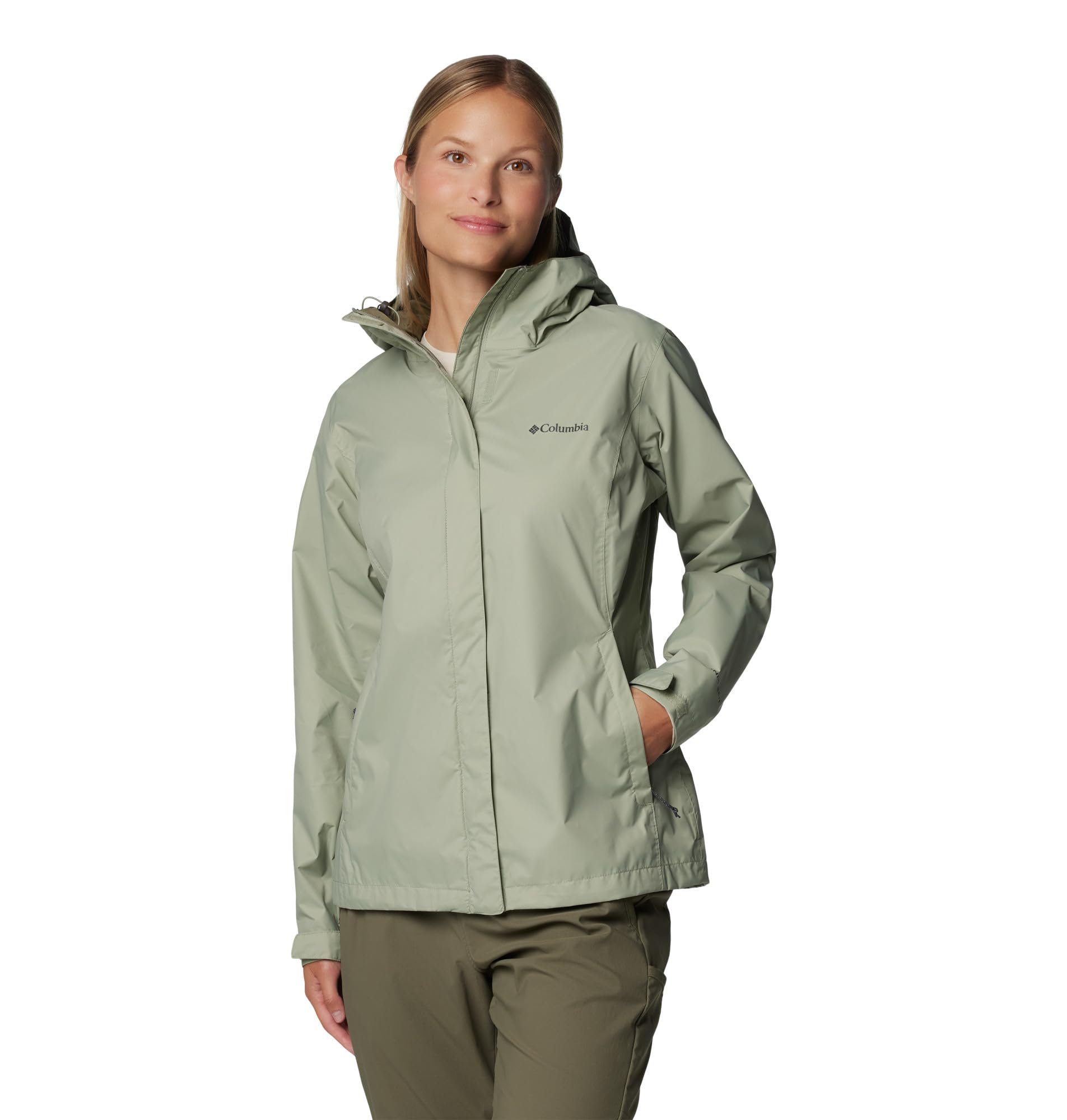
The Arcadia II is a rain jacket because of details you can check with your fingers: a full storm flap over the main zip, Velcro tabs at the cuffs, and an adjustable hood. Columbia calls it fully waterproof, and the construction backs that up — the places water usually finds a way in, the zipper and the wrists, are the places this jacket covers.
Of everything we tested for this trip, it’s the jacket we trust most for a long, wet day of walking. It’s light enough to live in a daypack until the sky turns, it goes over a sweater without a fight, and the fabric is quiet — no rustle with every step, which matters more than it sounds in a museum-quiet old town. The hood adjusts down far enough to cover your face instead of perching on top of your head.
Sizing is the one thing to get right: it runs small, so go up a size if you plan to wear anything thicker than a shirt underneath. Otherwise the choices are sensible — deep zippered hand pockets, a collar that stands up under your chin — and the one addition we wanted was an interior pocket for a passport. It sits at the top of the price range here, and it’s still the jacket we recommend first.
Pros
- Fully waterproof with a storm flap over the zip
- Packs small enough for a daypack
- Adjustable hood that covers the face
- Quiet fabric, not a crinkly shell
Cons
- Runs small; size up to layer
If you want one jacket that handles a wet week of European walking without fuss, this is the one we hand people.
2. 33,000ft Packable Rain Jacket
Best for Warm, Wet Days
Key Features
- Vents: Underarm zips
- Lining: Mesh
- Packability: Rolls into supplied sack
- Waterproofing: 10000mm H₂O
- Price: Midrange
Two zips sit under the arms of this jacket, and they’re the reason we pack it for Europe in late spring. A waterproof shell that doesn’t vent turns into a sauna the moment you climb a hill with a daypack on; cracking the underarm vents on a mild, drizzly afternoon lets the heat out without letting the rain in. The fabric is rated 10000mm and the mesh lining keeps it off your skin.
The hood adjusts with drawcords and stays where you put it in wind, and the pockets are the useful kind — two zippered hand pockets plus an interior zip pocket sized for a passport or phone. There’s a drawstring at the hem, and the length covers your seat, which is the difference between damp and soaked when you’re standing at a tram stop.
It rolls into a supplied stuff sack, though getting it back in there the second time takes patience and a knee. Plan on a layer underneath, too: the mesh lining adds no warmth, so a cold, wet day calls for a fleece.
Pros
- Underarm vents for warm, wet days
- 10000mm rating with a mesh lining
- Hood adjusts and holds in wind
- Packs into a supplied stuff sack
Cons
- Repacking the stuff sack takes patience
We recommend it for warm, rainy days, when a plain waterproof shell turns into a sauna.
3. Columbia Glennaker Lake II
Best Men’s Value
Key Features
- Hood: Stows in collar
- Cuffs: Velcro adjustable
- Packability: Stuffs into its own pocket
- Waterproofing: Water-resistant
- Price: Midrange
Think of the Glennaker Lake II as the men’s answer to our top pick — same company, lower price — but it’s a different animal. It’s a water-resistant shell rather than a fully waterproof one, and its party trick is packing: the whole jacket stuffs into its own left pocket, and the hood rolls away into the collar when the sky clears.
That makes it a jacket for city weekends and drizzle rather than a day on an exposed trail. Water-resistant means the fabric shrugs off a shower and holds up on the walk to the station; in sustained rain you’ll eventually feel it at the shoulders. The cut is roomy, so a winter jacket fits underneath without binding, and the Velcro cuffs let you close the gap at the wrist.
At the lower end of the range, that’s a fair trade. This is the shell to keep rolled up in a daypack for the afternoon the forecast changes, and it earns credit for a collar that sits high and cuffs that actually close. Just don’t ask it to be the jacket for a week of Scottish rain.
Pros
- Stuffs into its own left pocket
- Hood rolls away into the collar
- Roomy enough for a winter layer
- Lower price than our top pick
Cons
- Not breathable on a long climb
- Stiff, noisy fabric when new
Buy it as a men’s packable layer for city weekends and light rain, not as a downpour jacket.
4. APEXUP Packable Rain Jacket
Best Budget
Key Features
- Hood: Adjustable
- Weight: 8.82 oz
- Waterproofing: 5000-8000mm
- Package dimensions: 9.06 x 5.12 x 2.76 in
- Price: Budget
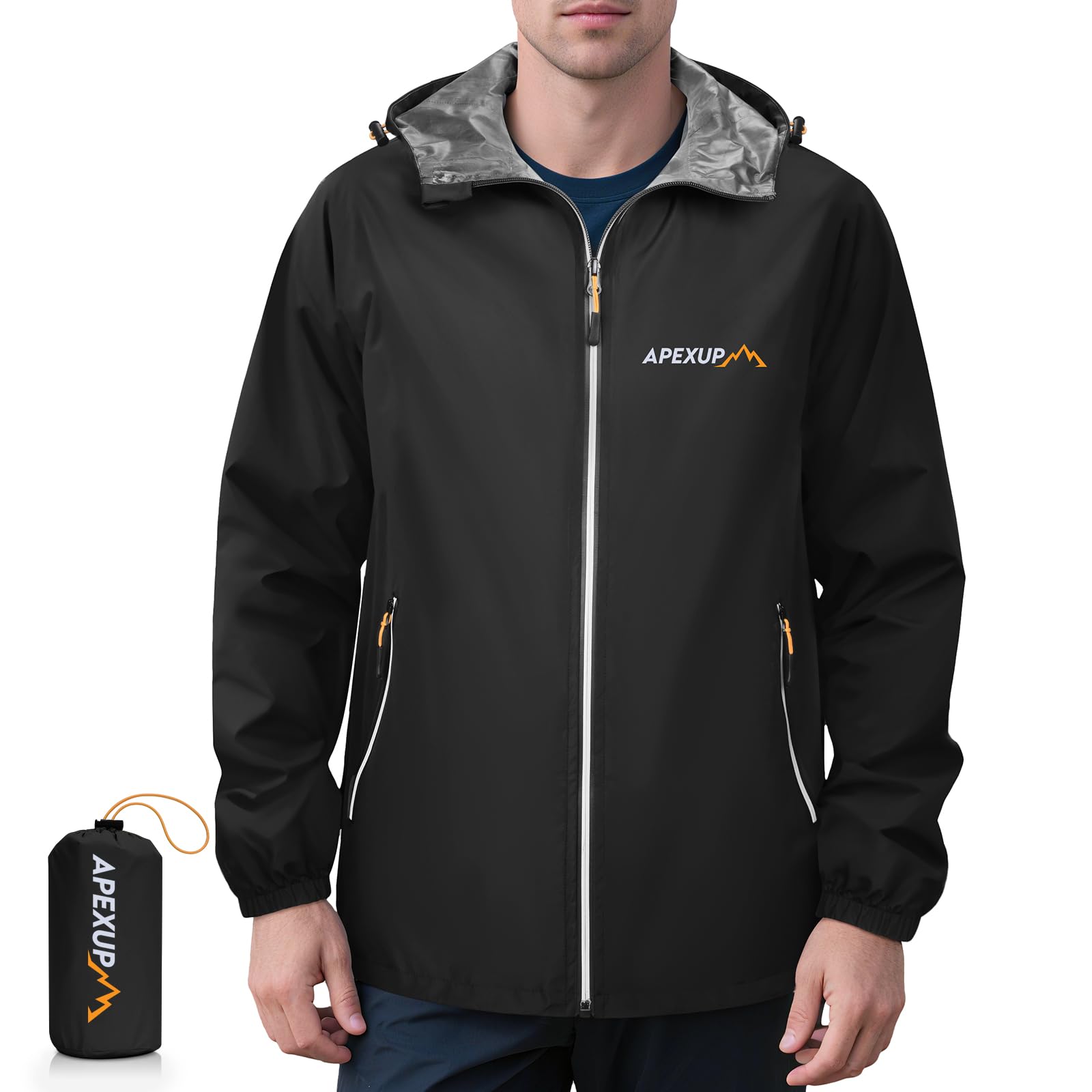
The packaged jacket measures 9.06 by 5.12 by 2.76 inches and weighs 8.82 ounces, and it arrives with a stuff sack. That’s the sort of bundle that lives in the bottom of a daypack and gets forgotten until the sky opens — and on a trip where you’re carrying everything between trains, that counts for a lot.
The shell carries a 5000 to 8000mm rating, which is honest about what it is: enough for steady, ordinary rain, not a mountain storm. The hood and hem both adjust, the pockets zip, and there are reflective details that we’re glad to see on a jacket this inexpensive.
What the price buys away is staying power in a real soaking. This is a jacket for crossing a city on a wet afternoon, not for a week of daily walking in the rain — a sustained, heavy downpour will eventually find its way through. Buy it as the spare that lives in your bag, the one you hand a kid, or the first shell you own before you know how much you’ll use it.
Pros
- Packs to 8.82 ounces with a stuff sack
- 5000-8000mm rating for steady rain
- Adjustable hood and hem
- Lowest price in this group
Cons
- No breathability, so you sweat on a warm walk
At the bottom of the price range, it’s the jacket that still keeps you dry in ordinary rain, which makes it the one to leave in a daypack.
5. Outdoor Ventures Rain Shell
Best in Heavy Rain
Key Features
- Vents: Underarm vents
- Lining: Mesh
- Weight: 1.13 lb
- Waterproofing: 10000mm H₂O, seams taped
- Price: Premium
The hood is why this one is on the list. It’s cut generously, adjusts with drawcords, and comes forward far enough to keep rain off your glasses — a detail most shells at this weight skip. Behind it sits a 10000mm fabric with taped seams, a mesh lining, underarm vents, and zippered hand pockets with an extra zip pocket inside.
That combination makes it the most weather-ready of the packable jackets here. It’s the one for an exposed coastal walk or a windy city where the rain arrives sideways, and the extra ounces buy a hood that holds its shape and seams that stay sealed through a long afternoon. If your only priority is the smallest bundle in your bag, the 33,000ft packs tighter; if you expect real weather, this is the one.
Pros
- Taped seams and a 10000mm rating
- Large adjustable hood that shields the face
- Underarm vents and a mesh lining
- Zippered pockets, including an inner one
Cons
- Runs small with short sleeves
- Crinkly fabric that rustles as you walk
Worth the extra weight if your trip includes wind, exposed coastlines, and rain that comes at you sideways.
6. Outdoor Ventures Fleece-Lined Coat
Best for Cold Trips
Key Features
- Lining: Fleece
- Closure: Two-way zip with snaps
- Pockets: Multiple zippered
- Waterproofing: Waterproof softshell
- Price: Midrange
The lining is what separates this coat from every other rain jacket here: soft fleece bonded to a waterproof softshell, so pulling it on in a cold hotel room doesn’t feel like stepping into a wet rag.
The details are built for daily wear in bad weather — a two-way zip you can open from the bottom when you sit down, snaps over the front, a waist drawstring, a roomy hood, and plenty of zippered pockets inside and out. Nothing about it feels delicate, which is what you want from the coat you’ll wear every day for a week.
Water beads and rolls off the surface, and the softshell blocks wind, so it works as your only coat on a 40-to-55-degree day rather than a layer you carry and hope you don’t need. Toss a thin sweater underneath and it covers a wet Paris afternoon or a drizzly week in Scotland.
Where it earns its place is the cold half of the year: a December city break, a wet northern European week, anywhere you’d otherwise pack both a shell and a midlayer. If your trip falls in September, take the Arcadia II instead — this coat is built for weather that bites.
Pros
- Fleece lining warms without a puffer
- Waterproof softshell sheds rain and wind
- Two-way zip and a roomy hood
- Lots of zippered pockets
Cons
- A coat, not a stuffable shell — it takes suitcase space
- Too warm for summer travel
Choose it for a cold-weather trip, when one coat that handles rain and chill beats packing a shell and a fleece.
7. baleaf Packable Rain Jacket
Best for Dark Mornings

Key Features
- Hood: Tucks into collar
- Weight: 10.6 oz
- Visibility: Reflective trim
- Waterproofing: Waterproof zipper
- Price: Midrange
Fluorescent color and reflective trim are what put this jacket in the bag for a trip: on a dark, wet morning in an unfamiliar city, being seen by traffic matters as much as staying dry. The hood has a stiffened brim that pushes rain away from your face, and it tucks into the collar when the weather clears — one less thing flapping at your neck.
The jacket has a waterproof fabric and a waterproof zipper, and at 10.55 ounces it packs into a carry-on without a fight. There’s an anti-slip strip along the hem that keeps it from riding up under a backpack, which is the kind of detail we notice on a long walking day. It’s cut for movement rather than layering, so read the size chart before you commit.
Pros
- Reflective trim and high-visibility colors
- Stiffened hood brim keeps rain off your face
- Hood tucks into the collar
- Packs to 10.55 ounces
Cons
- Gets clammy during hard effort
- Runs small for some builds
Our pick for anyone walking or riding in traffic before sunrise, where being seen matters as much as staying dry.
8. LOMON Lined Raincoat
City Style

Key Features
- Lining: Printed lining
- Closure: Zip with snaps
- Pockets: Snap-close pockets
- Waterproofing: Waterproof shell
- Price: Midrange
Most rain jackets look like rain jackets. This one reads as a coat first: clean lines, a zip with snaps over it, and a printed lining that shows whenever you open it. On a trip where you’ll walk into a church or a restaurant without going back to the hotel to change, that counts for more than another hundred millimeters of waterproofing.
It’s lined, which gives it a little warmth on a cool, damp day without turning it into a winter coat, and the waist drawstring lets you shape it instead of wearing a sack. There are snaps over the zip, decent pockets, and a hood that stands up when the wind gets under it.
Water beads on the shell rather than soaking straight in, and the hood and high collar are what you want on an exposed headland where wind drives rain sideways under an umbrella. Nothing about it feels technical, and that’s the appeal.
Sizing is generous: if you’re between sizes and plan to layer, take your usual; if you want it fitted, size down. It’s also the wrong choice for a humid July hike, since the lining holds warmth you won’t want at 80 degrees. For spring and fall city travel, it’s the jacket that looks like you meant to pack it.
Pros
- Looks like a coat, not rain gear
- Lined for a little warmth
- Zip plus snaps and a waist drawstring
- Hood and collar stand up in wind
Cons
- Runs slightly large; size down for a fitted look
A raincoat that passes as a coat, which is why we recommend it for city days and dinners rather than trails.
How We Tested Rain Jackets for Europe Travel
We built our shortlist by researching packable rain jackets from established outdoor brands, then narrowing by price, available sizes, and travel-specific features like adjustable hoods and taped seams. That left us with 12 jackets to test over eight months, ranging from featherweight shells to a fleece-lined softshell. We wore them in rotation on a weeklong trip through a few European cities, on morning hikes, and on everyday commutes.
Each jacket got packed into its own pocket or pouch, then unpacked and checked for creases that wouldn’t shake out. We walked for 30 minutes in steady rain and watched whether water beaded up or soaked through at the shoulders and hood. Hoods were tested in wind, pockets with cold hands, and fit was judged over both a T-shirt and a chunky sweater. We paid close attention to sizing — whether it ran true, and whether extended sizes were properly graded rather than just wider.
Lightweight jackets earned points for disappearing into a carry-on, but we also noted breathability by wearing each one on a brisk walk and checking for clamminess. For appearance, we compared colors in daylight and checked how the fabric held up after a week in a duffel bag. Quality came down to small things: zippers that didn’t snag, seams that stayed flat, and fabric that didn’t rustle like a tarp. The jackets that scored highest were the ones we kept reaching for even when the forecast looked fine.
How to Choose a Rain Jacket for Europe Travel
The jacket that works for a European trip is the one you’ll carry every day and can layer when the weather turns, which makes honest waterproofing, ventilation, and packed size the three things worth comparing.
Waterproof, Water-Resistant, and What the Numbers Mean
The millimeter figure on a rain jacket describes how much water the fabric holds back before it leaks. Anything from 5,000 to 8,000mm handles steady, ordinary rain; 10,000mm and up is what we look for when you’ll be outside for hours. The seams and the main zip matter as much as the fabric — a full storm flap over the zip is often the difference between a dry chest and a wet one.
If a listing only says water-resistant, treat it as a jacket for showers, errands, and the walk to the station, and don’t count on it for a day on an exposed coast. For a trip built around walking, buy the stated rating.
Packability Is a Range, Not a Label
Packable covers everything from an 8.8-ounce shell that stuffs into its own pocket to a 1.13-pound jacket you fold into a daypack with a bit of shoving. The extra weight usually buys a hood that holds its shape, taped seams, and pockets that fit a phone and a passport.
Decide how the jacket will travel before you compare ounces. If it lives in your bag until the sky turns, take the lightest one that keeps you dry. If you’ll wear it all day, weight matters less than a hood that stays up and vents that open. And know that a stuff sack isn’t a promise: most of these take a minute of rolling and stuffing to get back in.
Ventilation, Layers, and the Weather You’re Packing For
A waterproof shell that doesn’t breathe wets you from the inside on a climb. Underarm zips and a mesh lining are what make a mild, drizzly day with a backpack tolerable, and they’re the cheapest comfort upgrade in this category. Below roughly 55 degrees, plan on a fleece or sweater under the shell instead of a warmer jacket; above 70, ventilation decides whether you wear it at all.
An insulated, fleece-lined coat is the better call for a late-fall or winter trip — one garment instead of two — provided you have the suitcase room for it. For a shoulder-season trip with mixed weather, the shell-and-layer approach is more flexible.
Hoods, Sleeves, and Sizing
A good hood adjusts at the back and the sides and comes forward far enough to keep rain off your glasses; one that only perches on top of your head is useless in wind. Look for a stiffened brim if you’ll be walking into weather rather than waiting it out.
Sizing is the thing most likely to go wrong. Several jackets here run a size small, so order up if you plan to layer, and check sleeve length if you’re tall. A jacket that stops at the hip sends rain onto your thighs; a longer one earns its place in a city of cobblestones and puddles.
Frequently Asked Questions
Is a rain jacket better than an umbrella for a European trip?
In wind, an umbrella is a liability — on bridges, coastal paths, and any street where buildings funnel a gust. A hooded shell keeps both hands free for a phone, a ticket, or a handrail, and it keeps a daypack dry on your back.
Bring the shell as your default. Add a small umbrella only if you’ll be in one city long enough to want one for a windless, heavy downpour.
The surface of my jacket stopped beading. Can I fix it?
Yes. That’s the water-repellent finish on the outside wearing down, not the waterproof layer failing. Wash the jacket with a technical wash — no detergent, no fabric softener — rinse twice, then tumble it on low or follow the care label, since heat reactivates the finish.
If water still soaks the surface afterward, a spray-on repellent restores it. Do this before a trip, not during one, and skip the dryer if the label forbids it.
How do I pack a wet rain jacket without soaking everything else?
Roll it, don’t fold it, and keep it out of your bag until you’re somewhere you can hang it. On a travel day, strap it to the outside of your daypack or carry it; a shell that goes into a stuff sack damp stays damp and starts to smell.
At the hotel, hang it over a chair back or the shower rail and let it dry overnight. Never put it on a radiator — direct heat damages the coating.
Final Verdict
The Columbia Arcadia II is the rain jacket we recommend first. It’s fully waterproof where it counts, packs into a daypack, and layers over a sweater without a fight — just order a size up, because it runs small.
If your trip lands in warm, humid weather, the 33,000ft shell breathes better and costs less. If you’re traveling in late fall or winter, skip both and take the fleece-lined Outdoor Ventures coat: one garment, no layering decisions in a cold hotel room.