This post contains affiliate links. We may earn a small commission when you buy through our links — at no extra cost to you.
A packable backpack is a small miracle right up until you put something heavy in it. That’s the trade-off built into the category: the smaller a bag folds down, the more likely it skimps on padding, straps, and stitching. The right one earns its place as the second bag in your luggage — the one that’s already there when a day hike, a rainy afternoon, or an extra load of souvenirs suddenly appears.
Spec sheets don’t tell you the half of it. Stated capacity is measured to the seams, not to what actually fits through the opening, so a 20-liter packable can carry like a 15-liter daypack. We’ve spent six months putting 14 of these through airports, trailheads, and Saturday errands, and the winners all share a few traits.
None of them are built like a real hiking pack, and they shouldn’t be — you’re trading structure for a bag that weighs less than a paperback and vanishes into a corner of your carry-on. The picks below are ranked on how well each one makes that trade.
Our Top Picks



The Best Packable Backpacks, Reviewed
1. Gonex Packable Daypack 20L
Best Overall
Key Features
- Weight: 185 g (6.5 oz)
- Capacity: 20 liters
- Packed size: 6.29 x 6.29 in
- Compartments: 3 zippered
- Price: Budget
Folded, the Gonex is a 6.29-inch square that slides into a corner of a carry-on; opened, it is a 20-liter daypack with three zippered compartments and side pouches that hold a bottle upright. At 185 grams it adds almost nothing to the bag you are already carrying, and it has the highest rating in this guide. That is why it is the pack we point most travelers to first.
The three compartments earn their keep on a real trip. A wallet and a passport go in a pocket of their own, so a market stall or a museum coat check does not turn into a full unpacking. The nylon is water resistant rather than waterproof: a drizzle rolls off, an hour in a downpour does not, and a zip-top bag for your phone costs nothing.
What it does not do is disappear completely. Six inches square is small for a 20-liter pack, but it is big next to the Nanobag’s fist or the folded bundles on the ultralight picks here, so if your space budget is a jacket pocket rather than a suitcase corner, those are the ones to look at.
The real test is whether it is worth carrying on a day when there is room for a proper backpack. This one is.
Pros
- Folds into a 6.29-inch square
- Three zippered compartments plus bottle pouches
- 185 g adds almost nothing to a carry-on
- Highest-rated pack in this guide
Cons
- One size only, at 20 liters
We send most travelers here first: it folds to a six-inch square, opens into 20 usable liters, and costs less than nearly everything else in this guide.
2. Osprey Ultralight Stuff Pack
Best Materials and Harness
Key Features
- Weight: 0.15 kg (5.3 oz)
- Zippers: YKK with reinforced pulls
- Capacity: 18 liters
- Material: 40D recycled high-tenacity nylon
- Price: Premium
Osprey spends on the parts you actually touch: 40D high-tenacity recycled nylon, YKK zippers with reinforced pulls, and shoulder straps with real mesh padding instead of flat webbing.
The harness is what we noticed first. Padded mesh straps and an adjustable sternum strap are what keep it comfortable past the first hour, and they are the reason this is the pack we hand someone who plans to walk all day with it on. It also stuffs into its own top pocket, so the upgrade does not cost you the packability that got you here.
What it does not have is much organization: one main compartment, an internal key clip, and two stretch side pockets. That suits someone who packs light and hates digging, and frustrates anyone who wants a wet pocket and a dozen zip compartments.
It is, plainly, the nicest thing in this guide to carry, and the only one where the zippers are a selling point in their own right.
Pros
- Padded mesh straps and a sternum strap
- YKK zippers with reinforced pulls
- Stuffs into its own top pocket
- Real comfort on a long walking day
Cons
- Priciest pack in this guide
- Listed as not water resistant
Buy it when you will have the pack on all day: padded straps, a sternum strap, and YKK zippers do more for comfort than another few liters.
3. ZOMAKE Packable Backpack
Best Size Range
Key Features
- Straps: Breathable shoulder straps
- Pockets: Multiple pockets
- Capacity: 10, 15, or 20 liters
- Water resistance: Water resistant
- Price: Budget
One design, three sizes: ZOMAKE sells this pack in 10, 15, and 20 liters, so a family can put a small one on a kid and a full-size one on an adult and end up with the same straps, the same pouch, and the same price. The 10-liter suits a child’s day out; the 20 is the one an adult carries.
It is water resistant, it has multiple pockets, and the shoulder straps are the breathable mesh kind, which counts for something in August. Folding it back into its own pouch is quick and does not turn into a wrestling match.
The appeal for us is multiplication. Three of these cost about what one premium pack does, which makes it the sane choice for a family trip where bags get left in hotel rooms, borrowed, and covered in sand.
Water resistant, quick to fold, and simple enough that nobody in the family needs a tutorial before the shuttle bus.
Pros
- Comes in 10, 15, and 20 liters
- Cheap enough to buy for a whole family
- Folds into its own pouch
- Breathable mesh shoulder straps
Cons
- Front-pocket seams are the first to fail
Three sizes, a low price, and a pouch it folds into, which makes it the easiest way to put a packable bag on everyone in the family.
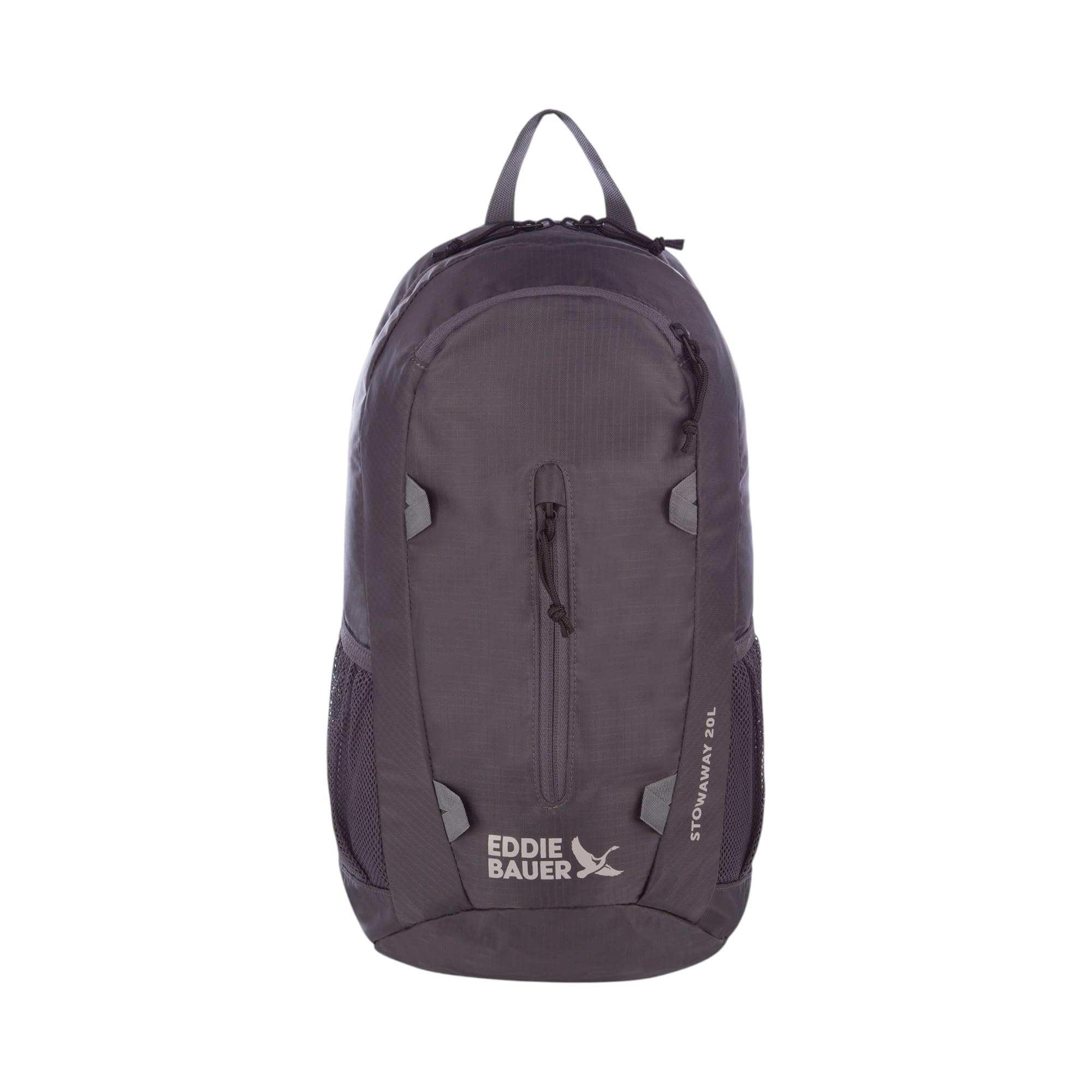
4. Eddie Bauer Stowaway 20L
Best for Loaded Hikes
Key Features
- Weight: 4.8 oz
- Harness: Hip belt and extended shoulder straps
- Capacity: 20 liters
- Packed size: 8.5 x 7 x 1.5 in
- Price: Midrange
Almost no packable backpack in this guide has a hip belt, and that one strap changes what the Stowaway is for. With the belt snug, the weight of a full day of jacket, water, lunch, and camera rides on your hips instead of pulling your shoulders back.
The rest is quiet competence: ripstop polyester with a StormRepel WR finish, extended shoulder straps, and 20 liters that open to 18 by 10 by 9 inches. It weighs 4.8 ounces and folds into its own 8.5 by 7-inch pocket, a flat, wide bundle rather than a stuff sack.
That flatter bundle is the trade: it takes more room in a suitcase than the fist-sized pouches here, and there is one size only, so a small adult and a tall one get the same harness.
What we noticed after an hour with a full pack is that the belt stops being a specification and starts being the reason your shoulders are not tired. That is the difference between a bag you tolerate and one you keep on for the whole walk.
Pros
- Hip belt plus extended shoulder straps
- 4.8 oz, lightest 20-liter pack here
- StormRepel WR ripstop polyester
- Packs into its own 8.5 x 7-inch pocket
Cons
- Pricier than the other 20-liter picks
The hip belt is the reason to buy it: no other pack here puts a full day’s weight on your hips instead of your shoulders.
5. MIYCOO 35L Packable Backpack
Best for Big Loads
Key Features
- Weight: 12.8 oz
- Pockets: 5
- Capacity: 35 liters
- Water resistance: IPX4 splash rated
- Price: Budget
Thirty-five liters is the biggest capacity in this guide, and the MIYCOO still folds into its own inner pocket. This is the bag you bring empty and fill with whatever the trip throws at you: laundry, souvenirs, a beach towel that never fully dried. It is also among the cheapest ways to get this much room.
The wet compartment is the detail that earns it a place rather than just a size. A damp swimsuit or a rain-soaked shell goes in its own zippered section instead of soaking everything else, which is a better use of weight than another liter of volume.
We rate it first for a beach week or a trip where you come home with more than you left with. Filled to 35 liters, though, the shoulder straps stop being comfortable, so pack it to about twenty and it carries like a much smaller bag.
The locking zipper pulls and the survival whistle are the odd extras: gimmicks until you are on a crowded ferry or a dark trail, and then not. The locking pulls are the more useful of the two, since a zipper that cannot be opened quietly is a real deterrent in a crowd.
Pros
- 35 liters, the most capacity here
- Separate wet compartment
- Anti-theft zipper clips and a whistle
- Folds into its own inner pocket
Cons
- Heaviest pack here at 12.8 ounces
- Splash-rated water resistance only
The one to take when you need the most room: 35 liters, a wet compartment, and a folded size that still fits inside a suitcase.
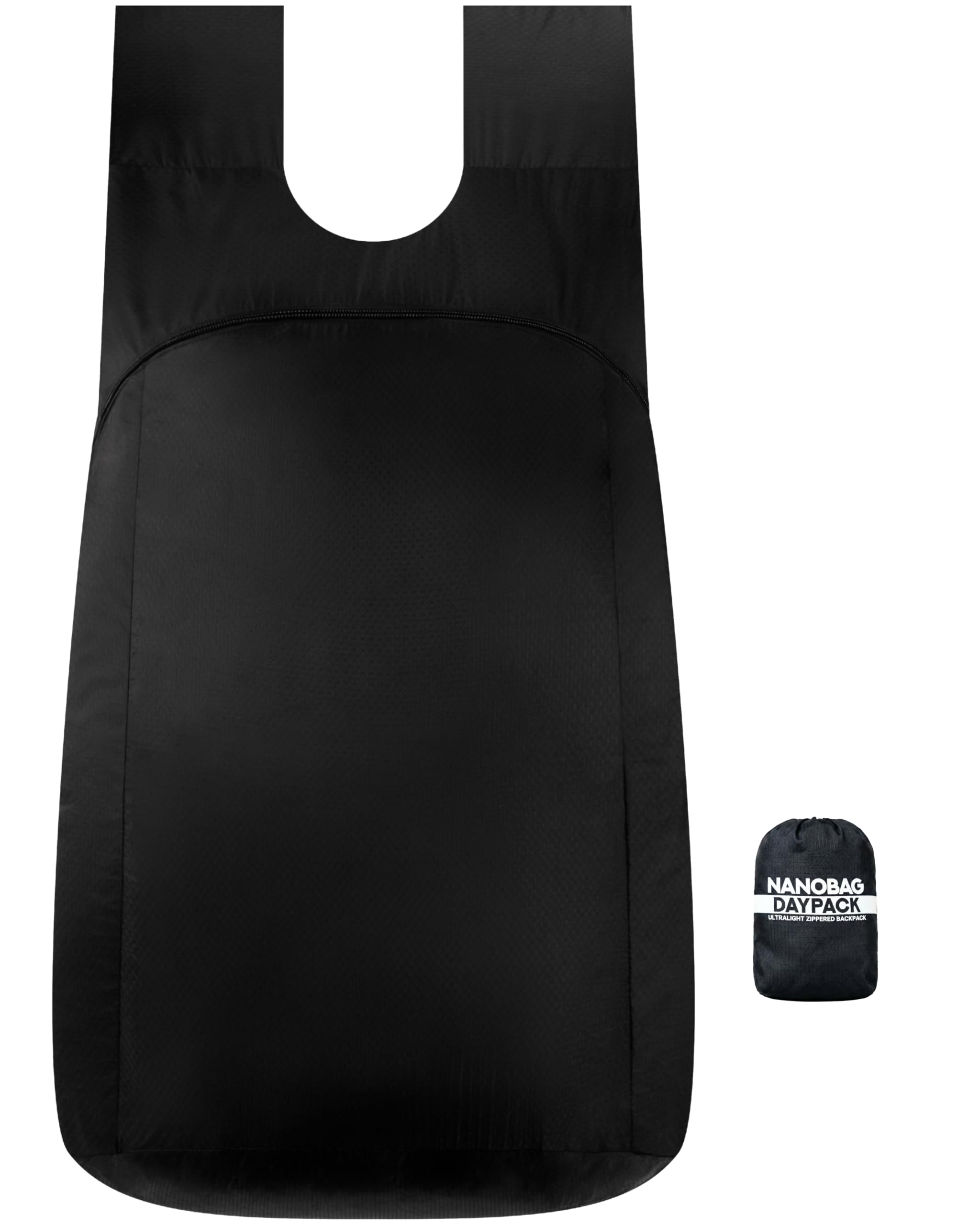
6. Nanobag Daypack 16L
Best Ultralight
Key Features
- Fabric: 0.05 mm diamond ripstop nylon
- Weight: 1.15 oz
- Capacity: 16 liters
- Strap length: 27 in
- Price: Midrange
At 1.15 ounces, this is the pack you can carry in a jeans pocket and forget about. The fabric is 0.05 mm thick, closer to a sturdy shopping bag than to a backpack, and it still holds 16 liters.
It also skips the annoying part of a packable bag: there is nothing to fold, you stuff it into the attached pouch and you are done in seconds. The zipper is YKK, the straps are 27 inches long and cut wide, and the maker rates the bag to 66 pounds, which is a claim about the fabric rather than an invitation to load it.
The straps are a fixed length, though, and that is the catch: on narrower shoulders they slide, and there is no adjusting your way out of it.
We think that is the whole case: it lives in a pocket, a purse, or a glovebox, and it costs you nothing to bring along. Sixteen liters of a heavier pack does you no good sitting in a hotel room.
Pros
- 1.15 ounces, the lightest here
- Stuffs into its pouch with no folding
- YKK zipper and diamond ripstop nylon
- 27-inch straps spread the load
Cons
- Fixed-length straps slide off some shoulders
- Costs more than larger packs here
If the bag has to live in a jacket pocket until you need it, nothing else here comes close to 1.15 ounces.
7. SKYSPER Ishell 10L
Best for City Days

Key Features
- Weight: 0.26 kg (9.2 oz)
- Capacity: 10 liters
- Packed size: 6.7 x 7 in
- Security pocket: Hidden back pocket
- Price: Budget
The best idea in this pack is a zippered pocket that sits flat against your back, where a pickpocket cannot reach it and neither can you, which is the point. A passport and a day’s cash go in and stay in.
For a walking day in a city, we think that organization beats capacity. Ten liters holds a layer, a bottle, a guidebook, and a phone, and the pack stays flat against your back instead of swinging around, which is the difference between a day bag and a duffel with straps.
The rest is well thought out: a vertical zip pocket on the front, deep mesh pockets on both sides that hold a bottle securely, ripstop polyester with a water-resistant finish, and a folded size of 6.7 by 7 inches. Ten liters fills fast once you add a camera or a souvenir, which is the honest limit on it, so for anything more step up to the 16- or 20-liter packs here.
Pros
- Hidden back pocket for a passport
- Deep side pockets hold a bottle
- Folds to 6.7 x 7 inches
- Water-resistant ripstop polyester
Cons
- Just over nine ounces for ten liters
A city pack with a secret pocket: ten organized liters and a back-panel pocket that keeps a passport out of reach.
8. WATERFLY 20L Packable Backpack
Best for Organized Family Days

Key Features
- Weight: 10.2 oz (290 g)
- Capacity: 20 liters
- Warranty: 3 years
- Packed size: 8.7 x 6.3 in
- Price: Midrange
Four separate compartments is unusual in a bag this light, and it changes how you live out of it: a wet swimsuit, a paperback, snacks, and a wallet each get their own zone instead of one communal sack. On organization, we put it near the top of this group.
The shell is recycled nylon with a water-resistant finish, the side pockets take a 32-ounce bottle, and it folds back into its own pouch at 8.7 by 6.3 inches. For a day out with four people’s stuff in it, the compartments are worth more than another liter.
The three-year warranty is the part nothing else here matches, and on fabric this thin it is worth more than it sounds, because seams and zippers are what fail first on a packable bag. It is also the easiest of these to hand a kid at a theme park: everything has a home, so nothing ends up lost in the bottom of the bag.
Pros
- Four compartments keep a day organized
- Three-year warranty
- Side pockets hold a 32 oz bottle
- Recycled nylon shell
Cons
- Heaviest and bulkiest of the 20-liter picks
Four compartments and the longest warranty here make it the easiest pack to live out of, if not the lightest to carry.
How We Tested 14 Packable Backpacks
We started by rounding up every foldable daypack we could find from brands we already trust and a handful we’d never heard of, then filtered for three things: it had to stuff into its own pocket, come in somewhere between 10 and 35 liters, and cost less than a checked bag fee. That left 14 bags, which we tested over six months — long enough for each one to be folded, unfolded, and crammed into a suitcase corner dozens of times.
We weighed every pack on a kitchen scale, empty and again once it was stuffed into its own pocket, then pressed the resulting bundle into the leftover space of a carry-on to see how much room it actually stole. Capacity got the same treatment: each bag was loaded with the identical kit — a liter bottle of water, a rain shell, a paperback, a sandwich, and a small pouch of cables — and we noted what slid in easily, what had to be forced, and whether the zipper closed without strain.
Then we carried them. Every pack went on a three-to-five-mile walk with about ten pounds inside, plus a full day of sightseeing, a grocery run, and at least one trail, with notes on where the straps cut in, whether the back panel turned into a swamp, and if the bottle pockets could be reached one-handed while walking. Each one also sat under a running faucet for ten minutes with a paper towel in the main compartment so we could see exactly where water got through, and every zipper and seam was worked open and shut until we found the ones that snagged.
The slow part was the folding. Six months of stuffing each bag back into its own pocket showed which seams frayed first, which coatings stopped beading water, and which packs quietly stopped folding as neatly as they did on day one.
How to Choose a Packable Backpack
A packable backpack earns its place with two numbers, how small it folds and how much it carries, and the rest of the decision is whether the harness is good enough to keep it on your back all day.
Start with the folded size, not the liter count
When a bag has to live in a carry-on corner, a glovebox, or a jacket pocket, the packed footprint is the number that decides. This group runs from a lump that fits in a fist to a flat 8.5 by 7-inch package, and the smallest folded bags here carry 16 liters while one of the biggest bundles carries 20. Packed size and capacity simply do not move together.
Measure the space you are willing to give it before you buy. A jacket pocket rules out everything but the ounce-class bags; a suitcase corner takes any of them. Empty weight matters for a different reason: you carry the pack empty for most of the trip, so anything under about seven ounces disappears into your luggage and your day.
Capacity: what a liter figure is actually worth
Ten liters is a phone, a bottle, a layer, and a guidebook. Twenty is a full day with a camera and a jacket. Thirty-five is shopping and souvenirs. Decide which day you are packing for before you compare numbers, because the numbers themselves are not standardized across brands.
The trap is treating the liter figure as a measurement. A packable bag has no frame, so the stated capacity assumes you fill every corner and nothing bulky is inside. Check the open dimensions against the claim when they are listed, and assume a soft body swallows less than a hard one of the same nominal size.
Straps decide whether you keep it on
A frameless pack puts every pound on the harness. Flat webbing is fine for a bottle and a jacket; padding and a sternum strap are what let you keep the bag on for a long morning, and a hip belt, which only one pick here has, is what lets you carry a real load without your shoulders doing all the work.
A belt that hangs loose is decoration. It only moves weight when it sits snug around your hips, so try it on a full pack rather than an empty one. If the bag is a spare that comes out for an hour at a time, straps matter much less than folded size.
Fabric, water, and the pockets worth paying for
Packable fabric is thin by definition. 30D and 40D ripstop nylons are the norm, and they are stronger than they feel, but the seams and zippers are where they give. Look for reinforced stitching at the strap anchors and named zippers if you plan to load the bag often.
Treat water resistance as splash protection rather than weatherproofing. One pack here carries a stated splash rating and the rest simply say water resistant, so a zip-top bag for a phone and a passport is the cheap insurance. In a crowd, a hidden back pocket is worth more than another liter.
Frequently Asked Questions
Can a packable backpack count as an airline personal item?
Usually. The 20-liter packs here run about 17 by 12 by 6 inches, which fits under the seat on U.S. carriers that cap personal items near 18 by 14 by 8 inches. Eddie Bauer’s 18 by 10 by 9-inch body is the one that pushes the depth limit once it is full.
Pack the bag before you fly and measure it stuffed, not flat. The sizer at the gate has no give, and your airline’s own limit is the one that counts.
How do you get the bag back into its pouch?
Stuff it, do not fold it. Turn the pouch inside out, push the base of the bag in first, then work the fabric in around the edges and zip. Starting from the base stops the bag from ballooning halfway through.
How should I clean a packable backpack?
Hand wash in cool water with a little mild soap, rinse, and air dry out of direct sun. The care listings across this group say hand wash or wipe with a damp cloth, and a washing machine’s agitation is hard on fabric this thin. Skip the dryer entirely.
Is a packable backpack worth it if I already own a daypack?
Only if your daypack is too bulky to bring. The case for these is the second bag: something that takes up a corner of a carry-on and saves you hauling a full-size pack around a museum or a market. If your current pack already stuffs into its own pocket, you have this covered.
Final Verdict
The Gonex 20L is our default for a simple reason: it folds into a six-inch square, carries a full day, and costs less than almost everything else in this guide. Nothing else here balances those three as well.
Spend more only for a specific job. The Osprey‘s padded straps and YKK zippers are worth it if the bag will be on your back all day, and the Eddie Bauer‘s hip belt is the better answer when the load is heavy. If the pack has to live in a jacket pocket, the Nanobag at 1.15 ounces is the one.