This post contains affiliate links. We may earn a small commission when you buy through our links — at no extra cost to you.
The first time a wave breaks over your pocket, you find out what your phone is really made of. A waterproof pouch is cheap insurance—a sealed bag you can still swipe through—and it only has to fail once to cost you a phone. The good ones and the bad ones look identical on the shelf; the difference shows up when your hands are wet and sandy and the seal has to hold anyway.
I’ve held a phone over open water on a boat, in a hotel pool, and on a kayak that took on more water than anyone planned. What I look for now is unglamorous: a bag that fits a phone with its case still on, a lanyard that survives a real tug, plastic clear enough that photos don’t come out hazy, and a pouch that floats instead of sinking when you inevitably drop it.
We spent three months with 18 pouches, and the gap between the best and the rest was wider than the price tags suggested. Below are the ones that kept our phones dry and our photos sharp—plus the small stuff, like how easily the seal locks and how fast the bag dries, that ended up deciding it.
Our Top Picks


The Best Waterproof Phone Pouches, Reviewed
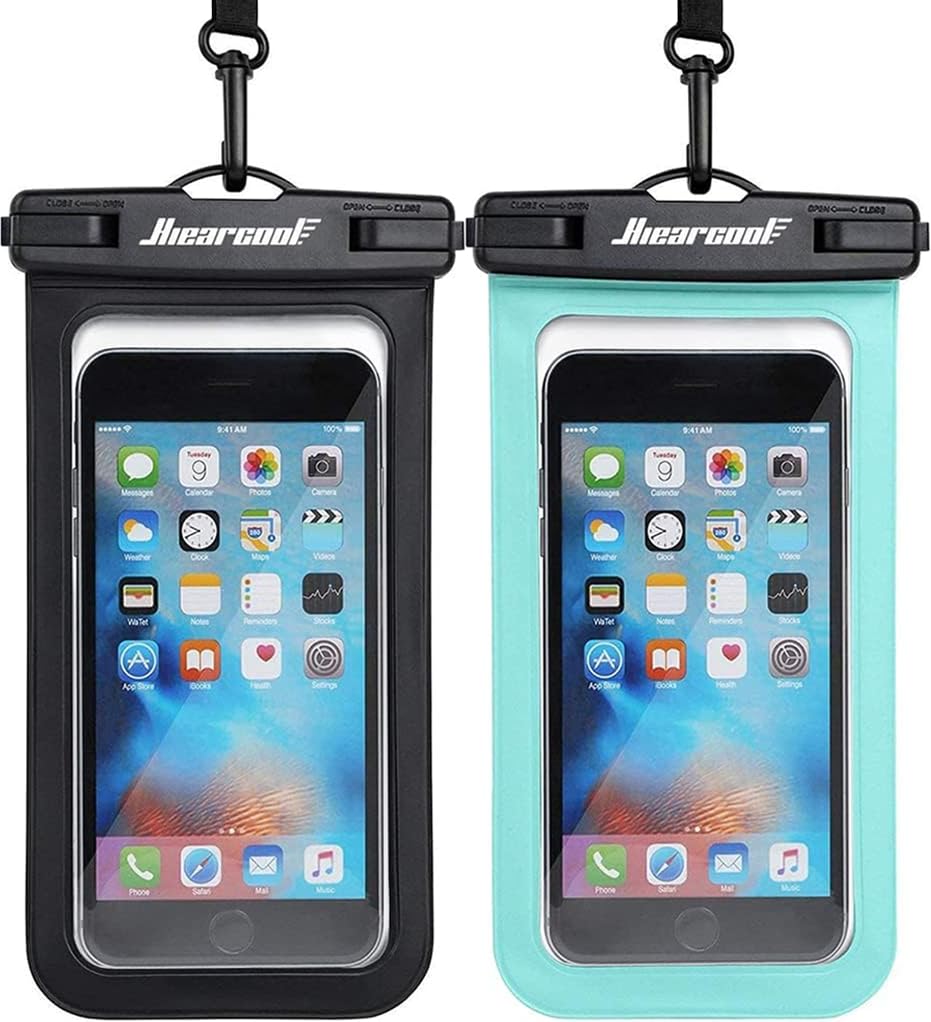
1. Hiearcool Waterproof Phone Pouch
Best Overall
Key Features
- Closure: Dual-lock clip
- Pack size: 2 pouches
- Max phone size: 8.9 in
- Waterproof rating: IPX8
- Price: Budget
Eight and nine-tenths inches is the number that decided this one for us. That is the inside of the pouch, and it is enough for a case-wrapped iPhone Pro Max or a Galaxy Ultra to slide in without a fight — a trick the tightest pouches in this group cannot manage. Plenty of dry bags ask you to think about your phone’s size first; this one mostly does not.
The seal is a two-stage press-and-fold clip, and IPX8 is the claim behind it. We ran the paper-towel test before trusting it with a phone — seal it, squeeze out the air, sink it, then check — and the closure came up dry. Seating it takes a firm press along the whole bar, and a partly closed clip looks exactly like a closed one, so run a thumb down the length every time.
Through the front window the screen stays bright and responsive enough to check a map, read a message, or let a kid take pictures, and face unlock worked for us once the phone was lined up. The back is clear as well, which is what makes underwater photos and video possible at all. Typing anything longer than a passcode is not worth the patience it takes.
Loading is the one chore. The pocket is deep and the mouth is narrow, so a phone goes in with two hands and comes out with a wiggle, and a chunky case makes both worse. The black-and-green pair helps here: one lives in the beach bag, and the other is the one you hand to whoever forgot theirs.
Pros
- Fits phones up to 8.9 inches with the case on
- Dual-lock seal stayed dry in our test
- Two pouches in one pack
- Clear front and back panels for photos
Cons
- Fiddly to load and unload with a thick case
We reach for this two-pack first because it swallows almost any phone, case and all, and the seal held every time we checked it. Buy it if you want one pouch that just works.
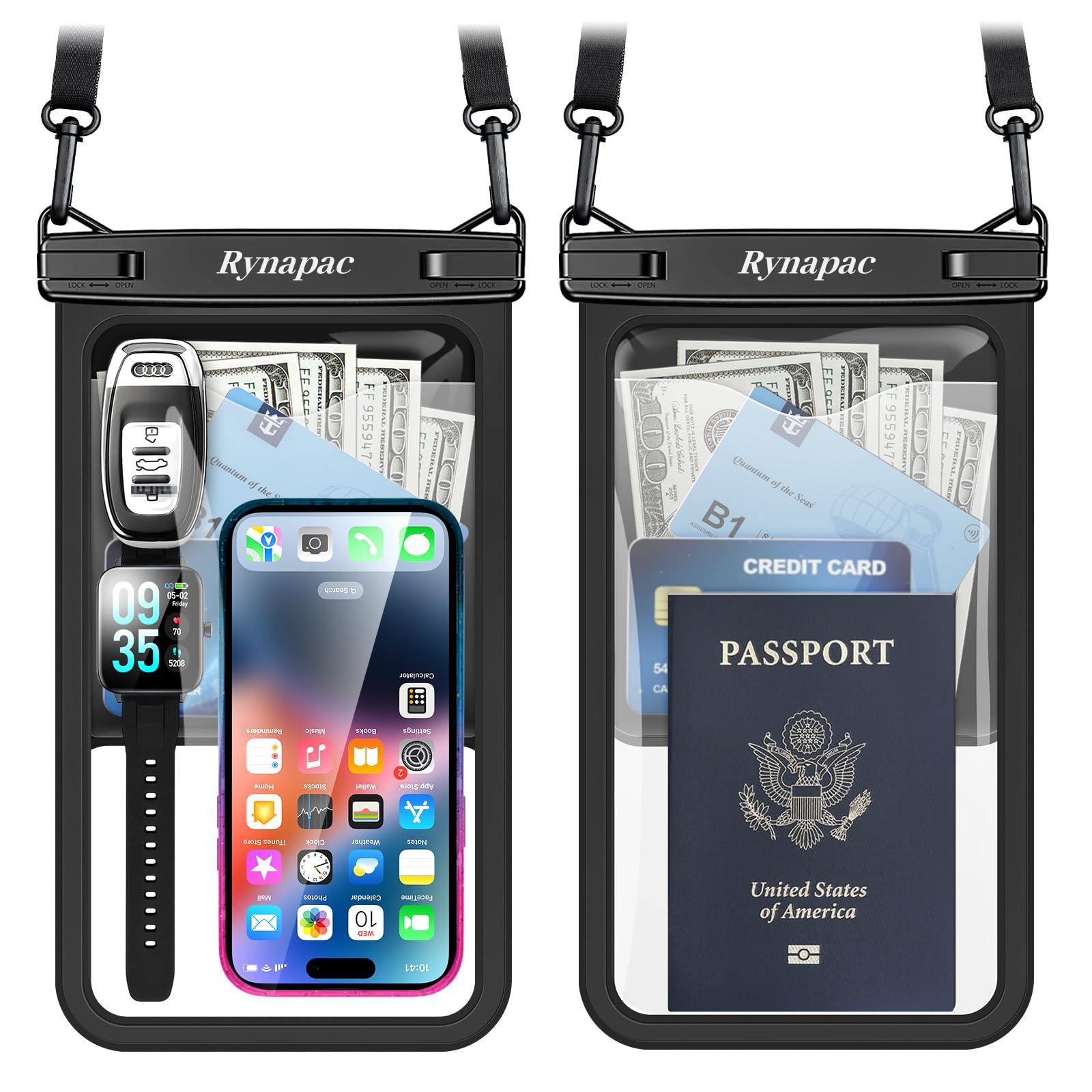
2. Rynapac Large Waterproof Phone Pouch
Best for Carrying Extras
Key Features
- Closure: Three-layer lock-down clip
- Extra pocket: Card, cash, and key sleeve
- Max phone size: 8.5 in
- Waterproof rating: IPX8
- Price: Midrange
There is a slim pocket inside this pouch, and it changes how a pool day works: a room key, a credit card, and a folded bill go in the sleeve while the phone sits in the clear outer compartment. It is the feature we used most on a resort trip, and it is why this one earns a place ahead of the plain sleeves here.
Roomy is the other half of the pitch. This is the biggest pouch in the group, with space for a large phone in its case, and both faces are clear — you can shoot through the back panel and still read the screen through the front. Touch response is fine for taps and swipes. It is not glass, and nothing about a plastic window is going to feel like one.
The closure is a three-layer clip that seats with a solid click, and it stayed dry in our paper-towel test. The lanyards detach, which we appreciated more than we expected: clip one to a tote strap and the pouch rides at hip height instead of bouncing against your chest all afternoon.
One thing to keep straight: the inner sleeve is not a separate waterproof compartment. It is a pocket inside the same seal, and filling it too full stops the clip from folding flat — pack it loose, close it, then check that the bar sits level before you get in the water.
Pros
- Inner sleeve holds a card, cash, and key
- Roomy enough for a large phone in its case
- Clear panels on both faces
- Detachable lanyards clip to a bag strap
Cons
- Stiff clip is hard to open with wet hands
- Bulkier and heavier than a slim sleeve
We like this one for travel days when a key and a card come along with the phone, and the extra room means a big phone keeps its case.
3. Lamicall Waterproof Phone Pouch
Best for Easy Closing
Key Features
- Closure: Curved easy-lock clip
- Pack size: 2 pouches
- Max phone size: 7.5 in
- Waterproof rating: IPX8
- Price: Budget
The clip is the reason we hand this pouch to first-timers. Lamicall curves the sides of the locking bar so your thumb has something to push against, and it seats in one motion instead of the two-rail squeeze most of these require. With sandy hands, that is the difference between sealed and almost sealed.
Behind the clip is a heat-pressed seam and an IPX8 rating, and the pouch came up dry in our paper-towel test. The PVC is soft and very clear, so the screen reads easily in daylight and photos taken through the back do not look like they went through a sandwich bag.
It is rated for phones up to 7.5 inches with a case on, which covers a standard iPhone or Galaxy and stops short of the biggest models in bulky cases. The mouth is snug enough that loading takes two hands, but once the pouch is empty it lies flat in a pocket.
Two come in the pack and the warranty runs two years, which is longer than most here. That is the sort of thing you notice only when something goes wrong, which is exactly when it matters.
Pros
- Curved clip seats in one push
- Clear window keeps the screen readable
- Fits phones to 7.5 inches with a case
- Two pouches and a two-year warranty
Cons
- Touch and swipes fade once the window is wet
We hand this pouch to people who have never used one, because the clip closes in a single motion and the window stays clear. It is the easiest seal here.
4. CACOE Floatable Waterproof Phone Pouch
Best Floating
Key Features
- Closure: Snap-and-lock clip
- Flotation: Four air chambers
- Max phone size: 7.0 in
- Waterproof rating: IPX8
- Price: Budget
The moment that matters for a floating pouch is the one where it leaves your hand. CACOE builds four air chambers around the rim, and the pouch rolls upright and stays there with a phone inside — lanyard attached or not. We dropped it in a bucket of water more than once, and it came back to the surface every time.
That flotation is the whole reason we keep one in the boat bag. The seal is a snap-and-lock clip with an IPX8 rating, and it held in our paper-towel test. The material is soft TPU, which wipes clean of sand and sunscreen far more easily than the stiff PVC sleeves here and does not crinkle against your neck.
The ceiling is the catch. This one is built for phones under 7 inches, so a Pro Max or an Ultra has to come out of its case, and a grip or card wallet on the back of the phone has to come off entirely. With a standard-size phone that is a non-issue. With a big one, the Hiearcool is the substitute.
Pros
- Floats upright with a phone inside
- IPX8 snap-and-lock seal held in testing
- Soft TPU wipes clean of sand
- Two pouches in the pack
Cons
- Air chambers make it bulky in a daypack
We keep one of these in the boat bag because it floats, seals, and costs about what a plain sleeve does. Take it anywhere the phone leaves the pool deck.
5. Case-Mate Soap Bubble Waterproof Phone Pouch
Best Crossbody Strap
Key Features
- Strap: Crossbody, adjusts to 30.5 in
- Closure: Press-and-fold clip
- Pack size: 1 pouch
- Waterproof rating: IP68
- Price: Midrange
Most waterproof pouches look like hospital supplies. This one does not — the iridescent TPU shifts color in the sun, and the detachable strap adjusts to 30.5 inches so the pouch rides crossbody instead of swinging from your neck for six hours.
The strap is the practical half of that. We wore it across the body on a walking-heavy trip and it stayed put, and the buoyant TPU floats without air chambers or foam, so there is nothing to puncture or waterlog. The clip is a press-and-fold closure, and the pouch came up dry when we tested it with a paper towel.
It is a snug pouch. There is room for a big phone, but a pop socket, a card wallet, or a thick case fights the fold — the clip has to sit flat, and anything stacked on the back of the phone gets in the way. Take the grip off before you load it and it is fine.
The finish earns its keep in a bag, too. In a tote full of towels and sunscreen, the one pouch that catches the light is the one you find without digging.
Pros
- Crossbody strap adjusts to 30.5 inches
- Floats without air chambers or foam
- Iridescent finish stands out in a bag
- Press-and-fold clip held in our test
Cons
- One pouch per purchase
We wear this one crossbody when we want our hands free, and it floats without a bladder that can fail. It is the pouch for the traveler who cares how the gear looks.
6. Pelican Marine Waterproof Phone Pouch
Best Certified Depth Rating
Key Features
- Closure: Snap lock
- Flotation: Floats
- Pack size: 2 pouches
- Waterproof rating: IP68, 1 m
- Price: Premium
Pelican is the only pouch here that names a depth: IP68, certified to 3.3 feet, where the rest of this group says IPX8 or IP68 and leaves the number off. If you want a figure you can hold a product to, that is the one.
It floats as well, which is the pairing that makes it useful in the surf rather than just on a pool deck. The TPU body is soft enough to work the side buttons through it, and the detachable lanyard can be worn at the wrist as a leash while you swim — we used that more than the neck loop. Our paper-towel test came up dry, and we give the lanyard anchor a tug before every trip.
The unlock swipe is the annoyance. The plastic adds just enough drag that getting past the lock screen takes a few tries, and wet fingers make it worse. Set the phone to stay awake longer before you get in, or shoot from the lock screen and skip the unlock entirely.
It is also the priciest pouch in this group by a wide margin. What the money buys is a rated depth and flotation in the same pouch, and nothing else here pairs the two.
Pros
- IP68 rated to 3.3 feet
- Floats with a phone inside
- Detachable lanyard works as a wrist leash
- Side buttons work through the body
Cons
- Unlock swipe takes a few tries
- Regular size is snug for a large phone
We take this one when the water is deeper than a pool, since it is the only pouch here with a stated depth rating and it floats. Worth the premium in the surf.
7. Rynapac Waterproof Phone Pouch 2-Pack
Best for Group Trips

Key Features
- Closure: Triple-seal snap lock
- Pack size: 2 pouches
- Max phone size: 8.5 in
- Waterproof rating: IPX8
- Price: Budget
Two pouches for less than the price of most single ones makes this the pair we hand out when a group is heading to a water park and nobody wants to spend much.
What you get is an IPX8 claim and a triple-seal snap lock, and it kept a phone dry in our paper-towel test. It is rated to 8.5 inches, which is generous — a big phone in a slim case goes in without being stripped — and both faces are fully clear, so the camera works through the back.
The plastic is the compromise. It is noticeably thinner than the Hiearcool’s, and thin plastic is what fails first at the corners where the pouch folds. We treat it as a vacation-season pouch rather than a permanent resident of a backpack.
At this price we think it is the right call for a trip where pouches get lost, borrowed, or left in a rental car. The full transparency earns its keep there too: you can see exactly where the phone sits relative to the seal before you close the bar.
Pros
- Cheapest two-pack in this group
- IPX8 triple-seal snap lock
- 8.5-inch capacity takes a big phone
- Clear on both sides for photos
Cons
- Thin plastic wears at the corners
- Room for a phone only, no cards
We hand this two-pack out to a group because it seals, fits a big phone, and costs the least here. Buy it for a trip, not for a decade.
How We Tested 18 Waterproof Phone Pouches
We started with a long list of pouches claiming an IPX8 or IP68 seal, then narrowed it by the things that actually change the experience: whether the bag would swallow a large phone with a case on, how the closure locked, what kind of lanyard came attached, and whether the pouch floated. Eighteen made the cut, and we ran them through three months of ordinary summer abuse rather than a lab bench.
Water resistance was the first filter and the easiest to check. We sealed a folded paper towel inside each pouch, weighed it down in a bucket for 30 minutes, then opened it and looked for damp corners. Every pouch also came to the pool, the lake, and one long kayak trip, where we texted with wet thumbs, took photos, and left them clipped to a strap in the sun. For drying, we shook each one out after a dunk and hung it by its lanyard, noting where water lingered—along the seal channel, inside the webbing, or nowhere at all.
Fit, ease of use, and image quality came down to repeated small actions. We slid a big phone with a chunky case into each bag without forcing it, then opened and closed every seal 50 times and watched for stress marks at the fold. We shot the same photo through each plastic window to compare glare and sharpness, and the floating models got dropped in the deep end with a phone-sized weight inside to see whether they bobbed back up. Durability and value showed up over time: lanyard clips that worked loose, grit that collected in a seal track, windows and trim that yellowed, and whether a two-pack was worth trusting with two phones or just one.
How to Choose a Waterproof Phone Pouch
The best pouch is the one you will seal properly every single time, and that comes down to fit and the closure long before it comes down to the rating on the package.
Fit Comes Before the Rating
A pouch is measured on the pouch, not on your phone, and a case adds width and depth that the number does not account for. Measure the phone in its case: the Hiearcool’s 8.9 inches clears a big phone with the case left on, while a 7-inch pouch like the CACOE asks you to strip a large phone first. Anything else you want to carry — a room key, a card — shares that same envelope, and an overstuffed pouch will not let the clip fold flat. A clip that does not fold flat is not sealed. If loading takes two minutes of fighting, you will stop doing it by day two.
What IPX8 and IP68 Actually Promise
Both ratings describe a laboratory submersion, and neither promises anything about a seal with sand in it. IPX8 means the maker’s own depth and time, which is why one pouch here states 3.3 feet and others state nothing beyond the letters; IP68 adds dust protection to the same idea. In practice, any dry bag here is fine for a pool, a beach, or snorkeling at the surface, and none of them belong on a dive.
Run the paper-towel test before every trip: seal a tissue inside the empty pouch, sink it, squeeze, then open and check. Retire the pouch when the lip looks cloudy, stays creased after you flatten it, or feels stiff instead of supple.
Floating, and What It Costs You
Flotation earns its bulk when the phone is over deep water or in a child’s hands. There are two designs: air chambers around the rim, as on the CACOE, which are cheap and bulky; and buoyant material, as on the Case-Mate, which packs flatter and cannot puncture. Neither matters at a pool with a shallow end. If you mostly sit on a towel, skip the flotation and take the slimmer pouch — you will carry it more often.
How You Will Carry It
A neck lanyard is the default and the least comfortable choice for a long day. A strap long enough to go crossbody, like the Case-Mate’s 30.5 inches, spreads the weight and keeps the pouch clear of your hands. Look for a detachable clip either way so the pouch can hang from a tote or a boat rail, and give the anchor a tug before you trust a phone to it. In the surf, a wrist leash beats a neck strap.
Frequently Asked Questions
Is a waterproof phone pouch worth it if my phone is already water-resistant?
A phone’s water-resistance rating is earned in fresh water at shallow depth, and salt, chlorine, and sand working into the ports are exactly what it handles worst. If your phone only ever sees rain or a splash, you can skip the pouch. For a beach, a water park, or anything that puts the camera underwater, the pouch is cheap insurance and the only way to shoot with the phone in the water.
How long does a waterproof phone pouch last?
Treat it as a consumable rather than luggage. The plastic creases along the fold, the lip picks up sunscreen, and a summer in a hot car stiffens both, so expect to replace one after a season or two of regular use. Store it open and dry, out of direct sun, and retire it as soon as the seal lip looks cloudy or stays creased when flattened.
How many pouches do I need for a family trip?
One per person who carries a phone, plus a spare. Two two-packs cover a family of four, leave you a backup for the friend who shows up without one, and cost less per pouch than a single premium pouch like the Case-Mate or the Pelican. Assign colors before you leave — it is the fastest way to sort out whose is whose at the pool gate.
Final Verdict
The Hiearcool two-pack is what we hand people first: it holds almost any phone with the case on, it seals, and the second pouch means a couple is not sharing one.
Change the requirement and the answer changes. A phone that might end up over deep water calls for the CACOE‘s flotation or the Pelican‘s rated depth, and anyone who keeps ending up with a room key and no pockets should take the Rynapac with its inner sleeve. For everything else, buy the two-pack and use the spare.