This post contains affiliate links. We may earn a small commission when you buy through our links — at no extra cost to you.
A travel day is mostly a standing day. You stand in the security line, you stand at the gate, and then you walk ten miles because that was the entire point of the trip. An insole is the cheapest way to keep your feet from calling it quits at noon, but only if it fits inside the shoe you actually packed.
Over four months, my team and I wore 14 pairs through airports, walking tours, and long days on hard hotel-room floors. The softest ones in the package were usually the first to flatten by midafternoon, and the plush models that lifted my heel and crowded my toes had traded one problem for another. Arch support is the other quiet variable: a firmer arch you can feel is doing work, while a soft lump under the foot mostly just feels like a lump.
What follows is sorted by what each pair is genuinely good at: long walking days, tight shoes, sweaty feet without socks, or covering a household’s worth of shoes before you leave.
Our Top Picks



The Best Insoles for Travel, Reviewed
1. Dr. Scholl’s Comfort Air-Pillo
Best Overall
Key Features
- Weight: 2.88 oz
- Fit range: Men’s 7–13, women’s 5–10, trim to fit
- Cushioning: Thin-profile memory foam
- Odor control: Yes
- Price: Budget
Most travel foot pain isn’t a diagnosis; it’s a day that runs four hours longer than the shoes you packed can handle. Dr. Scholl’s Air-Pillo answers that with a thin sheet of memory foam you trim to size, marked for men’s 7 to 13 and women’s 5 to 10, that slips into sneakers, loafers, and boots without changing how they fit. That combination, plus a price low enough to buy a second pair, is why it’s our top pick.
What we noticed first is that the foam is soft rather than springy — the right feel for pavement and airport concourse, because it gives under the heel and the ball of the foot instead of pushing back. It’s treated to control odor as well, a small mercy when one pair of shoes has to last a week. One oddity worth knowing: the two insoles arrive pressed together and look like a single one, so peel them apart before you decide the box is short a piece.
What it doesn’t do is support. There’s no arch shelf and no heel cup, so aching arches won’t be fixed by it — the WalkHero further down handles that job. Think of the Air-Pillo as a cushion that moves between shoes, which is exactly what a trip built around two pairs of footwear needs.
Pros
- Slides into almost any shoe without changing the fit
- Trims to size along marked lines
- Odor-controlling foam
- Inexpensive enough to buy a spare pair
Cons
- Foam wears out faster than thicker insoles
Our default recommendation for most travelers: a thin cushion that drops into the shoes they already own, trims to size, and costs little enough to buy a second pair for a second shoe.
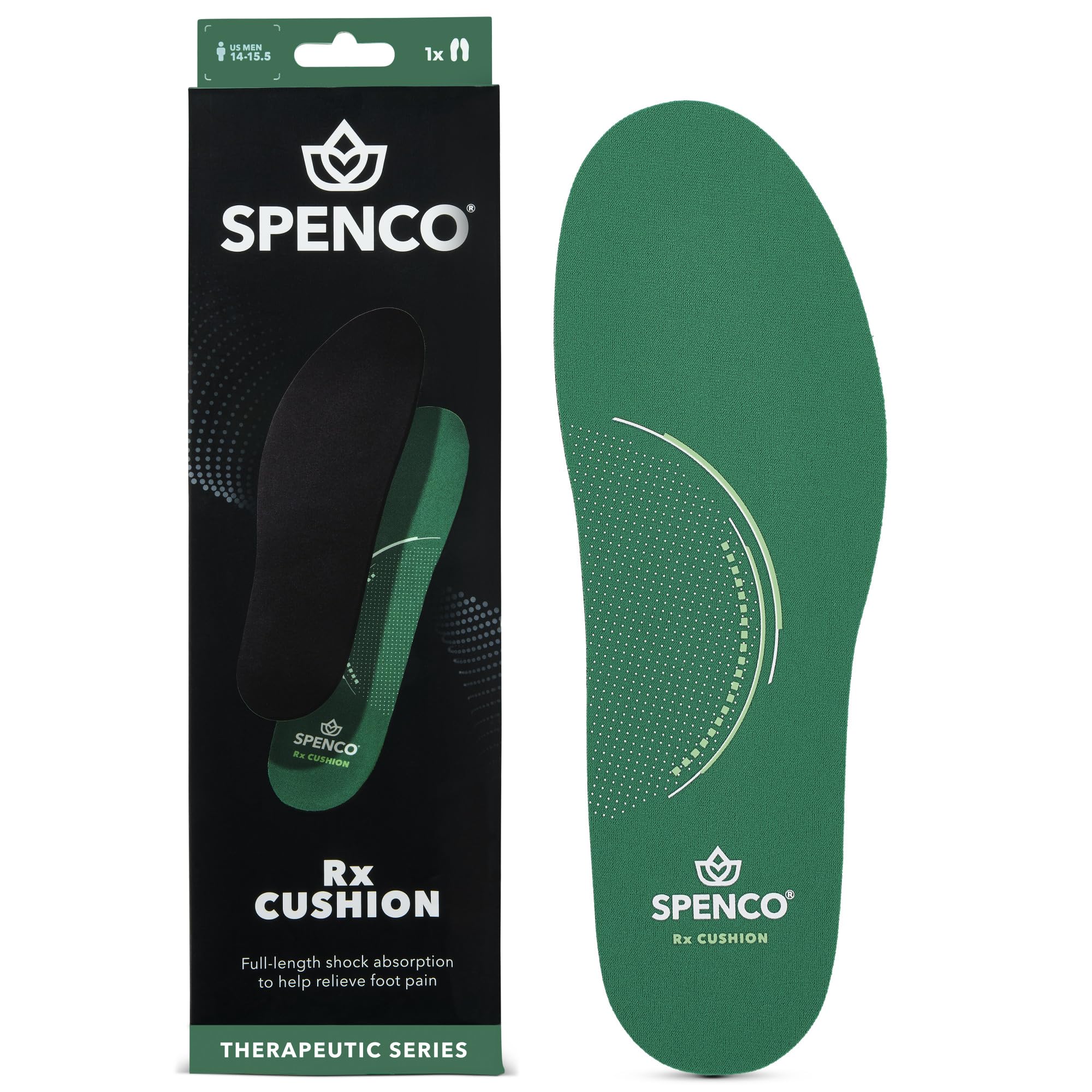
2. Spenco Rx Comfort Thin
Best Full-Length Cushion
Key Features
- Sizes: Seven sizes; this pair women’s 11–12.5 / men’s 10–11.5
- Weight: 2.88 oz
- Coverage: Full length, heel to toe
- Top fabric: 4-way stretch, odor-controlling
- Price: Premium
Where the Air-Pillo is a cushion, the Spenco Rx Comfort Thin is a full-length insole with a specific job: heel-to-toe padding under a four-way stretch fabric top that manages sweat. It comes in seven sizes, so you order your own rather than cutting to fit, and trimming only shortens an insole — it won’t narrow a wide one — so check the size chart before you buy.
That fabric top is the part we care about. Bare foam against a bare foot goes slick and hot by mid-afternoon; a stretch layer between your sole and the foam is where friction and blisters get handled. Add full-length coverage, which keeps the ball of the foot cushioned instead of stopping at the arch, and you have the pair we choose for a trip built around one good pair of walking shoes.
It is a comfort insole, not an orthotic. The arch is a gentle rise rather than a shelf, so if you need something to hold a fallen arch up, the WalkHero is the better answer. In a shoe with a roomy toe box this one disappears, which is the highest compliment an insole can earn on a twelve-hour travel day.
Pros
- Full-length cushioning from heel to toe
- Stretch fabric top limits friction and odor
- Seven sizes, so no trimming guesswork
Cons
- The priciest pair on this list
- Cushioning packs down with months of daily use
Choose the Spenco if you want one full-length insole to carry a whole trip; the stretch fabric top handles sweat and friction in a way bare foam can’t.
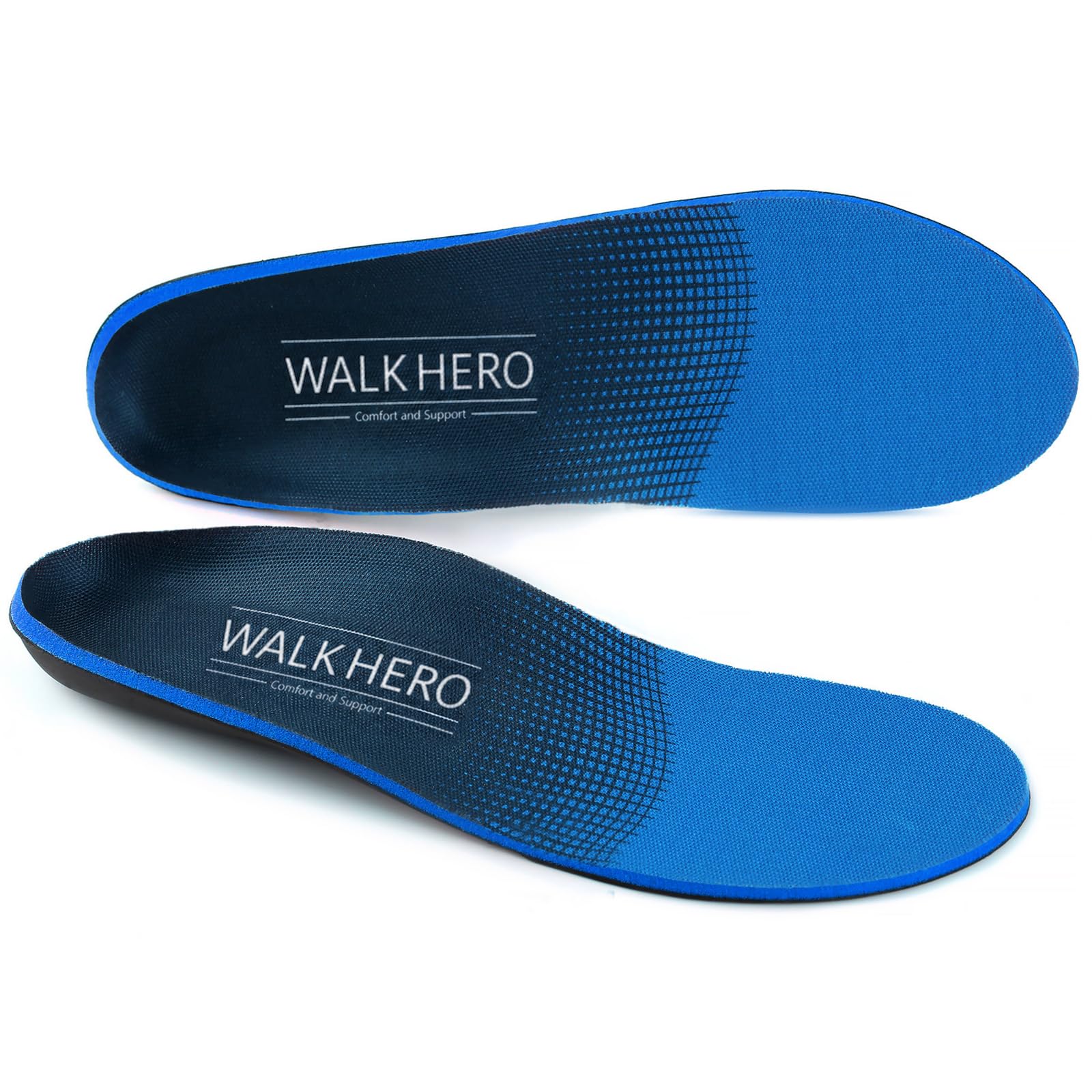
3. WalkHero Arch Support
Best for Arch Support
Key Features
- Arch: High, firm EVA
- Heel: Deep heel cup
- Weight: 3.53 oz
- Shoe volume: Wider, high-volume shoes
- Price: Midrange
Volume is the first thing to know about the WalkHero. Firm EVA, a deep heel cup, and a shape designed for wider, high-volume shoes — work boots, basketball shoes, running trainers — mean it lifts your heel and takes up toe room in anything slim. In a narrow leather sneaker it turns a comfortable shoe into a tight one, so look at your packing list before you look at your feet.
Under a foot that needs structure, though, it’s the most supportive insole in this guide. The arch is high and unyielding, the heel cup keeps the foot from rolling outward, and the fabric top keeps the surface from going clammy. For flat feet or plantar fasciitis, firmness is the treatment rather than a compromise: soft foam feels better for ten minutes and helps less by the end of a long day.
Our advice is to bring the shoes it fits and wear it on a couple of short days before the trip, rather than on the morning of a long flight. In a loose boot it can shift, so seat it once and check it after the first mile. This is the pair we reach for when the problem is the arch, not the distance.
Pros
- Real arch support for flat feet and plantar fasciitis
- Deep heel cup stabilizes each landing
- Fabric top stays cooler than bare foam
Cons
- Too firm for anyone wanting a soft ride
If your arches are the problem, this is the pair to pack — firm, structured support for flat feet and plantar fasciitis, provided your shoes have room for it.
4. Pedag Summer Terry Cotton
Best for Sockless Days
Key Features
- Care: Hand wash, air dry
- Sizing: US women’s 9 / men’s 6 / EU 39
- Material: Terry cotton
- Pack size: 3 pairs
- Price: Midrange
Every travel wardrobe has one pair of shoes that can’t take a sock: the loafers, the boat shoes, the flats you wear to dinner. Pedag’s Summer insole is a terry cotton liner built for exactly those — thin enough to disappear into the shoe, thirsty enough to absorb what a bare foot leaves behind. Three pairs come in the pack, so one can dry overnight while another is in the shoe.
The cotton surface feels like a towel underfoot, and that’s the point: it cuts the friction that turns a hot afternoon into a blister, and it keeps the inside of a leather shoe from darkening and going sour. We appreciate that the care is simple enough to do in a hotel bathroom — hand wash with mild detergent, air dry, wear again.
It isn’t a comfort insole. There’s no foam, no arch, and no shock absorption; cotton manages moisture and nothing else. Think of it as a sock you can’t see, and pack it for the shoes where a sock would ruin the look.
Pros
- Absorbs sweat and controls odor without socks
- Hand washable and quick to air dry
- Three pairs per pack for rotation
Cons
- Runs narrow in wide shoes
- Cotton pile flattens with daily wear
Pack these for the shoes you wear without socks: washable cotton that absorbs sweat and cuts friction, with no cushioning or support to speak of.
5. Dr. Scholl’s Prevent Pain
Best for Hard Floors
Key Features
- Arch: Flexible
- Build: Cushion, heel, and arch zones
- Sizing: Men’s 8–14, trim to fit
- Package weight: 6.74 oz
- Price: Midrange
Dr. Scholl’s builds the Prevent Pain in three zones: an impact-absorbing top layer that spreads load across the whole foot, a shock-absorbing heel, and a flexible arch that gives as you walk. The pitch is prevention — spreading the impact of each step so the knee and lower-back ache that shows up two days into a walking trip never gets started.
It feels different from the plush picks. Your heel lands on something with structure instead of sinking into it, and the arch rises higher than the flat sheet under the Air-Pillo. Trim-to-fit covers men’s 8 to 14 from a single pattern, which is a wide spread for one shape.
The trade-off is footprint. Full-foot protection is full-foot material, so this one takes up more room than a thin cushion and belongs in shoes you already wear loose — a roomy trainer or a work boot rather than a broken-in loafer.
For a city trip measured in pavement miles, this is the pair we pack. It’s the only insole here built around stopping pain before it starts rather than softening what’s already there, and by day three of a walking vacation that distinction stops being academic.
Pros
- Full-foot cushioning plus a shock-absorbing heel
- Flexible arch support that adapts as you walk
- Trims to fit a wide range of men’s sizes
Cons
- Men’s sizes only, 8 to 14
- Firm and slow to soften under the forefoot
The pick for men facing days of hard floors — full-foot structure and a shock-absorbing heel, sized 8 to 14, for travelers who want prevention rather than plushness.
6. 4D Cloud Insoles
Standing All Day

Key Features
- Heel: U-shaped memory foam
- Sizing: Men’s US 7–11, trim to fit
- Weight: 2.89 oz
- Material: PU memory foam
- Price: Budget
Soft is the whole idea here. A honeycomb PU base, a U-shaped memory foam heel, and a generous slab of foam under the forefoot add up to the plushest ride in this guide — closer to stepping into a foam clog than into a shoe. Trim lines are printed on top, and the men’s 7 to 11 pattern cuts down easily with kitchen scissors.
When the day is standing rather than striding, that softness is the right call. Twelve hours on a hard floor is the case this insole was built for, and the foam pays off under the heel and ball, where a thin cushion gives out first. We rate it the most comfortable pick here for anyone whose travel day is a shift on their feet.
Two things to plan around. The maker asks for a transition period, so wear them an hour at a time before you commit a whole day to them; and the arch is a soft swell rather than a shelf, which means a fallen arch gets no help from it.
Pros
- The plushest foam in this guide
- Easy to trim along printed lines
- U-shaped heel absorbs impact
Cons
- Takes up too much room in snug shoes
When the day is standing rather than walking, this is the softest foam in the guide and the easiest to live with in shoes you already wear loose.
7. Amitataha Memory Foam
Backup Pair

Key Features
- Sizing: US men’s 6.5–9 / women’s 7.5–10
- Weight: 3.17 oz
- Material: Memory foam, velvet top
- Foam options: High-elastic black or soft yellow
- Price: Budget
Two foams hide inside one Amitataha listing. The black version is a high-elastic memory foam built around a raised arch; the yellow is the softer of the two. Both come with cut lines printed on the back and three sizes to choose from — the medium covers US men’s 6.5 to 9 and women’s 7.5 to 10 — and both have a velvet top that feels warmer against a bare foot than plain foam.
In a boot or a roomy flat shoe it does what a cheap memory foam insole should: softens the floor, takes the sting out of a long walk, and doesn’t ask you to think about it. The velvet surface is a nicer touch than the price implies, and the cut lines turn sizing into a two-minute job instead of a project.
As the spare rather than the primary, this one earns its place. It’s one of the least expensive pairs on this list, so keeping a set in a second pair of shoes costs almost nothing, and if one is forgotten in a hotel room you won’t mourn it. Cut conservatively and check the result against the shoe’s own insole before you commit the scissors.
Pros
- Two foam firmness options in one listing
- Cut lines make sizing quick
- Velvet top feels soft against bare feet
Cons
- Runs about a size small
- Foam traps heat on warm days
A soft, inexpensive spare for a second pair of shoes; buy it as a backup rather than as the insole you build a trip around.
What We Put These Insoles Through
To build the shortlist, I read spec sheets and customer reviews for dozens of insoles, then filtered for three things that matter on a trip: a size range that actually covers your shoe, a top layer that can be trimmed if it doesn’t, and a profile thin enough to slide into a packed shoe without stealing room from your toes. That left 14 pairs, which my team and I wore for four months.
Testing happened where insoles actually live. I put pairs through two multi-day trips, complete with airport terminals, security lines, gate changes, and full afternoons of walking tours, plus a week of daily dog walks and one deliberately miserable day standing on concrete. Each pair went into at least two different shoes, a sneaker and something tighter like a loafer or boot, so I could see whether an insert that felt fine in one made the other unwearable.
We trimmed the cut-to-fit pairs with ordinary kitchen scissors and noted whether the printed size line was accurate and whether the edge cut cleanly or tore. We measured thickness before the first wear and pressed a thumb into each heel and forefoot to judge firmness, then checked again at the end of a long day to see which ones had bottomed out. After every wear, we looked at compression, top-layer pilling, and whether the arch had flattened, and the washable pairs got two rounds in the machine. We also tracked how feet, heels, and lower backs felt on day three of a trip compared with day one, and whether a multi-pair pack worked out cheaper per pair than buying singles.
How to Choose Insoles for Travel
The right travel insole is the one that fits inside the shoes you are already bringing; everything else, from arch height to fabric, is a detail you settle after that.
Start With the Shoes You’re Packing
The most common mistake is buying cushioning first and discovering it doesn’t fit. A plush insole can steal half a size of toe room, and a shoe that rubbed nowhere at home starts pinching at mile three. Pull the factory insole out and hold the new one against it: if the replacement is visibly deeper or wider, plan to wear it only in the shoes you already wear loose.
In a slim sneaker or a dress shoe, stay with a thin liner. That is where the Air-Pillo and the Pedag earn their places — neither asks the shoe to accommodate anything.
Cushion or Support, Pick by the Ache
Two different jobs get sold under one label. Foam and gel cushioning absorb impact under the heel and the ball of the foot, which is what a long walking day mostly needs. A firm arch and a heel cup do something else: they hold the foot in position, which is what flat feet and plantar fasciitis need.
Sore arches after an afternoon of sightseeing point toward structure, like the WalkHero. Sore heels and tired legs point toward foam, like the Air-Pillo or the 4D Cloud. If a podiatrist has already fitted you with something, bring that pair instead of shopping on the road.
Trim-to-Fit Doesn’t Mean Cut Blindly
Most shoe inserts are sold as one-size-trim, and most sizing complaints start with the scissors. Take the shoe’s own insole out, lay the new one on top of it, and trace that outline rather than trusting the printed line — the markings are a starting point, not a measurement.
Cut a little wide, test it in the shoe, then shave again, because you cannot add material back. If you are between sizes, buy up: an insole that is half a size short slides forward under the ball of your foot all day.
Plan for Sweat
Travel is hard on the inside of a shoe — the same pair, day after day, often without socks. A cotton or fabric top layer handles moisture far better than bare foam, which turns slick once it is damp, and an odor-treated foam keeps a closed shoe from turning sour on day four.
Terry liners like the Pedag pair wash by hand and dry overnight, so a rotation is realistic in a hotel room. On a leather shoe, a fabric top also keeps the lining from staining.
Frequently Asked Questions
Can I move one pair of insoles between different shoes?
Yes, if it is a full-length foam or fabric insole that sits flat in both. Thin cushions like the Air-Pillo swap easily between a trainer and a boot; an adhesive-backed three-quarter insole does not, because once it is pressed down it belongs to that shoe.
Swap only between shoes of similar depth, and give the insole a moment to settle before you head out.
Why does my insole slide forward when I walk?
Usually because it is trimmed too short, so the ball of your foot pushes it ahead of itself with every step. Cut to the outline of the shoe’s original insole rather than the printed line, and make sure you have removed the factory insole if you need the room.
Let a new foam insole flatten overnight in the shoe before you wear it on a long walking day.
How many pairs should I pack for a two-week trip?
One per pair of shoes you will actually walk in, plus a thin spare if you are wearing the same trainers every day. Insoles compress with use, and rotating two sets gives each one a night to dry out.
For sockless styles, a multi-pair pack is built for exactly this kind of rotation.
Final Verdict
Start with the Dr. Scholl’s Comfort Air-Pillo. It fits inside the shoes most people already travel with, softens a long day, and costs little enough that a second set for a second pair of shoes is not a decision worth agonizing over.
If you want one full-length insole with a fabric top that manages sweat, the Spenco is a real step up. If your arches are the reason you are shopping, skip both and take the WalkHero, with shoes roomy enough to hold it.