This post contains affiliate links. We may earn a small commission when you buy through our links — at no extra cost to you.
The gate agent calls your zone, your phone is at 12 percent, and the only outlet in sight already has a laptop charger plugged into it. That’s the moment a power bank stops being optional. The catch is that the big ones never leave your suitcase — a slim pack is the one that actually rides in a jacket pocket or a passport holder all day, so it’s there when you need it instead of back at the hotel.
Capacity ratings deserve a caveat, and it’s the first thing I’d tell a first-time buyer: a 10,000mAh label doesn’t mean 10,000mAh reaches your phone. Expect closer to two-thirds at the port, and less if the pack runs warm. We’ve spent five months with 14 of these, from magnetic discs thin enough for a wallet to slim 20,000mAh packs with the cable built right in, and the gap between the good ones and the rest showed up within minutes of plugging in.
Charging speed, real usable capacity, whether the cable is attached, and what you pay per charge were what separated the keepers from the drawer fillers. Below are the ones I kept reaching for.
Our Top Picks


The Best Slim Power Banks for Travel, Reviewed
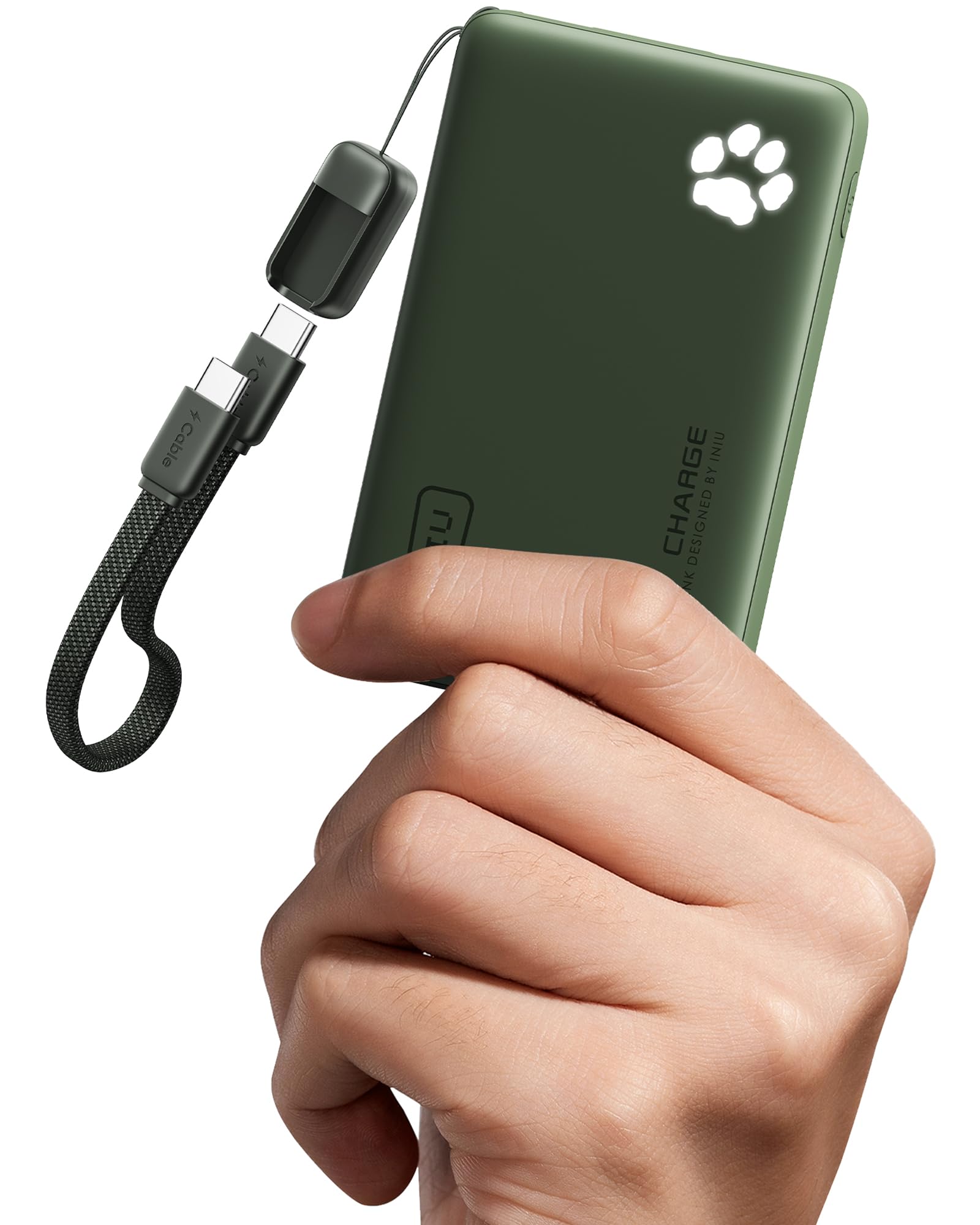
1. INIU P41 10000mAh
Best Overall
Key Features
- Cable: Detachable 0.4 ft USB-C
- Weight: 6.4 oz
- Capacity: 10,000 mAh
- Max output: 45W USB-C
- Price: Midrange
Six and a half ounces is the number that sells this one. INIU’s P41 holds 10,000mAh — close to two phone charges — in a body that weighs about what a paperback does and measures 0.7 inches thick, so it drops into a jacket pocket or a sling without announcing itself.
We keep coming back to it because the output is genuinely quick. At 45W over USB-C it ties the Neoseek for the highest wattage here, which is enough to take a phone from nearly dead to usable in a coffee stop and enough to push an iPad or a small laptop. On a long-haul connection with a dead phone, that is the difference between a bank that helps and one that merely exists.
The cable arrangement is the detail we appreciate most. Rather than molding a lead into the shell, INIU ships a 0.4-foot braided USB-C cable that clips to the body. Lose it and any USB-C cord takes over; fray it and you are out a cable rather than a battery. Three ports — two USB-C, one USB-A — let you top up a phone and earbuds at the same time.
Where we hesitate is longevity. The pattern to know about is that failures on this model cluster in the battery itself after a few months rather than at the ports, so buy it somewhere with a generous return window and work it hard in the first two weeks. Thickness is the smaller compromise: 0.7 inches is slim for the capacity but noticeably chunky next to the 5,000mAh magnetic banks here.
Pros
- 10,000mAh at just 6.4 ounces
- 45W output, the fastest wired charging here
- Detachable cable clips on and can be replaced
- Three ports for a phone plus earbuds
Cons
- 0.7 inches thick, chunky beside the 5,000mAh picks
- No wireless charging
For most travelers this is the right default: 10,000mAh and 45W in a 6.4-ounce body, with a cable you can replace instead of one that retires the bank.
2. TRKOY W5 5000mAh
Best Magnetic Pick
Key Features
- Weight: 4.2 oz
- Capacity: 5,000 mAh
- Thickness: 0.46 in
- Wireless output: 15W MagSafe
- Price: Budget
Sticking a bank to the back of a phone and walking away is the entire pitch, and the W5 does it better than its price suggests. A 15N magnet holds the alignment, 15W flows wirelessly, and at 0.46 inches and 120 grams it is the lightest way here to buy yourself a real top-up. We stopped carrying a cable on day trips because of it.
Capacity is the honest limit. Five thousand milliamp-hours is about one full charge on a current iPhone, so this is the bank for the museum day, the evening out, the flight where you land at nine at night with twelve percent left. It is not the bank for a week off-grid. When you do want speed, the USB-C port switches you to wired charging.
The price is the surprise. It undercuts Anker’s magnetic 5K by a wide margin while matching its 15W wireless rate and its roughly four-ounce weight, and the listed three-year warranty is longer than most here. For a brand you may not have heard of, that combination is more reassuring than a logo.
Compatibility is where it narrows. The magnets only mean anything on an iPhone 12 or newer, so an Android phone gets a plain wired bank and none of the convenience you are paying for. Buy it for an iPhone household and it earns its keep; buy it for a mixed group and half the table cannot use it.
Pros
- 15W MagSafe charging with no cable at all
- 120 grams and 0.46 inches thick
- Three-year warranty, longer than most here
Cons
- Magnets do nothing for Android phones
- 5,000mAh is about one phone charge
iPhone owners who want power without a cable should start here: light, thin, 15W magnetic, and far cheaper than the other magnetic bank we tested.
3. LISEN 2E437 10000mAh
Best for Travel to China
Key Features
- Weight: 6.7 oz
- Capacity: 10,000 mAh
- Thickness: 0.5 in
- Certification: CCC marked
- Price: Midrange
China’s airport security has gotten strict about power banks, and the mark screeners look for is CCC. LISEN prints it on the back of this one. That is the sort of detail nobody thinks about until a guard is turning a carry-on inside out at the gate, and it is the reason this otherwise ordinary bank is on the list at all.
Underneath the paperwork it is a good travel bank. The aluminum body is half an inch thick and 6.7 ounces, and it feels like a finished object rather than a plastic brick — we noticed the difference every time we pulled it out of a pocket. The 22.5W built-in USB-C cable is quick enough for any phone, and the LED percentage readout beats guessing at four dots.
That cable does double duty, charging your device and refilling the bank, so the whole kit is one object with nothing to lose. It is also the constraint: the lead is USB-C, so refilling needs a USB-C wall charger rather than the USB-A brick in most hotel rooms. Pack a small USB-C adapter and the problem evaporates. Anyone still carrying a Lightning device needs their own cord.
For a China itinerary this earns its place over every other pick here. For a domestic trip it is a well-made midrange choice that costs more than the VIYISI for a better shell and a certification you may never need — a fair trade for the frequent flyer, an unnecessary one for the occasional weekender.
Pros
- CCC mark printed on the shell for China travel
- Aluminum body at 0.5 inches and 6.7 ounces
- Built-in USB-C cable charges both ways
Cons
- Built-in cable is USB-C only
- 22.5W trails the 45W picks here
If your itinerary includes China, the printed CCC mark makes this the safest bet here; everyone else gets a well-built 10,000mAh bank with a cable that cannot get lost.
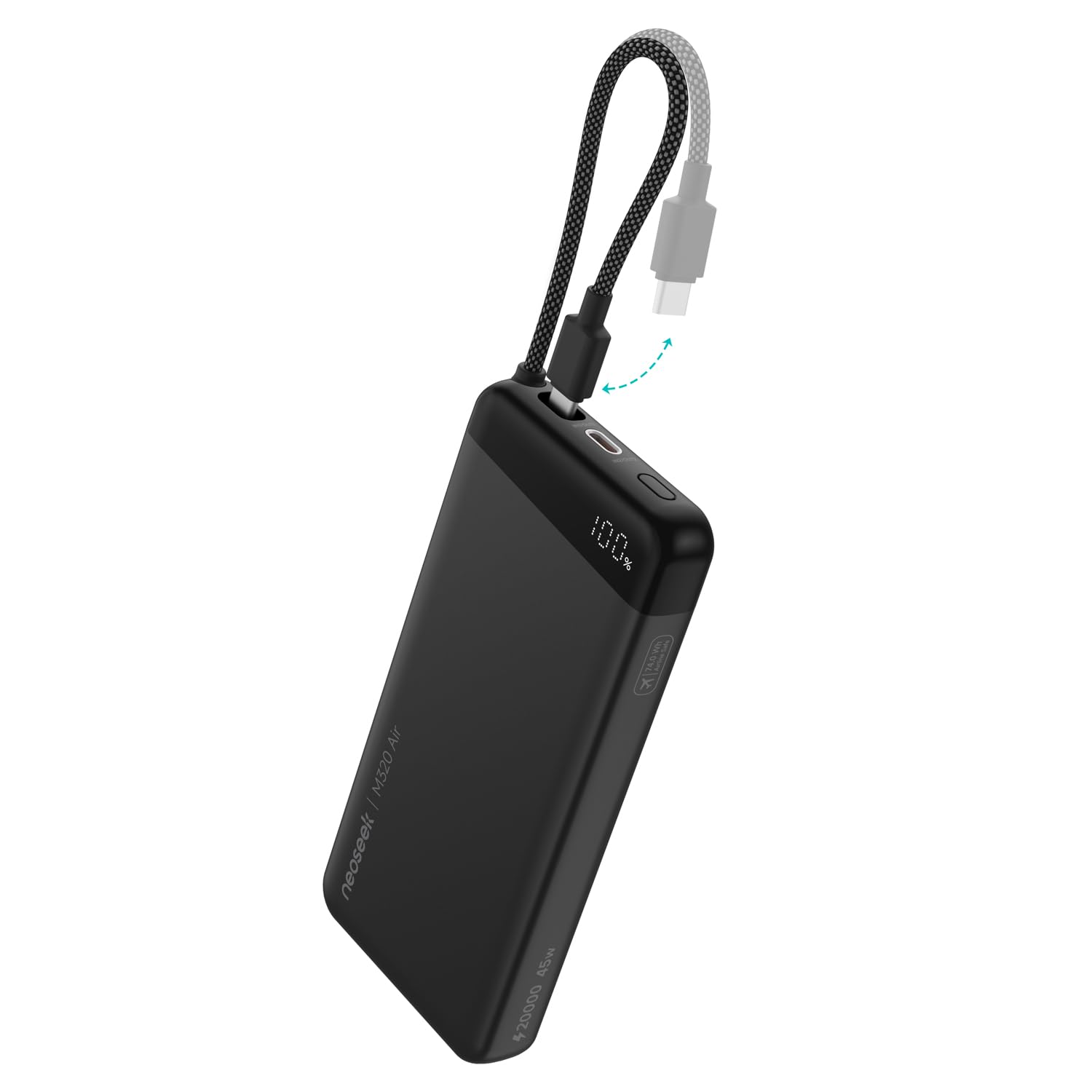
4. Neoseek iPB2055s 20000mAh
Best for Long Trips
Key Features
- Weight: 12.4 oz
- Capacity: 20,000 mAh
- Thickness: 0.71 in
- Input and output: 45W out, 40W in
- Price: Midrange
Twenty thousand milliamp-hours usually means a brick, and at 12.35 ounces this one still is one — but it is only 0.71 inches thick, so it slides into a laptop sleeve or a side pocket instead of tenting your jacket. That shape is what makes the capacity usable rather than merely present.
What we like most is the symmetry: 45W out and 40W in. Big banks are easy to sell and annoying to live with, because refilling them from a slow wall charger eats a whole night. At 40W input this one comes back to full in a fraction of that time, which is the difference between a bank you actually top up in a hotel room and one you forget to plug in.
The aluminum shell is the second reason it travels well. Plastic banks in a bag end up scuffed and creaky; this one has stayed solid, and the metal spreads heat rather than trapping it at one corner. Two ports cover a phone and a tablet at once.
The limits are weight and port count. At 12.35 ounces it is a personal-item bank, not a pocket one — we treat it as the thing that lives in the daypack and stays there. And a family charging three phones at bedtime needs more outlets than this offers, which is where the HELLEE comes in.
Pros
- 20,000mAh in a 0.71-inch body
- 45W out and 40W in, so refills are quick
- Aluminum shell holds up in a bag
Cons
- 12.35 ounces makes it a bag item
- Only two ports for charging
Twenty thousand milliamp-hours that refills fast is the whole pitch, and it is why this, not a 10,000mAh bank, belongs in the bag on a long trip.
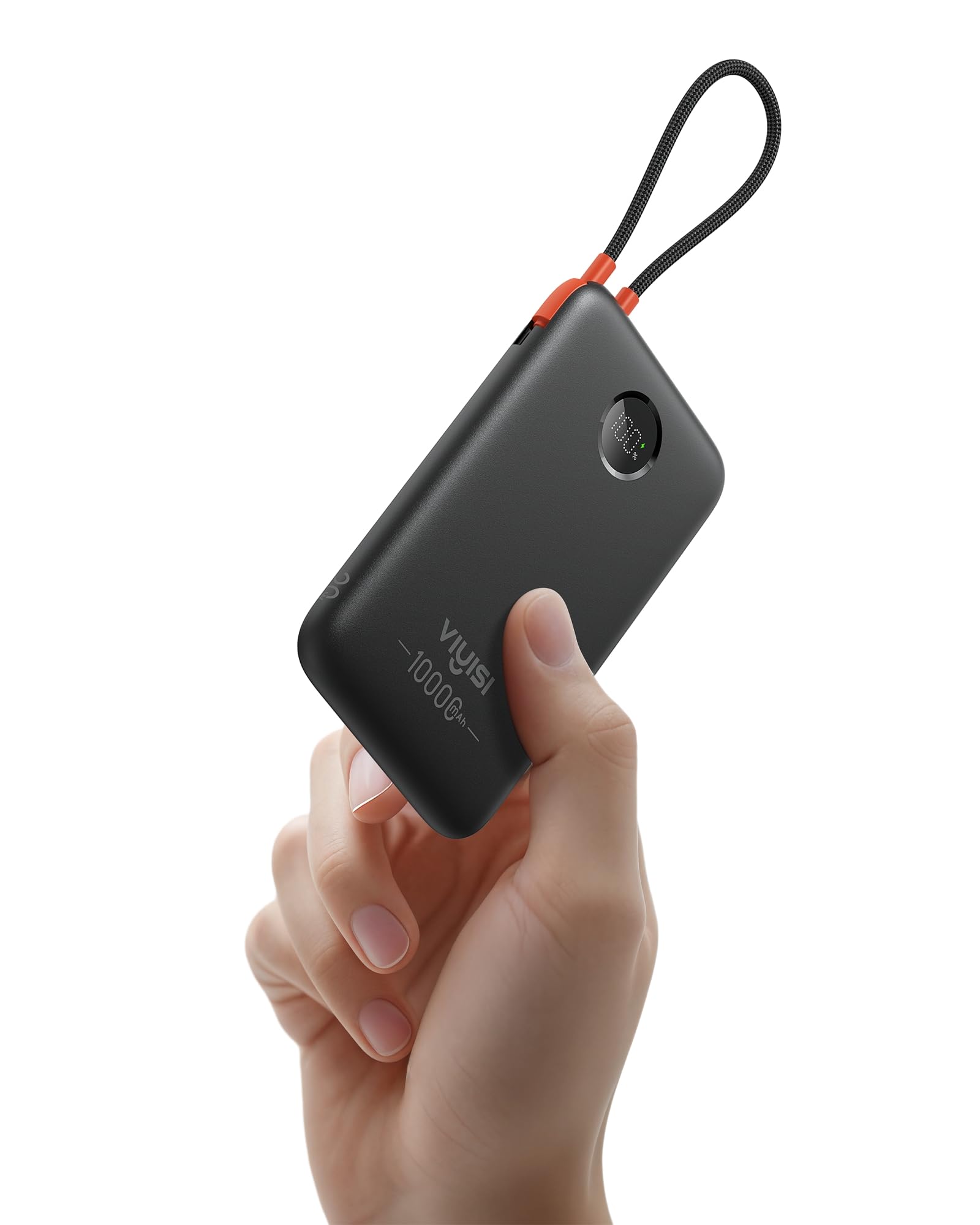
5. VIYISI G1189 10000mAh
Best Budget
Key Features
- Weight: 5.9 oz
- Capacity: 10,000 mAh
- Thickness: 0.58 in
- Max output: 20W PD
- Price: Budget
This is the least expensive way here to get a genuinely pocketable 10,000mAh bank. VIYISI lists it at 0.58 inches and 5.9 ounces, roughly wallet-sized, with a USB-C cable built into the shell and a travel pouch in the box.
We used it as a commuter and day-trip bank and it handled the unglamorous parts well: it charged a phone at 20W, the built-in cable meant nothing to remember, and it vanished into a front jeans pocket instead of printing a rectangle through the denim. The percentage readout is the pleasant surprise at this price, since most budget banks still make you interpret four LEDs.
What you give up is headroom. Twenty watts is a step behind the 45W picks, so a large phone takes noticeably longer to reach full, and the single built-in cable is USB-C — perfect for a modern iPhone or any Android, useless if a companion is carrying a Lightning device and no cord. Neither matters on a short trip; both matter if you are the person everyone borrows from.
Pros
- Cheapest genuinely pocketable 10,000mAh here
- Built-in USB-C cable and a percentage display
- Ships with a travel pouch
Cons
- Built-in cable is USB-C only
- 20W charging trails the 45W picks
Budget buyers get the essentials here — 10,000mAh, a built-in USB-C cable, and a pocket-sized body — without paying for wattage they may never need.
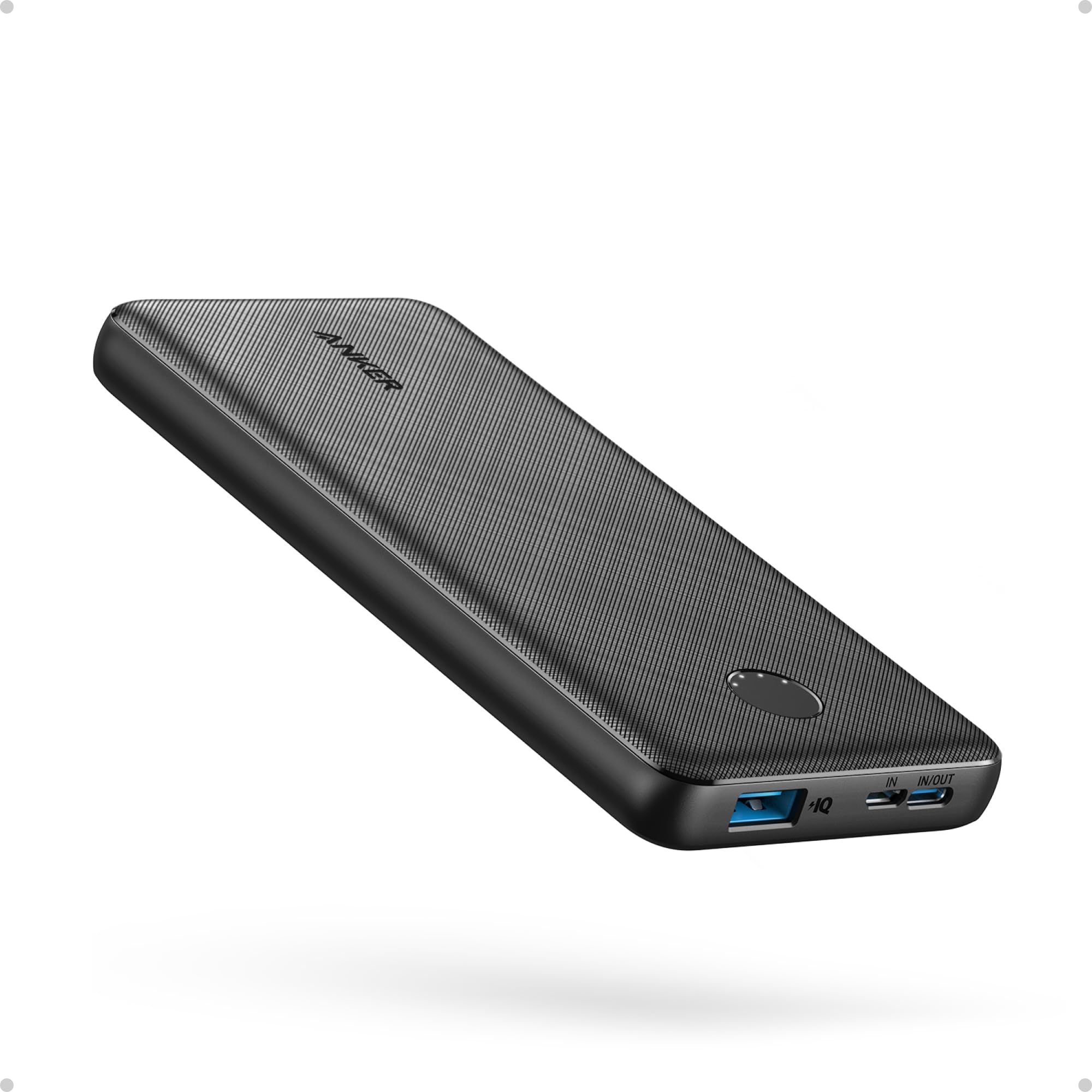
6. Anker PowerCore Slim 10000
Best No-Frills Pick
Key Features
- Output: 15W (5V/3A)
- Weight: 8.6 oz
- Capacity: 10,000 mAh
- Thickness: 0.61 in
- Price: Budget
There is no cable tucked into this one, no display, no magnet, and no 45W badge. Anker built a 10,000mAh slab 0.61 inches thick and 8.6 ounces, gave it a two-way USB-C port, and certified it against a 3.2-foot drop.
We keep it in the rotation for exactly that reason. Banks with molded-in cables are wonderful until the cable goes, and then the whole thing is e-waste. The PowerCore Slim asks you to carry a cord you probably already own, and in exchange it is the most likely bank here to survive being sat on, dropped on a hostel floor, or jammed under an airplane seat.
The trade is speed and weight. At 5V/3A it has the lowest output here, so a modern phone charges at a fraction of what the 45W picks deliver — fine overnight on a hotel desk, frustrating in a forty-minute layover. At 8.6 ounces it is also heavier than the INIU, which does more with less.
The warranty runs a standard 18 months, and the matte shell picks up scuffs the way plastic does. Neither has bothered us in a bag. Both are worth knowing if you like your gear to stay looking new.
Pros
- Certified to survive a 3.2-foot drop
- Nothing to break — no molded cable or display
Cons
- 15W output is the slowest here
- No built-in cable or percentage display
Plain, drop-tested, and slow: this is the bank for someone who already carries a cable and breaks things, not for someone chasing fast charging.
7. Anker Nano 5K MagGo Slim
Thinnest Possible Carry
Key Features
- Weight: 4.3 oz
- Capacity: 5,000 mAh
- Wireless: Qi2 15W
- Thickness: 0.33 in
- Price: Premium
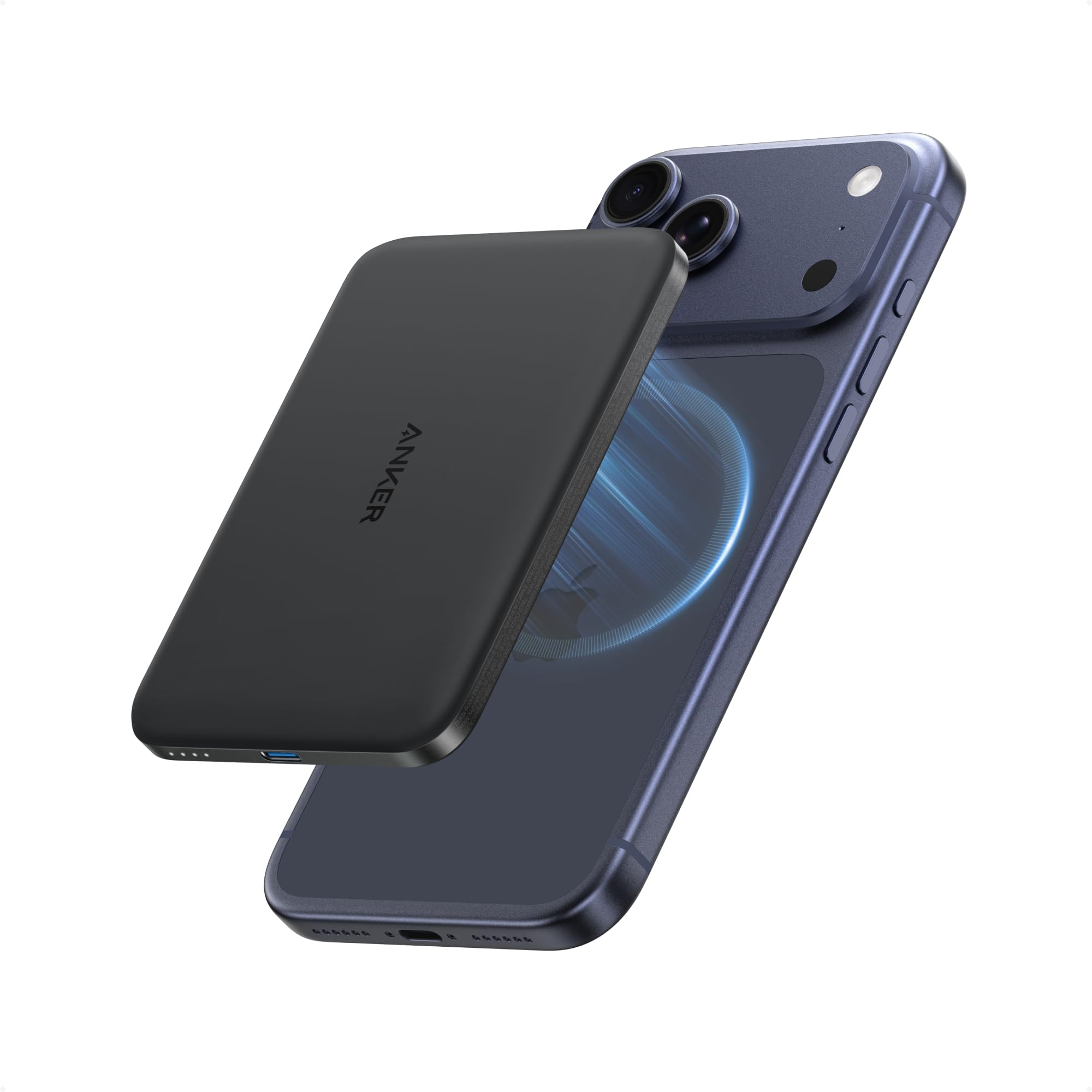
Against the back of an iPhone, the Nano looks like part of the phone rather than something clipped to it. At a third of an inch thick and 4.3 ounces, with Qi2 magnets holding it flush, it barely changes how the handset feels — which is the entire reason to buy a bank this small.
Qi2 certification is the meaningful part of the spec sheet, not the badge. It is a real standard, so you get an actual 15W rather than the 7.5W some magnetic banks quietly fall back to, and there is a 20W USB-C port when you want wires. Anker also claims graphene cooling keeps the stack below 104 degrees.
The math is where it gets hard. Five thousand milliamp-hours is the least capacity on this list at the highest price, and the TRKOY does the same 15W magnetic job for much less. The wireless stack also warms up in use — noticeable in a pocket on a warm day, and the most consistent complaint about this design.
So the case is aesthetic and dimensional rather than practical: buy it if a millimeter matters and you want the best-looking object on this page, not if you want the most charges per dollar.
Pros
- Thinnest bank here at 0.33 inches
- Qi2-certified 15W wireless charging
- 20W USB-C port for wired top-ups
Cons
- Warms up in wireless use
- Highest price here for the least capacity
If thinness is the whole point and budget is not, the Nano is the sleekest bank here — just know you are paying the most for a single charge.
8. HELLEE N18 15000mAh
Best for Group Charging

Key Features
- Weight: 8.8 oz
- Capacity: 15,000 mAh
- Thickness: 1.1 in
- Built-in cables: 4
- Price: Midrange
Four cables are molded into this bank, covering Lightning and USB-C devices, and with the extra ports it can feed six things at once. That makes it a family charger rather than a personal one — the bank you hand around a rental car instead of the one you keep in your own pocket.
Fifteen thousand milliamp-hours sits in a useful middle. The listing claims up to 3.5 phone charges, which covers a long weekend, and 22.5W gets a phone to about half in half an hour. The percentage display is legible in daylight and more useful than it sounds when you are deciding whether to plug in before a transfer.
Then the compromise: 1.1 inches thick and 8.8 ounces, the chunkiest bank here by a wide margin. We never got it comfortable in a jeans pocket; it is a daypack item. If your bag goes everywhere with you, that is a fair trade for never hunting a cable. If you travel with one small sling, it is not.
Pros
- Four built-in cables and six outputs
- 15,000mAh covers roughly 3.5 phone charges
- Digital percentage display
Cons
- 1.1 inches thick, so it lives in a bag
Four built-in cables and six outputs make this the group charger of the list; the thickness is what you pay for never hunting a cord again.
9. CFIAI PB-08 20000mAh
Thin High Capacity

Key Features
- Output: 22.5W
- Capacity: 20,000 mAh
- Thickness: 0.6 in
- Built-in cables: Lightning and USB-C
- Price: Midrange
Two built-in cables, a percentage readout, and 20,000mAh in a body the size of a large phone is a combination nothing else here offers. At 0.6 inches thick it is thinner than the Neoseek despite carrying the same capacity, which is the sort of number that makes a bag feel lighter.
The built-ins cover the two cables travelers actually need, Lightning and USB-C, with extra USB-A, USB-C, and micro ports behind them, and the listing says it can feed four devices at once. The display is a touch panel showing exact percentage. On paper this is the most complete travel bank on the page.
What holds it back is the record behind it. The warranty runs three months, the shortest here by a clear margin, which is a strange thing to see on a product priced alongside better-supported brands. Treat it as promising rather than proven: buy where returns are simple, lean on it hard in the first weeks, and keep the packaging until you trust it.
Pros
- 20,000mAh at just 0.6 inches thick
- Built-in Lightning and USB-C cables
- Touch display shows exact percentage
Cons
- Three-month warranty, the shortest here
A thin, fully equipped 20,000mAh bank with a three-month warranty — worth it if you want maximum capability in minimum space and accept the risk.
How We Tested These Slim Power Banks
We started by pulling every slim, travel-oriented pack we could find from brands we already knew and a few we didn’t, then filtered by thickness, weight, capacity, and price so the shortlist covered the range of sizes travelers actually buy. That left 14 units, from 5,000mAh magnetic discs to 20,000mAh packs. I rotated all of them through five months of ordinary use: commutes, a cross-country flight with a three-hour layover, weekend drives, hotel rooms with one working outlet, and long days out where I deliberately left the house at 15 percent.
Size was measured, not guessed. I stacked each pack against a phone and a passport, weighed it, then carried it for a full day in a front jeans pocket, a jacket pocket, and a small crossbody bag. I noted which built-in cables actually reached a phone while it sat in a case, which ones snagged on a bag lining, and which packs pulled free and dropped when I lifted the phone by the cord.
For speed, I drained a phone to zero, plugged in, and logged the percentage every 15 minutes through the first hour and then to full. Battery life came from running each pack until it quit, counting complete charges, and comparing that to the label. Heat got checked by hand and by thermometer at the 20- and 40-minute marks, and I noted which packs throttled down rather than cooking. Value was the last filter: what you pay per usable charge once the marketing capacity is stripped out, and whether the extras were worth the bulk they added.
How to Choose a Slim Power Bank for Travel
Slim is a measurement rather than a marketing word, and the gap between a bank you carry and one that lives in a hotel drawer usually comes down to two numbers: ounces and inches.
Start With Capacity, Then Check the Weight
Capacity sets how many days you can be careless, and it also sets the weight you carry through every one of them. A 5,000mAh bank is roughly one phone charge at about four ounces, 10,000mAh doubles that at six to nine ounces, and 20,000mAh buys three or four charges but lands near twelve ounces.
For most trips of a week or less, 10,000mAh is the right default: plane seats and hotel rooms both have outlets, so you rarely need more than a day of buffer. Go bigger for camping, long transit days, or a group sharing one pack.
Measure Thickness Before You Trust the Word Slim
Here is the trap: a bank sold as slim can be half an inch or a full inch, and that difference decides whether it rides in a jeans pocket or only in a bag. Check the listed thickness and weight together. Half an inch and under six ounces disappears; 0.7 inches still pockets in a jacket; anything over an inch is a bag item whatever the title claims.
Width counts too. A wide bank fights the pocket seam even when it is thin, which is why the credit-card-footprint designs feel smaller than their numbers suggest.
Built-In Cables Versus a Cable You Can Replace
Built-in cables are the biggest convenience in this category — nothing to forget, nothing to untangle at the gate. They are also a single point of failure. When a molded cable splits, the bank is finished, because the port usually cannot be repaired or replaced.
Detachable designs get you most of the convenience without the finality: the INIU ships a short braided cord that clips to the body, so a spare USB-C cable takes over if it dies. If you travel with more than one device ecosystem, the four-cable designs end a lot of arguments.
Wattage Cuts Both Ways
Output wattage decides how fast your phone refills. Input wattage decides how fast the bank itself does, and that second number is the one people forget. A 45W bank can put serious charge into a phone in twenty minutes; a 15W bank needs an hour for the same job.
With a 20,000mAh bank, check the input figure before you buy. Refilling a big battery from a low-wattage wall charger takes most of a night, which quietly defeats the point of carrying it. And match the output to your phone: paying for 45W is wasted on a handset that caps at 20W.
Airline Rules and the China Question
Power banks fly in the cabin, not in checked bags. The ceiling most airlines use is 100Wh, which is roughly 27,000mAh, so every bank here clears it with room to spare: 10,000mAh is about 37Wh and 20,000mAh about 74Wh.
The exception worth planning around is China, where airport security has tightened its checks and looks for the CCC mark printed on the device. The LISEN carries it; a bank without it can be taken at the airport. Confirm your airline’s limit before a long-haul trip and keep the bank in your personal item.
Frequently Asked Questions
Will a magnetic power bank charge through a phone case?
Yes, if the case is thin or built for MagSafe. Most silicone, leather, and clear cases under about 2mm pass the charge fine, and cases with their own magnet ring hold best.
Wallet cases, battery cases, and anything much thicker usually break the alignment or stop the charge entirely. Test it at home: stick the bank on and watch whether the phone shows it is charging before you rely on it at a gate.
Can I charge my phone while the power bank is plugged into the wall?
Some can, and it is called pass-through charging; the VIYISI lists it among its features. It is slower at both ends and makes the bank run warmer, so treat it as an overnight hotel trick rather than something to count on in an airport.
If pass-through matters to you, look for the wording on the listing before buying. Most budget portable chargers do not support it, and a bank without it will simply stop charging the phone when you plug the bank in.
How should I store a power bank between trips?
Leave it around half charge rather than empty or full, and keep it out of a hot car, since heat ages lithium cells faster than anything else. Top it up every three or four months so it never sits flat for a season.
Before a big trip, run it through one full charge and recharge so you know what it actually holds. Batteries that live at zero for months are the ones that disappoint you later.
Final Verdict
Most travelers should buy the INIU P41 and stop reading. You get 10,000mAh, the fastest wired output in this group, a 6.4-ounce body, and a cable that can be replaced instead of one that takes the whole bank with it when it frays.
Two requirements change the answer. If everyone in your party carries a recent iPhone and you want no cable at all, the TRKOY W5 does 15W magnetically for less money and less weight. If China is on the itinerary, take the LISEN: the printed CCC mark is the difference between a smooth security line and a confiscated battery.