This post contains affiliate links. We may earn a small commission when you buy through our links — at no extra cost to you.
A packable daypack makes an easy promise and a hard one to keep: it vanishes into your luggage, then carries a full day of walking without sawing at your shoulders. Most are sewn from the same thin nylon, so the differences live in the details: how the strap edges are finished, whether a 20-liter bag actually swallows a 20-liter load, and whether you can reach the outside pocket without swinging the bag off your shoulder.
Over four months, our team tested 14 of them, from sub-two-ounce stuff sacks to roomier packs with padded straps and a chest strap, on day hikes, weekend trips, and errands that end with the bag on wet concrete. Featherweights feel like a grocery bag until you load them; the structured ones behave like real backpacks but eat up luggage space. Listed liters are nominal too, so we judged the picks below on what they actually held, and on whether they still felt sturdy after being stuffed, dropped, and folded back into their own pockets.
Our Top Picks


The Best Packable Daypacks, Reviewed
1. Outlander 20L Daypack
Best Overall
Key Features
- Pockets: 5
- Capacity: 20 liters
- Empty weight: 0.46 lb
- Water resistance: Water resistant
- Price: Budget
Half a pound and 20 liters — those two numbers explain why this is the pack we hand to people who ask what to buy. The Outlander weighs 0.46 pounds empty, less than the water bottle you will drop into the side pocket, and it still swallows a jacket, lunch, a camera, and two bottles for a day out. The side pockets are cinched with a stretch cord, a detail that keeps a full bottle from flying out when you swing the bag off one shoulder.
Packing it away is genuinely one motion. There is no separate stuff sack to lose: the bag turns inside out into its own zippered inner pocket and unfolds into a pack again when you land. Two zippered front pockets keep a phone, a passport, and a boarding pass out of the main compartment, which matters more than it sounds when you are digging one-handed at a ticket counter.
We are clear-eyed about what 0.46 pounds buys. Twenty liters of anything is still twenty liters, so the bag sags into a soft lump when it is full, and sharp keys or a metal camera clip belong in an outer pocket where they are not grinding against the fabric all day. Pack it for a day out, not for a hardware store run.
The newer version adds a carabiner clip, a small thing until you want the packed bundle hanging off the outside of a bigger pack instead of buried at the bottom of it. Five pockets and five compartments mean nothing gets lost in a single black hole. It is the pack we reach for when we do not know what the day holds.
Pros
- Under half a pound empty
- Folds into its own zippered pocket
- Five pockets and five compartments
- Stretch-cord side pockets hold bottles in
Cons
- Water-resistant finish, not waterproof
Our top pick: 0.46 pounds empty, 20 liters full, and it folds into its own pocket — the pack that covers the most trips for the least fuss.
2. Osprey Ultralight Stuff Pack 18L
Best Premium
Key Features
- Fabric: 40D recycled high-tenacity nylon
- Weight: 5.29 oz
- Capacity: 18 liters
- Water resistance: Not water resistant
- Price: Premium
The priciest pack here is also the only one that carries like a real backpack. Padded mesh shoulder straps, webbing loops for clipping a light or a carabiner, and an adjustable sternum strap — the piece of hardware that stops a loaded pack from sliding off your shoulders halfway through a walk.
We think it earns the money in the parts that fail first. The body fabric is bluesign-approved 40D high-tenacity recycled nylon, the zippers are YKK with reinforced pulls, and the pulls are oversized enough to grab with one hand. None of that shows in a product photo, and all of it is why this one goes into a suitcase without a second thought.
What it does not do is rain. Osprey lists the pack as not water resistant, so a phone or a passport needs its own dry bag when the weather turns; there is no coating to fall back on. On a dry trip that costs you nothing, and it is the honest trade for a fabric this light.
The layout is deliberately plain: one main compartment, dual stretch mesh side pockets that will take a one-liter bottle, an internal key clip, and a quick-access pocket at the top. Eighteen liters is the sweet spot for a day of walking a city or a half-day hike, and the whole bag stuffs into that top pocket — the neatest fold in this group, with nothing separate to keep track of.
Pros
- Padded mesh straps with a sternum strap
- YKK zippers with reinforced pulls
- Bluesign-approved recycled 40D nylon
- Stretch side pockets take a one-liter bottle
Cons
- Highest price of any pack here
Worth the splurge for a pack you will wear all day: padded mesh straps, a sternum strap, and YKK zippers make 18 liters feel like real gear.
3. SKYSPER Iminix 15L
Best for Day Hikes
Key Features
- Weight: 0.75 lb
- Capacity: 15 liters
- Chest strap: Yes, with whistle
- Folded size: 7.9 x 6.7 in
- Price: Budget
The chest strap is why this one comes on hikes. Clip it across your sternum and a 15-liter load stops swinging when you step over rocks; unclip it and the pack sits like every other sack here. The buckle carries a safety whistle, which is the kind of thing you never touch and are glad is there.
The money went into the harness and the pockets rather than the fabric. There are six compartments, four of them zippered, including a flat one against your back that takes a wallet and a passport where nobody’s hand is going to wander in a crowd. The zip pulls are big enough to work with cold fingers.
Fifteen liters holds more than it sounds. The side pockets are deep enough for two full 32-ounce bottles, and the main compartment takes a shell, lunch, and a camera. A bungee cord across the front is there for a damp towel or the rain jacket you have given up wearing.
This is not a pocket pack. Folded, it is roughly 8 by 7 inches, so it earns a place in a suitcase rather than a jacket pocket — which is how we used it, flat in the bottom of a carry-on until the first morning it was needed.
Pros
- Chest strap with a built-in whistle
- Side pockets take two 32-ounce bottles
- Six pockets including a hidden back pocket
- Folds to about 8 by 7 inches
Cons
- Heaviest of the small packs at 0.75 lb
Our pick for hiking days: the chest strap and deep bottle pockets hold a 15-liter load steady on rough ground, and it still folds into a suitcase.
4. MIYCOO 35L Packable Backpack
Best for Big Loads
Key Features
- Weight: 12.8 oz
- Pockets: 5
- Capacity: 35 liters
- Wet compartment: Yes
- Price: Budget
Every trip ends with more than it started with. Thirty-five liters is how you stop paying for a second checked bag: this is the biggest pack on the list, and the only one here that takes a week’s overflow without a fight.
The details assume you will be living out of it. A wet compartment separates a swimsuit or a soaked shell from everything else, clips lock two zipper pulls together so a bag on your back cannot be opened behind you, and there is a survival whistle worked into the hardware. We also like that it folds into its own inner pocket, because a 35-liter bag that does not pack down is just a suitcase.
Loaded, it slides under an airplane seat — the test that matters on a cheap-flight itinerary — and a chest strap keeps the shoulder straps from slipping off on the walk from the terminal to the curb.
IPX4 is the honest limit: splashes, not a downpour. The fabric sheds water and the zippers are not sealed, so a passport and a camera ride in a dry bag when you will be out in weather. Everything else about the bag is built for the trip where you bought too much and have to carry it home.
Pros
- 35 liters, the biggest capacity here
- Separate wet compartment
- Locking zipper pulls and a whistle
- Folds into its own inner pocket
Cons
- Heaviest pack here at 12.8 ounces
The pick for a load bigger than a day: 35 liters, a wet compartment, and anti-theft zipper clips, and it still folds into its own pocket.
5. Gonex 20L Packable Daypack
Best Organization
Key Features
- Weight: 6.53 oz
- Capacity: 20 liters
- Folded size: 6.29 x 6.29 in
- Zippered compartments: 3
- Price: Budget
Same 20 liters as our top pick, and a smaller bundle when it is folded: the Gonex compresses to about a six-inch square. What the extra organization buys you is three zippered compartments instead of one maw, so a paperback, a charger, and a passport each have a place that is not the bottom of the bag.
It is the best-organized pack in this group, and the hardware is better than the price suggests — SBS metal zippers and bartack reinforcement at more than 25 stress points. At 185 grams it is light enough to forget you packed it.
The nylon is thin, and thin nylon is what eventually gives at a seam, so this is a pack for a city day or a light hike rather than a load of groceries. Keep sharp-edged gear in its own pouch and there is not much to go wrong.
The three compartments are sized sensibly: the front one takes a guidebook and tickets, the middle holds small electronics, and the main bag takes whatever the day produced. Folded, the six-inch square slips into the front pocket of a bigger bag and stays there until you need it.
Pros
- Three zippered compartments
- Folds to a 6.29-inch square
- SBS metal zippers and bartack reinforcement
- 185 grams empty
Cons
- Water-repellent finish only, not waterproof
The best-organized pack here: three zippered compartments, metal zippers, and a six-inch folded square at a budget price.
6. SKYSPER Ishell 10L
Best Small Pack
Key Features
- Weight: 9.17 oz
- Capacity: 10 liters
- Folded size: 6.7 x 7 in
- Compartments: 3
- Price: Budget
The pocket you cannot see is the good one. A flat zip pocket sits against your back, under the shoulder straps, sized for a passport, a card, and a folded bill — a place a hand cannot reach while you are wearing the bag. On a crowded metro that is worth more than another liter of capacity.
Ten liters is personal-item territory, and this SKYSPER uses the space well: a vertical zip pocket down the front, deep mesh bottle holders, and a main compartment that takes a book, a layer, and lunch. Three compartments in a bag this small is more organization than the size promises.
The straps are the compromise. They are simple webbing with no padding, and with two bottles and a book aboard you will feel the edges by late afternoon. Keep the load to a light day and it is a non-issue — this is a bag for a museum, a market, and a train, not a ten-mile hike.
Folded, it is about seven inches each way, pencil-pouch size, which is the size that matters on a trip where the day bag has to disappear into a suitcase at night. Ours spent the flight home in an outside pocket.
Pros
- Hidden back-panel pocket for valuables
- Folds to roughly seven inches
- Deep mesh bottle holders
- Front vertical zip pocket for quick access
Cons
- Heavier than the other 10-liter pack here
Our pick under 12 liters: the hidden back pocket keeps a passport safe and it folds to pencil-pouch size for city days.
7. 4Monster 16L Daypack
Backup Bag

Folded, it is wallet-sized — the kind of bundle that goes in a glove box and stays there until the day you need it. Sixteen liters is the middle of this category and, honestly, the size most people actually need: a jacket, water, lunch, a camera, and a hat.
The straps are the surprise. They are wider than the flat webbing on most packs in this bracket, so a loaded bag spreads across the shoulder instead of cutting a line into it, and the zippers have water-resistant closures that keep a pocket from filling in a drizzle.
Thirty-denier nylon is on the light end even for a packable, and that is the trade for the fold and the price. Treat it as a light-load bag — a shell, a bottle, a camera, lunch — and it holds up; stuff it like a school backpack and the fabric is what gives first.
There is a main compartment, a front zip pocket, and two mesh side pockets, which is the right amount of organization for a bag this size. Ours has stopped counting as luggage when we pack, which is the highest compliment a packable can get.
Pros
- Wider straps than most packables
- Folds to a wallet-sized pouch
- Water-resistant zipper closures
- 16 liters splits the difference
Cons
- Thin 30D fabric suits light loads only
The middle of the range done well: 16 liters, wider straps than most packables, and a wallet-sized fold that lives in a glove box.
8. G4Free 10L Packable Backpack
Best for Theme Parks

Key Features
- Weight: 4.59 oz
- Pockets: 4
- Capacity: 10 liters
- Water resistance: Water resistant
- Price: Budget
Four and a half ounces is the number that matters here. The G4Free weighs 4.59 ounces, less than most phones, and folds into a pouch small enough to drop in a tote — which makes it the pack you bring when you do not want to bring a pack.
What you give up for that is structure. The polyamide fabric is tear-resistant but thin, and the layout is two zippered compartments plus two mesh side pockets; there is no interior pocket to organize small things, so a wallet and a phone end up in the front compartment together.
For a theme park, a market, or a shore excursion, that trade is the right one — the bag is off your back and into a tote the moment you are back on the bus. It is when you load it like a real daypack that the thin fabric and the unpadded straps start to tell.
The zippers are SBS and the pulls are sturdier than the fabric suggests. On a pack this cheap, the part most likely to fail first is not the part that is cheap here.
Pros
- 4.59 ounces empty
- Folds into a pouch for a tote
- Two zippered compartments plus two mesh pockets
- SBS zippers
Cons
- Hand wash only
The lightest 10-liter pack here with real pockets: 4.59 ounces, two zippered compartments, and a price that makes it an easy second bag.
9. Nanobag Daypack 16L
Pocket Backup
Key Features
- Fabric: Diamond ripstop nylon
- Weight: 1.15 oz
- Zipper: YKK
- Capacity: 16 liters
- Price: Midrange
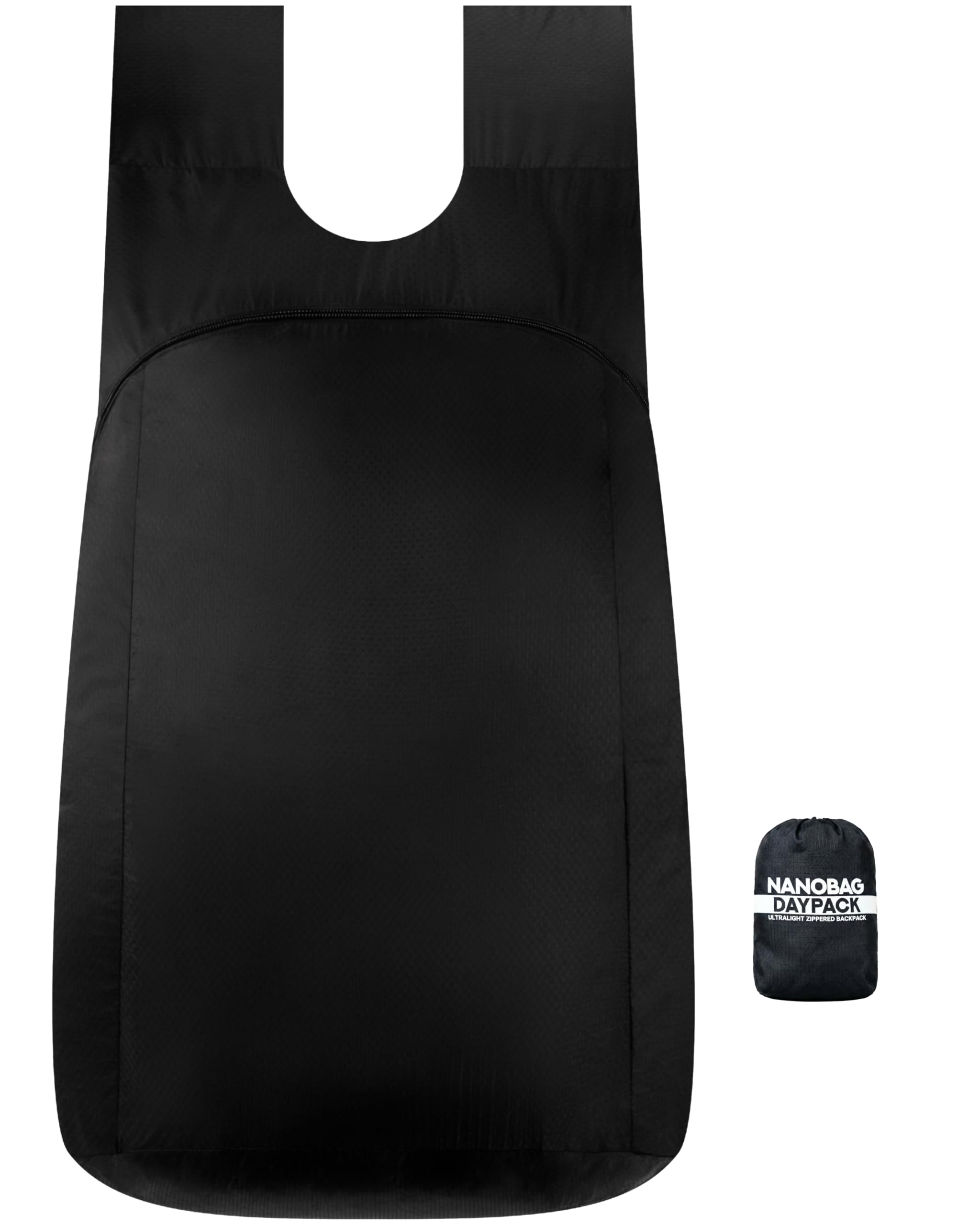
It lives in a jacket pocket, and most of the time we forget it is there. At 1.15 ounces the Nanobag is the lightest pack on this list by a wide margin, and it stuffs into an attached pouch with no folding at all — the fabric is 0.05 mm thick and the packed bundle disappears into a jeans pocket.
Sixteen liters from something this small is the trick. The diamond ripstop is rated to carry up to 66 pounds, and the wide 27-inch straps are shaped to spread a load rather than cut into your shoulders — at a grocery run’s worth of weight, they do exactly that.
What it is not is organized. One compartment, no key clip, no bottle holder, no inner pocket: a bottle rolls around with the shopping. It is a bag for a market run, a beach walk, or a ferry, not one for a laptop and a day’s water.
The YKK zipper is the tell that someone thought about the part that fails first, and the bartacks at the strap joins are the second tell. For 1.15 ounces, that is more engineering than the weight suggests.
Pros
- 1.15 ounces, lightest pack here
- Stuffs into an attached pouch, no folding
- YKK zipper and bartack reinforcement
- Wide 27-inch shoulder straps
Cons
- Straps are a fixed length with no adjustment
Buy it as the bag that lives in your pocket: 1.15 ounces, 16 liters when you need it, and a YKK zipper holding it shut.
How We Tested Packable Daypacks
We started with research, reading through listings and customer reviews for several dozen packable daypacks and filtering by listed weight, packed size, capacity, and price band until we had 14 worth putting our hands on. The group covered what shoppers actually choose between: 10-liter bags small enough to clip to a belt loop, standard 20-liter daypacks, and 33- to 35-liter haulers for people traveling with more. Anything with bare webbing straps and no edge binding got cut early.
Each bag went on a kitchen scale empty so we could see how the real weight compared with the claim. Then we loaded every one with the same kit, a fleece, a rain shell, a one-liter bottle, a paperback, and a sandwich, and noted which bags needed a shove to close and which swallowed it with room to spare. We timed how long it took to fold each pack back into its own pocket, and once packed, whether it lay flat enough to slide into a laptop sleeve or the front pocket of a carry-on. Pockets got a genuine workout: phone, passport, keys, and a snack, checking whether we could get to them with the pack on, and whether a chest strap sat across the chest instead of at collarbone height.
Sturdiness decided the rankings, because thin material is where these bags fail. We loaded each pack to roughly 15 pounds, lifted it by a single shoulder strap and shook it, then inspected the seams and strap attachment points for strain. We set the loaded bags on concrete and dragged them a few feet, scraped a key across the fabric to see how badly it marred, and ran each one under a faucet for a minute to watch whether water beaded up or soaked straight through. Every bag also went on at least two walks of an hour or more, which is where skimpy straps and flimsy fabric announce themselves.
How to Choose a Packable Daypack
Shop the fold before the features. A foldable backpack that stuffs into its own pocket in one motion gets carried; one that needs a separate sack and five minutes of rolling stays in the suitcase.
Start With the Fold, Not the Liter Count
Two packs can both claim to fold into their own pocket and behave nothing alike. The ones we like best turn inside out into a zippered pocket that is part of the bag, so there is no stuff sack to lose in a hotel room. A separate pouch works fine until the day it goes missing.
Compare folded size rather than unrolled dimensions: a six-inch square disappears into a carry-on, while an eight-inch bundle takes up real space next to your shoes. And remember that compact in a product title usually describes suitcase fit, not pocket fit.
Match Liters to the Day You Actually Have
Ten to twelve liters is a personal-item bag: a book, a layer, water, a phone. Fifteen to twenty covers a real day out with a shell, lunch, a camera, and a bottle or two. Past thirty you are hauling souvenirs or packing for an overnight, and the bag stops folding down small.
Stated capacity is only a rough guide. A soft 20-liter pack with deep side pockets swallows more than a 20-liter pack with a stiff, narrow opening, so look at pocket shapes before you trust the number.
Weight Is a Trade, Not a Score
Empty weight in this category runs from about an ounce to nearly a pound, and every extra ounce buys something: padding in the straps, thicker fabric, a better zipper, another compartment. A one-ounce pack lives in your pocket and comes out for a market run. A ten-ounce pack you can wear for six hours.
Decide which of those you are shopping for before you compare numbers, because the lighter bag is not automatically the better one.
The Harness Decides the Last Mile
Straps are where budget packables separate. Flat webbing is fine for a two-pound load and punishing at eight; padded mesh spreads the same weight across a wider band. A sternum strap — the small clip joining the two shoulder straps across your chest — does more for comfort than any other feature at this price, because it stops the bag swaying as you walk.
If you plan to hike in one of these, put a chest strap near the top of your list. If it will ride in a suitcase and come out for an afternoon, save the weight and skip it.
Fabric, Zippers, and What Water Resistant Means
Most of these bags are 30- to 40-denier nylon or polyester. Higher denier means more abrasion resistance and a little more weight. Zippers matter as much as fabric: metal pulls and bartack stitching at the stress points are what keep a thin bag together past its first season.
Water resistant means the fabric sheds a splash. It does not mean the seams and zippers are sealed, and none of the packs here is a dry bag. Electronics still want their own protection.
Frequently Asked Questions
How do you get a packable daypack back into its pocket?
Turn the pocket inside out first, then stuff the bag into it from the bottom up, working the fabric in a handful at a time. Folding it flat first makes a bundle too wide to close.
Bags where the pocket is sewn into the pack, like the Outlander’s inner zip pocket, are the easiest to close again. Ones with a separate sack give you more room but one more thing to keep track of.
Will a packable daypack fit under an airplane seat?
The 10- to 18-liter packs here generally will, and that is the size to pick if you are flying a carrier that charges for a carry-on. The exception is the 35-liter bag, which runs 20.9 inches long and needs checking against your airline’s personal-item limit before you count on it.
Measure the pack’s longest side against the published limit rather than trusting the liter count.
Can you machine wash a packable daypack?
No. Most of these carry hand-wash-only instructions, and a machine cycle is rough on 30-denier fabric and on the water-repellent coating that makes the bag useful in a drizzle.
Wash it in a sink with cool water and a little mild soap, rinse, and hang it to dry out of direct sun. Skip the dryer entirely — heat is what kills the coating.
Final Verdict
After all of it, the Outlander 20L is still the pack we point people to first. It is the rare case where the lightest, simplest option is also the most useful: 0.46 pounds, twenty liters, a fold you can do one-handed, and a price that makes buying a second one easy.
Buy the Osprey instead if the bag will be on your back for full days, because the padded harness and sternum strap are worth the premium. Buy the MIYCOO if the load is bigger than a day. Everything else here is a variation on those three decisions.