This post contains affiliate links. We may earn a small commission when you buy through our links — at no extra cost to you.
A universal travel adapter looks like a solved problem until you’re in a hotel room with one working outlet, three dead devices, and a plug that fits nothing. Universal describes the socket, not the electricity — it reshapes the prongs but does not convert voltage, so your laptop and phone charger are fine while anything with a motor or a heating element stays home. What it actually fixes is smaller and better: a single block that turns one wall outlet into a charging station for everything you packed. I’ve filled a drawer with these over the years, and my team and I spent the past six months traveling with 12 of them.
The differences that matter are less glamorous than the packaging. Port count and port type decide more than country coverage does: a USB-C port with real wattage can retire your laptop charger, while low-power USB-A ports are good for phones overnight and little else. GaN internals are why a few of these stay palm-sized at high wattage, and an actual AC outlet on the face is the only way to plug in a camera battery. The picks below are the ones that came home still working.
Our Top Picks


The Best Universal Travel Adapters, Reviewed
1. EPICKA TA-105+
Best Overall
Key Features
- Fuse: 10A, replaceable + spare
- Ports: 1 AC + 3 USB-C + 2 USB-A
- Weight: 5.1 oz
- Plug types: Type A, C, G, I
- Price: Budget
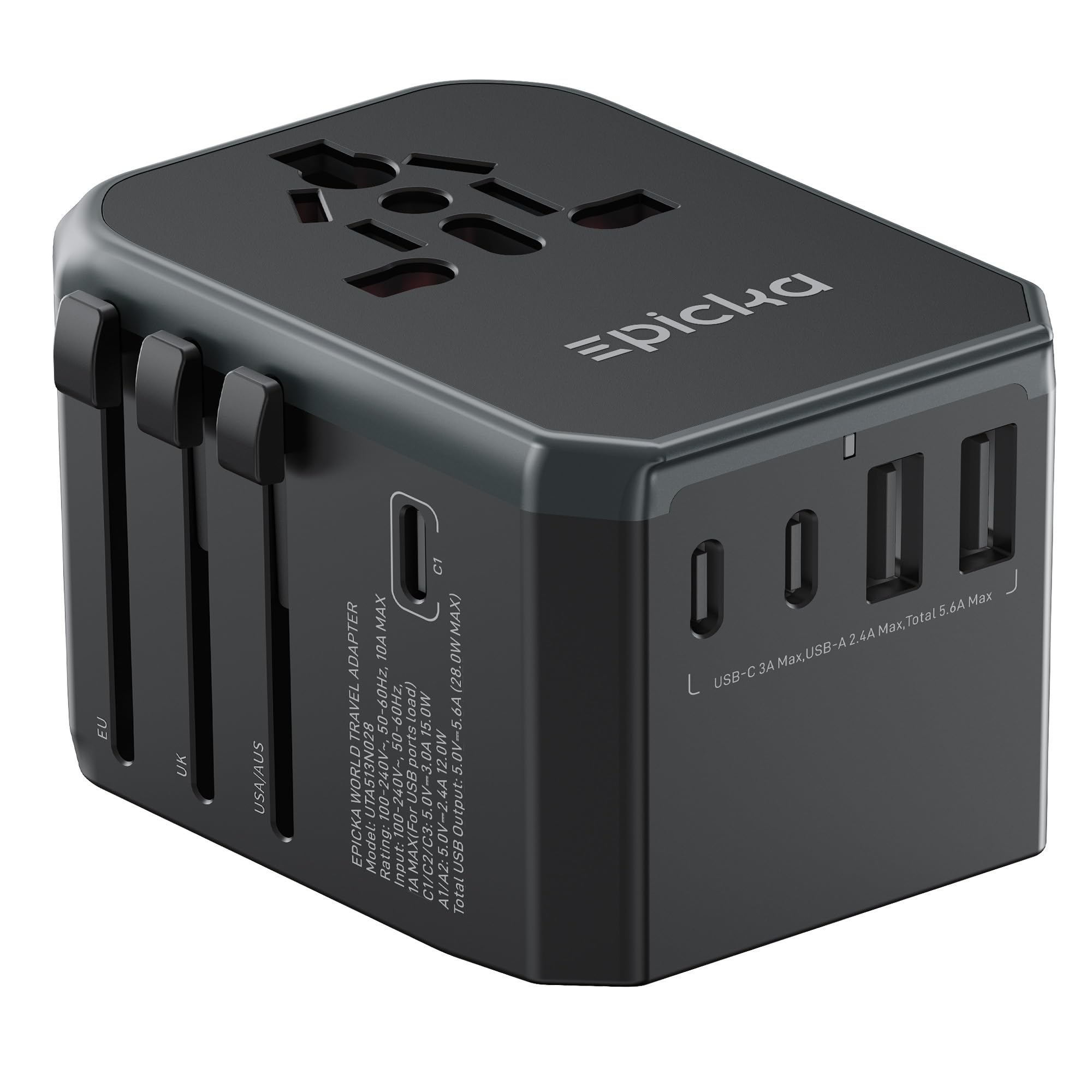
Six devices from one wall socket is the reason this cube earns the top spot. The EPICKA covers Type A, C, G and I outlets, so it works from a Tokyo hotel room to a Scottish guesthouse, and it splits that single socket into one AC outlet plus three USB-C and two USB-A ports. That’s the number that matters on a real trip: two phones, a watch, earbuds and a camera battery, all charging overnight without anyone unplugging anyone else.
Size is what we noticed first. At 5.1 ounces and a little under three inches across, it takes up less room than the pile of charging bricks it replaces, and the body feels dense and solid rather than hollow. Nothing about it rattles, and nothing about it makes you nervous when you push it into a socket.
The fuse setup is the detail we’ve come to care about most in this category. A replaceable 10A fuse protects the AC side and EPICKA includes a spare, which matters because the fuse is the part that fails when someone plugs a hair dryer into an adapter that was never built to feed one. The two-year limited warranty sits at the generous end of this group.
Where it stops short is laptop power. EPICKA rates the USB-C ports at 3A and lists no Power Delivery figure, which tells you this is a phone-and-tablet adapter rather than a laptop charger; the TA-105 Pro is the same cube with 70W on one port. One other limit worth knowing before you fly: the four plug types here cover the US, UK, Europe, Australia, China and Japan, but not India or South Africa.
Pros
- Six devices from a single outlet
- Three USB-C ports at this size
- Replaceable 10A fuse with a spare
- Compact 5.1-ounce cube
Cons
- USB-C ports have no published PD rating
We recommend the TA-105+ to almost every traveler: four plug types, three USB-C ports and six devices from one compact cube, with a spare fuse in the box.
2. EPICKA TA-105 Pro 70W
Best for Laptop Charging
Key Features
- Ports: 1 AC + 3 USB-C + 2 USB-A
- Weight: 5.1 oz
- Plug types: Type A, C, G, I
- USB-C1 power: 70W PD
- Price: Premium
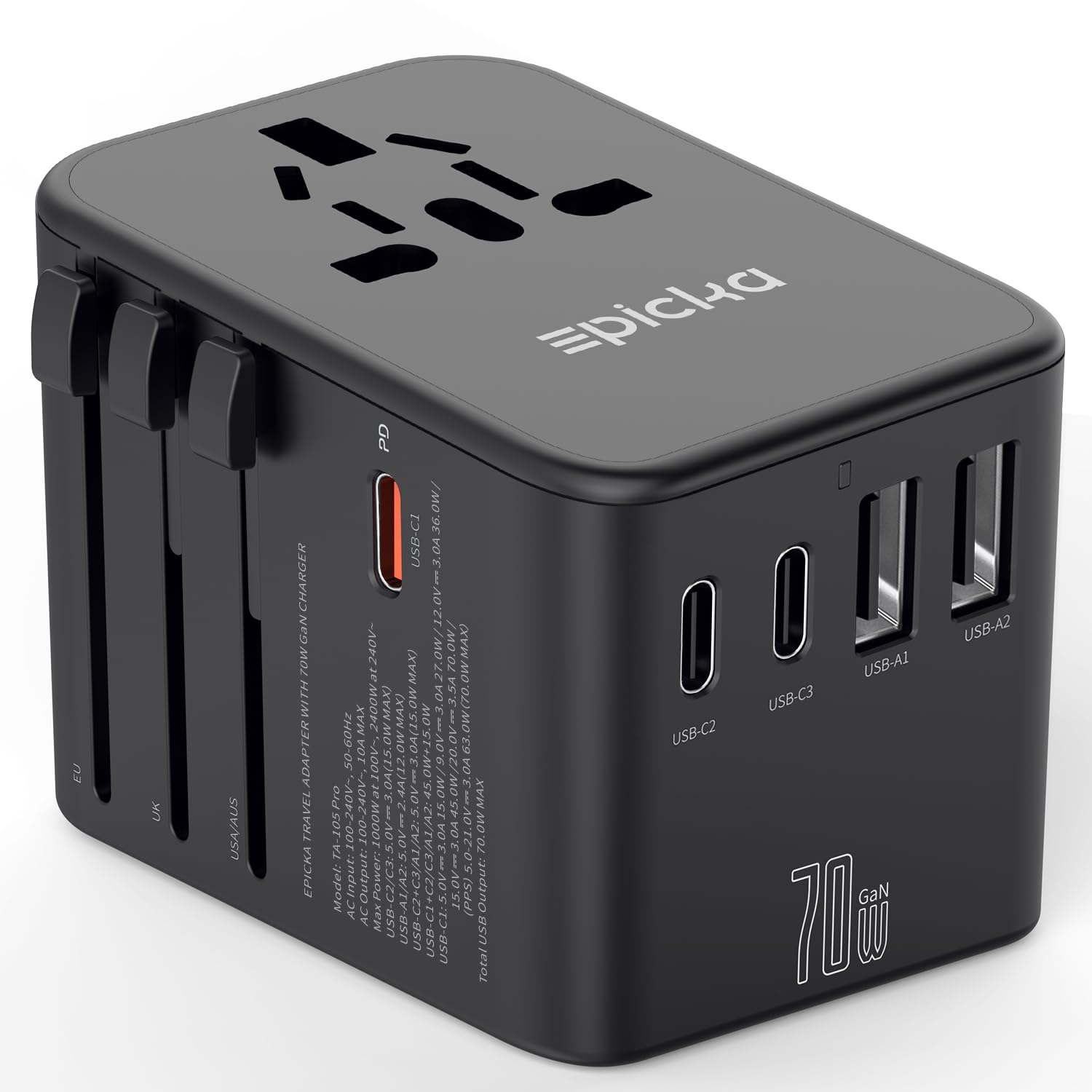
Same cube, more watts. The TA-105 Pro looks like our top pick and is built around one number: a USB-C port rated for 70W of Power Delivery, enough to charge a thin laptop or a tablet at full speed while the other five ports keep phones and watches topped up. That figure is the whole reason to spend more here, and it’s the difference between arriving with a charged laptop and hunting for an outlet at the airport.
The physical details earn their keep too. The prong arms lock into place and release with a button, so the plug doesn’t collapse in your hand while you’re pushing it into a tight socket, and the body stays upright in a wall outlet instead of drooping. A carry bag and two spare fuses come in the box, and the two-year warranty matches the top pick’s.
Two things to weigh. There’s no surge protection, which matters more with a laptop attached than with a phone. And 70W is the ceiling for a single port rather than for all six at once, so the laptop charges fastest on its own. Neither matters much when you’re charging overnight; both matter in a café with one outlet and four things to feed.
Pros
- 70W USB-C charges a laptop
- Six ports, three of them USB-C
- Locking prongs hold in loose sockets
- Carry bag and two spare fuses included
Cons
- No surge protection
If a laptop comes along, the 70W Pro is the upgrade worth paying for: the same six-port cube, with one USB-C port rated to charge a thin laptop.
3. Ceptics 45W Adapter
Best Fast-Charging Value
Key Features
- Weight: 5.9 oz
- USB ports: 2 USB-C + 3 USB-A
- Plug types: Type A, C, G, I
- USB-C power: 45W PD
- Price: Midrange
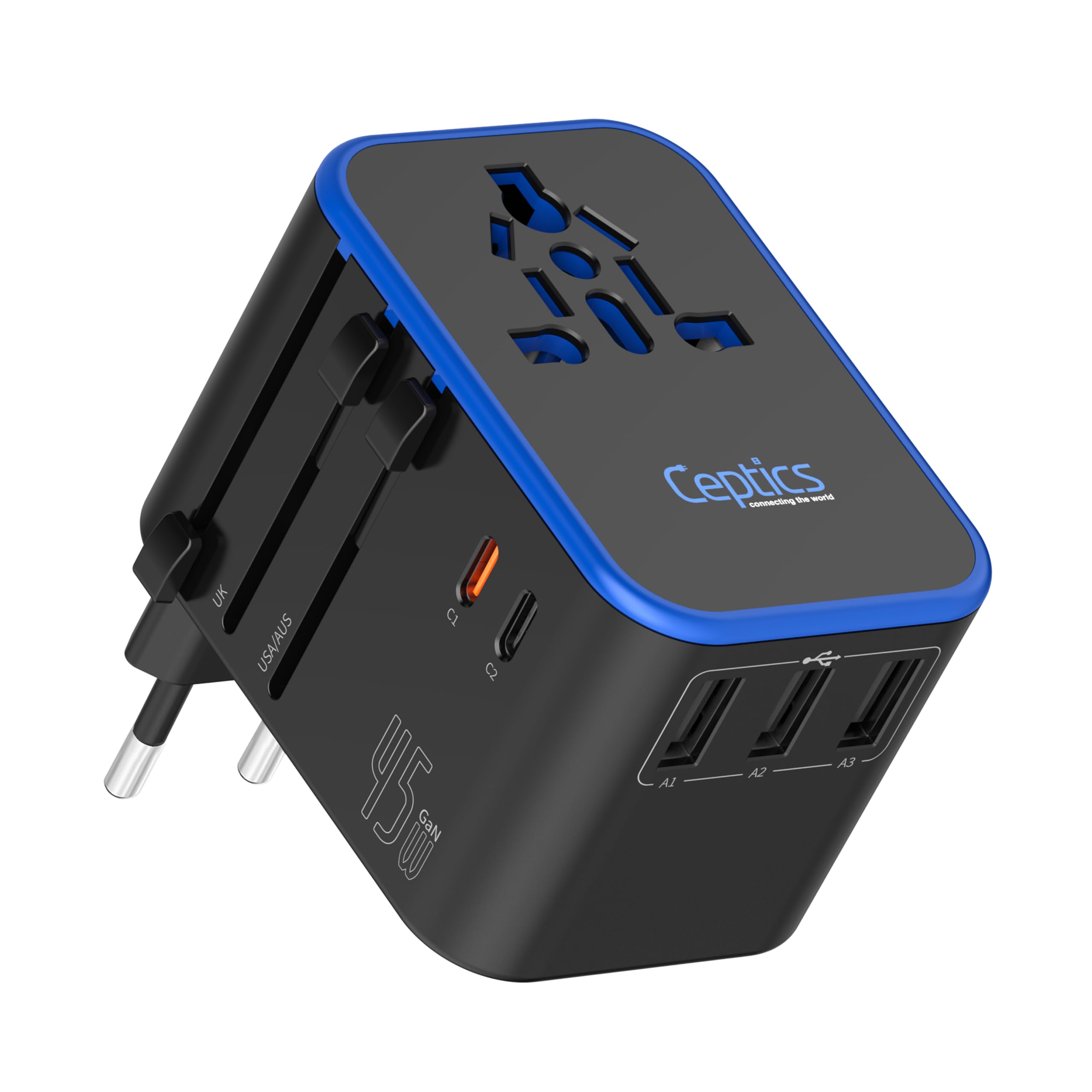
Forty-five watts of Power Delivery is the number to look for if one adapter has to top up a thin laptop, a tablet and a phone, and this Ceptics is the least expensive way to get there in this group. The main USB-C port carries PD and Quick Charge 3.0 for the heavy lifting; a second USB-C and three USB-A ports handle everything else.
What we like beyond the wattage is the universal input. The socket on the front takes a US, UK, EU, Australian or Chinese plug, so a colleague’s charger or the hotel’s spare lamp goes straight in, and that’s flexibility the USB-only bricks can’t offer. The 8A fuse is the trade-off: a lower ceiling than the 10A parts in the EPICKA cubes, so keep anything that heats up away from it. A spare fuse is included, and the plug lock keeps the prongs extended while you push it home.
Size is the other compromise. At three inches long and 5.9 ounces, it’s one of the longer, heavier units we packed — noticeably more in hand than the Anker Nano, though it still disappears into a tech pouch. In some sockets it takes a firm push before it seats, and an older recessed European outlet can hold it loosely enough that you notice a cable’s weight hanging off it.
The one-year warranty is among the shortest here, which is worth knowing if your gear gets thrown into carry-ons rather than placed.
Pros
- 45W PD without a premium price
- Five USB ports plus a universal AC input
- Spare fuse and a plug lock
Cons
- 8A fuse caps the AC side
- Longer and heavier than the compact picks
The Ceptics 45W is the fast-charging bargain: a 45W Power Delivery port and five USB ports in total, for a little more than our top pick.
4. Anker Nano Travel Adapter
Best for Minimal Packing
Key Features
- Weight: 3.77 oz
- AC outlet: 2-pin, no grounded plugs
- Plug types: Type A, C, G, I
- Shared USB output: 20W total, 15W shared
- Price: Midrange
At 3.39 by 1.97 by 0.98 inches, the Nano is the smallest full-featured adapter in this guide. Anker puts it at 43 percent smaller than comparable models, and the credit-card footprint is the claim that holds up in a dopp kit — it slides into the pocket a phone charger used to fill.
What settles the decision is the AC outlet. It’s a two-pin design, which cuts the shock risk Anker is engineering around, but it will not take a three-prong grounded plug, including the European Type F plugs a lot of laptop bricks ship with. If everything you carry is two-prong or USB, you’ll never notice the difference; if you travel with a grounded charger, you’ll notice it every night.
USB power is the other ceiling. The four ports share 20W, dropping to 15W when more than one device is plugged in, so a modern phone charges at a decent clip alone and slows once a second cable goes in. We charged a phone and a tablet together overnight and both filled up without either hurrying. For a watch, earbuds and a phone that’s a fair trade; it isn’t a laptop charger, and Anker doesn’t pretend it is.
The listed smart temperature control matters more than it sounds. A small body pushing power for eight hours straight gets warm, and the regulation is what keeps that warmth in check on a hotel nightstand.
Pros
- Credit-card footprint at 3.77 ounces
- Two USB-C and two USB-A plus AC
- Two-pin AC design reduces shock risk
Cons
- AC outlet won’t take grounded three-prong plugs
- USB output drops to 15W when shared
For a bag with no room left, the Nano is the adapter we grab: four USB ports and an AC outlet on a body the size of a thick credit card, as long as your plugs are two-prong.
5. Ceptics 140W GaN Adapter
Best for High-Power Gear
Key Features
- Ports: 2 AC + 3 USB-C + 1 USB-A
- Weight: 9 oz
- Plug types: Type A, C, G, I
- USB-C output: 140W
- Price: Premium
A CPAP, two phones, a camera and a laptop is not an unusual hotel-room load, and it’s the reason this Ceptics exists. Three USB-C ports and one USB-A sit alongside two AC inputs, one universal and one US/Japanese, so six things can be plugged in at once without dragging along a power strip. The 140W USB-C output is the highest in this group by a wide margin, well past anything a phone or tablet will ask for.
GaN is what makes the size possible. Gallium nitride internals run cooler and take less room than the older silicon designs, which is how a nine-ounce body carries this much power without a fan. In a European socket it sits flat and stays put rather than drooping under its own weight.
The second AC input is the feature we appreciate most, because a European plug and a US plug can be in use at the same time without swapping anything. For a photographer, a consultant with a big laptop, or anyone traveling with a medical device, this is the pick that takes the power strip out of the bag. That capacity is what you pay for in weight: nine ounces is the heaviest here and a lump in a jacket pocket, and the one-year warranty is on the short side for a premium adapter.
One number to keep straight: the 140W figure applies to USB-C. The AC side is still an adapter and not a converter, so the kettle and the hair dryer stay home.
Pros
- 140W USB-C covers laptops and CPAP machines
- Two AC inputs, one universal and one US-style
- GaN internals run cooler under load
- Sits flat in European sockets
Cons
- Heaviest pick here at 9 ounces
- One-year warranty on a premium adapter
The 140W Ceptics is the one for a heavy kit — a laptop, a CPAP, cameras and phones — with the most USB-C power here and two AC inputs to back it up.
6. Anker 100W GaN Charger
Best for Laptop-Focused Trips
Key Features
- Ports: 3 USB-C + 1 USB-A, no AC outlet
- Weight: 9.28 oz
- Max output: 100W
- Plug types: Type A, C, G
- Price: Premium
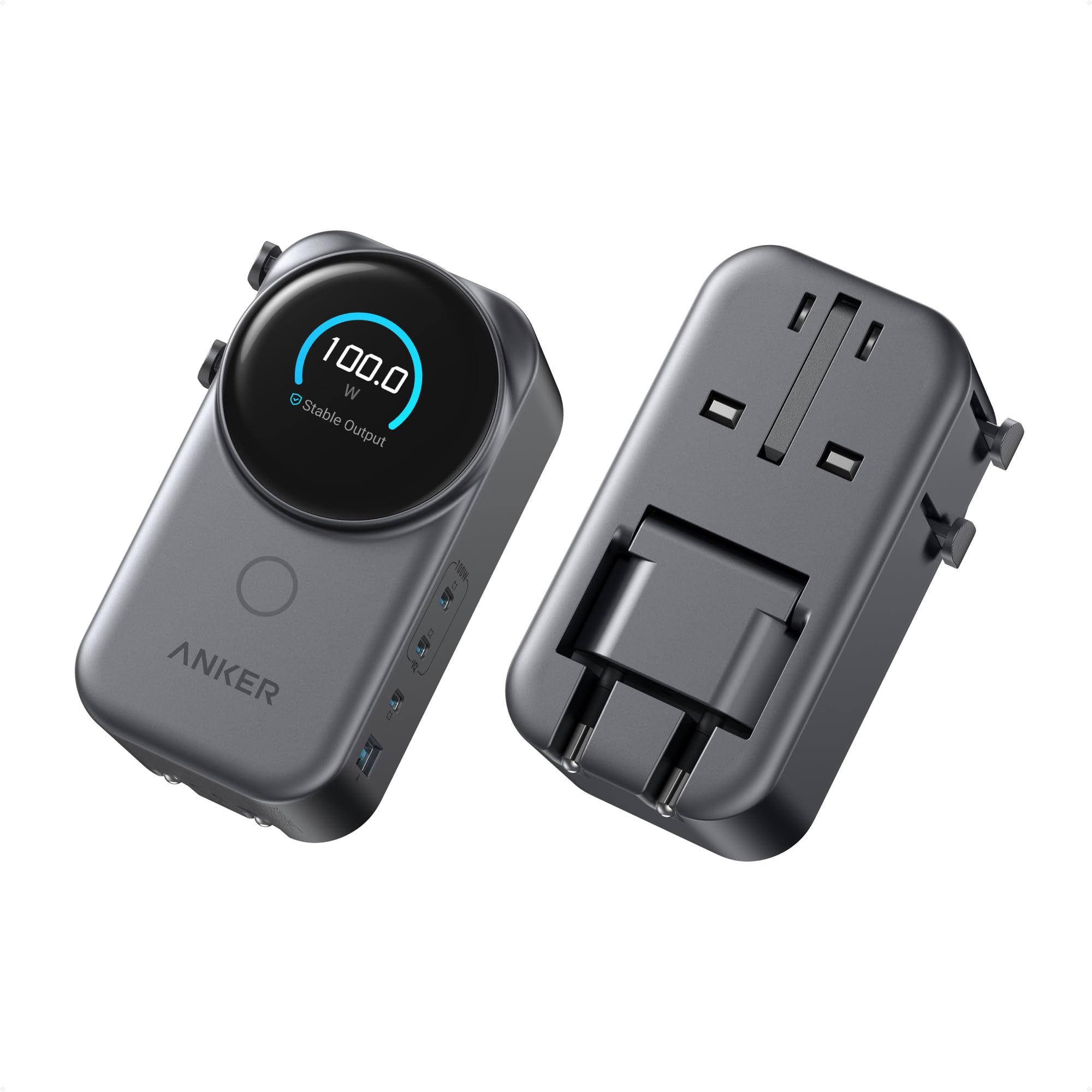
This is the one that isn’t quite a universal adapter, and it’s worth saying so up front: there’s no AC outlet and no Type I plug, so Australia, New Zealand and China are out unless you add something else. What it is instead is a 100W gallium nitride charger with US, UK and EU plugs built into the body — the thing that replaces a laptop brick, a phone charger and a tablet charger with one 9.3-ounce block.
The power side is genuinely good. Three USB-C ports and one USB-A share 100W through PowerIQ 4.0, so a laptop can pull most of that on its own while a phone takes the rest, and the 100-275V input covers every voltage region you’ll meet. Anker detects local voltage in about a second and shows it on a small screen, a detail that sounds like a gimmick until you’re standing in a dim hotel room wondering what the outlet is doing.
The flat plug is the other thing we like: it sits close to the wall and holds in the loose outlets that swallow a chunkier adapter’s prongs. What it comes down to is whether your trip is about plugs or about power. If you need to run a laptop and three gadgets from one block in the US, UK or EU, this is the most capable charger here. If you need one adapter for Bangkok, Sydney and Rome, it isn’t.
Pros
- 100W shared across four USB ports
- US, UK and EU plugs built in
- Flat plug holds in loose sockets
- 100-275V input covers every region
Cons
- No AC outlet for corded devices
- No Type I plug for Australia and China
A 100W travel charger rather than a true universal adapter: it replaces a laptop brick in the US, UK and EU, but there’s no AC outlet and no Australian plug.
7. TESSAN 009 Travel Adapter
Best for Slim One-Bag Trips

Key Features
- Ports: 1 AC + 2 USB-C + 1 USB-A
- Weight: 3.52 oz
- Plug types: Type A, C, G, I
- USB-C power: 20W PD, single port
- Price: Budget
For the trip where the bag is already full, the TESSAN 009 earns its place by being 1.24 inches thick. It’s a flat slab rather than a cube, so it slides into a laptop sleeve next to the cables instead of fighting them for room, and 3.52 ounces barely registers in a daypack.
The thin body doesn’t cost you ports. There’s an AC outlet rated to 2000W, two USB-C ports with 20W Power Delivery on a single port, and a USB-A — four devices, enough for a phone, a watch, earbuds and a camera. The adapter covers Type A, C, G and I sockets, so a London-Paris-Sydney itinerary doesn’t need a second piece.
Twenty watts is the catch. It’s enough to charge a phone quickly and not enough to do much for a tablet that wants 30W, let alone a laptop. The AC side is rated generously at 2000W, though it’s still an adapter and not a converter, so check the label on anything that heats up.
For phones, watches, earbuds and a camera on a short trip, the port mix is right and the thin body is a genuine convenience. A laptop changes the answer: the Ceptics 45W further up this guide carries a 45W port for close to the same money.
Pros
- 1.24-inch body slips into a laptop sleeve
- Two USB-C PD ports plus USB-A and AC
- Covers Type A, C, G and I
Cons
- 20W USB-C is phone speed, not laptop speed
The TESSAN 009 is the slim, affordable pick for a carry-on-only trip: 1.24 inches thick, four ports and a 2000W AC outlet, with 20W USB-C that suits phones.
8. decqle Universal Travel Adapter
Budget Backup

Key Features
- Fuse: 10A, spare included
- AC sockets: 2, 2500W max
- Plug types: Type A, C, G, I
- Total USB output: 17W
- Price: Budget
Two AC sockets on a travel adapter is rare; most of the picks here give you one. The decqle adds a second, a US-style outlet on the side, so a laptop charger and a camera charger can both stay plugged in, and it does that for less than anything else in this guide.
The rest of the port count is generous too: two USB-C and two USB-A alongside the AC sockets, six devices in a body the company says is 15 percent smaller than comparable units. The plug release works one-handed, which sounds trivial until you’re holding a phone in the other hand at a hotel desk.
The catch is USB power. All four USB ports share 17W, and the ports are individually rated at 15W and 12W, so the total is what matters: split across four devices, each one gets a trickle. A phone and a watch overnight is fine. A phone charging while a tablet tops up is slow enough that you’ll notice in the morning.
What it’s for, then, is the traveler who mostly needs sockets and a little USB on the side: a couple with two laptops, someone whose chargers are all cords, or a second adapter for a family so nobody argues about the outlet. As the inexpensive one that lives in the suitcase between trips, it’s easy to justify.
Pros
- Two AC sockets, including a side outlet
- The least expensive adapter in this guide
- Six devices from one compact body
- Two 10A fuses, one a spare
Cons
- 17W total USB output is slow when shared
The decqle is the least expensive adapter here and one of two with a pair of AC sockets, which makes it a sensible budget buy or a second adapter.
How We Tested Universal Travel Adapters at Home and Abroad
We started by pulling every adapter we could find that covered the Type A, C, G, and I outlets that make up most of the world, then filtered by port mix, wattage, and price so the group ran from slim plug-only blocks to high-wattage multi-port units. Twelve made the cut, and testing ran for six months. Some units went straight into my own travel — a week of hotel rooms, two long flights, a rental apartment with two outlets hidden behind the bed — while others went out with editors on their own trips.
At home, I plugged each adapter into a test board wired with U.S., U.K., EU, and Australian sockets and noted which ones sat loose in the slot, which needed a hard shove, and which blocked the neighboring outlet on the plate. On the road, I charged a laptop, phone, watch, and earbuds at once, timing how quickly each filled and watching whether the laptop’s charge rate sagged once the other ports were occupied.
Every unit got a hand check after an hour under full load to see how warm the body became, and I weighed each one and carried it in a jacket pocket to judge how much bulk it adds to a personal item. I cycled each sliding or interchangeable plug mechanism until it either loosened up or didn’t, and I read the fine print on the devices I travel with to confirm which ones genuinely need a converter rather than an adapter. Value came last: a cheap block that handles one phone overnight is a different purchase than one that replaces a laptop charger.
How to Choose a Universal Travel Adapter
A universal travel adapter changes the shape of your plug and nothing else — the voltage question is the one you have to answer yourself.
An Adapter Doesn’t Convert Voltage
The most expensive mistake in this category is assuming an adapter fixes the power. It doesn’t: a 230-volt outlet still delivers 230 volts through the adapter, and a device built only for 110-120 volts will not survive it. Read the small print on every brick you plan to bring — ‘100-240V’ means it’s dual-voltage and fine; ‘120V only’ means leave it home.
Anything that heats up is a separate problem. Hair dryers, curling irons and kettles pull more current than the 8A or 10A fuse in these adapters is rated for, which is why every listing warns against them. A dual-voltage travel dryer is a cheaper answer than a blown fuse in a foreign hotel room.
Match Plug Types to Your Itinerary
Four standards cover the bulk of a typical trip: Type A for the US, Canada and Japan, Type C for most of Europe, Type G for the UK, Ireland and Singapore, and Type I for Australia, New Zealand and China. Every adapter in this guide handles those four. Most international power adapters advertise a country count instead — ‘over 200 countries’ is shorthand for that same list, so read what’s actually covered rather than the number.
The gaps are worth knowing before you fly. India uses Type D and M, South Africa uses M and N, Brazil uses N, and Italy and Switzerland keep their own L and J sockets. A universal socket on the adapter will often take those plugs anyway, but check your destination rather than assuming.
Count Ports and Read the Wattage
Port count is the easy part: one adapter with three USB-C and two USB-A ports keeps a family’s phones, watches and earbuds charged from a single outlet. Wattage is where buyers get caught. A figure like 20W is often the total for all ports at once rather than per port, so a phone that charges quickly alone will crawl once a tablet joins it.
If a laptop comes along, look for a stated Power Delivery rating of 45W or more; the Ceptics 45W, the EPICKA 70W and the 140W Ceptics are the three here that clear it. If everything you carry is a phone or smaller, 20W is plenty and you can choose on size instead.
Weight, Grip and the Fuse
Adapters here run from about 3.5 ounces to over 9 ounces, and the difference shows up in a wall outlet as much as in a bag. A heavy adapter hanging off a loose, recessed European socket droops and can lose contact; a compact body that sits close to the wall holds better. We care more about that grip than about saving two ounces.
Look for a replaceable fuse and a spare in the box. The fuse is the part that fails when something draws too much current, and with a spare it’s a two-minute fix instead of a dead adapter in a strange city. Shutters over the live contacts and a warranty of at least a year are the other details that separate a keeper from a hotel-room casualty.
Frequently Asked Questions
Will a UK or European plug fit into a universal adapter?
Yes — the universal socket on most of these takes Type C, G, A and I plugs, so a British or German plug goes straight in and the adapter handles the outlet end. Voltage is a separate question: a European appliance expecting 230 volts will not run properly on a 120-volt US outlet unless its label says 100-240V.
What do I do if the adapter stops working mid-trip?
Check the fuse first. The EPICKA cubes and the decqle ship with a spare, and a blown fuse is the usual explanation when an adapter that worked in one city is dead in the next. Swap it in, and if the adapter is still dead, it has failed — which is why a second, cheap adapter at the bottom of the bag earns its space.
How many adapters do I need for two people?
One is usually enough. A six-port adapter like the EPICKA TA-105+ covers two phones, two watches and a tablet from a single outlet, and hotel rooms rarely offer more than one free socket anyway. Add a second if you split up during the day, or if you’re both carrying laptops that charge overnight.
Final Verdict
For most travelers, the EPICKA TA-105+ is the answer: four plug standards, six devices from one outlet, and a five-ounce cube that disappears into a bag. Spend more only when you have a specific reason — the 70W version if a laptop comes along, the 140W Ceptics if you travel with a CPAP or a full camera kit.
That’s the whole decision: what’s in your bag, and how much power it wants.