This post contains affiliate links. We may earn a small commission when you buy through our links — at no extra cost to you.
The moment I gave up on airport outlets came at a crowded gate mid-connection: phone at 4 percent, boarding pass on the screen, every plug in sight already occupied. A power bank is the fix — it puts the outlet in your bag. My team and I have spent the past six months carrying 14 of them through terminals, hotel rooms, and long days away from a desk.
Two things are worth knowing before you shop. The capacity printed on the shell isn’t the capacity that reaches your phone, since some of it is lost in conversion, so how a bank performs under a real load matters more than the headline number. Built-in cables cut both ways, too: they save you a pouch full of tangles, but they’re often the first thing to wear out.
What follows is judged on charging speed, honest battery life, weight, and whether a bank survived being dropped on a hotel floor. Some are small enough to forget in a jacket pocket; a couple can top up a laptop on deadline.
Our Top Picks




The Best Power Banks for Travel, Reviewed
1. Anker 20,000mAh 87W Power Bank
Best Overall
Key Features
- Ports: 3 (built-in USB-C, USB-C, USB-A)
- Weight: 15.2 oz
- Capacity: 20,000mAh
- Max output: 87W total, 65W to one device
Eighty-seven watts is the number that earns this pack its place. Spread across three ports, with as much as 65W going to a single device, it’s enough to push a 14-inch MacBook Pro to roughly half in half an hour and still leave a port free for a phone. That’s the argument for carrying it: one pack replaces the laptop brick, the phone charger, and the cables that go with both.
The built-in USB-C cable is the part we appreciate most, and not just because it saves a cord. Anker rates it for 10,000 bends, it folds flat against the body, and it removes the gate-side moment where you have the pack but not the cable. The pack itself refills in about 90 minutes on a 100W-or-better charger, so a lunch stop can reset it completely.
Weight is the honest trade. At 15.2 ounces and just over six inches long, this is a bag pack, not a pocket one — if that’s what you’re after, the INIU P41 weighs less than half as much and still moves fast. What the extra bulk buys is a pack that can carry a working day for a phone, a tablet, and a laptop with no wall outlet anywhere in sight.
Pros
- Runs a laptop and a phone at once
- Built-in USB-C cable rated for 10,000 bends
- Three ports cover phone, tablet, and laptop
- Refills fully in about 1.5 hours
Cons
- Can stop accepting a charge over time
Our pick for most trips: 20,000mAh and 87W in one bag-friendly pack, with a built-in cable that lets you leave the laptop charger at home.
2. AIFENG 10,000mAh with AC Plug
Best for Light Packing
Key Features
- Weight: 7.05 oz
- Capacity: 10,000mAh
- Recharge: Foldable AC plug, about 4 hours
- Max output: 22.5W
- Price: Budget
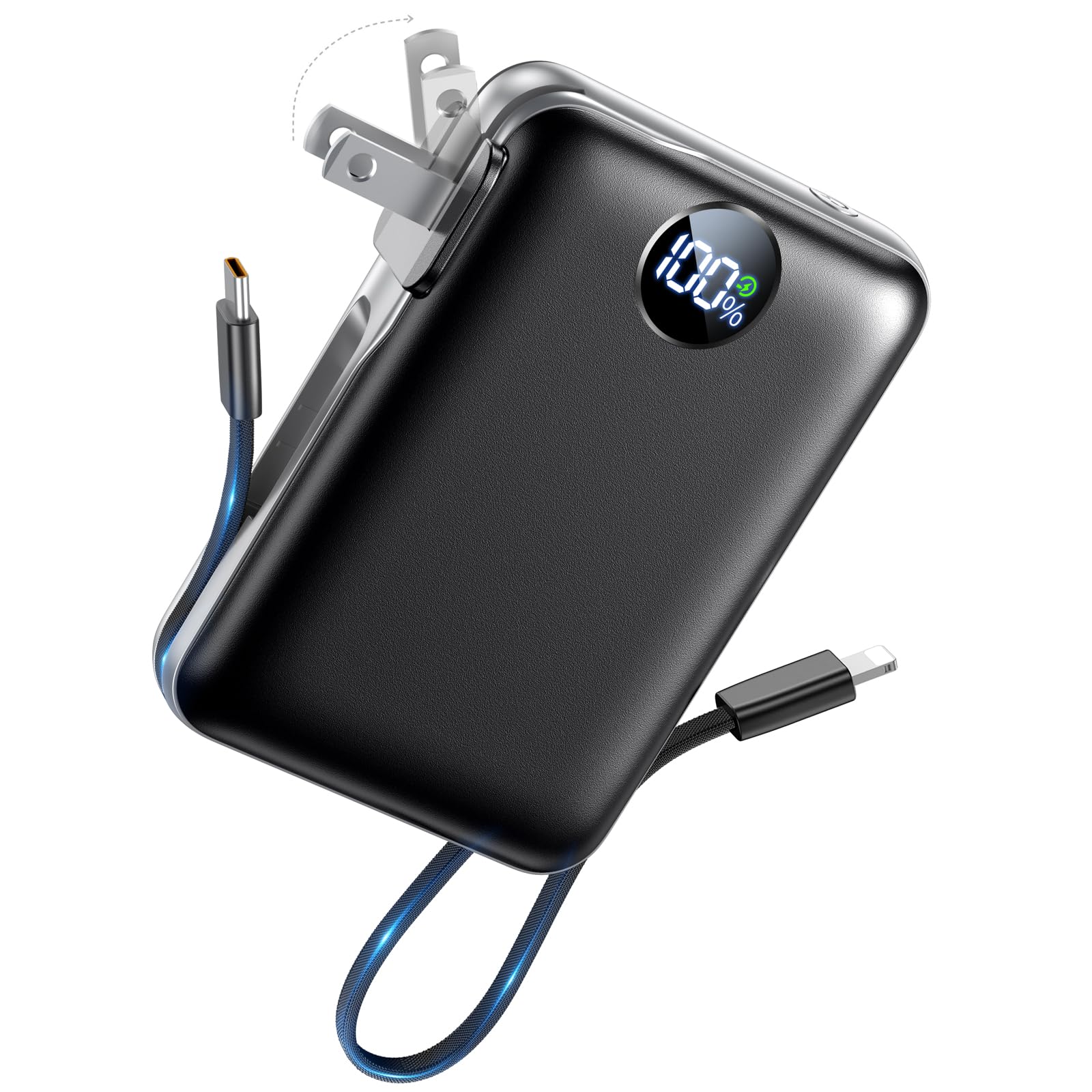
The pleasant surprise with this one is what stays home. There’s no charger brick and no cable for the pack itself — a foldable AC plug is built into the body, so it refills from any wall outlet in about four hours, on the same socket your phone is already using, and then goes back in the bag with its built-in iPhone and USB-C cables.
At 3.66 by 2.36 inches and 200 grams it’s one of the smallest packs here. The 10,000mAh cell is good for about two phone charges, and 22.5W puts a useful amount back into a phone in half an hour — the combination we like best for a two- or three-night trip.
The plug is also the catch: it makes the body 1.26 inches thick, roughly double the flat packs in this guide, so it sits in a tote rather than a jeans pocket. Anyone who has arrived somewhere with a dead pack and no wall adapter will find that a fair exchange.
Pros
- Built-in AC plug needs no charger
- iPhone and USB-C cables built in
- 200 g and under four inches long
Cons
- No laptop charging at 22.5W
For short trips, this is our favorite: a 10,000mAh pack with its own wall plug, so there’s nothing extra to pack or forget.
3. INIU 10,000mAh 45W (P41)
Best Compact Fast Charger
Key Features
- Cable: 0.4 ft detachable USB-C
- Weight: 6.42 oz
- Capacity: 10,000mAh
- Max output: 45W
- Price: Budget
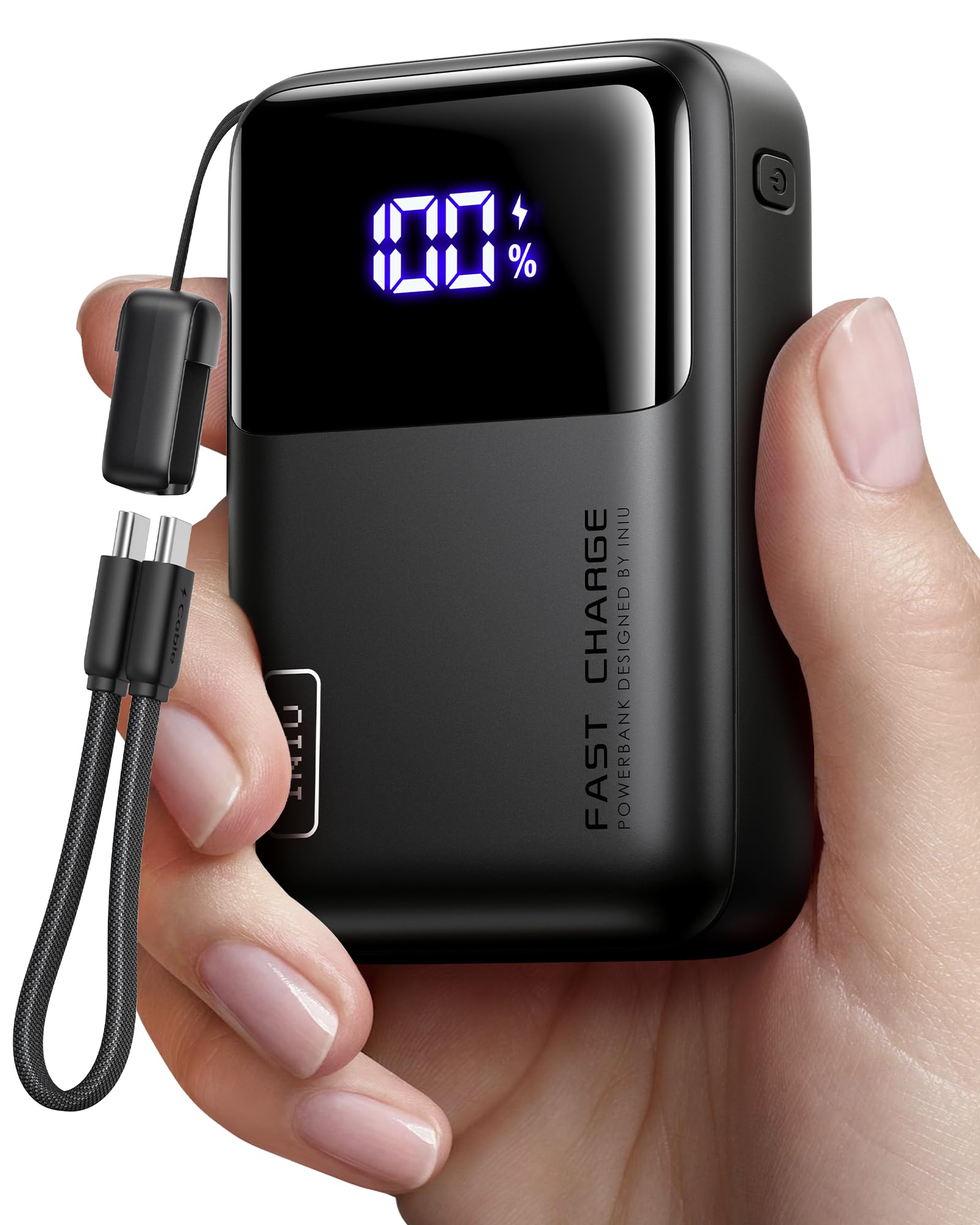
Half an inch thick and 182 grams, this is the pack that disappears into a jacket pocket and stays there until someone’s phone is at 4 percent. It’s the lightest thing we recommend, and it’s also the fastest 10,000mAh pack here.
45W is what makes that second claim true. The box figure is 76 percent of an iPhone 17 Pro Max in half an hour, and there are three ports to share — two USB-C and one USB-A — so a phone and a pair of earbuds can charge together without either waiting.
The cable is the design decision we like best. It detaches, a 0.4-foot braided USB-C lanyard, which means the part that wears out is the part you can replace, unlike the fixed cords on most packs here.
The warranty runs three years, as long as anything in this guide, which is the coverage that matters for a pack you’ll drain and refill constantly.
Pros
- 45W, the quickest 10,000mAh here
- Detachable cable you can replace
- 182 g and half an inch thick
- Three-year warranty
Cons
- Two phone charges only, no laptop
- Can stop holding a charge early
Our pocket pick: 45W charging and a replaceable cable in a 182-gram body that’s still the quickest small pack here.
4. INIU 20,000mAh 65W (P62-E1)
Best for Laptop Travel
Key Features
- Ports: 3 (2 USB-C, 1 USB-A)
- Weight: 13.4 oz
- Capacity: 20,000mAh
- Max output: 65W
- Price: Midrange
Both this and our overall pick feed a laptop 65W. The difference is the body it comes in: this INIU is 4.3 inches long and 13.4 ounces, small enough to vanish into a backpack’s laptop sleeve, and it lands in the middle of the price range here rather than at the top of it.
Inside is 20,000mAh, which INIU figures as a full MacBook Air charge or three-plus phone top-ups, plus a percentage display that we rate highly for travel — you know what’s left instead of guessing from four dots. The USB-C cable detaches and doubles as a lanyard, and a small pouch comes with it.
Staying power is the open question. This is the least proven of the laptop-capable packs here, and one that quits after a few weeks is a different problem from one that simply runs flat. The 3-year warranty is the backstop, and the 4.3-inch body is why we still reach for it when the laptop is coming.
Pros
- 65W laptop charging in a small body
- Exact battery percentage display
- Detachable lanyard cable
- 13.4 oz, light for 20,000mAh
Cons
- Slow to recharge itself
Our choice when the laptop comes along: 65W and 20,000mAh in a 4.3-inch pack, with a percentage readout we trust more than dots.
5. Anker 25,000mAh 165W Power Bank
Best for Multi-Laptop Trips
Key Features
- Capacity: 25,000mAh
- Dimensions: 6.18 × 2.13 × 1.93 in
- Max output: 165W total, 100W per USB-C port
- Built-in cables: 2, one retractable to 2.3 ft
- Price: Premium
This is the most expensive pack here, and the only one that can fast-charge three laptops at once — which is the entire case for it. Three USB-C ports, each good for 100W, add up to 165W shared, so two people working from a hotel room can run their machines and charge a phone without negotiating turns.
The 25,000mAh cell is the largest here and still sits under the 100Wh carry-on ceiling, which matters if you fly often. Both built-in cables are USB-C: a short one that doubles as a carry strap, and a retractable one that reaches 2.3 feet and rewinds. The retractable cord is the feature we ended up using most — a phone on a tray table doesn’t need a loose cable across your lap.
It costs like the tool it is, and it’s built for a backpack rather than a jacket. If your trip is a phone and a pair of headphones, our overall pick is the far easier carry; if you’re traveling to work, this is the one that keeps two laptops alive through a long connection and refills in about 110 minutes.
Pros
- Three 100W USB-C ports
- 25,000mAh and still flight-legal
- Retractable built-in cable
- Full refill in about 110 minutes
Cons
- Heavy and nearly two inches thick
- Long-term durability is inconsistent
For working trips with more than one laptop to feed, this is the pack that keeps up — three 100W ports and 25,000mAh, if you’ll carry the bulk.
6. HELLEE 15,000mAh 22.5W
Best Mid-Capacity Pick
Key Features
- Weight: 8.82 oz
- Capacity: 15,000mAh
- Max output: 22.5W
- Built-in cables: 4
- Price: Budget
Fifteen thousand milliamp-hours is the capacity almost nobody advertises and most weekend travelers should look at first. It lands at roughly three and a half phone charges — enough for a long weekend with a tablet in the mix — without the heft of a 20,000mAh brick.
Four cables are built into the body, covering iPhone, USB-C, and older micro-USB gear, and the pack will run six outputs at once. That’s the part we think earns its keep: nobody in the group needs to have remembered a cord.
There’s a percentage display, a bidirectional USB-C port, and a recharge time of about three hours, which is quicker than most of the bigger packs here manage.
Two limits worth knowing: it’s six inches long, so it lives in a bag rather than a pocket, and 22.5W is phone-and-tablet power. For a weekend bag that trade is easy to take — the size is what buys the four cables and the fast refill, and a laptop was never coming on this trip anyway.
Pros
- 15,000mAh in a bag-friendly body
- Four built-in cables, six outputs
- Refills in about three hours
- Percentage display
Cons
- Holding a charge is the weak spot
Our favorite compromise: 15,000mAh and four built-in cables, enough for a long weekend without the weight of a 20,000mAh pack.
7. Orfeika 20,000mAh 4-Cable
Best for Groups
Key Features
- Weight: 0.73 lb
- Outputs: 6 (3 built-in cables, 3 ports)
- Capacity: 20,000mAh
- Max output: 20W
- Price: Midrange
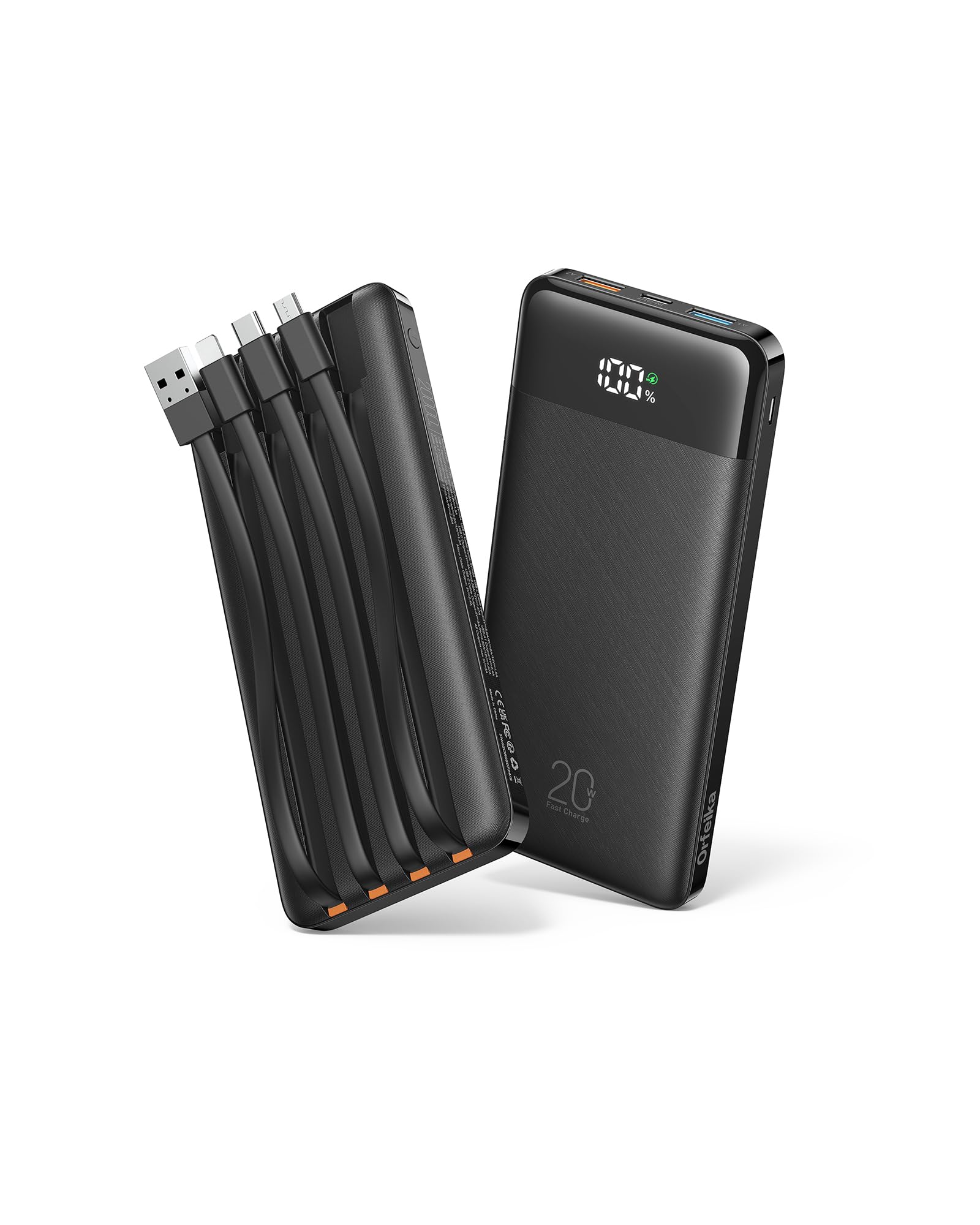
Four people, one rental car, one working outlet — that’s the scene this pack is built for. Three cables are built into the body and three more ports sit alongside them, which is enough for a carload of phones, a tablet, and a pair of earbuds without anyone digging through a bag for a cord.
It’s slim for a 20,000mAh portable charger at 0.74 inches and about three-quarters of a pound, and one of the four built-in cables is an input, so refilling it doesn’t depend on remembering a USB-C cord. A two-year warranty backs it, and the whole thing has a plain, solid feel that suits a pack living in a glovebox.
What earns it a place is the cable drawer it replaces: an iPhone cable, a USB-C cable, and a micro-USB cable are attached, so nobody on a group trip has to have remembered anything. In a rental car, that’s worth more than another few watts of output.
Pros
- Three built-in cables plus three ports
- Slim and light for 20,000mAh
- Built-in input cable for refilling
- Two-year warranty
Cons
- 20W rules out laptop charging
- Six devices drain 20,000mAh fast
Our pick for a group: three built-in cables and six outputs, so four people can top up from one pack without a tangle of cords.
8. VRURC 10,000mAh 4-Cable
Budget Carry
Key Features
- Weight: 9.17 oz
- Outputs: 5 (3 cables, 2 ports)
- Capacity: 10,000mAh
- Recharge time: About 6 hours
- Price: Budget
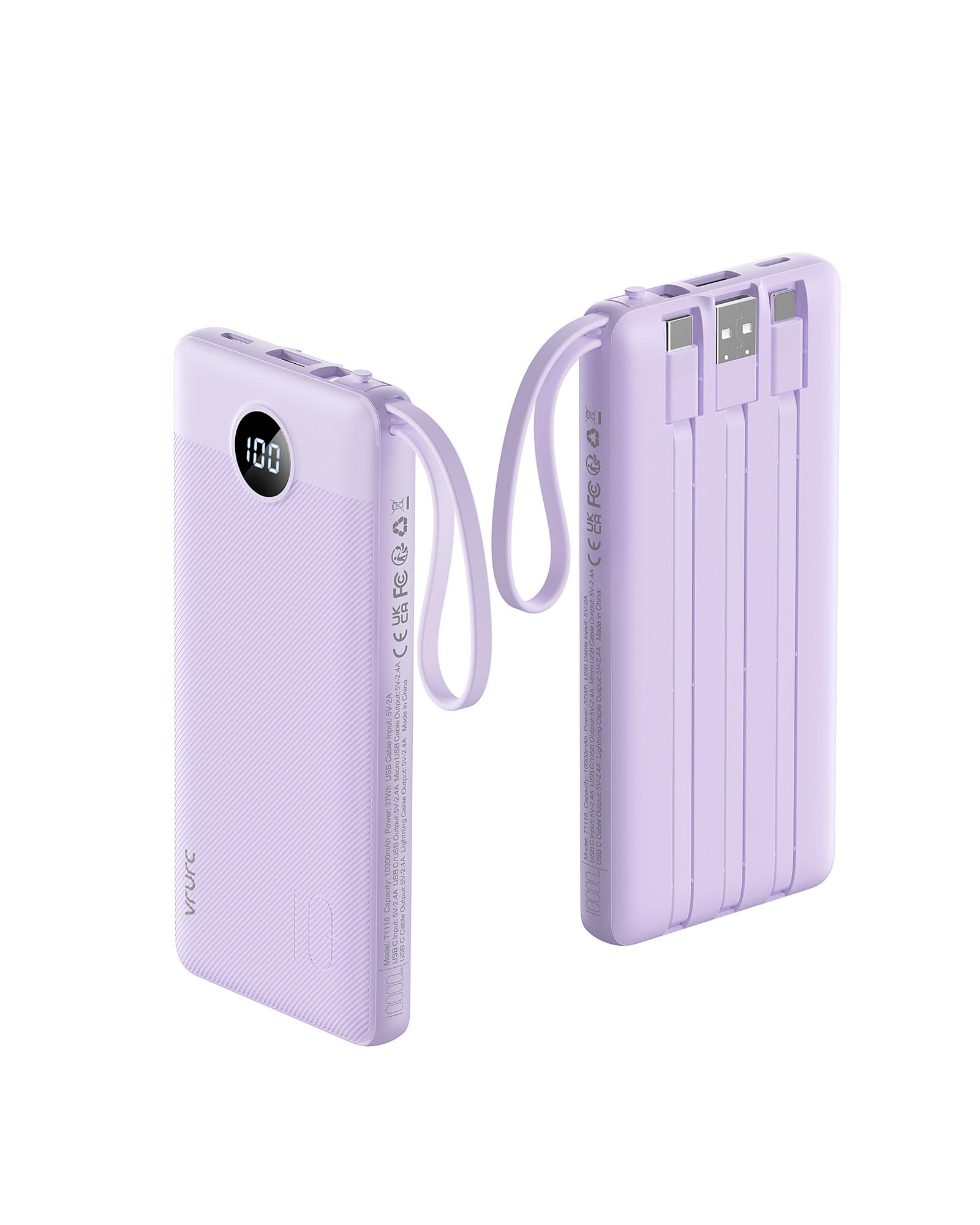
This is the least expensive pack we recommend, and the cables are where the money went. Four are built into the body — USB-C, Lightning, micro-USB, and a USB-A cord — which is as many as anything in this guide, and it means a family with mixed phones doesn’t need to pack a single cord.
The rest is sensible, and we think it’s the right set of priorities at this end of the range: 10,000mAh, five outputs, a percentage display, a lanyard that hangs it off a backpack strap, and a body 0.72 inches thick at 9.17 ounces. At 37Wh it clears airline carry-on rules with room to spare.
The catch is pace. It tops out at 2.4A, so plan on an overnight refill rather than a half-hour rescue, and treat it as the pack that rides in a purse all day and gets plugged in at the hotel. If you need a phone filled before a connection, spend a little more on the INIU P41.
Pros
- Four built-in cables
- Five outputs for mixed devices
- 0.72 inches thick, 9.17 ounces
- Percentage display
Cons
- Can stop holding a charge
The budget pick: four built-in cables and a slim 10,000mAh body for the least money here, as long as you charge overnight.
9. FancyBean 10,000mAh 2-Pack
Best for Two Travelers

Key Features
- Pack: 2 power banks
- Outputs: 4 (2 built-in cables, 2 USB-A)
- Capacity: 10,000mAh each
- Dimensions: 5.83 × 2.68 × 0.63 in
- Price: Budget
Two packs for close to what one of the single packs here costs is the whole pitch, and it’s a good one for couples or for anyone who has left a power bank plugged into a hotel wall. One rides in the bag, the other stays charged at home.
Each unit is 10,000mAh and 0.63 inches thick, with an iPhone cable and a USB-C cable built in plus two USB-A ports, so four things can charge at once. There’s a percentage display, airline-approved capacity, and a 3-year warranty covering both — the kind of coverage that makes a cheap pack a reasonable gamble rather than a throwaway.
What you trade is pace: this is a steady charger rather than a quick one. That’s the right trade for the job — one pack stays plugged in overnight while the other rides in a bag, so a slow fill never becomes your problem.
Pros
- Two packs for the price of one
- iPhone and USB-C cables built in
- 0.63 inches thick
- Three-year warranty on both
Cons
- Can stop taking a charge early
The value play for two travelers: a pair of 10,000mAh packs with built-in cables for about the price of one pack here.
How We Tested 14 Travel Power Banks
The shortlist started as a spreadsheet of roughly 40 banks, filtered down by wattage, port count, cable design, and whether each one clears the 100-watt-hour cabin limit. Anything that weighed more than we’d want in a personal item for a full travel day got cut, as did banks whose price didn’t match what they delivered. That left 14, which we bought ourselves so nobody was testing a hand-picked unit.
Each one then went into rotation for six months, riding along on flights, commuter trains, and weekend drives, and sitting on hotel nightstands where there is exactly one working outlet. We kept a running note of every time we reached for a bank and how much charge it actually moved.
Speed got measured rather than guessed: a stopwatch on a phone charging from 10 to 50 percent, and a half-hour laptop run on the banks rated high enough for it. For real battery life, we drained a phone from empty to full over and over until the bank quit, then counted the cycles — which is where the gap between printed capacity and delivered capacity showed up. We also weighed each bank on a kitchen scale and tried sliding it into a jeans pocket and a seatback pocket.
Built-in cables earned their own round of scrutiny: how many devices could charge at once without everyone fighting over one cord, whether the cable would reach a phone in a jacket pocket, and how the connector felt after weeks of bending. Durability was less scientific — a waist-high drop onto tile, then a few weeks loose in a bag with keys and a water bottle.
How to Choose a Travel Power Bank
The right travel power bank is the one whose capacity matches your longest day and whose weight you’ll still tolerate on day four; almost everything else is a detail you can settle afterward.
Match Capacity to the Trip
A 10,000mAh pack is a phone pack: expect roughly two charges, which covers a day of maps, camera, and messages. Step up to 15,000 or 20,000mAh when a tablet, a camera, or a laptop joins the trip, and to 25,000mAh only if you’re powering serious hardware away from outlets.
The trap is the headline number. That figure describes the cells, not what reaches your phone, so a 10,000mAh portable charger delivers noticeably less than 10,000mAh of charging. Buy by nights away, not by the biggest number you can afford.
Watts Decide What You Can Actually Charge
Output wattage, not capacity, tells you what a pack can do to a device. Around 20 to 22.5W fills a phone at a respectable clip; 45W does the same with room to spare and is the sweet spot for a pocket pack; 65W and up is laptop territory. Our top pick spreads 87W across three ports, so a laptop and a phone can share without either crawling.
Two cautions here. A port only delivers its rating to a device that negotiates it, and shared wattage drops when several things charge at once — so read the total as carefully as the per-port figure.
Built-In Cables or One You Own
Built-in cables are the biggest day-to-day convenience in this category: nothing to forget, nothing to untangle, and a four-cable pack like the Orfeika will charge nearly anything a group brings. The catch is that the cable is the first part to fail, and a fixed one can take the whole pack out of service.
If you plan to keep a pack for years rather than a season, a detachable cable is the safer design. The INIU P41 uses one, and replacing a cord beats replacing a battery.
Weight and Shape Decide Where It Lives
A pack under about 200 grams disappears into a jacket pocket; nine to thirteen ounces is a purse or backpack pack; anything near a pound is a deliberate carry you’ll notice by the second day. Thickness matters as much as weight — half an inch slips into a pocket, well over an inch does not.
Packs with built-in plugs or retractable cables pay for that convenience in bulk, and that’s usually a fair trade if the pack lives in a tote. Be honest about where yours will actually sit, then buy for that spot.
Frequently Asked Questions
Can you take a power bank on a plane?
Yes, in your carry-on and never in checked luggage. Under U.S. rules a lithium power bank up to 100Wh — roughly 27,000mAh — needs no special approval, which covers every pack here; anything larger requires airline permission. Keep it in the bag at your seat rather than the overhead bin so a screener or crew member can see it if asked.
How long does a power bank take to recharge?
Longer than most people expect. A 10,000mAh pack needs four to six hours on a standard wall charger, a 20,000mAh pack most of a night, and a 25,000mAh pack longer unless you pair it with a 100W-or-better charger. Plan on refilling overnight at the hotel, and if you’re changing cities every night, a pack with a built-in AC plug means one less brick to carry.
Do power banks lose capacity over time?
Yes — the lithium cells age whether you use them or not, and heat accelerates it. Store a pack around half charge rather than empty or full, keep it out of a hot car, and treat warranty length as a signal of how long the maker expects it to last. A pack that swells, gets hot while charging, or smells should be retired rather than used again.
Final Verdict
Our pick for most travelers is the Anker 20,000mAh 87W pack. It’s the one that covers a phone, a tablet, and a laptop without a separate charger, and the built-in cable means the thing you forget at home isn’t fatal.
Two alternatives earn their place on specific trips. If you’re packing light and outlets are the enemy, the AIFENG‘s foldable wall plug makes it the easier companion for a couple of nights away. If the laptop is the whole point and you want a smaller body, the INIU 65W does the same job at 4.3 inches.