This post contains affiliate links. We may earn a small commission when you buy through our links — at no extra cost to you.
Every umbrella works until the wind shows up. I’ve watched a cheap one turn itself inside out on a city corner in about four seconds, ribs first, and then walked the rest of the way with a bent spoke poking at my ear. What a real wind-and-rain umbrella buys you is a dry pocket of air that stays put and a frame that pops back into shape instead of giving up.
Size is the tradeoff nobody warns you about. The big vented canopies that shrug off gusts take a whole hand to carry, and the compact ones that vanish into a backpack need a stiffer frame to survive the same block. Over eight months, my team put 12 umbrellas through commutes, school pickups, dog walks in sideways rain, and one long, wet soccer season.
Weight, folded length, and how an umbrella closes one-handed at a car door matter as much as the wind rating on the hangtag. So does whether the fabric still looks presentable after a season in the trunk. The ones that made the list are the ones I’d still grab on a gusty morning.
Our Top Picks


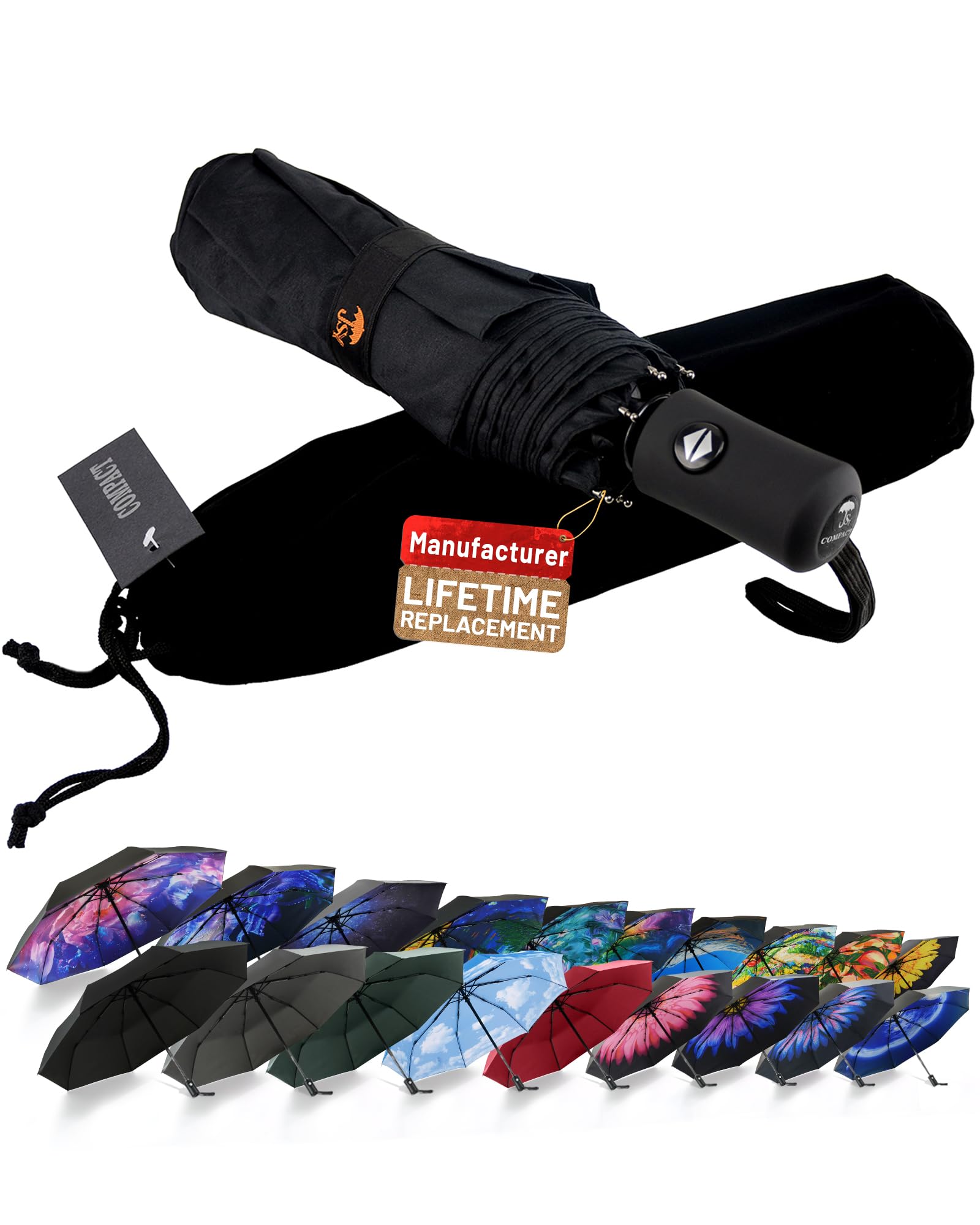
The Best Umbrellas for Wind and Rain, Reviewed
1. Royal Walk Large Stick Umbrella
Best Overall
Key Features
- Frame: 16 ribs
- Weight: 1.39 lb
- Canopy arc: 54 in
- Canopy diameter: 120 cm
- Price: Premium
Sixteen ribs is roughly double the count on most umbrellas here, and it’s the reason we recommend this one first for wind and rain. Every extra rib is another point where the canopy is pinned to the frame, so a gust has to work harder to fold a panel over. The shaft is aluminum with fiberglass where it needs to flex, the canopy is a 190T pongee that beads water, and the whole thing opens on a button.
Coverage is generous without turning into a sail. A 54-inch arc works out to a 120 cm canopy, enough for two people walking shoulder to shoulder and still narrow enough to angle into the wind. Closed, it’s 39 inches long and 0.63 kg, so it lives on a hook by the door or in the trunk of the car; it is not a bag umbrella, and we don’t pretend otherwise.
The curved wooden handle hooks over your forearm when you need a hand for keys, and the included sleeve has a shoulder strap for the walk to the office. The two-year replacement guarantee is the longest of any pick here, which matters more than it sounds: ribs and tips are what fail on an umbrella, and a maker that will replace them is answering the category’s real weak spot.
Where it stops is width. This canopy is smaller than the 62- to 68-inch golf umbrellas in this guide, so if you’re sheltering two adults and a bag of groceries, the ZOMAKE earns its place. For one person walking into weather with a shoulder bag, the extra ribs are worth more than the extra inches.
Pros
- 16 ribs hold the canopy against gusts
- 47-inch canopy covers two people walking close
- Two-year replacement guarantee
- Auto-open with a wooden crook handle
Cons
- Canopy narrower than the golf umbrellas here
We recommend it first for wind and rain: 16 ribs, a 47-inch canopy and a two-year replacement guarantee make it the sturdiest stick umbrella here for one or two people walking into weather.
2. ZOMAKE Golf Umbrella
Best for Two People
Key Features
- Size: Extra large, 2 person
- Canopy: Vented double canopy
- Opening: Auto open and close
- Price: Premium
Two adults and a child fit under the 68-inch version of this canopy, which is the kind of thing you notice at a rainy soccer game and not on a product page. The canopy is double-layered with a vent between the layers, so air that gets under the rim has somewhere to escape instead of lifting the whole umbrella. Open and close are both automatic.
It’s the umbrella we hand over when the whole family is walking somewhere together, and the venting is what keeps all that width from turning into a liability the first time the wind picks up. Closing is the part to learn. The button releases the canopy, but you still have to collapse the shaft, and the stiffest examples need a firm push against the ground with both hands.
This sits at the top of the price range in this group, and what you’re paying for is square footage rather than hardware. The canopy comes in bright yellow and burgundy as well as black, and the bright versions are easier for a driver to pick out at a crossing — a small thing that matters more than the pattern.
Pros
- Extra-large canopy shelters a whole family
- Vented double canopy lets gusts escape
- Automatic open and close
- Bright color options are easy to spot
Cons
- Ribs can snap in a hard gust
- Long and bulky when furled
Buy it if two people share an umbrella: the widest vented canopy here keeps a family dry, and the venting stops all that width from becoming a sail.
3. TUMELLA Compact Travel Umbrella
Best Compact
Key Features
- Weight: 14.5 oz
- Opening: Auto open and close
- Open canopy: 40.94 in
- Price: Midrange
Of the folding umbrellas here, this is the one we trust most in a crosswind. The canopy opens to about 41 inches, the frame is built around a one-button open and close, and at 14.46 ounces it doesn’t drag on your wrist the way a full-size umbrella does. It’s the compact that behaves most like a stick umbrella once it’s up.
The maker rates it to 100 mph, which we read as a ceiling rather than a promise. What earns the rating is the flex: the ribs give with a gust and spring back instead of kinking, so a canopy that turns inside out can usually be pushed back into shape by turning it into the wind rather than fighting it.
Closing is the friction point. The button releases the canopy but doesn’t retract the shaft, and the last few inches take a firm push from the top while you hold the base — practice it once in the dry rather than in a doorway with an armful of shopping.
The lifetime replacement offer is the detail that tips it for us. Compacts are the umbrellas people lose, sit on and break, and a maker that will replace one is offering something no canopy diameter can.
Pros
- Compact enough for a backpack pocket
- Flexible ribs spring back instead of kinking
- Lifetime replacement offer
- One-button open and close
Cons
- One-person canopy leaves a shoulder bag exposed
We trust this compact most in a crosswind — a 41-inch canopy, flexing ribs and a lifetime replacement offer in something that fits a backpack pocket.
4. totes Bubble Umbrella
Best for Visibility
Key Features
- Style: Stick umbrella
- Canopy: Clear dome
- Coverage: Head and shoulders
- Price: Midrange
The point of a bubble umbrella is the five seconds before you step off the curb. A clear dome lets you see the street and lets a driver see you, and the rim hangs at shoulder height, so rain that would normally cut under a flat canopy and hit your face runs off the outside instead.
That dome is what does the work in wind-driven rain, and it’s why we keep recommending it for city walking. It’s a one-person canopy on a stick frame, and the clear plastic is the feature — a black dome this size would be a much less useful umbrella.
We like it best for crowded sidewalks, school gates and the walk to the bus, where seeing the curb is worth more than another inch of coverage. It isn’t a gale umbrella: the frame is light and the dome presents a broad face to the wind, so we leave it home on an exposed bridge and take it on the ten-minute walk instead.
One daily annoyance worth knowing: the strap latch takes a firm push to close, and the canopy is stiff enough that you’ll do it with two hands rather than one.
Pros
- Clear dome lets you see traffic
- Dome rim shields the face from side-driven rain
- Generous head and shoulder coverage
Cons
- Legs get wet in driving rain
- Bulky to carry and store when wet
Choose it for crowded, rain-soaked crossings: the clear dome keeps your face dry and lets you see the curb, though your legs stay exposed.
5. G4Free Golf Umbrella
Best Lightweight Full-Size
Key Features
- Frame: Fiberglass
- Weight: 1.1 lb
- Opening: Auto open
- Canopy diameter: 68 in
- Price: Midrange
A 68-inch canopy normally comes with a wrist that aches by the end of the walk. This one is listed at 1.1 pounds, with a fiberglass shaft and ribs and a foam grip, and it’s the full-size umbrella here we don’t mind carrying for an hour.
What we like most is the ratio: a canopy that wide on a frame that light is unusual, and it’s what makes this the umbrella for a long walk to a game rather than a dash to the car. The button opens it one-handed, and the foam handle stays grippy in wet hands.
Two adults fit under it with room to spare, and it ships with a cover you can sling over a shoulder. The 210T pongee sheds water instead of soaking it, so a shake at the door is usually enough before it goes back in the sleeve.
The vent deserves a note of its own: the gap between the two canopy layers lets pressure equalize instead of building under the fabric, which is the mechanism that flips a lesser umbrella inside out. It doesn’t make this one storm-proof, but it buys you the second you need to turn your shoulder into the gust.
Pros
- Wide 68-inch canopy with room for two
- Light 1.1-pound frame for its size
- Vented double canopy bleeds off gusts
- One-year guarantee on ribs and tips
Cons
- Ribs can break in a hard gust
- Wide canopy is awkward in a crowd
We reach for this one on long walks: a 68-inch canopy at 1.1 pounds gives two people real coverage without a tired wrist.
6. SY COMPACT Travel Umbrella
Best Budget
Key Features
- Frame: 8 fiberglass ribs
- Weight: 10.9 oz
- Folded length: 11 in
- Canopy diameter: 38 in
- Price: Budget
This is the least expensive umbrella in this guide, and by a margin wide enough that it changes how you use one: buy two, park one in the car and one in a desk drawer, and stop carrying an umbrella you’d be sorry to lose.
What the money buys is a 38-inch canopy on an aluminum frame with eight fiberglass ribs, at 310 grams. It opens and closes on a button, and it folds to eleven inches, so it disappears into a backpack side pocket and stays there until it rains.
We think of it as the spare rather than the last umbrella you’ll buy. It’s the one for the car door pocket and the commute where an umbrella is a just-in-case item, and if it’s going to be your only umbrella, this isn’t the one to build a habit around.
Closing takes a firm push: put the tip on the ground and drive the runner up rather than fighting it in midair. The velvet sleeve is a nicer touch than the price suggests, and the auto-open button is genuinely handy when you’re getting out of a car.
Pros
- Folds to eleven inches for a bag
- Light 310-gram frame
- Eight fiberglass ribs on an aluminum frame
- Lowest price in this group
Cons
- Small canopy leaves shoulders exposed
- Button and ribs give out with heavy use
Buy it as a spare: eleven inches folded, light enough to forget, and the cheapest umbrella here — just don’t make it your only one.
7. Repel Windproof Travel Umbrella
Best for Backpack and Car
Key Features
- Style: Compact folding
- Opening: Auto open and close
- Wind rating: Up to 100 MPH, maker
- Price: Midrange
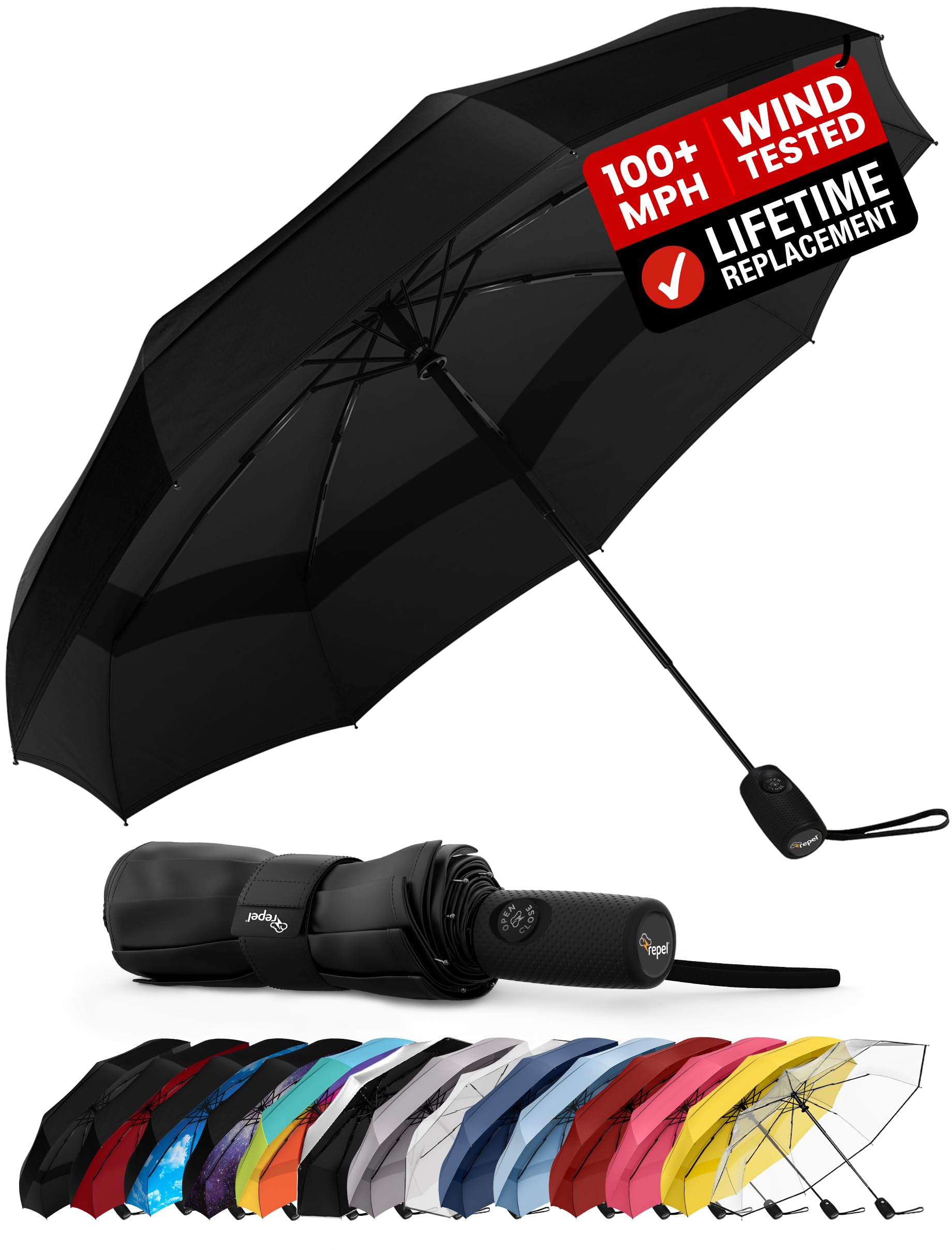
The button is loud and fast, and closing is where this one gets people: the canopy releases, but the shaft still has to be collapsed by hand, and the last inch takes a push. Do it against the ground with one hand on the handle and one on the top, and it stops being a fight.
Once it’s up, the canopy is wider than most folding umbrellas — wide enough that two people can share it in a pinch — and it still folds down to something that disappears into a backpack side pocket. That’s the balance it strikes: closer to a full-size umbrella overhead than the pocket size suggests.
The detail we didn’t expect: furled, the canopy traps the water inside, so it doesn’t drip down your leg or across a floor on the way in. In a wet hallway that’s the difference between a good umbrella and a puddle.
Our read is that the build is the reassuring part — a solid shaft, tidy stitching and a lifetime replacement offer — while the 100-mph figure in the listing is the maker’s rating rather than something we measured. The TUMELLA is the tougher frame in a crosswind; this one gives you more canopy for the same pocket.
Pros
- Wider canopy than most folding umbrellas
- Traps water inside when furled
- Lifetime replacement offer
- Fits a backpack side pocket
Cons
- Canopy can turn in a hard gust
- Heavier in the hand than basic compacts
We keep it in the car: a compact with a genuinely wide canopy, a lifetime replacement offer and a closing ritual you learn once.
8. SIEPASA Inverted Umbrella
Car Entry

Key Features
- Frame: 8 steel ribs
- Canopy: 49 or 56 in
- Handle: C-shaped
- Opening: Manual
- Price: Midrange
The handle is the whole idea: a frosted C-shape that crosses over your forearm so your hand stays free for a stroller, a phone or a bag of shopping. It’s the umbrella for the walk from the shop door to the car, and the handle hangs off your arm while you dig for keys.
The reverse fold is the second half of it. The canopy closes wet-side-in, so the water ends up inside the umbrella instead of on the car seat, and the eight steel ribs turn into legs that let it stand on its own in a doorway while you sort yourself out.
It’s manual rather than automatic: you push the runner up the shaft. That’s one more hand than an auto-open needs, but it’s also fewer springs and catches to break, and the 49- or 56-inch canopy is big enough for one person plus a bag.
Where we land: this is a convenience umbrella, built around getting in and out of a car dry, and there’s no wind rating claimed on it at all. If your walk is a driveway and a parking lot, it earns its spot; if it’s four blocks of open pavement, the Royal Walk is the one.
Pros
- C-shaped handle frees your hand
- Reverse fold keeps water off the car seat
- Stands on its own when closed
- 49- or 56-inch canopy for one person plus a bag
Cons
- Manual opening needs two hands
It’s the umbrella for the shop-to-car dash: the C-handle frees your hand and the reverse fold keeps water off the seat, not a gale pick.
How We Tested Wind and Rain Umbrellas
We started with a couple dozen listings and cut them down by the specs that actually change how an umbrella behaves: canopy arc, rib count and rib material, whether the canopy is vented, folded length, and listed weight. That left 12, which we used for eight months. There was no lab bench — just the weather we already had to walk through, plus a few errands scheduled on purpose.
Wind got the hardest test, on a stretch of open pavement where it funnels between buildings. We walked it with each canopy held at the same angle into the gust and noted whether it inverted, how far the ribs bent before they held, and whether the frame sprang back or stayed creased. Vented double canopies came out ahead, and the biggest sticks stayed steady enough to shelter a second person walking beside me.
Each umbrella got weighed on a kitchen scale and measured against a backpack’s side pocket. Opening and closing got timed one-handed with a coffee in the other hand, because that is how it happens at a door. The reverse-closing models got their own parking-lot test, since collapsing an umbrella into the driver’s seat without soaking it is a skill.
Durability showed itself over the months: wet storage in a car trunk, a few drops on pavement, one gust that bent a rib on a cheaper contender. We checked stitching at the canopy edge, the joints where ribs meet the shaft, and the tips that wear out first. Appearance and value we judged at the end, comparing how the fabric and handles had aged against what each one cost.
How to Choose an Umbrella for Wind and Rain
The umbrella that holds up in wind is rarely the one with the biggest canopy — it’s the one whose frame spreads the load and whose canopy lets some of the gust out.
Vents and Ribs Do Different Jobs
Two designs keep a canopy upright. A vented double canopy lets air pass through a gap near the top, which bleeds off the lift that flips an umbrella; a dense rib count spreads the load across more anchor points so no single panel takes the whole gust. The Royal Walk goes the rib route with sixteen, while the ZOMAKE and G4Free use vented canopies, and both approaches work. Material matters too: fiberglass ribs bend and spring back, while steel ones are stiffer and can take a permanent set. For an exposed walk, insist on one of the two approaches; for a few city blocks, either is plenty.
Match the Canopy to the Walk
A 38- to 42-inch canopy covers one person and a shoulder bag. A 47-inch canopy lets two people walk close together. The 62- to 68-inch golf umbrellas cover two adults plus gear, and they catch noticeably more wind and take up more pavement. Walk alone and a wide canopy is extra sail you have to hold onto; shepherd a child, a dog or a bag of groceries and the width earns its weight. Buy for the walk you actually take, not the one you imagine.
Stick or Folding, and Where It Lives
A stick umbrella runs about 39 inches closed, which rules out a backpack but suits a hook by the door or a car trunk, and a fixed shaft can carry more ribs than a folding frame. A folder closes to 11 or 12 inches and lives in a bag, at the cost of some rigidity. The trap is the word compact: it describes the folded shape, not the weight. A 14-ounce folder still pulls at your wrist after twenty minutes, and a 40-inch canopy on a folding frame is still a lot of umbrella to hold in a gust.
Open, Close, and Carry
Automatic opening earns its keep when you’re stepping out of a car in the rain. Automatic closing promises more than it delivers: the button releases the canopy, but the shaft still collapses by hand, usually against the ground. If that ritual will annoy you every time, a manual umbrella is simpler and has fewer parts to break. Handle shape matters more than shoppers expect — a C-handle frees your hand, a wooden crook hangs on your arm while you find keys, and a straight foam grip is the steadiest thing to hold when the wind is pulling.
Pay for the Frame, Not the Print
Ribs, tips and the runner are what fail; the fabric almost never does. That’s why a two-year replacement guarantee or a lifetime replacement offer is worth more than a nice pattern, and why a low price is best read as a reason to buy a second umbrella rather than your only one. Between two umbrellas you like equally, take the one whose frame you can describe without opening the listing.
Frequently Asked Questions
Can I take an umbrella in a carry-on?
Folding ones, yes. Carry-on bags are capped at roughly 22 inches, so an 11-inch compact like the SY COMPACT disappears into a backpack, while a 39-inch stick umbrella won’t go in the cabin at all — it rides in the trunk or a checked bag. Traveling with only a personal item? Take the smallest folder you own and accept a one-person canopy.
How should I dry a wet umbrella?
Open it fully and let it dry that way, handle down, before you furl it again. Trapped moisture is what rusts steel ribs and sours the fabric, and a sleeve or a car trunk is the worst place for a wet umbrella to spend a week. A shake at the door removes most of the water; the rest needs air, not a towel.
Does an umbrella protect me from lightning?
No. An umbrella is a small object held above your head, and it offers no lightning protection at all. If you can hear thunder, you’re close enough to be at risk — get into a building or a hard-topped vehicle instead of walking out the storm under a canopy.
Final Verdict
If you want one umbrella for weather that pushes back, the Royal Walk is the pick. Sixteen ribs, a 47-inch canopy and a two-year replacement guarantee come closer to insurance against a gust than anything else here, and the fixed shaft is what lets it carry all that.
It is a stick, so it lives by the door rather than in a bag. If the umbrella has to disappear into a backpack, the TUMELLA is the compact we trust: it folds small, holds its shape in a crosswind and comes with a lifetime replacement offer.