This post contains affiliate links. We may earn a small commission when you buy through our links — at no extra cost to you.
Packing for four days in a carry-on is a puzzle with real stakes: the airline’s sizing frame, an overhead bin that’s already full, and three nights of living out of a bag. I spent years rolling clothes into tight cylinders, then digging through the same collapsed pile every morning. The first time I zipped my things into separate cubes, unpacking went from a search to a glance.
Packing cubes aren’t interchangeable, though. A compression cube’s second zipper can flatten a week of clothes into a few inches, but on a cheap set that’s also the first thing to fail, and a mesh panel is the difference between spotting a clean shirt and dumping the whole bag onto the bed. We’ve spent four months with 14 sets, and the gaps in capacity, durability, and value showed up fast.
The ones worth buying aren’t the ones with the longest feature list. They’re the ones whose zippers still glide and whose seams still hold after a few dozen zip-ups, and whose shapes actually fit the footprint of a carry-on. The picks below are grouped by how they’re best used, so you can head straight to the one that matches the way you travel.
Our Top Picks


The Best Packing Cubes for Carry-Ons, Reviewed
1. Shacke 5-Set Packing Cubes
Best Overall
Key Features
- Pieces: 5 (4 cubes + laundry bag)
- Material: Water-resistant nylon
- Cube sizes: 11 × 6.75 in to 17.5 × 12.75 in
- Set weight: 1.1 lb
- Price: Midrange
Cross-stitched sidewalls are the reason this set is our top pick. Most cubes bow outward the moment you fill them, which turns a suitcase into a pile you have to dig through; the Shacke cubes keep a squared-off box shape, so they stack on each other and slide in and out without collapsing. It is a small construction detail that changes how a carry-on behaves on the fourth day of a trip.
The size mix is built around a 22-inch bag. The extra-large cube measures 17.5 by 12.75 inches, close to the floor of a carry-on, so it works as a base layer; the large, medium, and small cubes fill the space above it, and the small one is the right home for socks and underwear. The nylon is water-resistant, which matters less in rain than for the shampoo that leaks on the way home, and the included laundry bag handles the last day.
Durability is where this set separates from the cheaper ones here. The seams and the reinforced sides are the best-supported of the standard cubes in this group, and the zippers run the full length of each cube so you can open one flat and pack it like a drawer. At 1.1 pounds for all five pieces, it takes very little out of an airline’s weight allowance.
What it does not do is compress. If your carry-on has to hold a week of clothes and nothing else, the Veken nine-piece set will buy you more room. What the Shacke set buys instead is structure: cubes that behave like drawers, in a bag that has no drawers.
Pros
- Cubes hold a box shape when full
- Four sizes cover a carry-on floor
- Water-resistant nylon shrugs off spills
- Light at 1.1 pounds for five pieces
Cons
- No compression zippers
We recommend this set to most carry-on packers: the cubes stay square, stack instead of slumping, and outlast the cheaper options here.
2. Veken 9-Set Compression Packing Cubes
Best for Compression
Key Features
- Pieces: 9
- Set weight: 1.5 lb
- Suitcase fit: 20 to 34 in
- Compression cubes: 4 (S to XL)
- Price: Midrange
The second zipper does the work. Load a compression cube, close the main zip, then run the outer zip around the cube and it flattens — fleece, sweaters and other soft, bulky layers lose most of their air, and the bag closes without a knee on the lid. Four of the nine pieces are compression cubes, small through extra large, and the set is sized for bags from 20 to 34 inches.
Nine pieces sounds like more than a carry-on needs until you count them: tops in one cube, bottoms in another, underwear and socks in the small one, the bulky layer compressed flat, then the shoe bag and the laundry bag. That is why we reach for this set on long trips in small bags. It weighs 1.5 pounds, a little more than the Shacke set, and the extra zippers are where that weight goes.
The mesh windows are the part to watch. Compression puts real strain on the panel where it flexes, and a torn window is the failure that turns up on these cubes. Leaving a cube slightly under full and pulling the compression zip slowly keeps the load off the mesh. Otherwise the value is straightforward: four compression cubes plus the extras for less than the premium compression sets here.
Pros
- Four compression cubes, small to extra large
- Sized for 20 to 34 inch suitcases
- Shoe, laundry and toiletry bags included
- Full mesh panels show contents
Cons
- Mesh windows can tear under compression
- Heavier than the standard sets here
We pick this set when space is the problem: four compression cubes that flatten a week of soft clothes enough to shut a carry-on.
3. Amazon Essentials 4-Piece Packing Cubes
Best Budget
Key Features
- Pieces: 4
- Material: Polyester with mesh top
- Cube size: 11 × 6.75 × 3 in
- Set weight: 2.5 oz
- Price: Budget
This is the least expensive set we recommend, and the one we suggest to anyone who has never used a packing cube. Four cubes, each 11 by 6.75 by 3 inches, with a mesh top so you can see what is inside without opening them. They are small by design: these are the cubes for socks, underwear, undershirts and charging cables, the loose small stuff that turns a suitcase into a mess by day two.
Because they are small, they go where bigger cubes cannot — the end pocket of a duffel, the top compartment of a travel backpack, a tote for a weekend. The double zipper pulls are a nice touch at this price, and the set is the same product that used to sell under the Amazon Basics name, so nothing changed but the label.
Pros
- Lowest price of the sets we recommend
- Mesh top shows contents at a glance
- Double zipper pulls on every cube
- Fits duffels, totes and backpacks
Cons
- No large cube for bulky clothes
- Seams can give out when overpacked
Our budget pick: a four-pack of small mesh cubes for socks, tees and cables, and the least expensive way to try packing cubes at all.
4. BAGAIL 6-Set Compression Packing Cubes
Best Value Compression
Key Features
- Pieces: 6
- Material: 320D polyester
- Cube size: 13.75 × 12.75 × 4.5 in
- Compression: Middle-zip slider
- Price: Budget
If the Veken set is the one that goes in the bag when a week has to fit, this is the version for anyone who does not want to pay for it. Both are compression sets; the BAGAIL has six pieces instead of nine and costs noticeably less, and the 320D polyester is denser than the price suggests.
The mechanism is different too. BAGAIL puts the compression slider in the middle of the cube rather than on a second full-length zip: fill the cube to no more than two-thirds, close the main zipper, then put a finger behind the middle slider and pull. Done that way it flattens smoothly; overfill it and the compression zip binds, which is the one technique this set asks of you.
Six cubes is a better match for a carry-on than nine, and the fabric is what surprised us — the 320D polyester feels closer to the premium sets than to the budget ones. On soft clothes the middle zip takes out enough air to matter, and it is our value pick among the compression sets here.
Pros
- Dense 320D tear-resistant polyester
- Middle-slider compression closes evenly
- Six pieces at a low price
- Two-way zippers throughout
Cons
- Compression barely affects stiff fabrics like denim
Our value compression pick: a dense 320D fabric and a middle zip that flattens soft clothes for less than the premium sets.
5. TRIPPED Travel Gear Compression Cubes
Best for Backpack Travel
Key Features
- Pieces: 6
- Material: Ripstop nylon
- Cube size: 14 × 10 × 4 in
- Set weight: 11.8 oz
- Price: Premium
Under twelve ounces for six pieces is what sells this set to anyone carrying the bag on their back rather than rolling it. The cubes are ripstop nylon with a water-resistant coating, the compression zippers are double-stitched and reinforced, and nothing here is stiff enough to fight a soft-sided backpack.
The shapes are the giveaway that someone thought about carry-on travel: a sleeve for swimwear or underwear, small cubes for t-shirts and activewear, large ones for jackets and jeans. We like it best in a travel backpack, where a stiff 16-inch cube is a nuisance and a compressible 14-inch one disappears into the load.
One thing to know before you pay for it. The compression zippers take the strain when a cube is packed tight, so leave some slack and pull the second zip slowly rather than forcing it past a bulge. That is the difference between a set that lasts and one that gets retired after a season.
Pros
- Under 12 ounces for the whole set
- Ripstop nylon with water-resistant coating
- Shapes sized for a travel backpack
- Double-stitched, reinforced compression zips
Cons
- One of the two priciest sets here
We recommend this set for backpack carry-on travel: light ripstop cubes that compress into a soft pack instead of fighting it.
6. LeanTravel 6-Pack Compression Cubes
Best Premium
Key Features
- Pieces: 6
- Material: 300D polyester
- Cube size: 16 × 12 × 4 in
- Compression: Dual-zip, up to 75%
- Price: Premium
LeanTravel advertises up to 75 percent compression, and the mechanism is the most aggressive in this group: a second zip that pulls a loaded cube down from about four inches thick, with reinforced piping around the sides so the cube stands up while you load it. A second zip this stiff needs a slow, even pull once the cube is full — rush it and it fights back.
The build is why it costs what it does. 300D polyester, SBS zippers, a mesh top you can read through, and stiffened edges that make the cube closer to a drawer than a bag. Load it, zip it, and the whole thing holds its rectangle instead of bulging into the space next to it.
For a heavy packer on a carry-on-only trip, this is the set that earns its keep at the check-in counter. For everyone else it is more than the job requires — a standard set from Shacke, or a cheaper compression set from BAGAIL, does most of the same work without the fussier zip.
Pros
- Second zip compresses deeper than any set here
- Reinforced piping keeps cubes upright
- 300D polyester with SBS zippers
- Mesh tops for quick identification
Cons
- At the top of the price range here
For heavy packers flying carry-on only: the deepest compression here, with sides stiff enough to pack like drawers.
7. Veken 8-Set Packing Cubes
Best for First-Time Cube Buyers

Key Features
- Pieces: 8 (4 cubes + 4 bags)
- Set weight: 1.2 lb
- Load capacity: 30 lb
- Listed cube size: 8.7 × 6.7 × 3.5 in
- Price: Budget
Most sets throw in a laundry bag and stop there. This one adds a hanging toiletry bag with four compartments, a shoe bag, a laundry bag and a small accessory pouch, which makes it the set to buy if you are starting from nothing and do not want to shop for a dopp kit separately.
The four cubes are standard rather than compression, with buckle straps on the extra-large and large ones so you can cinch a full cube tighter. Load capacity is listed at 30 pounds, well beyond anything a carry-on should weigh, and at 1.2 pounds the set barely touches a weight allowance.
The toiletry bag is the piece we appreciate most: it hangs from a hook, which matters in a hotel bathroom with a shelf the size of a paperback. Everything else is competent rather than special — the cubes organize, the mesh tops let you see in, and the zippers are two-way.
Buy it for the bundle. If you already own a toiletry kit and a shoe bag, a simpler set does the same work for less money; if you are assembling a travel kit from scratch, this one covers the whole suitcase in one order.
Pros
- Includes a hanging toiletry bag
- Buckle straps on the two biggest cubes
- Eight pieces cover shoes and laundry
- Light at 1.2 pounds for the set
Cons
- Shoe bag only fits small shoes
- Cubes run small for the stated size
The set we hand to first-time packers: four cubes plus a hanging toiletry bag, shoe bag and pouch in a single purchase.
8. OlarHike 10-Set Compression Packing Cubes
Best for Long Trips
Key Features
- Pieces: 10
- Material: Tear-resistant polyester
- Set weight: 1.9 lb
- Compression cubes: 4 (S to XL)
- Price: Midrange
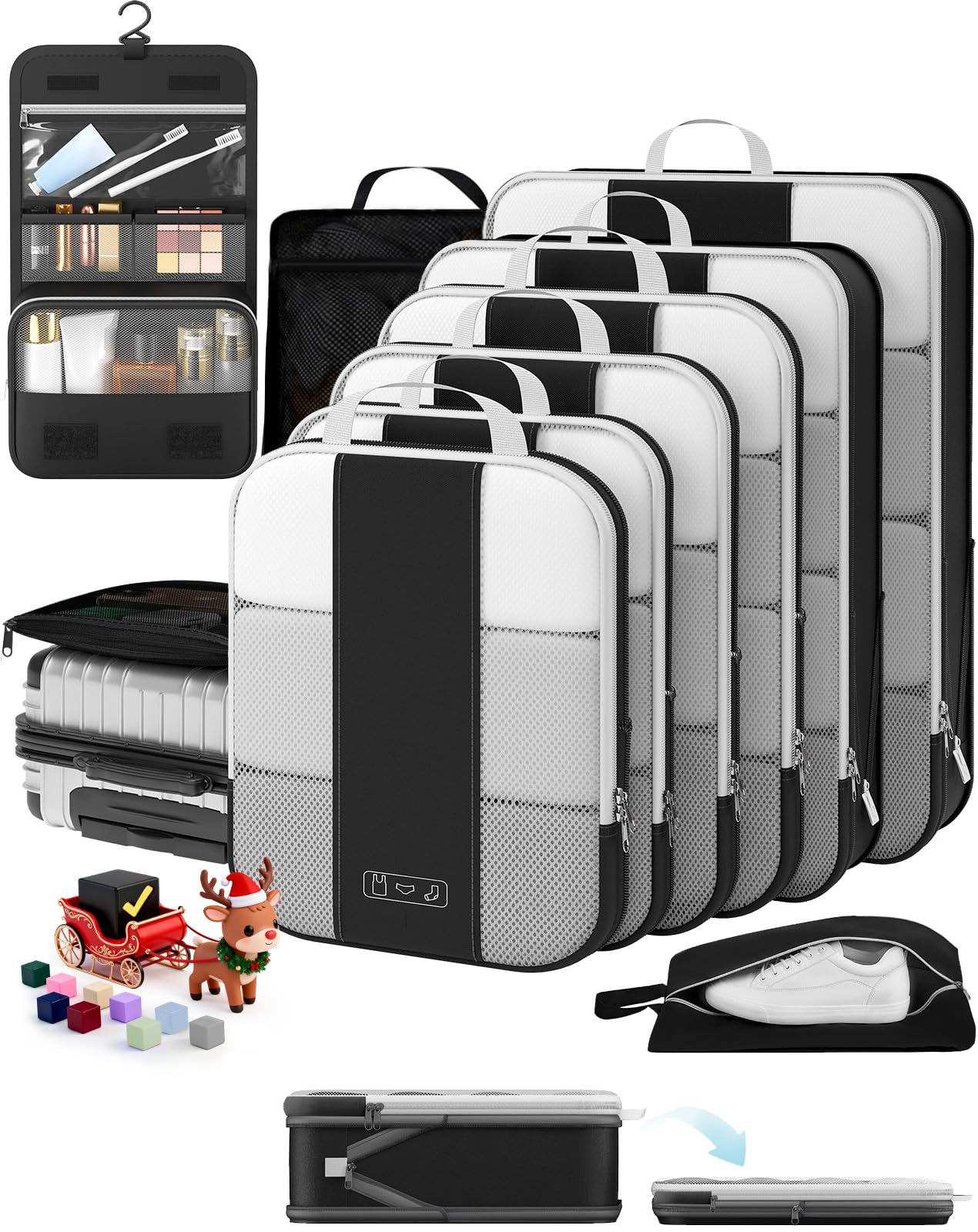
Ten pieces is the biggest set on this list, and four of them are compression cubes in extra large through small. The compression runs on the same principle as the Veken set — an outer zip flattens a loaded cube — and a full mesh panel lets you see what is inside before you unzip anything.
The fabric is the upgrade. High-density, tear-resistant polyester with reinforced stitching, at 1.9 pounds for the set. That is heavier than the other compression sets here, and we think the weight is where the durability comes from.
It is also the set that crosses over to home use. Between trips the cubes fit drawers and shelves, and the mesh front makes them serviceable for off-season clothes, which is more than most packing cubes manage.
If you want the most pieces and a set that keeps earning its place between trips, this is a sensible buy. If compression is the whole reason you are shopping, the Veken set compresses better with fewer pieces to lose in a hotel room.
Pros
- Ten pieces, four of them compression cubes
- High-density, tear-resistant polyester
- Full mesh panel for visibility
- Works as drawer storage between trips
Cons
- Compression is modest on bulky items
- Accessory bags are very small
We like this set for travelers who want their cubes to keep working at home: ten pieces, four of them compressible.
How We Tested Carry-On Packing Cubes
We started with the sets that kept surfacing in customer reviews and in the travel forums where frequent flyers compare notes, then narrowed to 14 that covered the real spread of the category: plain cubes, compression cubes with a second zipper, mesh-topped and solid-panel designs, and set sizes from four pieces up to ten. Brands ran from budget no-names to the ones road warriors recommend by name. Every set got four months of actual use, not a single trial trip.
Each one was packed for a genuine trip: three to five days in a 22-by-14-by-9-inch carry-on, a long weekend in a travel backpack, and one deliberately overstuffed checked bag for a family visit. I counted how many rolled shirts, folded pants, and socks each cube actually swallowed before the zipper strained, closed the suitcase, and then judged whether the compression zip bought real inches or just squeezed the contents into a brick that wrinkled everything inside. After each trip I unpacked into drawers and noted what arrived creased, damp, or smelling like the dirty laundry bag it had been sitting next to.
Durability came down to repetition. Every zipper on every cube was opened and closed 30 times in a row while I watched for snags, skipped teeth, and pull tabs that bent instead of pulling. I filled each cube and lifted it by a single handle to see whether the stitching held, and I set a damp towel against the water-resistant panels for ten minutes to check whether moisture wicked through to the clothes underneath. We also weighed each empty set on a kitchen scale, since a few ounces per cube adds up when you’re carrying four of them.
The pattern held across the whole group: the sets that stayed useful were the ones with a zipper that felt solid in the hand and a shape that matched how a carry-on is actually packed. Price rarely predicted it.
How to Choose Packing Cubes for a Carry-On
The set that ruins a carry-on is the one whose biggest cube is an inch too wide for the bag’s floor, not the one with the cheaper zipper.
Start With the Largest Cube, Not the Piece Count
A standard carry-on gives you roughly 19 to 20 inches of usable floor by about 13 inches wide, and the biggest cube in a set is what decides whether that set works. A 17.5-by-12.75-inch cube, like the extra-large in the Shacke set, becomes a base layer with everything else stacked on top. A 16-by-12-inch cube leaves a strip down one side for shoes. A pack of small cubes organizes the loose items and leaves the bulky clothes to float.
Do the arithmetic before you buy: measure your bag’s interior, then add up the two or three cubes you would actually use side by side and check that total against the floor. This is where the word compact trips people up — it describes how a set packs down empty, not whether the loaded cubes tile the inside of your specific bag.
Decide Whether You Actually Need Compression
Compression cubes use a second zip to pull a loaded cube flatter. They earn their keep on soft, bulky layers — fleece, sweaters, knitwear — and do very little for denim, shoes, or anything already dense. The extra zip adds weight and one more component that can bind, so a standard set with structured sides packs more predictably if your clothes are mostly t-shirts and rolled casual wear.
If the carry-on has to hold a week, compression buys real room, and it is worth paying for. Just go in knowing that compression sets weigh more than standard ones and that the zip only works when the cube is underfilled by a comfortable margin.
Look at the Zippers and the Mesh Before Anything Else
Zippers and mesh windows are what fail first on a packing cube, because they flex every time the bag is compressed or thrown into an overhead bin. Look for two-way pulls, stitching that runs past the corner rather than stopping short, and a compression zip reinforced where it meets the side panel. Reinforced piping around the edges is the other detail worth money, since it is what keeps a full cube square instead of bulging.
Then pack to the cube’s usable capacity rather than past it. An overfilled compression cube puts the whole load on the second zip, and that is the failure worth designing around.
Treat the Extras as a Bonus, Not a Reason
Big sets sell on piece count, and the pieces padding that number are usually the smallest ones: the shoe bag that fits a pair of flats, the accessory pouch, the laundry bag. Count cubes against bags and buy for the cubes. These packing organizers are doing their job when the cubes tile the suitcase, not when the set has the longest list on the box.
Extras are worth real money only if you do not own them yet. The Veken eight-piece set replaces a dopp kit and a shoe bag in a single order, which is a genuine saving for a first-time buyer and dead weight for someone who already travels with both.
Frequently Asked Questions
Do packing cubes count toward my carry-on weight limit?
Yes. The set flies with you, so its weight comes out of your allowance, and the sets here run from a couple of ounces for four small cubes to nearly two pounds for a ten-piece compression set. On an airline that weighs cabin bags, that is a real slice of the budget.
Weigh the packed set once before your first flight with it. If you are close to the limit, move to a lighter standard set and leave the compression cubes home.
How do you clean packing cubes?
Hand wash and hang dry is the routine that works for nylon and polyester cubes; Travel Wise states it outright for its set, and it is the safe default for the rest. Empty them, wipe spills with a damp cloth, and let them air dry completely before the mesh goes back in a drawer.
Skip the dryer. Heat is what damages the water-resistant coating and the zipper tape, and a cube that dries stiff never quite recovers its shape.
Will packing cubes keep my clothes wrinkle-free?
Partly, and folding decides most of it. A structured cube holds shirts flat and stops them shifting, which does more against creases than any compression zip. Roll casual clothes for compression cubes, and fold dress shirts into the largest standard cube you own with the collar at the top edge so nothing presses on it.
Over-compressing a linen shirt or a blazer will crease it in any cube. If wrinkle-free matters more than space on a given trip, pack those pieces in a standard cube and compress everything else.
Final Verdict
The Shacke five-piece set is the one we point most carry-on packers to. The cubes hold their shape, so they stack like drawers in a bag that has none, the four sizes cover a 22-inch case from floor to lid, and the construction is the strongest of the standard sets here.
If space is the specific problem, the Veken nine-piece compression set flattens a week of soft clothes far enough to shut the bag. The BAGAIL six-piece does a similar job with fewer pieces and a denser fabric if nine cubes is more than you need.