This post contains affiliate links. We may earn a small commission when you buy through our links — at no extra cost to you.
The gate agent’s metal sizer is the smallest piece of furniture in the airport and the one that decides your trip. I’ve watched a stranger unzip a week of clothes onto the carpet because a bag that measured fine at home didn’t measure fine at the gate. A good carry-on backpack keeps you out of that line and keeps your hands free.
Capacity is where marketing runs ahead of reality: two 40-liter bags hold wildly different amounts depending on how the seams are cut. My team and I spent six months packing 12 of these — slim personal-item styles up to expandable 50-liter models — through weekend flights, a ten-day trip, and the morning commute.
One thing worth knowing: expansion zippers are a trap half the time. A bag that grows from 40 to 50 liters helps on the return leg and won’t clear the sizer on the way out. What earns its space is a real shoe compartment and a quick-access pocket you can reach while the bag is wedged under the seat. The picks below are the ones that got that right.
Our Top Picks



The Best Carry-On Backpacks, Reviewed
1. LOVEVOOK 40L Travel Backpack
Best Overall
Key Features
- Weight: 2.2 lb
- Capacity: 40 liters
- Included: 3 packing cubes
- Dimensions: 8"D x 14"W x 18"H
- Price: Midrange
Three packing cubes come in the box — two flat pouches and a shoe bag — and that is the detail that turns this 40-liter bag into a system rather than a sack. The frame underneath is the real argument, though: 18 by 14 by 8 inches is the box Spirit and Frontier use for a free personal item, and this bag is cut to it.
We think it’s the best all-around pick here because it gets both halves of the job right. The main compartment opens flat like a suitcase lid, four compartments and 18 pockets separate clothes from cables from a damp swimsuit, and the padded laptop sleeve takes a 17-inch machine without borrowing room from the packing side.
At 2.2 pounds empty it’s one of the heavier bags in this group, and that weight buys heavyweight, tear-resistant nylon instead of a thin shell. The care label says dry clean only, which nobody follows on a travel backpack; a damp cloth and mild soap is what this actually needs.
The trolley sleeve is the quiet win — the bag slides down over a rolling case handle and stays there through a terminal instead of slipping off a shoulder every thirty steps. The wet pocket is a separate lined compartment, too, so a damp swimsuit doesn’t wick into the laptop sleeve on the flight home.
Pros
- Three packing cubes included
- 18 x 14 x 8 footprint clears strict sizers
- Suitcase opening with four compartments
- Padded 17-inch laptop sleeve
Cons
- 2.2 lb empty is heavy for 40 liters
It’s the one we hand to anyone flying carry-on only: 40 liters in an 18-by-14-by-8-inch frame, a suitcase opening, and three packing cubes in the box.
2. tomtoc Navigator-T66 40L
Best Built
Key Features
- Weight: 1,200 g
- Capacity: 40 liters
- Dimensions: 9"D x 12.99"W x 20.47"H
- Laptop fit: Up to 17 inches
- Price: Premium
The zippers are why this one costs what it does: YKK hardware throughout, on a shell woven from recycled PET bottles and finished without PFAS. We think it’s the best-built bag in this group, and it’s the one that looks most at home in an airport lounge — matte black, no dangling straps, nothing that reads as a hiking pack.
Forty liters spreads across seven compartments, and the layout is the clever part. The laptop section unzips and lies flat at up to 180 degrees so you can send it through security without pulling the machine out, and the quick-access front pocket opens straight into the main bag, which means a charger is reachable without unpacking the top half.
The body is 12.99 inches wide, narrower than most here, and that is why it carries so well on a crowded platform — though it does mean bulky items have to go in lengthwise and a fully stuffed cube needs persuading before it sits flat. At 1,200 grams empty it’s the heaviest bag we’re covering, and that is the price of the fabric and the hardware.
Pros
- YKK zippers on recycled fabric
- Laptop section opens flat to 180 degrees
- Front pocket reaches the main compartment
Cons
- 20.47-inch length can pinch under a seat
We point people here when the bag has to survive a year of business travel: YKK zippers, a recycled-fabric shell, and a laptop section that lies flat at security.
3. Taygeer 35L Travel Backpack
Best Budget
Key Features
- Weight: 1.74 lb
- Capacity: 35 liters
- Dimensions: 7"D x 11"W x 16.8"H
- Laptop fit: Up to 15.6 inches
- Price: Budget
Empty, this bag weighs 1.74 pounds. That is the number to start with, because a 35-liter pack you can carry all day is a different proposition from a 45-liter one you resent by the second terminal.
Taygeer gets the travel mechanics right for the money: a 180-degree zipper that opens the bag flat, a bonus shoe bag that keeps dirty soles away from clean shirts, a lined wet pocket, and two padded handles so it can be carried like a tote when the straps are off your shoulders. The 15.6-inch laptop sleeve is separate from the main compartment, and at 16.8 by 11 by 7 inches the whole thing sits comfortably inside a personal-item sizer.
The maker rates the load at 10 kilograms, or 22 pounds, and on a bag this light that is a number to respect: 35 liters is a long weekend, not a fortnight, and packing to the rating keeps the weight advantage that made you buy it in the first place. It’s the bag we hand to someone who flies a few times a year and wants to stop paying bag fees.
Pros
- 1.74 lb empty
- Shoe bag and lined wet pocket included
- Two padded handles for tote carry
- 16.8 x 11 x 7 fits under a seat
Cons
- Lightweight shell and seams are the weak point
Under two pounds empty, 35 liters, and a footprint nobody at the gate argues with — this is our budget pick for the occasional flight.
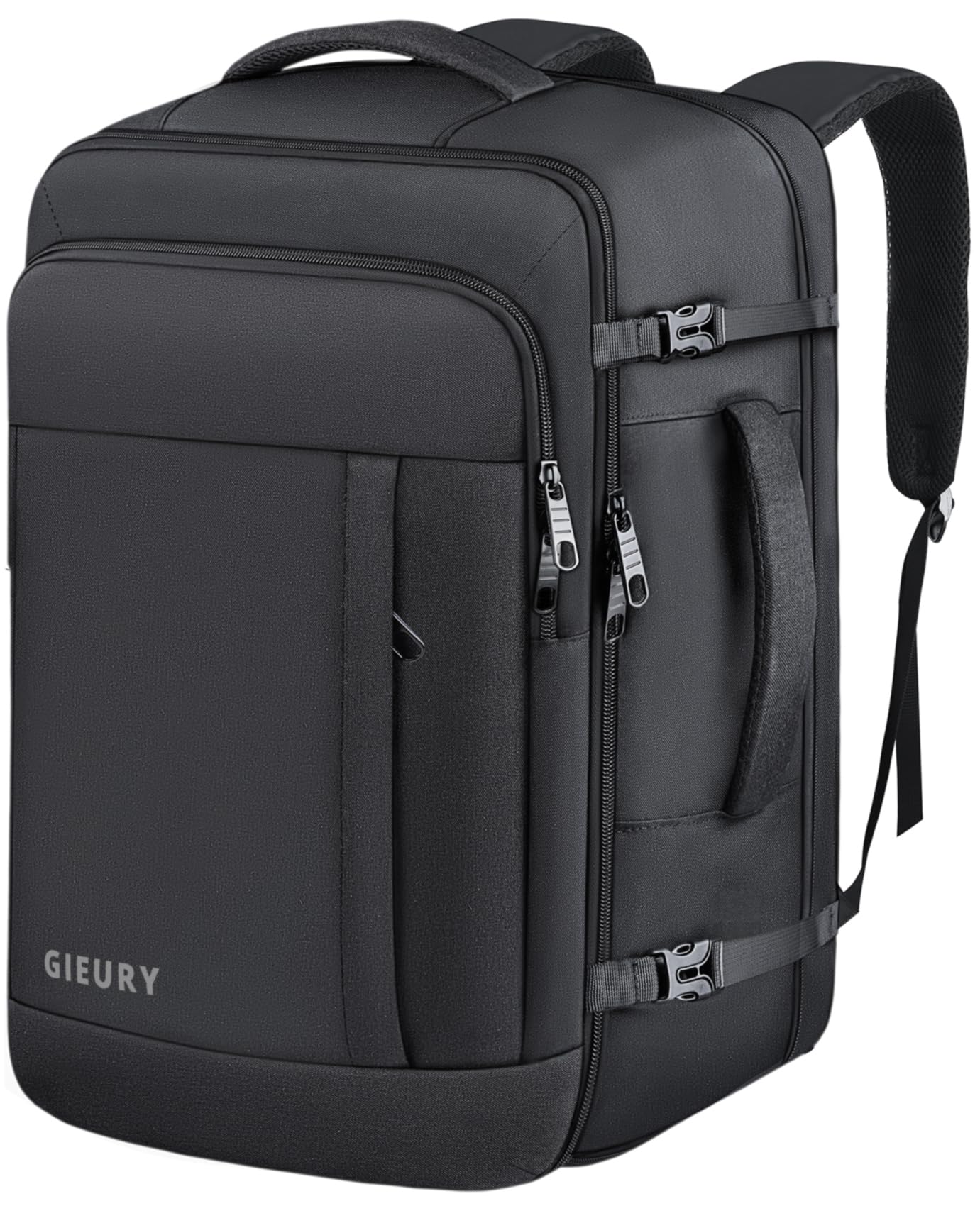
4. Gieury 50L Carry On Backpack
Best for Long Trips
Key Features
- Capacity: 40 liters, expands to 50
- Dimensions: 8"D x 14"W x 20"H
- Laptop fit: Up to 17.3 inches
- Shoe compartment: Fits sizes 5-12
- Price: Midrange
A zip runs around the middle of this bag and buys it another ten liters on demand, taking it from 40 to 50 when the trip home includes souvenirs. That single feature is the argument for it.
Everything else is competent: a lay-flat laptop section that opens to 180 degrees for a 17.3-inch machine, dual-zip access to the main compartment, seven pockets across seven compartments, and water-repellent fabric with reinforced stitching. The shoe well in the base takes a size 5 to 12 and does double duty for toiletries or anything damp.
A bottom shoe well always costs main-compartment depth, and this one is no exception — on a five-day pack you will feel it. Otherwise the layout is sound: the laptop section lies flat and stays on its own side of the bag rather than pressing into your clothes.
For a week without a checked bag, it does more work than anything else in this group for the money. Just go in knowing you are buying volume rather than a hiking harness: the straps are padded and the back panel is ventilated, but this is a bag you set down at the gate rather than wear for an hour.
Pros
- Expands from 40 to 50 liters
- Bottom shoe compartment fits sizes 5-12
- Lay-flat 180-degree laptop section
Cons
- Too big for a personal-item sizer when expanded
- Zippers are the wear point on a full bag
The one to take when a week of clothes has to fit and you refuse to check a bag: 40 liters that unzip to 50, with a shoe well in the base.
5. HOTOR 26.5L Travel Backpack
Best Ultralight Personal Item
Key Features
- Weight: 1.2 lb
- Capacity: 26.5 liters
- Dimensions: 7.9"D x 11.8"W x 17.3"H
- Laptop fit: Up to 15.6 inches
- Price: Budget
At 26.5 liters and 1.2 pounds, this is the smallest and lightest bag we’re recommending, and for a certain kind of trip that is the entire point: it is a personal item, not a carry-on, sized at 17.3 inches tall and just under eight inches deep, which is what an under-seat space actually measures.
It still packs like a suitcase. The main compartment opens flat, there’s a padded 15.6-inch laptop sleeve, a wet pocket, and six compartments in a bag that disappears on your back. Oxford cloth resists water, stains, and abrasion, which is a lot of protecting for the money.
The limit is volume, not cleverness: 26.5 liters is two days of clothes if you roll them and three if you are ruthless, and there’s no expansion zip to bail you out. For a weekend under the seat it’s ideal; for anything longer you end up packing for the bag rather than the trip.
Pros
- 1.2 lb empty
- Suitcase-style opening in a small bag
- Oxford fabric resists water and stains
Cons
- Zipper pulls are the weak point
The lightest way to fly with just a personal item: 1.2 pounds, 26.5 liters, and a suitcase opening under the seat in front of you.
6. MOZETO 30L Tactical Travel Backpack
Best for Gear-Heavy Trips

Key Features
- Opening: 180° clamshell
- Capacity: 30 liters
- Dimensions: 18"D x 14"W x 8"H
- Laptop fit: Up to 17.3 inches
- Price: Midrange
The main compartment opens 180 degrees and lies flat, which is the best thing about packing this bag: you are loading a drawer, not mining a sack. MOZETO hangs the padded, suspended 17.3-inch laptop sleeve and a tablet compartment on the back of that clamshell, so electronics never touch clothes.
We think it’s the best-organized bag at this size, and the materials back it up: military-spec nylon, YKK zippers, and a wet-dry compartment that is a genuinely separate zone rather than a plastic patch in a pocket. The back panel is ventilated, the straps are thick, and there’s a trolley sleeve for a rolling case.
Thirty liters is a three-day bag, so treat it as a weekender rather than a week — though the flat-packing clamshell holds more than the number suggests, because nothing ends up in a shapeless lump at the bottom. It’s the one here we reach for when a trip involves gear rather than clothes: chargers, a camera, a jacket, and a laptop that all need their own slot.
Pros
- 180-degree clamshell packing
- YKK zippers on military-spec nylon
- Separate wet-dry storage zone
- Suspended 17.3-inch laptop sleeve
Cons
- MOLLE webbing is a strong look
- USB port needs your own power bank
Our pick for organization: full clamshell access, YKK zippers, and a genuinely separate wet zone in a 30-liter bag.
7. MATEIN 40L Expandable Backpack
First Travel Bag

Key Features
- Weight: 1.96 lb
- Capacity: 40 liters, expands to 45
- Dimensions: 8"D x 13"W x 19"H
- Laptop fit: Up to 17 inches
- Price: Budget
Forty liters that unzip to 45 is the headline, and this is the least expensive way to get that much space in this group. For a first travel backpack or a spare for a kid heading off to college, the math is hard to argue with.
The harness is the part we didn’t expect to like as much as we did: the padded straps zip away into a panel on the back, two grab handles let you carry it like a duffel, and there’s a sternum strap and an air-mesh panel for the days you actually wear it. Inside, elastic compression straps hold a half-full load in place and the zipper heads are lockable.
At 19 inches tall it’s on the long side for under-seat use, so plan on the overhead bin rather than the space at your feet. The ventilated back panel and the sternum strap make a full bag tolerable on a long walk through a concourse, which is more than you can say for most bags at this end of the range.
Forty liters is a genuine week if you pack cubes, and the expansion is best saved for the return leg when souvenirs eat the slack. What you are buying here is volume and a strap system that stows — not the last word in materials.
Pros
- 40 liters expandable to 45
- Hideaway harness converts it to a duffel
- Least expensive 40-liter bag here
- Padded 17-inch laptop compartment
Cons
- No side pocket for a water bottle
- Straps and top handle are the wear point
The least expensive route to 40 expandable liters: a hideaway harness, a 17-inch laptop sleeve, and enough room for a week of clothes.
8. Samsonite Better Than Basic 30L
Underseat Business
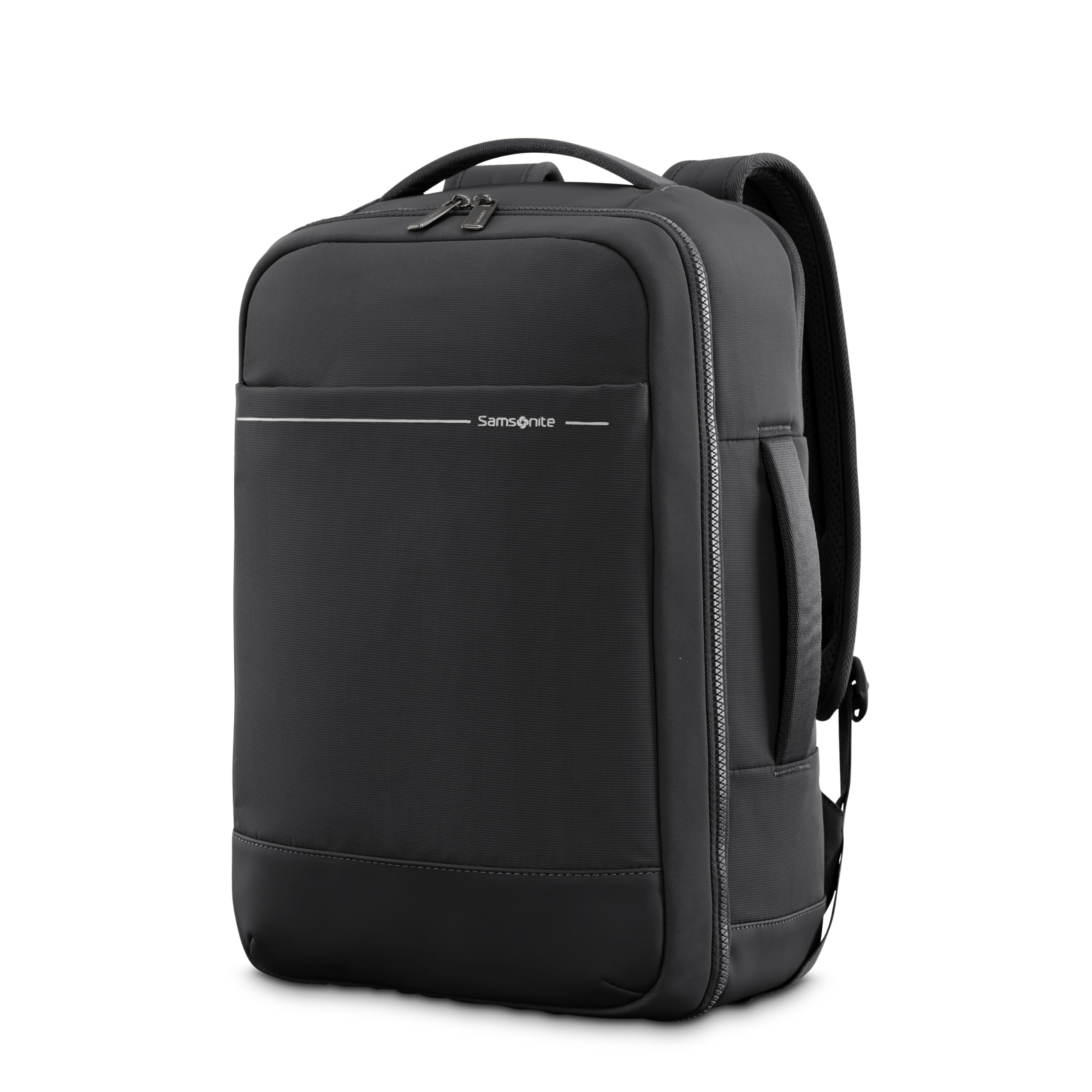
Key Features
- Weight: 2.1 lb
- Opening: Full-zip book style
- Capacity: 30 liters
- Dimensions: 11.5"D x 6.5"W x 17"H
- Price: Premium
No logos, no webbing, no USB port: the Better Than Basic is a plain 30-liter bag with a full-zip book opening that lies open like a suitcase lid. Samsonite sized it at 17 inches tall to sit under most airline seats, which is the job it is actually for.
The details are quietly good. The front pocket has a key leash, two slip pockets, and a pen sleeve; the shoulder straps are padded and carry a sunglass loop; and there’s a trolley sleeve on the back that slides over a rolling case. The fabric is a ribbed matte polyester with an RPET lining, and it wipes clean with a damp cloth.
What you are paying for is the shape and the finish rather than cleverness: one big opening, a laptop sleeve, a trolley strap, and a bag that looks like it came off a more expensive shelf. It’s the least fussy pick here, and the one to buy if you want to pack once and stop thinking about it.
Pros
- Book-style full-zip opening
- Trolley sleeve and key leash
- Wipe-clean ribbed matte polyester
- 17 inches tall, under-seat sized
Cons
- Not water resistant at all
- Laptop sleeve tops out at 15 inches
We keep this one for the traveler who wants a plain, well-finished bag and no decisions: a book-style opening, a trolley sleeve, and an under-seat shape.
How We Packed, Measured, and Stress-Tested 12 Carry-On Backpacks
We started with about 60 backpacks marketed as carry-on or personal-item bags and cut the list by checking listed dimensions against the published size limits for the major U.S. airlines, then filtering for what travelers actually compare: a padded laptop sleeve, a separate shoe compartment, expandable capacity, water-resistant fabric, and enough exterior pockets to keep a passport out of the main compartment. That left 12 bags, from budget to mid-range, which we bought ourselves.
Each got the same load: four days of clothes, a 15-inch laptop, a toiletry kit, and a pair of shoes. We packed and repacked them on three weekend flights, on a ten-day trip spent living out of one bag, on a train, and on the everyday commute. Between trips they sat in a hallway closet so we could see whether straps and handles held their shape when empty.
We measured every bag at the seams with a tape, empty and loaded, because a listed 40 liters means little if the corners round off. Zippers took the worst of it: we overstuffed each main compartment past comfortable and zipped it one-handed, counting skipped teeth and noting whether a storm flap covered the track. Fabric went under a faucet for two minutes, then we checked for dampness inside. For pockets, a tester had to find a passport, phone, and charger in the dark with the bag wedged under a seat.
Durability showed up in small ways — a handle starting to fray, a strap that dug in after an hour of walking, a laptop sleeve that didn’t float off the bottom. We also noted whether the packing cubes and pouches in the box were usable or landfill, since that changes what you’re really paying for.
How to Choose a Carry-On Backpack
The liter rating tells you almost nothing about whether a bag boards free — the three external dimensions do, and they’re where we start every time.
Measure against the sizer, not the liter rating
Two 40-liter bags can differ by four inches in one direction, which is the gap between a free personal item and a gate fee. Add the height, width, and depth and compare that total to the carrier you fly most: Spirit’s free personal item is 18 by 14 by 8 inches, and most mainline overhead bins take something closer to 22 by 14 by 9.
"TSA approved" is not a size standard — TSA screens what’s inside the bag, not what it measures — and "flight approved" is marketing until you have matched it to a specific sizer. If a listing gives you liters and nothing else, keep looking.
Decide whether it lives under the seat or overhead
Under-seat travel backpacks run 25 to 30 liters and roughly 17 to 18 inches tall; overhead bags run 40 to 50 liters and 20 to 22 inches. The first is a two-day bag you never pay for. The second is a week of clothes that costs you a carry-on fee on a budget carrier.
Expansion zips blur the line, and that is where buyers get caught: a bag that grows to 50 liters is a carry-on at that size, not a personal item. Buy the size you fly most and treat the expansion as a return-leg bonus.
Weigh the empty bag against the cabin limit
Weight limits are where U.S. travelers get surprised abroad. Several international carriers cap cabin bags around 7 to 10 kilograms, which is 15 to 22 pounds, and they weigh them at the gate. A 2.6-pound bag eats a real chunk of that before you have packed a thing.
Lighter shells cost durability, so this is a genuine trade rather than a free win. Take the airline’s limit, subtract the bag’s empty weight, and you have your packing budget. That number decides more trips than any feature list.
Check the hardware before the pockets
Zippers, strap anchors, and top handles are what end a bag’s life, and they are the hardest thing to judge from a photograph. Named hardware such as YKK is a reasonable proxy, as is a stated load rating — a bag rated to 22 pounds is telling you something about how it was built.
Look for reinforced stitching at the handle and lockable pulls if the bag will ever be gate-checked. Pockets are easy to add later with cubes; a torn strap anchor is not repairable on the road.
Match the opening and the carry to your trip
A clamshell or book-style opening packs like a drawer and is worth the bulk on any trip longer than three days; a top-loader suits a daypack you are in and out of. If you travel with a laptop, a section that lies flat at security saves you the repack at the bin.
Then think about the two minutes you spend moving through a terminal: a trolley sleeve, a side grab handle, and straps that stow turn a backpack into luggage. Those small things matter more on travel day than an extra pocket ever will.
Frequently Asked Questions
What happens if my carry-on backpack doesn’t fit the sizer at the gate?
You pay the gate fee, which is usually the most expensive way to buy that space — more than adding a carry-on to your booking online before the trip. The sizer is a rigid metal frame, so the bag has to drop in on its own; a soft bag bulging at the seams will not make it.
Test it at home against a tape-measured box before you fly, and wear your bulkiest layer to the airport if you are borderline.
Can I wash a carry-on backpack?
Almost never in a machine. Hand washing or spot cleaning is what bags in this category specify, and the coating that makes the fabric water resistant breaks down in a washer and a dryer.
Use mild soap and a damp cloth, work at the stain rather than scrubbing the seams, and air dry away from a radiator — heat is what warps a back panel.
Do I need packing cubes to make a carry-on backpack work?
For a clamshell bag over 35 liters, yes. Cubes turn one deep compartment into three or four bricks you can lift out whole, and they stop clothes sliding into the laptop side.
Match their depth to the bag’s internal depth, because a too-deep cube means the lid will not close flat, and keep a separate shoe bag so nothing dirty rides against clean shirts.
Final Verdict
Start with the LOVEVOOK. It pairs a frame cut to the strictest U.S. personal-item box with three packing cubes in the box, which means you board free and pack in five minutes. The tomtoc is the better buy if the bag works for a living — YKK hardware, a recycled shell, and a laptop section that lies flat at security — and that premium pays for itself once you are flying monthly.
If a week of clothes has to fit and you refuse to check a bag, the Gieury‘s expansion adds ten liters on demand. And if the whole goal is to stop paying for luggage, the HOTOR at 26.5 liters is the lightest way there.