This post contains affiliate links. We may earn a small commission when you buy through our links — at no extra cost to you.
Every trip to Europe produces the same small panic: you’re on a crowded metro with a passport, a phone, and a fistful of train tickets, and nowhere safe to put any of it. A travel vest moves all of that onto your body and keeps your hands free. The trouble is that most look the part and then fail on the details.
I started wearing one after a man on a crowded bus slipped his hand into my front pocket, and I’ve traveled with one ever since. Over the past eight months my team and I have worn 12 vests on trains, through airport security, and across cobblestones, and pocket count turned out to matter far less than where those pockets sit.
Fit and weight come next. A vest that’s too snug fights you every time you add a sweater underneath, and one that’s too loose flaps and rides up on long walking days. The picks below are the ones that held up — and the ones I’d pack again.
Our Top Picks


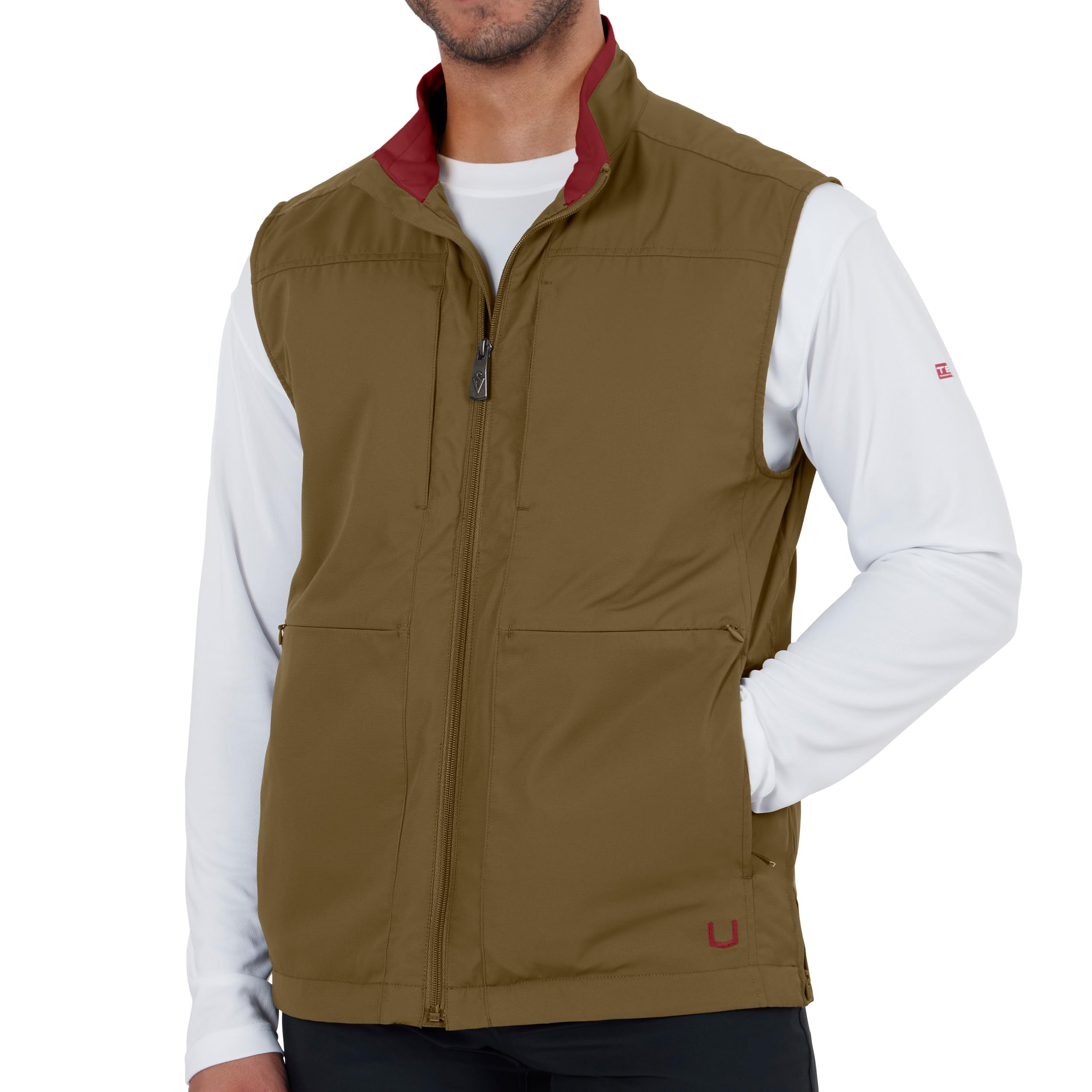
The Best Travel Vests for Europe, Reviewed
1. SCOTTeVEST 101 Travel Vest
Best Overall
Key Features
- Care: Machine washable
- Fabric: Water- and stain-repellent
- Pockets: 9
- Price: Premium
The job of a travel vest in Europe is to replace the day bag, and this is the one here that does it without making you look like you are on a photo safari. Nine pockets, a shell treated to shed water and stains, and a cut that sits close over a shirt — that combination is why it is our top pick.
Nine pockets is fewer than the sixteen- and twenty-six-pocket vests in this guide, and in raw capacity it shows. What you get instead is organization. Two of the nine are specialist slots, one sized for a pen and one for a license or a card, so it is not nine cargo pouches, and the rest sit where you can reach a passport or a phone without unpacking the whole vest. We paid close attention to how it hangs when it is full, because a loaded vest that sags at the shoulder is worse than a small bag, and this one keeps its line.
The catch is cost. This is a premium purchase in a category where a perfectly serviceable vest costs a fraction as much, and the premium buys tailoring and pocket design rather than more storage. We think it earns out across a couple of trips, but only if the vest is going to be your main carry rather than an emergency layer.
It also machine-washes, which matters more than it sounds on a two-week trip: a vest worn every day gets grubby, and one you cannot wash becomes a vest you stop wearing. Buy the plainest colorway you can find — the whole point is that it reads as clothing, and the louder the vest, the less that works.
Pros
- Nine well-placed, organized pockets
- Water- and stain-repellent shell
- Reads as clothing, not gear
- Machine washable after a grubby week
Cons
- Premium price next to the budget vests
For a city trip where the vest replaces your day bag, this is the one we recommend: secure pockets in a vest that still looks like clothing.
2. Hixiaohe Travel Vest
Best Value
Key Features
- Shell: Nylon, mesh-lined
- Pockets: Multiple zippered
- Listed weight: 4.8 oz
- Price: Budget
Nylon shell, mesh lining, a chest pocket that takes a phone or a pair of reading glasses, and zips on the pockets rather than flaps and velcro. The cut ends just below the belt line, so it layers over a T-shirt without swallowing your waist, and it weighs next to nothing once it is stuffed into a daypack.
We have kept this one in the rotation for hot days because the mesh lining stops it turning into a sauna by mid-afternoon, and the pocket layout is sensible rather than maximal: a phone slot, a chest pocket, a few larger ones, all of them closable. The zips have been fine for us, though the fabric will catch if you pull at an angle, so seat the pull straight before you tug.
Sizing is the one thing to get right. It runs small, and the gap between a good fit and a bad one is a single size on the chart, so order up from your usual. Set against our top pick it is a plainer vest — fewer pockets, no hidden compartments, less tailoring — but it is also the one you will not baby, and that counts for something on a trip where the vest spends half its life in the bottom of a bag.
Pros
- Light enough for hot afternoons
- Every pocket zips shut
- Mesh lining stays breathable
- Inexpensive next to the premium picks
Cons
- Runs small; order a size up
The budget pick we trust: light, mesh-lined, and fully zippered — order a size up from your usual and it handles everything but the tailoring.
3. SCOTTeVEST 26-Pocket Travel Vest
Best for Maximum Storage
Key Features
- Fabric: Water- and stain-repellent
- Pockets: 26
- RFID blocking: Yes
- Price: Premium
Twenty-six is not a round marketing number. There are pockets sized for a tablet, a passport, cards, a phone, glasses, and a pen, plus a couple whose purpose only becomes clear once you are packing. The card slots are RFID-blocking, the zips are hidden, and the shell is treated against water and stains.
It is also a lot of vest. Loaded up it is the heaviest thing in this guide — you feel it across the shoulders by late afternoon, and it stops being a layer and starts being luggage. We kept finding pockets we had not noticed, which is either the point or the problem depending on your patience. Fit is the least predictable thing about it: sizing runs both ways depending on the size you order, so it is the one here worth trying on before a long trip.
For the right trip, though, it earns its keep. If you are traveling with a cabin bag and want to leave a laptop sleeve in the hotel room while still carrying a tablet, chargers, and documents, this is the only vest here built for that. The price is the real obstacle, and it is a great deal of money for a garment that only gets worn on travel days.
What sold us is the security argument. On a crowded metro or in a market there is no visible pocket for a hand to slip into — most openings are zipped and several are hidden — and that is a different kind of confidence than a deep front pocket on a fishing vest.
Pros
- 26 pockets, including tablet-sized ones
- RFID-blocking card slots
- Hidden zips and water-repellent shell
Cons
- Heavy and bulky once loaded
- Premium price
The one to buy if the vest is replacing a carry-on: 26 pockets, hidden zips, and RFID blocking, at a weight and price that only make sense for heavy packers.
4. Soothfeel Women’s Vest
Best for Light City Layering

Key Features
- Fabric: Windproof softshell
- Pockets: 4
- Water resistance: Water-resistant
- Price: Budget
Four pockets will not replace a day bag, and we are not going to pretend otherwise. What this vest does is the other half of the job: it is a windproof, water-resistant softshell that looks like clothing, packs down small, and keeps a city walk from turning into a gear exhibition. If your pockets only need to hold a phone, cards, and a key, it is the neatest option here.
The two front pockets are deep and zippered, which is what you want. The interior ones are the weak spot: they are small enough that a large e-reader will not fit, and they do not close, so a strip of velcro sewn inside is a cheap fix worth making before you travel. The arm openings run generous, which is comfortable over a thin shirt and roomy enough for a light sweater. It is cut like a golf vest rather than a utility vest, and that is the trade: it looks better and carries less.
What we like most is how little it asks of you. It takes the wind on a ferry deck, it rolls into a corner of a carry-on, and it does not look like it came from a tackle shop. That is a narrow brief compared with the twenty-six-pocket vest, but it is the brief most city trips actually have.
Pros
- Windproof and water-resistant
- Two deep zippered front pockets
- Looks like a normal vest
Cons
- Interior pockets too small for a large e-reader
- Runs small against the size chart
For a woman who wants a light, windproof layer with two secure front pockets — and no interest in looking like she is off on safari — this is the one.
5. Rizanee Unisex Mesh Vest
Best for Hot-Weather Walking

Key Features
- Fit: Unisex
- Fabric: Breathable mesh
- Pockets: Multi-pocket
- Price: Budget
Mesh is the whole point of this one. A solid nylon vest on a hot afternoon of museum-hopping turns into a sauna; a mesh one does not, and that is the difference between wearing the vest and carrying it. It is also the least expensive vest in this guide, which makes it the low-risk way to find out whether the hands-free habit suits you.
The pockets are the surprise. There are more of them than the price suggests, and the internal ones take a Kindle or a small camera body — the kind of vest a photographer wears to a market or a safari. We carried it exactly that way: camera inside, no bag, hands free.
Sizing is the risk. It runs very small, and the larger sizes are where that bites hardest, so order up at least one and two if you plan to layer. The body is short as well, which is fine over a T-shirt and less fine over a sweater. And it reads as gear rather than clothing — fine at a market, less fine at dinner, which is the trade you make for the price.
Pros
- Mesh shell stays cool in heat
- Internal pockets take a camera or e-reader
- Lowest price in this guide
Cons
- Runs very small, especially in larger sizes
- Short body limits layering
Buy it for hot-weather days when pockets and airflow matter more than looks — and size up at least once, twice if you plan to layer.
How We Tested These Travel Vests
We started with a list of more than 40 vests sold in the U.S., then filtered for the things that actually decide a trip: fabric light enough for a July afternoon, a cut structured enough to hide a passport, and at least one interior pocket that closed securely. Anything dry-clean only, or heavier than a light jacket, came off the list. That left 12 vests, from slim four-pocket shells to pocket-heavy travel vests, and we wore every one of them for eight months.
Each tester carried the same load for a full day: passport, phone, wallet, sunglasses, a paperback, and a 16-ounce water bottle. We wore the vests through airport security, on regional trains, on a week of drizzly sightseeing, and out to dinner, and we noted every time we had to unzip the front to reach something that should have been within one hand.
Zippers got their own tally — we opened and closed the main front zip and every pocket zip at least 50 times, watching for snags at the corners and pulls that stuck halfway. Water resistance was judged with a spray bottle: ten spritzes across the chest, then a check of whether the beads rolled off or the fabric darkened and soaked through.
Fit was checked two ways: we measured each vest flat against its stated size, then tried it over a T-shirt and again over a heavy sweater to see how much room was really there. Each one was weighed empty and again fully loaded, since a vest that feels weightless in a shop can drag at the shoulders by hour six. We scored value on the pockets we actually used on a two-week trip rather than the ones on the spec sheet, and asked whether each vest read as gear or as clothing when worn with jeans.
How to Choose a Travel Vest for Europe
The right travel vest keeps your passport closed and your hands free, so the closures deserve more attention than the pocket count.
Start with the pockets you will actually use
The number in the listing is a poor guide. A sixteen-pocket utility vest can hold less of what you need than a nine-pocket vest with deeper, better-placed pockets, because cheap utility pockets are often shallow and flat. Count the things that will live in it — phone, passport, cards, glasses, a small camera, maybe a water bottle — then check that each has a home with a closure.
Give priority to at least one inside pocket that sits against your body rather than facing outward. That is the pocket you will use for the document you cannot afford to lose, and it is the one feature worth paying more for.
Zippers decide whether the vest is worth buying
A travel vest is a bag you wear, and the zips are its only lock. This is exactly where the budget end of the category falls down: thin, sticky zips with small pulls that catch the fabric, on vests whose entire selling point is secure storage. Run the main zip before you commit, and check that the pull is big enough to grab one-handed.
Do not be talked out of a vest because the zip sits on the left. A good share of these are cut that way, and it is a preference rather than a defect.
Fit for layers, and size up more often than you think
A European trip usually means several temperatures in one day, so a vest that only fits over a T-shirt is a vest you leave in the hotel room. Buy for the bulkiest layer you will wear underneath — a light sweater in spring and fall, a shirt in summer — and accept a slightly looser fit in the heat.
Sizing is where these vests go wrong most often, and many low-cost ones run a full size small. Order up unless the maker’s chart clearly says otherwise, and check the length as well: one that ends just below the waist works over jeans, while a cropped one rides up over a sweater.
Match the fabric and the look to the trip
For Spain or Italy in July, mesh or a thin nylon shell is the difference between wearing the vest and carrying it. For London, Copenhagen, or Amsterdam in spring, a treated shell that sheds drizzle and blocks wind is worth more than airflow.
Then think about how it reads. The multi-pocket fishing vest is a recognizable garment, and in a city it says gear rather than clothing. A cleaner front with hidden pockets passes at a restaurant, and a neutral color does most of that work for you.
Frequently Asked Questions
Will a travel vest count against my cabin bag allowance?
A vest you are wearing is treated as clothing by most carriers, so it does not count against your cabin allowance the way a bag does. A vest visibly stuffed with a water bottle and a camera may still get a second look at the gate, so check your airline’s cabin baggage page before you rely on it and keep bulky items in your actual bag.
How do I keep a passport secure in a vest?
Use an inside pocket that closes, not the big outer cargo pocket, and keep the passport against your chest or ribs. Split cards and cash into a second pocket so one loss is not a total one, and zip the pocket shut every single time you use it — an open zip is the likeliest way to lose something. RFID-blocking slots are a bonus, not a substitute for either habit.
Do I need a travel vest if I already carry a crossbody bag?
Not always. A crossbody bag is easier to live with when you are hauling a water bottle, a guidebook, or shopping. A vest earns its place when you want your hands free, your valuables in front of you rather than at your hip, and the weight spread across both shoulders instead of one. If you are carrying more than a couple of pounds all day, a small backpack still wins.
Final Verdict
The SCOTTeVEST 101 is the vest we recommend for a European trip: nine zippered pockets, a shell that handles drizzle, and a cut that looks like clothing rather than equipment. If the budget is tighter, the Hixiaohe does the same job with a plainer front and fewer pockets, as long as you order a size up.
And if you want to leave the day bag behind entirely, the twenty-six-pocket SCOTTeVEST is the only vest here that carries a tablet and a full day of gear — accept the weight and the price, or step down to the 101.