This post contains affiliate links. We may earn a small commission when you buy through our links — at no extra cost to you.
The hardest part of flying with a baby isn’t the flight — it’s standing at the end of a jet bridge with a baby on one hip and a stroller that won’t fold. A travel system, meaning a stroller plus an infant car seat that clicks onto it, is supposed to erase that moment. Whether it does comes down to the fold, the weight, and how squarely the car seat lands.
I’ve gate-checked enough strollers to be particular. Over six months, my team and I put 10 travel systems through real trips and real errands — folding them one-handed in terminals, wedging them into rental car trunks, clicking car seats in and out in parking lots. The keepers shared a fold you can do while holding a baby, a seat flat enough for a newborn, and a car seat that installs without a base.
The lightest frames give up some sturdiness and storage, and the most solid-feeling full-size strollers are the ones that fight you at the gate. The picks below split the difference.
Our Top Picks


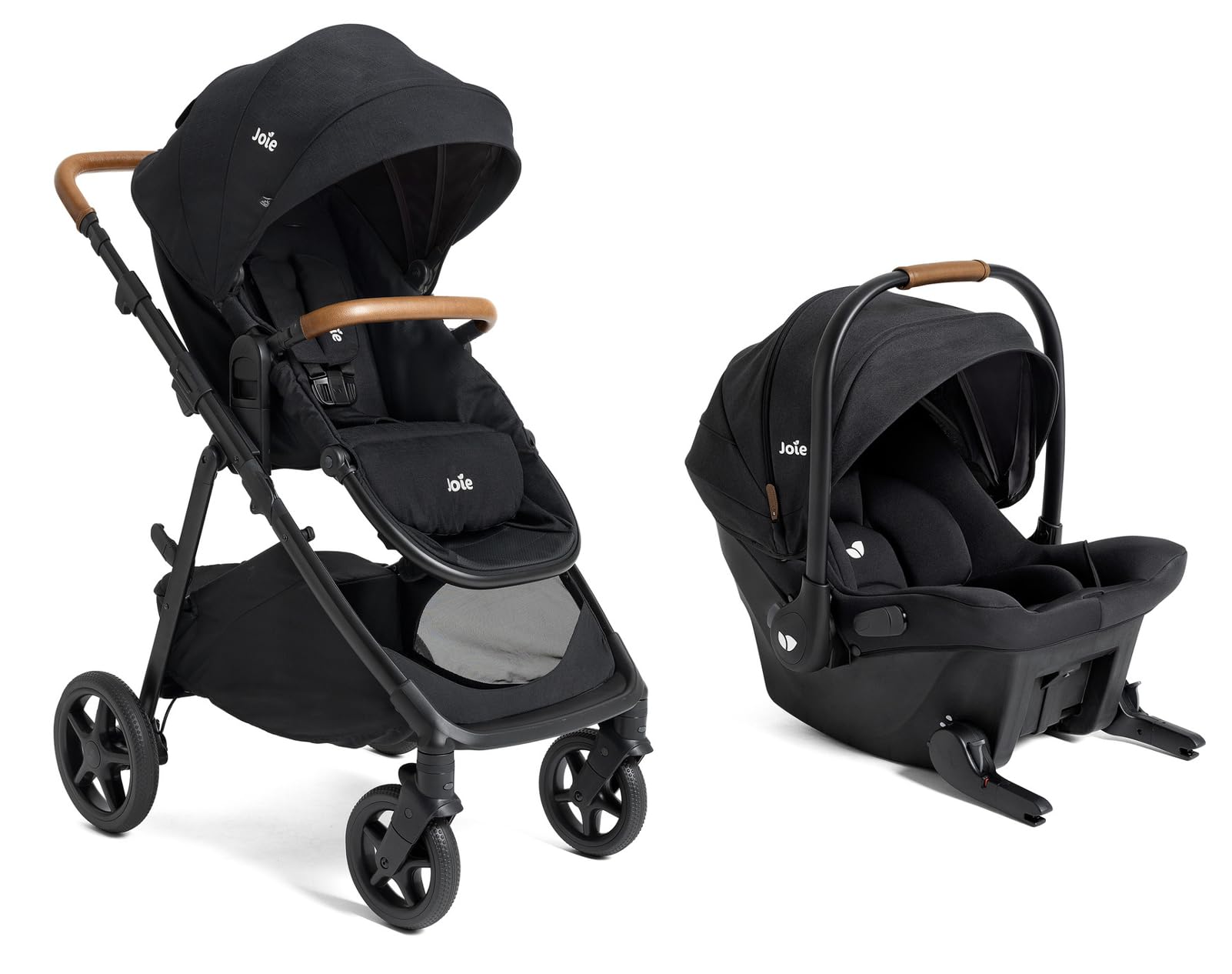


The Best Travel System Strollers for Travel, Reviewed
1. Graco Gomax Travel System
Best Overall
Key Features
- Folded size: 20.5 x 17.3 x 7.1 in
- Aircraft use: Certified without base
- Stroller weight: 9 lb
- Car seat weight range: 4-30 lb
- Price: Premium
The Gomax is the one in this group that treats the trip itself as the design problem. Graco builds it around a 9-pound stroller frame that folds to 20.5 by 17.3 by 7.1 inches, and the included car seat is certified for aircraft use without the base. We recommend it first for air travel because those three facts change the day: you can carry the folded frame in one hand, tuck it into a tight trunk or, on the right aircraft, an overhead bin, and move a sleeping baby from a rental-car back seat without hunting for a base.
The base-free install is more useful than it sounds. The car seat has built-in rigid LATCH connectors, so it can go into a vehicle without the stay-in-car base, and the stroller accepts the seat directly. We like that for taxis, rentals, and a second family car, where a base would be one more thing to pack or forget. The one-hand standing fold is also the right shape for a traveler juggling a bag and a baby.
The asterisk is the overhead-bin claim. Graco describes the fold as overhead-bin friendly, but bin size varies by aircraft and carrier, so check the folded dimensions against your airline’s rule before you count on it. This is also an infant-seat system, not a stroller that grows into the toddler years; it does one travel job very well, and it does not pretend to be the only stroller you will ever own.
Pros
- Folds to 20.5 by 17.3 by 7.1 inches
- Weighs just 9 pounds
- Car seat installs without a base
- Car seat is aircraft-certified
Cons
- Premium price for a specialized frame
For flights and rental cars, we recommend the Gomax: its 9-pound frame folds to about the size of a diaper bag, and the car seat installs without a base.
2. Graco Modes Pramette Travel System
Best Full-Featured
Key Features
- Modes: 3-in-1
- Folded size: 38 x 24 x 18 in
- Stroller weight: 20.9 lb
- Max child weight: 50 lb
- Price: Midrange
The Modes Pramette answers the question the Gomax leaves open: what happens after the infant carrier? It starts as a car-seat carrier, reclines into a pramette for a newborn, and then becomes a reversible toddler stroller. That three-stage run is the reason it earns a place for families who want one purchase to cover more than the first year.
We appreciate the seat that flips to face you or the world; on a long walk, being able to turn a fussy baby toward you is worth more than another cup holder. The one-hand fold is genuinely useful when you are holding a baby on one hip, and the 50-pound stroller limit gives it a longer working life than the infant-only frames here. It is a full-size stroller at 20.9 pounds, so it belongs in a trunk, not a carry-on pile.
The regular stroller seat is the part to check. The infant car seat clicks in with a positive lock, but the stroller seat can feel less planted on the frame; give it a firm push to confirm both sides are engaged before you walk. That is a small habit, not a reason to skip the system, and the pramette conversion is worth the practice. If your trips are mostly by car and you want one stroller that keeps going, this is the more versatile buy.
Pros
- Three modes from newborn to toddler
- Reversible seat faces parent or world
- Folds with one hand
- 50-pound stroller limit
Cons
- Long folded footprint for tight trunks
If you want one system from newborn pramette to toddler errands, we recommend the Modes Pramette for its reversible seat, one-hand fold, and 50-pound limit.
3. Joie Ginger Travel System
Best Base-Free
Key Features
- Folded size: 19 x 24.5 x 31 in
- Frame weight: 22.8 lb
- Car seat weight: 9.3 lb
- Car seat install: Base-free rigid LATCH
- Price: Premium
The Ginger’s best trick is the seat you do not have to pack around. The Mint Latch infant car seat has rigid LATCH connectors built in, so it can install in a vehicle without a separate base, and it clicks onto the stroller. For a trip that includes a taxi, a rental car, or a grandparent’s sedan, that is the difference between a quick handoff and a trunk full of hardware.
We like that the stroller seat itself reclines into a pramette, so you do not need a separate bassinet for a newborn. The seat height adjusts, which puts a small baby closer to your face and gives a taller caregiver a more comfortable push. The 10-inch rear wheels also roll with more composure than the tiny wheels on the most compact frames, and the folded package is tidy for a trunk.
This is a premium system, and the fabrics are hand wash only; a snack spill becomes a sink job on a trip. The basket is also on the small side at 10 pounds, so a diaper bag will fill much of it. Neither changes how well the seat installs in a taxi, but both are worth knowing before you pay the premium.
Pros
- Base-free rigid LATCH install
- Built-in pramette
- Height-adjustable seat
- 10-inch rear wheels
Cons
- Small 10-pound basket
- Hand-wash-only fabrics
We recommend the Ginger when you will use taxis and rentals: its infant seat installs with rigid LATCH and no base, and the stroller has a built-in pramette.
4. Evenflo Pivot NXT Travel System
Best Lightweight Car Seat
Key Features
- Modes: 6
- Car seat limit: 3-30 lb
- Car seat weight: 8.6 lb
- Stroller weight: 21.9 lb
- Price: Midrange
The number that matters most in a travel system is the weight of the seat you lift out of the car, not the weight of the stroller sitting in the trunk. The Pivot NXT’s LiteMax NXT seat is 8.6 pounds, and that is the detail that makes this system worth considering for a caregiver who does a dozen car-to-stroller transfers a day.
It pairs with a modular stroller that can face parent or world in car-seat, carriage, and toddler modes, and the self-standing trigger fold is easy to manage with one hand. We appreciate the 10-inch rear wheels and the 20-pound basket; the bigger rear wheels give it a more settled push than the smallest travel frames, and the basket has room for a diaper bag plus a few groceries. At 21.9 pounds, the stroller is still a full-size piece, so the light seat does not make the whole package disappear into a backpack.
The folded package is tall rather than flat, which can matter in a shallow trunk or a crowded hall closet. That is the trade for the larger wheels and the six-mode frame. If your priority is the seat you carry, this is the one we point to; if your priority is the smallest possible folded footprint, the Gomax is the better fit.
Pros
- 8.6-pound infant car seat
- Six modes
- Self-standing trigger fold
- 20-pound basket
Cons
- Folded package is tall
We recommend the Pivot NXT when you want a genuinely light infant seat: at 8.6 pounds, it is easier to lift out of a car, and the stroller offers six modes.
5. Baby Trend Passport Switch Travel System
Best Budget Modular
Key Features
- Modes: 6
- Car seat limit: 35 lb
- Basket capacity: 50 lb
- Stroller weight: 21.3 lb
- Price: Budget
The Passport Switch is the budget system that does not feel like a single-purpose compromise. It can take the EZ-Lift car seat parent-facing or forward-facing, switch to a carriage in either direction, and then become a toddler seat. That is a lot of flexibility for a system that costs far less than the premium picks here, and it makes a sensible second stroller or a first system for a family that mostly does errands and car trips.
We like the phone holder at the center of the handlebar and the flex-grip cup holder; small things, but they keep a phone and a water bottle where you can reach them. The 50-pound basket is the practical surprise, with room for a diaper bag and a day’s supplies. The 35-pound car seat limit also gives it a little more growing room than the 30-pound seats on several picks.
The compromise is refinement. The stroller is 21.3 pounds and the fold takes some practice, and it can feel less planted over rough pavement than the larger-wheeled options. None of that undoes the value if you want a modular system for errands and car trips; it just means this is not the one for a flight-first packing list.
Pros
- Six modes for the price
- 35-pound car seat limit
- 50-pound basket
- Phone and cup holders
Cons
- Less settled over rough pavement
We recommend the Passport Switch for a budget-friendly way to get six modes, a 35-pound car seat limit, and a 50-pound basket.
6. Safety 1st Smooth Ride Travel System
Budget Full-Size

Key Features
- Folded size: 18.75 x 22 x 28.25 in
- Car seat limit: 4-30 lb
- Basket capacity: 50 lb
- Stroller weight: 32 lb
- Price: Budget
The Smooth Ride is the familiar, no-drama option: a full-size stroller, an OnBoard FLX car seat, a large canopy, and a 50-pound basket. It arrives with no assembly required, which is a real kindness when the box shows up the week the baby does.
We appreciate the one-hand fold and the extra-large canopy with a flip-out visor; on a sunny errand day, that canopy does more for a baby than a fancy handlebar. The 32-pound stroller is the catch. It is a trunk stroller, not a carry-on stroller, and lifting it into a high SUV or up stairs will remind you of that.
The car seat-to-base fit is the other place to slow down: the seat can take a firm push to release from the base, and a base that is not seated flat is worth fixing before you drive. The stroller also steers with two front wheels, so tight store aisles take more care. For a family that wants a low-cost full-size system and mostly travels by car, those are manageable trade-offs; for air travel, we point you to the Gomax.
Pros
- No assembly required
- One-hand fold
- Extra-large canopy with visor
- 50-pound basket
Cons
- 32-pound stroller
- Car seat release can take a firm push
We recommend the Smooth Ride as a budget full-size system for errands and trunk-based trips, not as the lightest choice for flights or stairs.
7. Baby Trend Venture Travel System
Three-Wheel Value

Key Features
- Wheels: 3
- Car seat limit: 4-30 lb
- Car seat weight: 7 lb
- Stroller weight: 14 lb
- Price: Budget
Three wheels usually mean a bigger, heavier stroller; the Venture is the exception here at 14 pounds. That alone makes it worth a look for a family that wants an all-terrain look and a low price without wrestling a tank into the trunk.
We like the parent tray with two cup holders and the child tray with two more, plus the large basket with front and rear access. The in-seat center fold is meant to collapse with one hand, and the 7-pound EZ-Lift seat is easy to lift out of the car. On a stroller this light, those conveniences matter more than a fancy finish.
The single front wheel is the trade-off: it rolls nicely once you are moving but takes more care in tight store aisles, and the light frame can feel busy over broken pavement. Before relying on it, make sure the car seat clicks firmly onto both the base and the stroller; that connection is the one thing to verify on your own.
For errands and neighborhood walks, the weight and the price are hard to argue with. This is not the system we choose for a flight with tight connections; the narrower fold and lighter frame of the Gomax are easier to live with in an airport. But as a second stroller or a budget three-wheeler, the Venture earns its place.
Pros
- 14-pound stroller
- 7-pound car seat
- Large basket with front and rear access
- Two parent and two child cup holders
Cons
- Single front wheel is less nimble in tight aisles
- Light frame feels busy over broken pavement
We recommend the Venture for a low-cost three-wheel system with a 14-pound stroller and a 7-pound car seat, provided you mostly push on pavement.
How We Tested 10 Travel Systems on Real Trips
We started with the brands that dominate this category, then cut anything that couldn’t do three jobs: accept an infant car seat, fold small enough to gate-check or drop into a sedan trunk, and hold a newborn flat. That left 10 systems across the price range, all bought at retail. Testing ran six months, in the places these products actually live — airport terminals and jet bridges, rental car lots, hotel lobbies, and the lumpy sidewalk outside our office.
Weight and fold came first. We weighed every stroller and car seat separately on a luggage scale, then folded each one while holding a 15-pound sandbag against a hip, timing the fold and checking whether the stroller stood on its own afterward. Each system got 20 fold-and-unfold rounds to find the pinch points, plus a trunk-loading test with a carry-on and a diaper bag already in the back.
Handling we judged on the move: a one-handed push through a crowded terminal, tight turns between rows of airport seating, curbs, gravel, and that brick sidewalk. Car seat alignment got its own session — each seat installed with a base and without one in three different vehicles, tugging at the belt path for movement and checking the recline angle for a newborn, then clicked onto its frame 30 times to see whether it seated on the first try or needed a shove.
Last came stability and sturdiness: a loaded diaper bag hung from the handlebar to see what tipped, and repeated curb drops to catch rattles. We also tallied what each system included for the money, since a cheap frame that needs three add-ons isn’t a bargain.
How to Choose a Travel System for the Trip You Take
A travel system is a stroller and car seat combo, but the right one depends less on a single headline number than on whether your trips run through airports, rental-car counters, or your own trunk.
Start With the Trip You Take
Air travel rewards a different design than a weekly neighborhood walk. If you will fold the stroller at a gate, lift it into an overhead bin, or slide it into a rental-car trunk, prioritize a low packed weight and a short folded package. The Graco Gomax is the clearest example here: a 9-pound frame and a 7.1-inch fold make it the easiest to travel with, but it is built around the infant seat rather than a toddler seat.
If most of your travel is by car and you want one stroller to last, a full-size system with a reversible seat and a higher child-weight limit is the better use of space. The Graco Modes Pramette gives up compactness for a pramette, a toddler seat, and a 50-pound limit. Neither is universally better; they answer different trips.
Count the Whole Package, Not Just the Stroller
It is easy to compare stroller weights and forget that the car seat is the part you lift most often. A 9-pound frame paired with a heavier seat can still be a handful at every stop, while an 8.6-pound seat such as the Evenflo Pivot NXT’s makes repeated car-to-stroller transfers easier. Add the folded stroller, the seat, and the diaper bag before you decide the package is light.
Fold shape matters as much as the number on the scale. A tall, narrow fold can stand in a closet but fight a shallow trunk; a flat, long fold can slide under a seat but crowd a hallway. Check both dimensions against the space you actually use, and practice a one-hand fold if you will be holding a baby at the same time.
Decide Whether You Need a Base
A stay-in-car base is convenient when one vehicle does most of the driving, but it becomes extra luggage when you fly, take taxis, or rent cars. A base-free seat with rigid LATCH connectors, like the Joie Ginger’s, can install directly in a vehicle and still click onto the stroller. That is the feature to prioritize if your trips involve changing cars.
The stroller side is separate: the car seat should lock onto the stroller frame without the base, and the seat should sit at the angle the maker specifies. Before you fly, confirm that the car seat is approved for aircraft use without its base. Do not assume every travel system seat is certified for the cabin.
Plan for Newborn Support and Toddler Longevity
A newborn needs a flatter, more supported position than an upright toddler seat provides. A pramette mode or a lie-flat stroller seat gives you that without relying on the car seat for long walks. The Graco Modes Pramette and Joie Ginger both recline into a pramette; the Gomax relies on the infant carrier instead.
Then decide how long you want the system to work. A frame-style travel stroller may top out around 30 pounds, while a convertible stroller can carry a child to 50 pounds. If you want one purchase to cover newborn walks and toddler errands, pay for the convertible seat. If you want the smallest possible travel kit for the first year, the frame is the smarter specialty tool.
Check the Wheels, Seat Attachment, and Storage
Bigger rear wheels roll more calmly over sidewalk cracks and curb cuts; small wheels pack better but transmit more chatter. A three-wheel stroller can feel nimble in open spaces and awkward in a narrow aisle, so match the wheel layout to where you actually push. Storage matters too: a 10-pound basket disappears under a diaper bag, while a 50-pound basket can handle errands.
Finally, check the connection you will use every day. The infant seat should click in with a clear lock, and the stroller seat should not feel loose once it is engaged. Give both a firm push before you walk away. That habit matters more than any single convenience feature.
Frequently Asked Questions
Do I need a travel system if I already own an infant car seat?
Only if your car seat is compatible with the stroller frame. Check the stroller’s compatible-seat list and whether an adapter is required; a seat that does not lock in on both sides is not a travel system, it is a stroller with a passenger you still have to carry. If your seat is not listed, buy a stroller that accepts it or choose the bundle.
Can you gate-check a travel system stroller?
Airlines set their own gate-check rules, so confirm the folded size and policy before you fly. In practice, you remove the infant car seat if you are using it on board, ask for a gate-check tag at the desk, and leave the stroller at the jet bridge. A padded gate-check bag is worth the trouble if the stroller will be handled roughly.
Is a travel system stroller safe for overnight sleep?
No. A stroller seat or pramette is not a substitute for a crib, bassinet, or play yard rated for sleep. Use the pramette for supervised strolling and move a sleeping baby to a firm, flat sleep surface. If you are traveling, a compact travel bassinet is the safer purchase.
Final Verdict
We recommend the Graco Gomax for the traveler who wants the easiest possible journey: it is the lightest and most compact system here, and its car seat installs without a base. If you need one stroller to last through toddlerhood, choose the Graco Modes Pramette instead; its reversible seat and 50-pound limit buy more years of use. For rental cars and taxis, the Joie Ginger‘s base-free seat is the specialist.