This post contains affiliate links. We may earn a small commission when you buy through our links — at no extra cost to you.
A ride-on suitcase is genius parenting math for about twenty minutes. Then the terminal floor gets fascinating, walking gets boring, and you’re dragging a hard-shell elephant with one hand. What separates a good one from a novelty is everything after that: a seat that still holds a squirmy four-year-old, wheels that track straight down a jet bridge, a case that converts back into luggage you’d actually pack.
My team and I spent six months hauling 12 of these through airports, hotel hallways, and neighborhood sidewalks. The keepers share a few habits: a weight limit that clears your kid’s size, a seat that folds flat at the gate, spinner wheels that don’t fight you in a crowd. Small things count, too, like a cup holder that survives being sat on and a strap for the days your kid refuses to ride.
Appearance matters more than I expected — kids ride the case they picked, so let them pick it. Everything below survived our hall closet and a few thousand feet of jet bridge.
Our Top Picks



The Best Ride-On Suitcases for Kids, Reviewed
1. VEVOR Ride-On Luggage 18-Inch
Best Overall
Key Features
- Capacity: 26 liters
- Dimensions: 18.5 x 10.83 x 14.57 inches
- Item weight: 4.7 lb
- Rider weight limit: 110 lb
- Price: Budget
At 4.7 pounds empty, this is one of the lightest cases here that still takes a rider, and it’s rated to 110 pounds — more than most kids weigh by the time they stop wanting to sit on their luggage. That pairing is the whole job of a ride-on: light enough to carry in one hand when your child would rather walk, stiff enough that the shell doesn’t flex underneath them. The 26-liter body measures 18.5 by 10.83 by 14.57 inches, which puts it inside standard carry-on limits rather than a couple of inches past them.
What we appreciate most is how many ways it moves. The handlebar extends from 28 to 53 inches, tall enough for an adult to pull without stooping and low enough for a small rider to hold; there’s a removable shoulder strap for getting through the terminal hands-free, plus a reinforced top handle for the one-handed haul up the jet bridge. The wheels are the detail that decides it, though. The front pair swivels and the rear pair doesn’t, so the case tracks straight behind you instead of wandering the way four free-spinning wheels can when there’s a child on top.
The shell is an ABS and polycarbonate composite, and hard use shows on it — scuffs first, then wear at the wheels. Keep it with you in the cabin rather than handing it to a belt loader and it holds up; the trouble starts when it becomes a checked bag in all but name. That’s true of every case here, but it’s worth saying plainly for a bag a child will sit on.
Pros
- Rated for riders up to 110 pounds
- Front wheels swivel while the rears track straight
- Shoulder strap and two handlebar heights
Cons
- 26 liters is tight past a long weekend
We think most families should buy this one: it’s the lightest fully equipped case here, rated to 110 pounds, and priced well below the premium picks.
2. Younglingz LIL FLYER GO v2
Best for Long Trips
Key Features
- Capacity: 47 liters
- Dimensions: 21 x 8.5 x 16 inches
- Item weight: 10 lb
- Rider weight limit: 80 lb
- Price: Premium
Forty-seven liters is a different class of case from the rest of this list. Where most ride-ons here top out around 26 to 35 liters, this one takes a week of a child’s clothes, a pair of shoes, and the tablet and still closes. At 21 by 8.5 by 16 inches, that volume comes from depth rather than footprint, which makes it friendlier to a full overhead bin than a wide case would be.
The details show it was designed by people who fly with toddlers: handlebars that fold flat, wheels that come off, foot pedals for a rider whose legs don’t reach, and a padded seat. The 80-pound rating covers ages 2 to 6, and the red firetruck shell is the kind of thing a toddler points at across a departures hall.
Steering asks more of you than the rest of the case does. The front end is light, so a rider who leans will pull it off line, and you’ll want a hand on the bar and a walking pace rather than a hurry through the concourse. It’s manageable — just don’t expect to steer it with one finger the way you would an empty case.
Our take: if you’re packing for a week or more and would otherwise carry a second bag, the capacity is worth the premium. For weekend hops, the VEVOR does the same job for a fraction of the money.
Pros
- 47 liters, the most packing space here
- Folding handlebars and removable wheels
- Foot pedals and a padded seat for riders
Cons
- 10 pounds empty before you pack a thing
For a trip longer than a weekend, we reach for this one: 47 liters is the most packing space here, and the handlebars fold so it still boards as a carry-on.
3. MRPLUM Ride-On with Foldable Seat
Best Seat for Toddlers
Key Features
- Capacity: 41 liters
- Max load: 440 lb
- Dimensions: 18.1 x 13.4 x 9.8 inches
- Item weight: 9 lb
- Price: Premium
A seat belt is what sets this one apart, and it’s a bigger deal than it sounds. The seat folds down and a strap crosses a child’s lap, so a two-year-old who can’t balance can still be pulled through a terminal instead of carried — we think that’s the difference between a ride-on that gets used and one that stays in the closet. Behind the seat there’s 41 liters of space in a case measuring 18.1 by 13.4 by 9.8 inches.
The rest is thoughtfully done. A brake on the wheels holds the case where you stop it, there’s a hook on the back of the seat for a tote, and the TSA combination lock sits flush enough that it won’t catch on a carousel. The polycarbonate shell is built over an aluminum frame rated to a 440-pound bearing weight — far more than any rider needs, which is the point.
What it doesn’t do is let a child ride it themselves. This is a sit-and-be-pulled case: no deck to push, no pedals to work, which is exactly right for a toddler and a dead end for a five-year-old who wants to do the scooting. For airport days with a very young child, we’ve found that trade worth making.
Pros
- Belted fold-down seat for toddlers
- Wheel brake holds it where you stop
- 41 liters with a TSA lock
Cons
- Shell isn’t water resistant
The only case here with a seat belt. We think it’s the right buy for a toddler who can’t balance on a case yet.
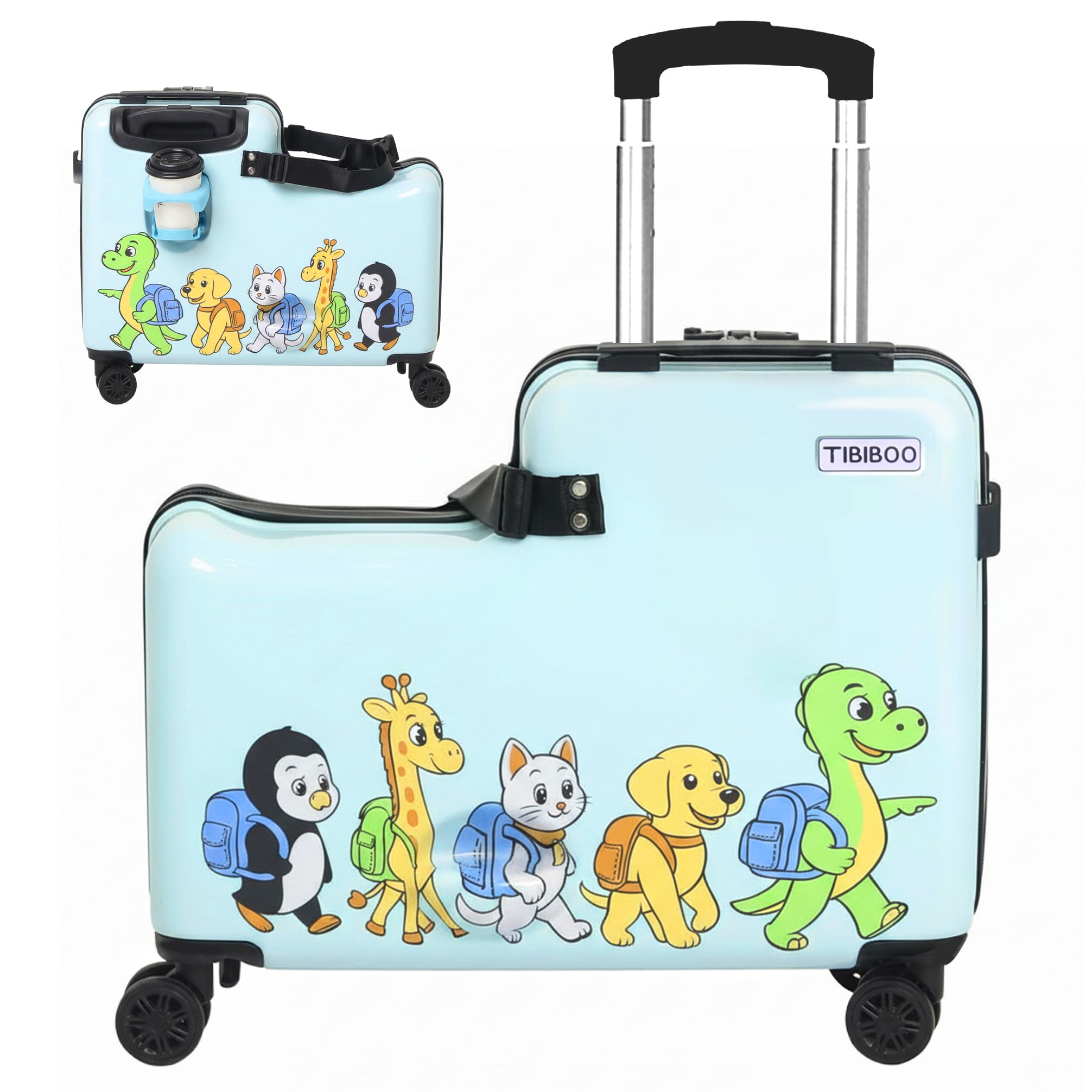
4. TIBIBOO Ride-On Suitcase 20-Inch
Best for Kids 3 to 7
Key Features
- Age range: 3 to 7 years
- Dimensions: 20 x 10 x 18 inches
- Item weight: 7.05 lb
- Rider weight limit: 80 lb
- Price: Midrange
TIBIBOO publishes the numbers most sellers leave out: ages 3 to 7, 35 to 47 inches tall, 80 pounds, and a case that measures 20 by 10 by 18 inches and weighs 7.05 pounds. That’s guidance you can hold a tape measure against, and it’s why we like this one for a child at the older end of the ride-on years — a 45-inch six-year-old is inside the stated range instead of past it. The 20-inch height also sits taller than most kids’ cases, closer to a small adult carry-on.
The hardware is the other reason it’s here: 360-degree spinner wheels, a TSA combination lock, a cup holder molded into the top of the shell, and a hard polypropylene body that stays rigid with a child aboard. It rolls loaded without fighting you, and it stays upright when someone climbs on. What it isn’t is light — 7.05 pounds empty is half again our top pick, which is the difference between one hand and two on a jet bridge. For a six-year-old, though, that’s the weight of a case actually sized for them.
Pros
- Published height and age range to check
- TSA lock and built-in cup holder
- Rolls loaded without tipping
Cons
- Shell isn’t water resistant
We like this for the top of the ride-on years: it’s sized for ages 3 to 7 and 80 pounds, and the 20-inch shell takes a TSA lock and a cup holder.
5. TABU Ride-On Luggage Set
Best with Cup Holder and Charging
Key Features
- Wheels: 6
- Included: Portable bag
- Dimensions: 16.93 x 8.26 x 18.11 inches
- Item weight: 12.4 lb
- Price: Budget
Twelve and a half pounds empty makes this the heaviest case we recommend, and it’s worth understanding what that buys before the feature list pulls you in. Extra wheels, a charging port, and a second bag in the box all add ounces, and the payoff is a case that sits planted on six wheels instead of balancing on four.
The features are real, not filler. There’s a hidden cup holder that folds out of the shell, USB-C and USB ports on the outside for a power bank you supply, a foldable pedal for a rider’s feet, a TSA combination lock, and a scratch-resistant EVA hard shell. Packing is one main compartment, and the included portable bag takes the overflow that would otherwise end up in your own carry-on. It measures 16.93 by 8.26 by 18.11 inches.
We like it for long airport days with a bigger kid: the six-wheel base is the most planted arrangement in this group, and the cup holder and port earn their keep trip after trip. It’s also the case that most rewards a family who checks nothing, since the child’s things and the small extras fit in one piece.
Pros
- Six-wheel base stays planted
- Hidden cup holder and USB-C port
- Portable bag included
Cons
- Tall enough to miss some regional-jet bins
The most gadget-friendly case here — six wheels, a hidden cup holder, a USB-C port — and we like it for long airport days.
6. Bioworld Scooby Doo Ride-On Luggage
Best Character Design
Key Features
- Shell: Polycarbonate
- Wheels: 2 spinner
- Dimensions: 13 x 9 x 18 inches
- Item weight: 3 lb
- Price: Midrange
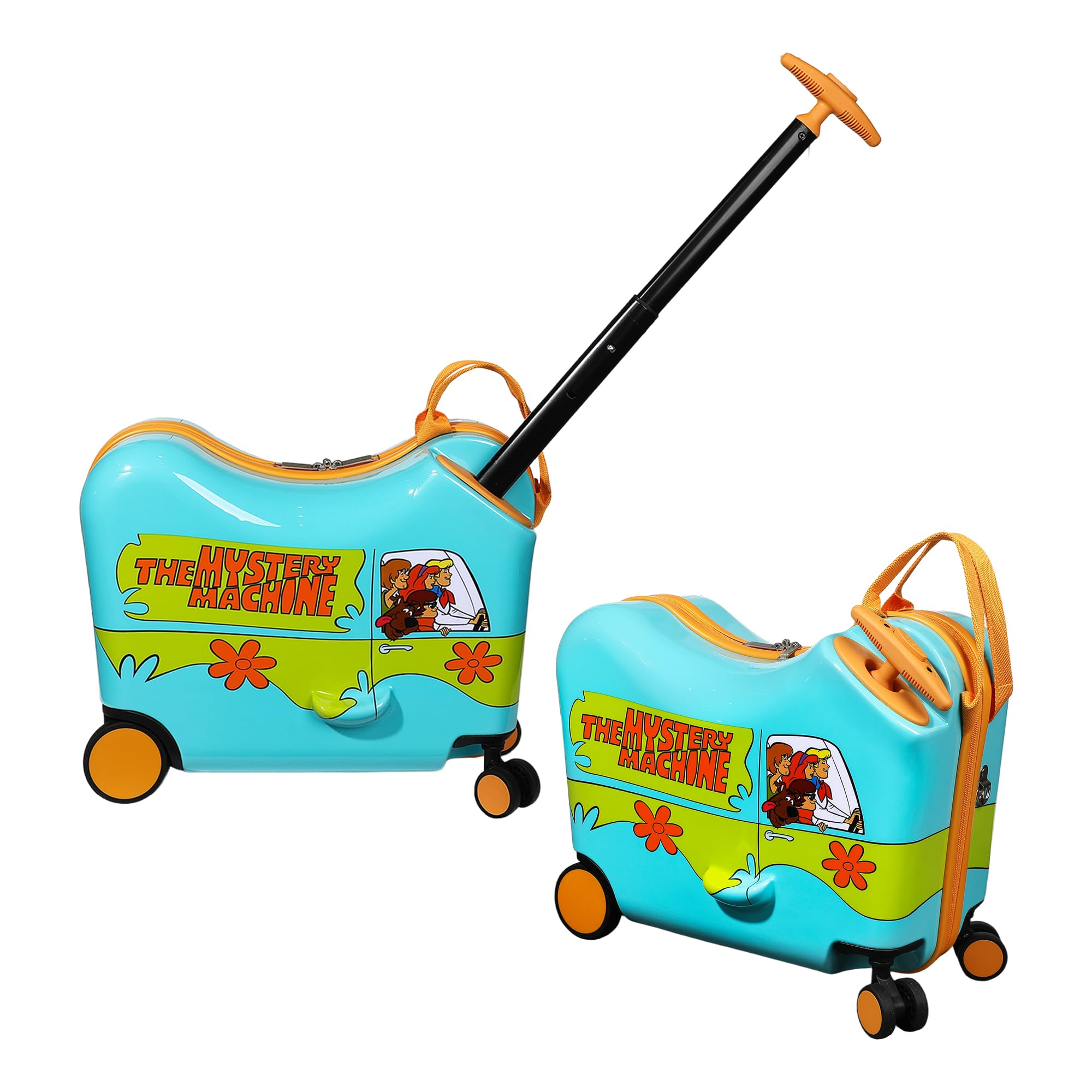
Two wheels rather than four is the first thing to understand here, because it changes how the case behaves. Like a rolling duffel, it tips onto its wheels and follows you instead of standing on its own, which makes it the easiest case here to carry at 3 pounds and the least stable thing for a child to climb on while you’re not holding it. At 13 by 9 by 18 inches it’s sized to a preschooler, and the polycarbonate shell carries Scooby Doo graphics across the whole face.
Inside there’s one main compartment and two pockets: enough for a toddler’s clothes, snacks, and a tablet for the trip, not the family’s overflow. The wheels roll smoothly, the shell wipes clean with a damp cloth and mild soap, and it takes stickers and scuffs without showing them. It’s the only case here with a licensed character, and for a two-year-old that’s most of the argument.
What we keep coming back to is how much use you get out of a small case. It’s the one a toddler can sit on at the gate and then drag behind them at the hotel, and at 3 pounds it’s the one you won’t mind carrying when they quit. For an older kid who wants to scoot, look at the Younglingz; as a first ride-on, this is the least fussy case here.
Pros
- 3 pounds, the lightest case here
- Licensed Scooby Doo shell
- Wipes clean with soap and water
Cons
- Handle runs short for taller parents
Three pounds, licensed Scooby Doo graphics, and the easiest case here to carry — we like it for toddlers who mostly want to sit and be pulled.
7. AODI Ride-On Suitcase 20-Inch
Best for Packing More Clothes
Key Features
- Lock: TSA combination
- Capacity: 35 liters
- Case size: 20 inches
- Item weight: 9.6 lb
- Price: Midrange
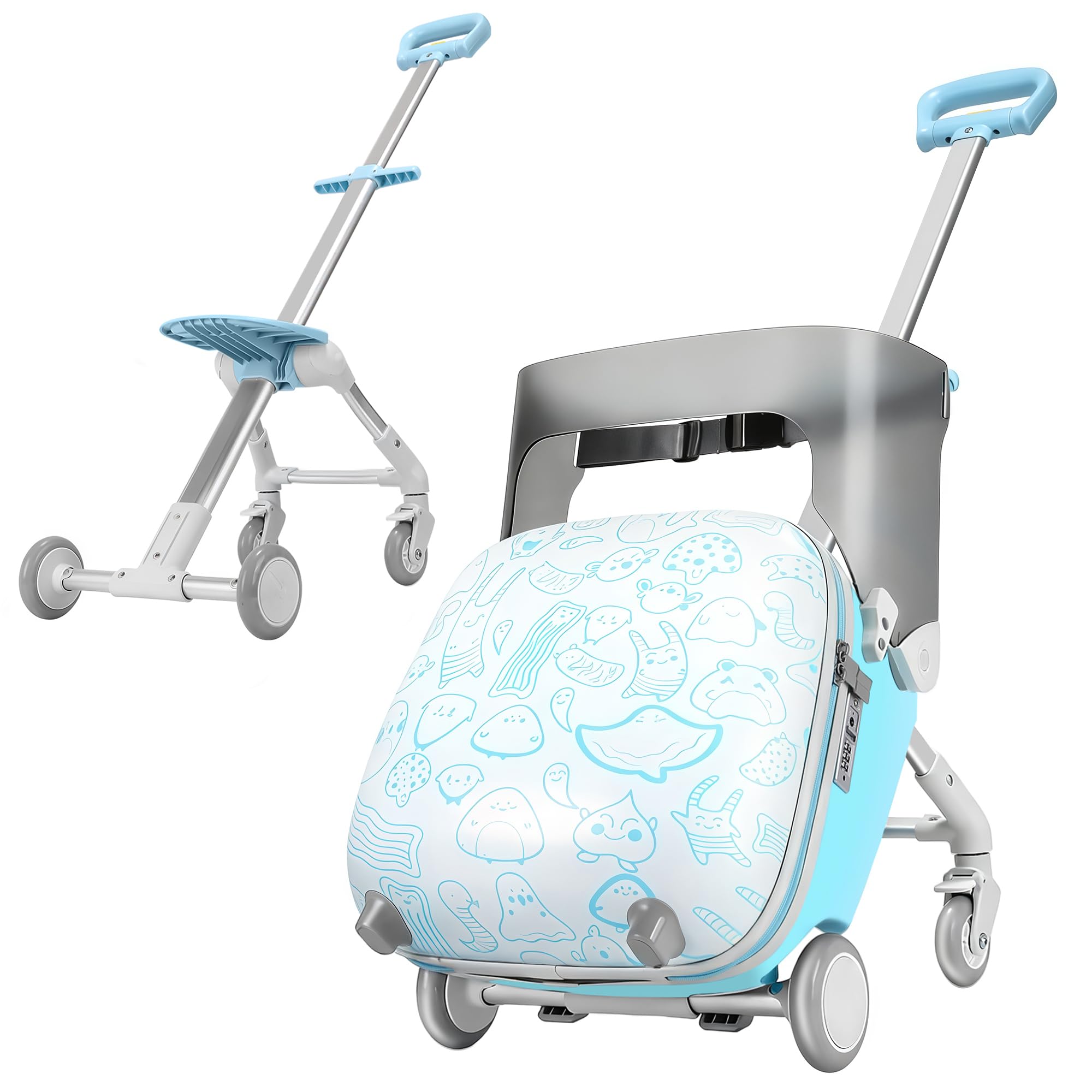
The trolley separates from the case with a push and folds flat, which makes this the only pick here that turns a single purchase into two jobs: a 35-liter, 20-inch carry-on for the overhead bin and a ride-on frame for the terminal. The detach is quick enough to do at the gate rather than at home, and the frame folds small enough to stow once you’re seated.
We like it for families with a longer packing list. Thirty-five liters is more than our top pick’s 26, the case expands, and there’s a TSA lock, two zippered pockets, and mesh compartments so a small person’s things stay findable. The PU wheels run quietly over terminal floor, and the ABS and polycarbonate shell has held its shape with a child aboard.
The maker’s own instruction is to detach the trolley before boarding, and it’s worth following: assembled, the unit is listed at 22.44 inches long, which is at or past the limit on the stricter airlines. Detached, the 20-inch case goes into the bin — the trade is a second piece to keep track of until you’re in your seat.
Pros
- Trolley detaches and folds flat
- 35 liters with a TSA lock
- Quiet PU wheels
Cons
- 9.6 pounds empty to haul
One bag that packs 35 liters and then comes apart into something a child can ride — we like it for families who’d rather buy once.
8. Milk&Moo Ride-On Suitcase 21L
Best for Short Trips

Key Features
- Capacity: 21 liters
- Footrests: Fold-out
- Dimensions: 12.2 x 18.89 x 9.45 inches
- Item weight: 3.3 lb
- Price: Budget
This is the least expensive case we recommend, and nothing on the outside of it reads as the budget option: a hard ABS shell, four spinner wheels, fold-out footrests, and a tow strap in the box. The Little Mermaid artwork covers the whole case in purple, which is the part the four-year-old in your life will notice first.
At 21 liters it takes a long weekend of clothes, pajamas, snacks, and a tablet, with an interior zip pocket for the small things. It measures 12.2 by 18.89 by 9.45 inches, sized to cabin limits rather than a few inches over them, and the hard shell means it doesn’t need babysitting in a pile of bags.
The ride is where a small case can go wrong, and four spinner wheels are the right call at this size: they turn in place, so a child can stand the case upright and pivot in a queue instead of dragging it sideways. The footrests fold out for a rider whose legs don’t reach the floor, which keeps heels from scraping along the terminal. At 3.3 pounds it’s the second lightest case here — you can lift it with two fingers when your child decides they’re done.
Our take: buy it if the ride-on is still a novelty and you’d rather not spend premium money finding out whether your child takes to it. If they do, 21 liters is what you’ll outgrow first — the VEVOR’s 26 liters and 110-pound rating is a modest step up in both space and years.
Pros
- Least expensive case we recommend
- Fold-out footrests for a rider
- Four spinner wheels turn in place
Cons
- 21 liters fills fast past a weekend
The least expensive way into a real ride-on, and we think it’s the right first case: 21 liters, fold-out footrests, and four spinner wheels.
How We Chose and Tested Ride-On Suitcases for Kids
We started with a shortlist of three dozen listings and cut anything without a stated weight limit, a seat a child could actually sit on rather than lean against, or a handle long enough for an adult to tow comfortably. Then we brought in 12 suitcases across the price range, mixing licensed character shells with plain hardshells, and lived with them for six months, two weeks of which were spent on real trips with connecting flights.
Kids ages 2 through 6 packed each case with the identical weekend load — four outfits, pajamas, a stuffed animal — so we could see how much actually fit and whether the lid shut without a knee on it. In airport terminals, hotel hallways, and on a cracked stretch of sidewalk, we loaded a child onto each seat and watched what happened when they leaned sideways or pushed off a wall, since a narrow wheelbase tips fast. We noted which cases tracked straight when a 4-year-old steered and which veered into every display rack, then carried each one packed up a flight of stairs by its handle to judge how it felt in one hand.
Durability got the least gentle treatment: wheels-down drops off a curb, a few gate-checks, and trunks packed tight against a stroller. Afterward we looked for wobbly wheels, scuffed corners, and zippers that had started to catch. We judged value on the whole package — what the case held, how easily a kid moved it alone, and whether it still worked as luggage once they got tired of riding.
How to Choose a Ride-On Suitcase
A ride-on case has to work as luggage first and a toy second, and the three things that decide whether yours lasts past the second trip are the rider rating, the wheel layout, and how much the empty case weighs.
Match the Rider Rating to Your Child
The number in the spec sheet is a structural limit, and the spread across these picks is wide: 80 pounds on the TIBIBOO and the Younglingz, 110 on the VEVOR. A three-year-old is nowhere near either figure, so buy for the child you’ll have in two years. Height is what children outgrow first, which makes published age and height guidance worth more than a top-line weight. TIBIBOO’s 35-to-47-inch range is the most specific here and the easiest to check against a doorframe before you order.
Wheel Count Changes How It Rides
Count wheels before you count features. A two-wheel case tips and follows like a rolling duffel — the Bioworld is the featherweight version — and while it’s easy to pull, it won’t stand up with a rider aboard. Four spinners turn in place and suit a child who wants to stand the case upright in a queue. Our favorite arrangement for a rider is the mixed one on the VEVOR: swiveling front wheels with a fixed rear pair, which tracks straight instead of wandering. More wheels is not more quality; on the TABU, six of them are mostly extra weight.
Empty Weight Beats Capacity
The case becomes your bag the moment your child decides they’d rather walk, so the empty weight matters as much as the liters. The VEVOR is 4.7 pounds with 26 liters; the Younglingz is 10 pounds with 47; the TABU is 12.4. Our rule is to pick the smallest case that holds the trip, then check what it weighs unladen — a 47-liter case you end up carrying is worse than a 21-liter case the child actually rides.
Check the Aircraft, Not Just the Airline
Carry-on limits vary by airline and by aircraft, and ride-on luggage sits close to the line because the ride surface adds height. Detachable designs make this easier: the AODI’s trolley comes off, and the maker tells you to remove it before boarding because the assembled unit runs 22.44 inches long. Twenty-inch cases fit most mainline overhead bins; regional jets are what catch people out. Look up the aircraft type on your booking and check that airline’s limit for it, not the number you remember from last time.
Frequently Asked Questions
Can you gate-check a ride-on suitcase?
You can, but it’s the fastest way to shorten the life of one, because the shell and the wheel mounts take the handling. If the flight is full and the bins look tight, ask at the gate rather than at check-in, and photograph the wheels before you hand the case over. Expect the shell to show the trips first.
Does a ride-on suitcase replace a stroller at the airport?
For a child who can sit up and hold on, often yes — that’s the appeal of the MRPLUM’s belted seat and the TIBIBOO’s 80-pound deck. What none of these do is recline, so they’re no help for a toddler who still naps on the move, and a sleeping child ends up in your arms either way. Try the ride at home on a hard floor before you depend on it for a connection.
How does a kid get through security on one?
They get off and walk through the metal detector while the case goes on the belt, so practice the dismount at home before the trip. Collapse the handle and fold the footrests so the case lies flat on the X-ray belt, and keep snacks in your own bag so you aren’t digging through it at the far end of security.
Final Verdict
Buy the VEVOR. It’s the lightest fully equipped case here, rated for riders up to 110 pounds, and priced well below the premium picks — for most families it ends the search.
Two cases justify the extra money. If your child is under three and can’t hold on, the MRPLUM‘s belted seat is the only design here that works for a toddler who needs strapping in. If you pack for a week at a time, the Younglingz‘s 47 liters saves you a second bag.