This post contains affiliate links. We may earn a small commission when you buy through our links — at no extra cost to you.
A soft-sided carry-on is the bag that says yes when the overhead bin doesn’t. It gives when you wedge it into the last few inches of space, shrugs off a knee to the side pocket, and swallows one more layer on the trip home. The trade-off is that its structure lives in the frame, the handle, and the zippers rather than a molded shell — so a weak one sags, drags a wheel, and starts listing to one side by trip three.
Over the past eight months, my team and I have lived out of 10 soft-sided carry-ons: packing them for four-day trips, hauling them through terminals and up jet bridge ramps, lifting them overhead one-handed, and overstuffing them on purpose to see what gave first. Two things I wish someone had told me sooner — eight wheels roll noticeably smoother but add width and hardware, and an expansion zipper buys you two days of souvenirs at the cost of bin clearance. Below are the bags that held their shape and still measured up as carry-ons when it counted.
Our Top Picks



The Best Soft-Sided Carry-On Luggage, Reviewed
1. Travelpro Maxlite 5 Spinner
Best Overall
Key Features
- Weight: 5.4 lb
- Capacity: 46 liters
- Expansion: 2 inches
- Case dimensions: 21" x 14" x 9"
- Price: Midrange
Five and a half pounds is the figure that settles this one for us. The case measures 21 by 14 by 9 inches — the bag alone, before the wheels and the handle — so it clears the international carry-on limits that a 23-inch overall bag runs into. On a route where your bag gets weighed at the gate, saving weight on the suitcase itself is the cheapest way to bring more clothes.
What we appreciate most is how little it asks of you in an airport. The four spinner wheels go in any direction, the PowerScope handle locks at 38 and 42.5 inches so it fits short and tall travelers alike, and there are grab handles on the top, side, and bottom — that last one earns its place when you are lifting the bag into a bin. Inside, 46 liters across five pockets, including a full-length lid pocket and a side accessory pocket, is enough for a week if you roll rather than fold, and two inches of expansion covers the return leg.
The stain-resistant polyester and the water-repellent DuraGuard coating shrug off scuffs and drizzle, and the zippers are stout enough to handle being overpacked. Coverage is the reason a mid-priced bag makes sense: limited lifetime warranty plus the Trusted Companion Promise, which repairs airline damage for a year — but only if you register the bag, so do that the week it arrives.
Where the Platinum Elite spends its extra money is on a suiter and USB ports; where this one spends it is on staying out of your way. For most trips, that is the better trade.
Pros
- 5.4 pounds leaves more allowance for clothes
- 46 liters with two inches of expansion
- Handle stops at 38 and 42.5 inches
- Lifetime warranty covers airline damage for a year
Cons
- Telescoping handle is the part that fails
- No integrated TSA lock
Five and a half pounds, 46 liters, and a lifetime warranty that covers airline damage: we think this is the soft-sided carry-on most travelers should buy first.
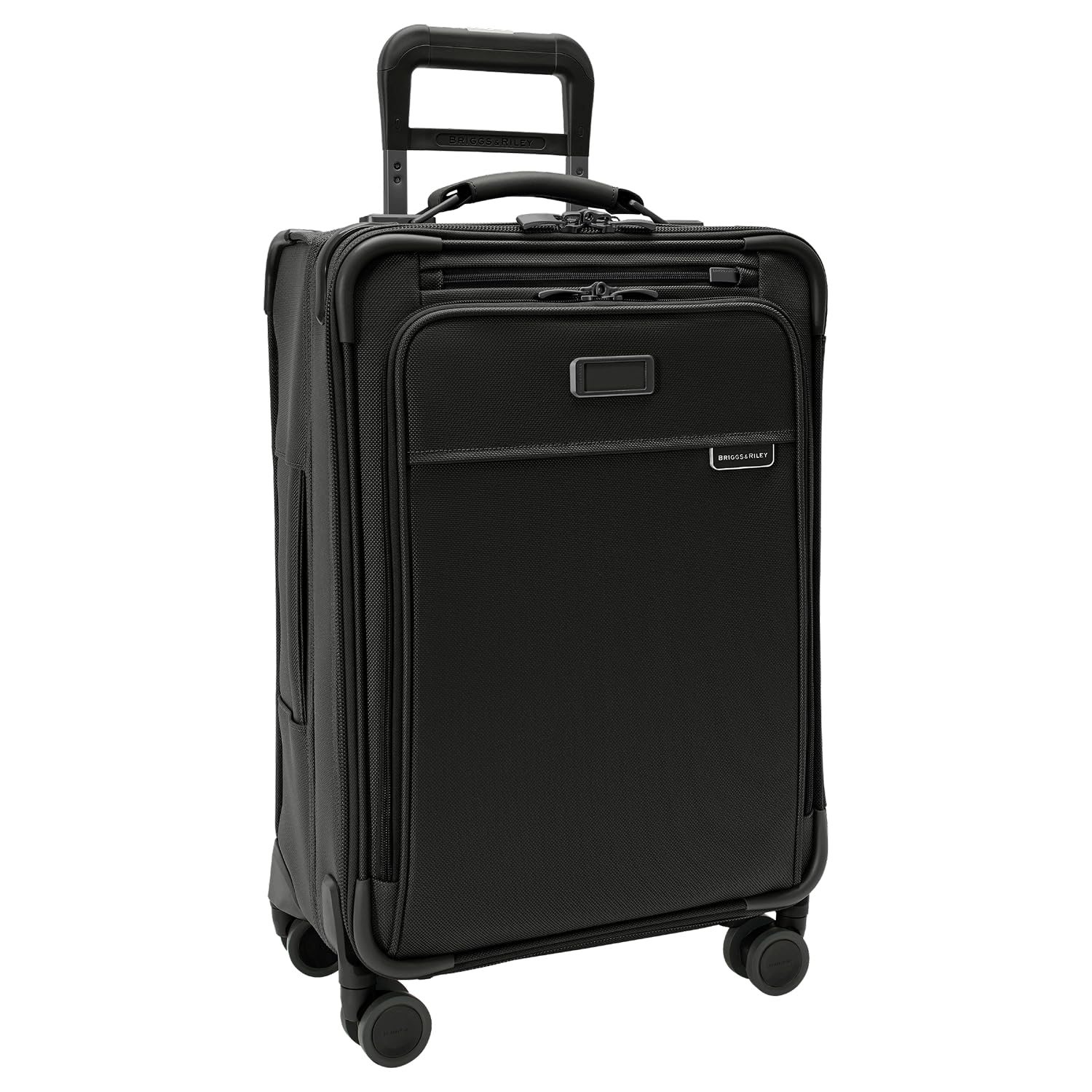
2. Briggs & Riley Baseline Essential
Best Splurge
Key Features
- Weight: 10 lb
- Capacity: 51 liters
- Warranty: Lifetime repair service
- Dimensions: 22" x 14" x 9-11.5"
- Price: Luxury
The lifetime repair service is the whole argument. Briggs & Riley fixes a Baseline bag for as long as you own it, airline damage included, which turns the highest price in this group into a one-time purchase rather than the first of several. Run the arithmetic over a decade of replacing mid-priced suitcases and the number stops looking extreme.
The packing design earns its keep too. A front compartment holds a genuine garment carrier, with hangers, so a jacket or a dress travels flat instead of folded into a cube. Expansion takes the depth from 9 to 11.5 inches and then compresses back down — the difference between fitting a week in and fitting the sizer on the way home. We also like a small thing: the front pocket is lined in orange, so you can see from across the room that you left it open.
Nylon and mesh, water-resistant, four shock-absorbing spinner wheels, three grab handles, and a USB pass-through pocket that takes a battery you supply yourself. It is unmistakably a business traveler’s bag — quiet, black, and happier on a hotel lobby floor than on a gravel road, which is roughly the boundary of what we recommend it for.
Pros
- Lifetime repair service, airline damage included
- Real garment carrier keeps a jacket flat
- Expands from 9 to 11.5 inches deep
- Orange lining shows when the pocket is open
Cons
- Ten pounds empty, the heaviest here
- Wheels wander when packed full
Buy it once: the lifetime repair service, a real garment carrier, and 51 liters of compressible space make this the bag we point hard travelers to when they are done replacing suitcases.
3. Travelpro Platinum Elite Carry-On
Best for Business Travel
Key Features
- Weight: 7.7 lb
- Capacity: 46 liters
- Case dimensions: 21" x 14" x 9"
- Overall dimensions: 23.5" x 14.5" x 9"
- Price: Premium
Packing a jacket in a carry-on usually means accepting a crease somewhere. The Platinum Elite’s drop-in suiter is the feature this bag is built around: a garment rides on its own hanger in its own compartment while the rest of the suitcase packs around it. If your trips end in a meeting rather than on a beach, that one design decision is worth more than every other difference between these bags.
Everything else is drawn up the way a frequent flyer wants it: nine pockets across three sections, tie-down straps and a full-length lid, a TSA combination lock built into the zippers, and USB-A and USB-C ports wired to a dedicated power bank pocket. The pocket, not the battery — you supply that.
We haven’t handled a bag in this group that rolls better. Eight dual spinner wheels with magnetic self-aligning heads straighten the case out when you pull it fast through a concourse, and the four-stop handle suits almost any height. One number deserves attention: the case is 21 by 14 by 9, but the overall length including wheels and handle is 23.5 inches, and that is what a sizer measures. It is why Travelpro bills this as fitting most major US carriers rather than every airline everywhere.
Coverage softens the outlay — limited lifetime warranty plus the Trusted Companion Promise for airline damage. What you are paying for, in the end, is a suitcase that behaves like office equipment: organized, quiet, predictable, and with somewhere to put a jacket.
Pros
- Drop-in suiter keeps a jacket flat
- Magnetic self-aligning dual spinner wheels
- Nine pockets and a built-in TSA lock
- USB-A and USB-C ports with a power bank pocket
Cons
- 7.7 pounds empty for a 46-liter bag
- Front-pocket zipper can fail early
For work travel where a jacket has to arrive unwrinkled, the Platinum Elite’s drop-in suiter, magnetic wheels, and nine pockets are worth the extra weight and money.
4. American Tourister 4 KIX 2.0
Best Budget
Key Features
- Weight: 7.5 lb
- Wheels: 4 spinner
- Expansion: 1 inch
- Overall dimensions: 14.5" x 9.5" x 23.5"
- Price: Budget
For well under what our top pick costs, the 4 KIX 2.0 delivers most of what most people need from a carry-on. It is a 20-inch softside spinner in rugged polyester with carbon-fiber trim and gunmetal hardware, and it looks considerably more expensive than its shelf position suggests.
The first thing we noticed is how firmly it stands. A 20-inch four-wheeler has a narrow footprint, and plenty of them pirouette the moment you let go of the handle; this one holds its ground at the gate while you dig for a boarding pass. The ball wheels roll easily on tile and low carpet, and the trolley grip is shaped rather than a bare tube, which matters over a long walk through a big airport.
Every 4 KIX case expands by an inch, so the trip home has somewhere to put the souvenirs. Inside it is one compartment and a stretch strap with no dividers, which makes it the fastest bag here to pack and unpack — whether that reads as simplicity or as a missing feature depends on how much you like compartments. We didn’t miss them.
Pros
- Stands steady on four wheels
- Rolls easily on tile and low carpet
- Expands an inch for the trip home
Cons
- 7.5 pounds is heavy for a 20-inch bag
- Zipper pulls can snap when the bag is full
The 4 KIX 2.0 is the carry-on we point first-time flyers and occasional trippers to: steady, easy to roll, and priced well below everything else full-sized here.
5. LUGGEX Expandable Softside 20"
Best Compact Option
Key Features
- Weight: 6.9 lb
- Wheels: 8 spinner
- Capacity: 35 liters, expands to 40
- Dimensions: 22" x 14.2" x 9.1"
- Price: Budget
The laptop compartment comes out. That is the detail that sold us: the padded sleeve is sized for a 15.6-inch machine and detaches with a pouch for a charger and a passport, so you can walk into a meeting with the sleeve and leave the suitcase in your room. Most bags that advertise a laptop pocket give you a flimsy slot against the back wall.
It is also the one here that genuinely goes under the seat. At 22 by 14.2 by 9.1 inches and 6.9 pounds, it slides into the space in front of you on a regional jet where the overhead fills before boarding finishes — a different kind of carry-on from the 21-inch cases that assume bin space. Eight spinner wheels keep it steady when you haul it at an angle through a crowd, and the aluminum handle feels more solid than the weight would suggest.
The fabric is where the budget shows. It is nylon with no water-resistant treatment, so a rainy connection means a pack cover or a dry bag for anything that cannot get damp — worth knowing before you commit a laptop to it. For a bag that spends its life between an office and a hotel room, that is a trade we can live with.
Pros
- Detachable padded 15.6-inch laptop sleeve
- Slides under the seat on regional jets
- Eight spinner wheels and an aluminum handle
- 6.9 pounds empty
Cons
- 35 liters before expansion, so short trips only
- Handle housing takes space from the main compartment
If you fly regional jets and want your laptop with you, this is the one: 6.9 pounds, eight wheels, a detachable padded sleeve, and a footprint that slides under the seat.
How We Tested Soft-Sided Carry-Ons
We started with every soft-sided carry-on we could find that publishes its exterior dimensions, then narrowed with three filters: it had to be sold as a domestic carry-on, it had to ride on spinner or inline wheels rather than being a pure tote, and the lineup had to span budget nylon through lifetime-warranty construction. That left 10 bags, which we bought at retail so none of them arrived pre-broken-in by a brand.
Each one got the identical four-day packing list — five shirts, two pairs of pants, a dopp kit, a 15-inch laptop, chargers, and a pair of shoes. We weighed every bag empty on a luggage scale, weighed it again fully packed, and noted how much of the interior we actually used versus how much the published capacity promised.
The bags lived where carry-ons actually live: curbside drop-offs, terminal tile, the carpeted run to a tight connection, jet bridge ramps, the aisle of a regional jet, and the stairs up to a third-floor walkup. We rolled each one fully loaded with one hand while holding coffee in the other, pivoted them inside a two-foot square to see how tight a turn they’d make, and lifted them overhead one-handed at chest height 20 times to watch for handle flex and frame sag.
Zippers got the least gentle treatment. We packed each bag past its expansion limit, then ran the main zipper around all four corners and pulled hard at the seam where soft bags usually split. We measured every bag against an airline sizer with the expansion open and closed, tracked how much bin clearance expanding cost, and over eight months of real trips logged how fabric, wheels, and handles wore — which is how we landed on value rather than just price.
How to Choose Soft-Sided Carry-On Luggage
The number that decides whether you walk past the gate agent or hand over your bag at the jet bridge is not the one printed largest on the box — it is the overall measurement, wheels and handle included.
Case Dimensions vs. Overall Dimensions
Most soft-sided carry-ons are listed with two sets of numbers, and the smaller set is the one that sells bags. A case measuring 21 by 14 by 9 inches often measures around 23.5 by 14.5 by 9 once the wheels and the telescoping handle are counted, and the sizer at the gate measures the second figure. Domestic carriers are usually forgiving; the strict limits are international, and on the small regional aircraft where a bag that boarded fine last month suddenly doesn’t.
Compare the overall length first, then the case dimensions. If you fly one airline regularly, check its published sizer rather than a product page’s carry-on claim — the airline’s number is the one that decides whether your bag stays with you.
Empty Weight Is the Spec That Costs You Clothes
The bags here run from 5.4 to 10 pounds empty, and that spread is not a rounding error. On carriers that weigh cabin baggage, every pound of suitcase is a pound of clothing left at home; on any trip, it is the difference between lifting your bag into the bin with one hand and asking a stranger for help.
We choose the lighter bag and spend the difference on a better packing cube, because a bag you can lift after a long flight is a bag you keep using. Subtract the empty weight from your airline’s allowance before you decide a bag is big enough.
Four Spinner Wheels or Two
Spinners roll upright beside you, take the load off your wrist, and pivot on the spot in a crowded aisle. Two inline skate wheels track straighter over cobblestones, curbs, and gravel, and they leave more room inside the case because the wheel housings are smaller.
Match the wheels to the ground you actually travel on. Airports, hotels, and taxi trunks call for four spinners; old European cities, train platforms, and walk-up apartment stairs make the case for two. Neither is the better bag — each is better on a different trip.
Where Softside Bags Actually Fail
The fabric is rarely the weak point. Polyester and nylon with a water-repellent coating — Travelpro’s DuraGuard is the example here — shed drizzle, wipe clean, and flex when an overhead bin is tight. What fails is the hardware: the main zipper, the front-pocket zipper, and the telescoping handle.
Look for chunky coils, seams that are stitched and backed rather than glued, and a handle with at least two stops so you are not always running it out to full height. Then read the warranty, because on a soft bag the parts that break are the parts that can be repaired.
What the Warranty Actually Promises
A limited lifetime warranty and an airline-damage promise are different things, and the second is the one worth having. Travelpro’s Trusted Companion Promise covers repair for carrier damage for a year on top of limited lifetime coverage, and Briggs & Riley repairs its bags for life. Both start with the same step.
Register the bag the week it arrives and keep the receipt somewhere you will find it. These promises generally require proof of purchase, and a registration you meant to do after the first trip is the one that never happens.
Frequently Asked Questions
Is soft-sided luggage as durable as a hard-shell suitcase?
Neither is tougher in the abstract. A hard shell spreads impact across its shell and protects crushables better; a softside flexes, squeezes into a full bin, and forgives an overpacked return leg. The wear points on a soft bag are the zippers and the handle, which is why warranty coverage matters more here. Carry bottles or a camera and choose hard shell; overpack and fly crowded routes and choose softside.
How do I clean a soft-sided carry-on?
Spot clean with mild soap, a soft brush, and a damp cloth, then wipe with clean water. Don’t submerge the bag or put it in a washing machine — the wheel bearings and the water-repellent coating won’t survive either. Empty every pocket, open the case fully, and let it air-dry completely before storage, since a closed damp bag is how mildew starts.
Can I expand the bag and still carry it on?
Yes, if you expand it after the gate. Two inches of expansion takes a 9-inch-deep case to 11 inches, which is over the limit on airlines that measure and enough to keep a bulging bag out of the overhead bin. Pack it expanded the night before, zip it back down before you board, then open it again at the hotel.
Final Verdict
For most travelers, the Travelpro Maxlite 5 Spinner is the answer: 5.4 pounds, 46 liters, wheels that go in any direction, and a warranty that covers airline damage for a year. It is the bag that asks the least of you on the day you fly.
Step up to the Briggs & Riley Baseline if you want to stop shopping for suitcases — the lifetime repair service is the point, and carrying ten pounds to the lobby is the price. Travel for work with a jacket and the Platinum Elite‘s suiter earns its keep. The 4 KIX 2.0 covers the first-time flyer without feeling cheap, and the LUGGEX is the one for regional jets and laptop bags.