This post contains affiliate links. We may earn a small commission when you buy through our links — at no extra cost to you.
There’s a particular panic that hits at the gate: the line is moving, the agent has a hand out, and your boarding pass is buried under three days of clothes. A carry-on with a front pocket kills that problem with one zip — and introduces another, since that pocket gets carved out of the space your socks were counting on.
I’ve traveled out of a 20-inch hardshell for years, and I was skeptical a front flap could earn its keep. After six months with 12 of these bags — flights, train platforms, the trunk of the car on weekend drives — the good ones share a trait: the pocket lies flat when it’s empty and doesn’t steal from the main compartment when it’s full. The bad ones bulge, fishtail on four wheels, and wear every curb they’ve met.
Two things surprised me. Seller dimensions usually leave out the wheels and handle, so a bag badged 22 by 14 by 9 can miss an airline sizer by an inch. And hard shells do scratch — matte finishes hide it far better than glossy ones. A handful of these came home looking new; a few looked borrowed. The ones below struck the balance between quick access, real capacity, and a shell that still looks decent after a year of being thrown into bins.
Our Top Picks


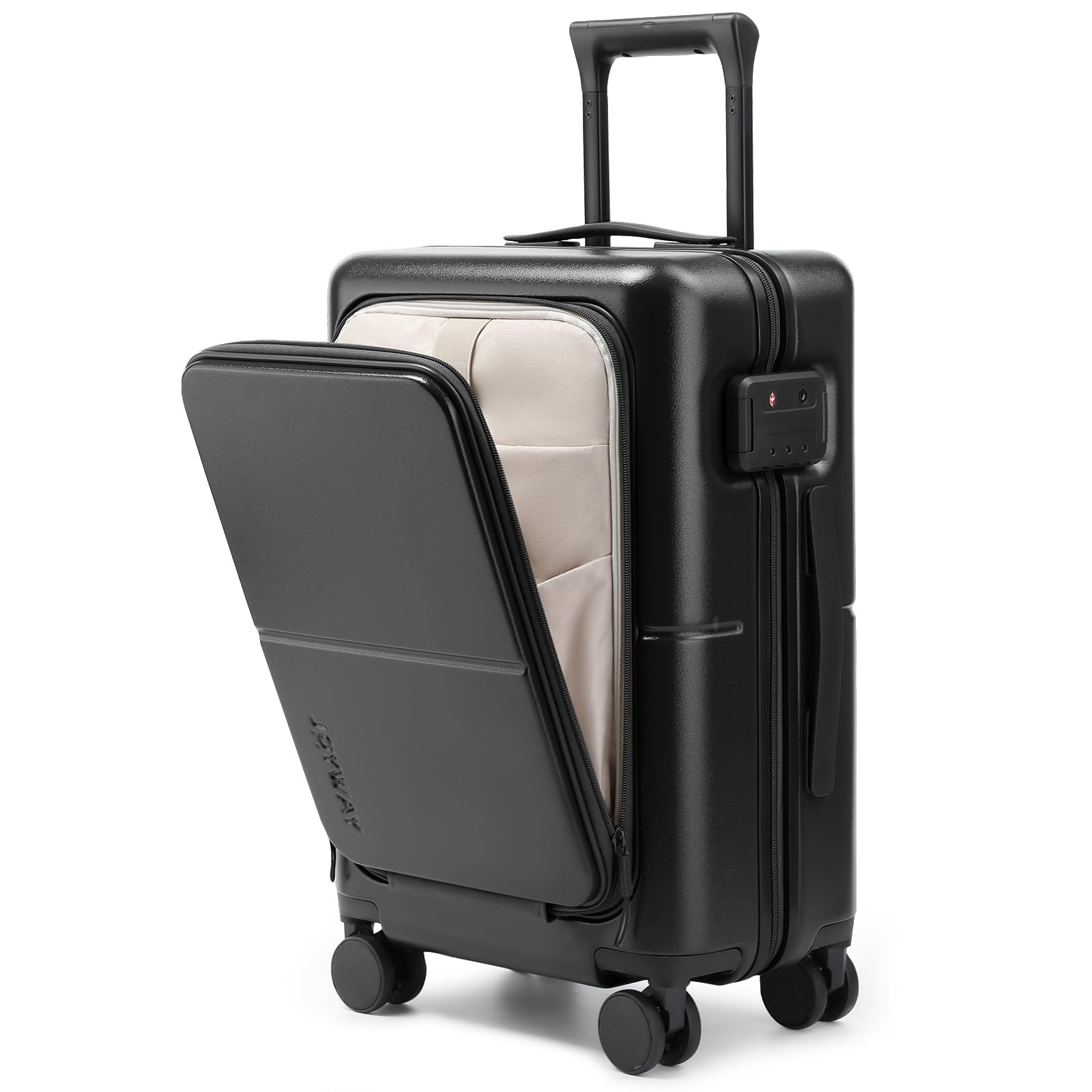
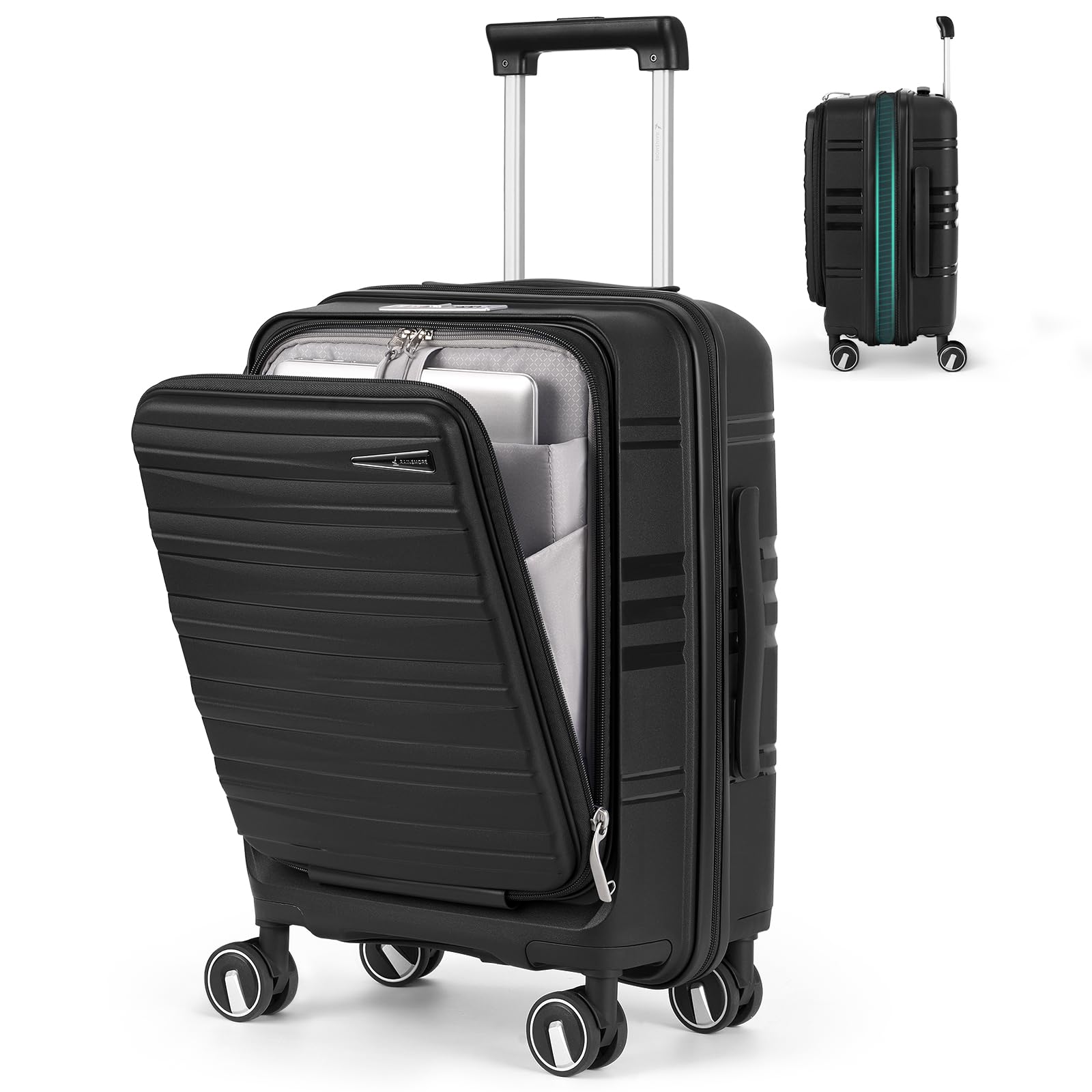
The Best Carry-On Luggage with a Front Pocket, Reviewed
1. Delsey Helium Aero 19"
Best Overall
Key Features
- Capacity: 41 L
- Item weight: 8.7 lb
- Front pocket: Lined laptop sleeve
- Exterior dimensions: 21 x 14 x 10 in
- Price: Midrange
The Helium Aero measures 21 by 14 by 10 inches with the wheels and handle counted, and that last figure is the one to keep in mind. Length and width sit inside the 22 x 14 x 9 that U.S. carriers publish; depth runs an inch past it before you unzip anything, and the expansion adds two more. We fly it unexpanded and it has never drawn a second look at a mainline gate.
What earns it the top spot is the front pocket itself — a lined laptop sleeve built into the front lid, with the rest of the case divided into five sections and eight pockets, more organization than anything else here. Getting a laptop out means opening one zip rather than unpacking in a security line. Pair that with the smoothest rolling in this set, on eight spinner wheels and soft-touch handles, and you have the case we hand to someone who wants one bag that behaves.
Packing is generous for a 19-inch international shell: a four-day trip with a laptop, a pair of shoes and a toiletry kit fits with room for a folded layer, and the expansion buys the leg home once you’ve added a souvenir. At 8.7 pounds empty it is lighter than the LUGGEX and the Joyway, though not by enough to decide anything on its own.
Where it gives ground is front-pocket depth. The sleeve takes a laptop, a tablet or a folder, not a jacket, and if you want a bay that swallows a sweater and a paperback the LUGGEX is the better shape. For everything short of that, this is the shape that works.
Pros
- Smoothest, steadiest rolling in this set
- Lid sleeve clears security without unpacking
- Eight pockets and five sections keep gear sorted
- Expands two inches for the trip home
Cons
- Glossy shell picks up scratches and scuffs
Our pick for most travelers: a real laptop sleeve in the lid, an interior that stays organized, and the steadiest roll in this group.
2. LUGGEX Front Pocket 20"
Best for Laptop-First Travelers
Key Features
- Capacity: 38 L, expands to 42 L
- Item weight: 9 lb
- Front pocket: Separate laptop bay
- Exterior dimensions: 22 x 15 x 9.5 in
- Price: Midrange
The front compartment on the LUGGEX opens away from the case like a laptop bag’s lid, and that single decision is why we like it. Drop the case flat on a bench, lift out a laptop, close it up and roll on without ever touching the packing side. Nothing else here separates the two that cleanly.
It is a 22 by 15 by 9.5 inch case — 15 inches wide, not 14 — so it is the one to measure against a strict carrier before you commit. Capacity runs 38 liters and expands to 42 with a zip, but the front bay takes its depth out of the main compartment, so a day when the laptop pocket is full is a day the clothes side is shallower. Nine pounds empty is near the heavy end here, and with a laptop up front the case stands front-heavy; we load the shoes and the heavy layers at the back to compensate.
Two details are worth the money. The TSA lock covers both the main bag and the front bay separately, which is the arrangement that lets you leave a laptop in the room safe without leaving the whole case open. And the expander buys four liters of extra room — enough for a pair of shoes picked up on the road, not enough to rescue a chronic overpacker.
Pros
- Front bay opens flat for instant laptop access
- Dual-zone lock secures front and main separately
- Expands from 38 to 42 liters
Cons
- Nine pounds empty is on the heavy side
- Fifteen-inch width may miss strict sizers
Buy it if your laptop rides with you on every trip and you want it out of the bag in seconds — just check your airline’s sizer first.
3. CENSIEN 20" Front Pocket
Best Lightweight
Key Features
- Capacity: 36 L
- Item weight: 6.5 lb
- Front pocket: Laptop sleeve
- Exterior dimensions: 21.46 x 13.78 x 8.66 in
- Price: Budget
Six and a half pounds empty is the number that sets the CENSIEN apart: three pounds lighter than the Joyway, two lighter than the LUGGEX, and the only case on this page whose listed exterior — 21.46 by 13.78 by 8.66 inches with the wheels counted — sits inside a strict 22 by 14 by 9 box without a caveat.
The weight comes from an ABS and polycarbonate blend rather than a full polycarbonate shell, and you can feel it when you press a thumb into the front panel; there is more give than on the Delsey or the LEVEL8. We treat this as a cabin bag. It is entirely happy in an overhead bin and it belongs nowhere near a checked-bag belt. The front pocket is a slim laptop bay that takes a 15-inch device and a folder, and it borrows a little depth from the main side — the 36 liters you actually pack.
What we did not expect at this end of the range is YKK zippers and a dual TSA lock, hardware that usually turns up a tier higher. Add the white shell, which shows scuffs less than a glossy dark one, and the case makes sense for the traveler doing two- and three-day hops on carriers that measure. If you want a shell that shrugs off airport abuse, spend up; if you want to lift your bag off the belt with two fingers, this is the one.
Pros
- 6.5 pounds empty, the lightest here
- Dimensions fit a strict 22 x 14 x 9 sizer
- YKK zippers and dual TSA lock at a budget tier
Cons
- Shell flexes more than full polycarbonate
- Front bay narrows the main packing depth
The lightest case here and the easiest to walk past a strict sizer — a smart buy for short trips where every pound counts.
4. Joyway 20" Rigid Frame
Best for Business Travel
Key Features
- Capacity: 35 L
- Item weight: 9.5 lb
- Front pocket: Fits 15.6-inch laptops
- Exterior dimensions: 21.85 x 14.96 x 9.45 in
- Price: Midrange
There are brake levers on the wheels. Flick one down with a toe and the Joyway stays where you parked it — on a moving train, a sloped platform, a hotel shuttle — instead of drifting for the door. It is a small thing that no other case on this list does, and after a week of juggling coffee and a boarding pass we minded every bag that lacked it.
The other half of the pitch is the frame: a rigid plastic hoop instead of soft fabric edging around the closure, reinforced where the zip takes the strain. We noticed the difference at the hotel — the main compartment holds its shape half empty, so it packs like a small suitcase rather than a sack. The front compartment is raised off the shell and takes a 15.6-inch laptop, the largest sleeve in this group, with the device sitting proud enough to pull out one-handed.
Nine and a half pounds empty is what the frame costs you, and 35 liters is on the small side of the group: this is a three-day case, not a week’s. It is also 14.96 inches wide, so it is not the one for an airline that measures carefully at the counter. Fly Tuesday to Thursday with a laptop and a few days of clothes, though, and the trade is clearly worth it — and there is a two-year warranty behind the shell.
Pros
- Brake wheels hold it parked
- Rigid frame keeps its shape half full
- Front bay takes a 15.6-inch laptop
Cons
- Heaviest case here at 9.5 pounds
- Nearly 15 inches wide for strict carriers
For short business trips, the brake wheels and rigid frame make this the most planted case here — pack light and fly a mainline carrier.
5. RAINSMORE 20" Expandable
Best Budget
Key Features
- Expansion: Adds 5 L
- Item weight: 6.8 lb
- Front pocket: Top-lifting laptop sleeve
- Exterior dimensions: 21.5 x 14.2 x 9.5 in
- Price: Budget
This is the least expensive case here, and it still arrives with a polycarbonate shell, a front laptop sleeve, a TSA lock and a five-liter expansion zip. For a first front-pocket bag, or a second one for weekenders, that is a persuasive package — the sort of purchase that makes sense before you know exactly what you want from a suitcase.
We think it earns its place on the shape of the opening. The flap lifts from the top instead of the shell splitting into two clamshell halves, which is a pleasure in a hotel room the size of a closet and in a crowded bin where you cannot lay the case flat. The catch is packing from scratch: you load through a lid rather than laying the bag open, and the zip behind the laptop sleeve adds a step every time you reach the main compartment.
At 6.8 pounds it is the second lightest on this page, and 21.5 by 14.2 by 9.5 inches is close enough to the line that we keep it unexpanded on a strict carrier. The front sleeve is deep enough for a 15-inch laptop and a notebook, and the expansion is best used on the return leg with the laptop in your hand rather than the pocket.
Pros
- Cheapest front-pocket case here
- 6.8 pounds and expandable by 5 liters
- Top-lifting flap works in tight spaces
Cons
- Top-opening flap is slow to pack
A genuinely useful front-pocket case for occasional travelers: light, expandable and organized, with an opening that suits tight hotel rooms.
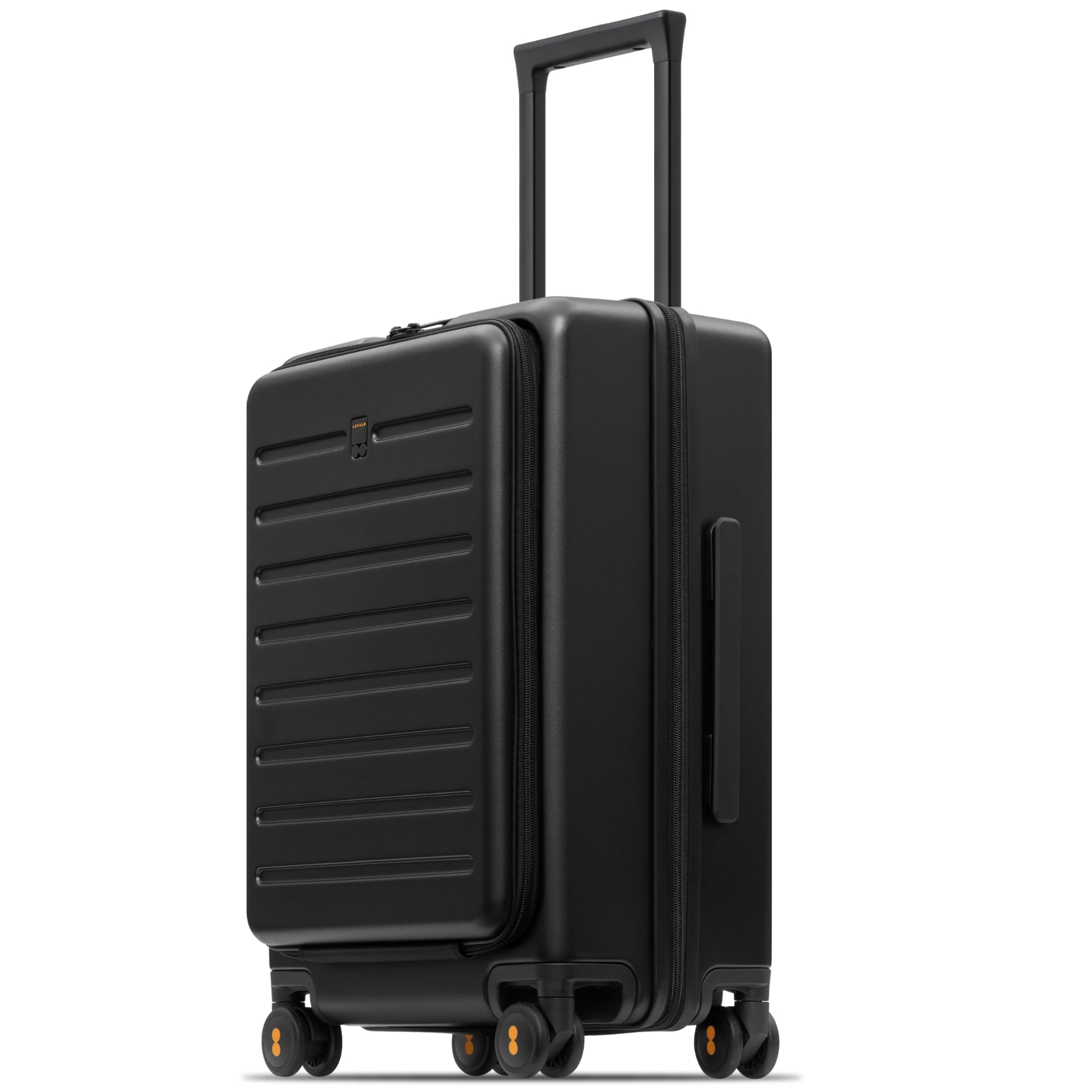
6. LEVEL8 Front Pocket 20"
Best for Smooth Rolling
Key Features
- Capacity: 38 L
- Item weight: 8.8 lb
- Front pocket: Fits 15.6-inch laptops
- Exterior dimensions: 21.46 x 14.57 x 9.45 in
- Price: Premium
Roll the LEVEL8 across a terminal and the wheels are the first thing you notice: quiet, planted and steady at the end of an outstretched arm. Over cobblestones it stayed composed where lighter cases skitter. That is the best rolling in this group, and on a long connection with a tight transfer it is not a small thing.
The rest of the design is equally considered — reinforced zippers on the main and front compartments, a TSA lock on each, and 38 liters in a shell that measures 21.46 by 14.57 by 9.45 inches. The front pocket takes a 15.6-inch laptop. We came back to the four-position handle more than expected; being able to set it at shoulder height is the difference between pushing the case and dragging it.
What holds it out of the top tier is longevity against price. The zipper line and the shell edge are where this model shows wear soonest, and at a premium price that is a question mark worth weighing rather than ignoring. The spec sheet also makes no water-resistance claim, where most cases here do. If rolling feel matters more to you than a five-year outlook, it is a lovely thing to travel with; if you want a bag to hand down, look at the Delsey.
Pros
- Quietest, steadiest wheels here
- Reinforced zippers and locks on both compartments
- Four-position telescoping handle
Cons
- Premium price against a mixed durability record
- No water-resistance claim on the shell
Worth it if you want the smoothest roll here and don’t mind premium money for a case with a mixed long-term record.
7. LOVEVOOK 20" with USB
Charging on the Go

Key Features
- Capacity: 40 L
- Charging: External USB port
- Front pocket: Fits 15.6-inch laptops
- Exterior dimensions: 22 x 14.5 x 9.4 in
- Price: Budget
An external USB port is the one feature here that nothing else offers, and it earns its keep on a long layover: your phone charges from the case instead of from an outlet three gates away. There are also hooks on the side that hold a tote or a neck pillow up to five pounds, and we found ourselves using those more than the port.
Organization is the second argument — seven pockets across two sections, 40 liters of packing space, and a 15.6-inch front sleeve. That is more capacity than anything here except the Delsey, and the cream shell is easy to spot coming down a carousel of black bags. The wheels roll cleanly and the case tracks straight when you push it ahead of you.
The dimensions are where it needs a second look. At 22 by 14.5 by 9.4 inches it is over the 14-inch width most U.S. airlines publish, and there is little margin at a gate that decides to measure. It is fine on a mainline jet and a gamble on a regional one. Nothing about the build suggests it will let you down on the trip; it is the counter, not the case, that decides.
Pros
- External USB charging port
- 40 liters with seven organizing pockets
- Side hooks hold a tote or pillow
Cons
- 14.5-inch width exceeds the common limit
Seven pockets, 40 liters and a charging port make this the organizer’s pick — as long as your airline isn’t measuring.
How We Tested Front-Pocket Carry-Ons
We started by pulling every front-pocket carry-on that listed exterior dimensions near the common 22-by-14-by-9 airline limit, then filtered out soft-sided bags, which slump once the pocket is loaded, and pockets too shallow for a tablet. That left 12 hardshell spinners, which we tested for six months in the places these bags actually live: security lines, overhead bins, hotel room floors, train platforms, and the trunk of a car.
Fit and size came first. We measured every bag with a tape at the wheels, the handle, and the widest point of the shell, since seller measurements rarely include hardware, then pushed each one into a sizer frame. We weighed them on a luggage scale — empty, then packed with the same week’s worth of clothes — to see what the pocket and its hinges actually cost. Capacity got checked the honest way: front compartment loaded with a laptop, charger, and a paperback, then testing whether the main compartment still closed without forcing the zipper, both flat and with the expansion zipper open.
Maneuverability was judged loaded and one-handed, through carpeted terminals, over cobblestones, up a curb. We noted which bags tracked straight on four wheels and which wandered. For zipper quality we overstuffed the front pocket, zipped it shut, and watched for catching teeth or a seam pulling. Scratch resistance came from dragging each shell past a concrete curb and checking for white marks; sturdiness from overhead-bin stacking, short drops, and a wobble check on each handle.
How to Choose a Carry-On with a Front Pocket
The pocket is the easy part of this purchase; the harder question is what that pocket costs you in packing depth, empty weight and balance.
Start With the Sizer, Not the Inch Count
Almost every case here is sold as a 20-inch carry-on, and almost none of them is 20 inches once you count the wheels and the handle. What an airline measures is the whole exterior against a frame of roughly 22 by 14 by 9 inches, and an inch of difference decides whether you board with the bag or gate-check it.
Two traps sit inside that. First, expansion: a zip that adds two inches of depth is a lovely thing on the return leg and a liability at a strict counter, so pack it unexpanded and expand after you land. Second, width — several of these run close to 15 inches. The CENSIEN, at 21.46 by 13.78 by 8.66 inches, is the one that sits squarely inside the box with no excuses.
Decide How Much Front Pocket You Need
There are two designs on this page. A lid-mounted sleeve is a lined pocket on the inside of the front panel: it holds a laptop and a folder, costs you almost nothing in packing room, and takes one zip to reach. A separate front bay opens away from the case like a laptop bag and takes a device out without exposing your clothes — faster at security, but it borrows depth from the main compartment, and a heavy laptop up front shifts the balance forward.
Our rule: if a laptop travels on every trip, pay for the separate bay, as on the LUGGEX. If the pocket is for a charger, a passport and a paperback, a sleeve is enough and you keep the packing space.
Weigh the Shell Against the Trip
Empty weights here run from 6.5 to 9.5 pounds, and the difference is not magic — it comes from thinner shells and ABS blends rather than full polycarbonate. The light cases are cabin bags. They are happy in an overhead bin and they are not what you hand to a checked-bag belt, however good the wheels are.
The reverse is not automatically true either. A heavier case does not guarantee a tougher one; we have seen stiff frames that survived nothing and light shells that came back clean. Buy the weight that matches the trip: lightest for short hops on strict carriers, more structure for the case that gets checked on the way home.
Wheels, Brakes and the Handle
Four spinner wheels roll fine on terminal tile; eight, or four doubles, are noticeably steadier when you push the case ahead of you instead of dragging it. Brake levers are the feature almost nobody buys for and everybody misses once they have had them: on a moving train, a sloped platform or a shuttle bus, a flick of the toe parks the bag. Only the Joyway offers them here.
Handles matter just as much. A telescoping handle with several height settings keeps the case from tipping back on your wrist if you are tall or short, and a rigid aluminum shaft beats a wobbling one every time you cross a curb.
Expect the Finish to Age
Hard shells pick up their history. Glossy, deep-lacquered finishes look superb in the shop and show every scuff from the first trip; a checkered or matte surface hides the same wear. On the Delsey, a glossy brick-red shell, scratches are the most consistent note in the ownership record, and that is cosmetic rather than structural — the shell itself holds up.
If marks bother you, choose a textured finish or a forgiving color and spend the difference elsewhere. If they don’t, buy the shiny one; scuffed luggage still rolls.
Frequently Asked Questions
Can a front-pocket carry-on double as my personal item?
No. These cases measure roughly 21 to 22 inches long, and a personal item has to fit under the seat in front of you, which puts it closer to 18 inches. An airline that checks will treat it as a second carry-on and charge you for it, or make you check it at the gate.
Bring a small tote or backpack as your under-seat piece and keep the case as your overhead bag; the front pocket holds everything you need between the curb and your seat.
Will it fit in the overhead bin on a regional jet?
Probably not. Regional jets have noticeably smaller bins than mainline aircraft, and a case at the top of the size range often ends up gate-checked. That is not a defect in the bag, just the shape of the airplane.
Pack accordingly: laptop, medication and anything you can’t lose go in the front pocket, so a gate-check tag takes the clothes and leaves the essentials with you at the seat.
Are hard-shell front-pocket suitcases waterproof?
Water-resistant at best. The shell sheds rain, but the zipper is an open seam, and a front pocket is the most exposed part of the case. A case with no water-resistance rating at all, like the LEVEL8, is the one to keep out of a downpour.
Slide the laptop into a neoprene sleeve or a dry bag before it goes in the front pocket, and put anything that must stay dry inside a zip pouch in the main compartment.
What can I pack in a 35- to 40-liter front-pocket case for three days?
Three shirts, two pairs of pants, a sweater, one pair of shoes, a toiletry kit and a laptop, if you roll the clothes and use packing cubes. That is a realistic three-day load; a fourth day means wearing the bulkiest layer on the plane.
Load the main side first and add the laptop last. A packed front pocket pushes into the main compartment, so the bag holds most when the pocket goes in after the clothes rather than before.
Final Verdict
For most travelers the Delsey Helium Aero is the front-pocket carry-on to buy. The laptop sleeve lives in the lid, the interior sorts a week of clothes into five sections, and the roll is the steadiest in this set — an easy bag to live with on a trip that mixes work and everything else.
Two requirements change that answer. If a 15.6-inch laptop comes out of the bag at every security line, the LUGGEX front bay is the faster design. If you fly carriers that measure and you pack for two or three days, the CENSIEN‘s 6.5 pounds and true 22 x 14 x 9 footprint are worth more than any feature on this page.