This post contains affiliate links. We may earn a small commission when you buy through our links — at no extra cost to you.
The promise of underseat luggage is simple: walk past the overhead-bin scramble and keep your bag at your feet. The catch is that ‘underseat’ means different things to different airlines, and a bag that clears one carrier’s sizer can bulge into your footroom on another. I’ve watched people wrestle soft totes that technically fit but leave no room for their feet. What you want is a bag that slides under the seat without a fight, holds enough for a two- or three-night trip, and still feels solid when you pull it by one handle through a crowded terminal.
We’ve tested 12 underseat bags over the past eight months, from soft-sided rollers to duffels, and the differences come down to real-world fit, usable capacity, and how the materials hold up after repeated packing. Some sag or tip when full; others sacrifice too much space to a rigid frame. The best ones balance a compact footprint with thoughtful storage and hardware that doesn’t feel flimsy after a few trips—and they’re easy to live with on a travel day.
Our Top Picks


The Best Underseat Luggage, Reviewed
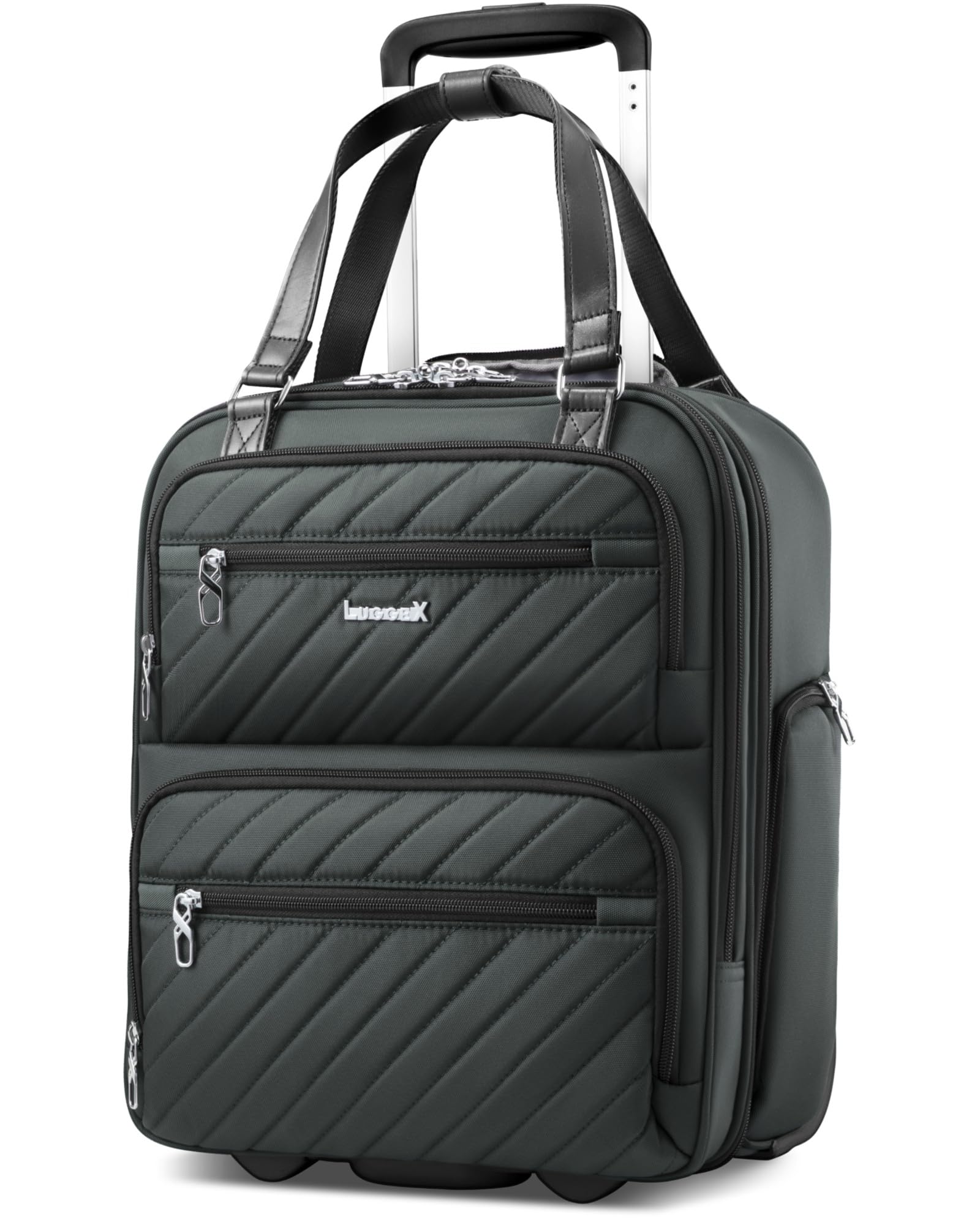
1. LUGGEX Underseat Carry-On
Best Overall
Key Features
- Weight: 4.8 lb
- Laptop sleeve: Fits up to 15.6 in
- Packing capacity: 24 L main, 26 L total
- Exterior dimensions: 15.7 x 13 x 7.7 in
- Price: Midrange
The measurement that settled this one is 15.7 by 13 by 7.7 inches. That is the exterior, and it sits inside the 18-by-14-by-8 personal-item envelope most U.S. carriers publish — which is why this is the bag we hand people first. The maker lists Spirit, Delta, Southwest, Hawaiian, American, and Allegiant by name, and that is the claim worth checking, because a bag that is half an inch too wide is a bag you are paying to check.
Inside is where it earns the trip. There are 24 liters in the main compartment and 26 in total, split into two sections with a zippered divider and tie-down straps, plus a padded sleeve that takes a 15.6-inch laptop. For a two-night work trip we put the laptop and charger in the padded side, clothes and a dopp kit in the main section, and the divider kept the clean clothes off the shoes. The front organizer holds a boarding pass, a pen, and a power bank where you can reach them without opening the bag.
Rolling it is uneventful in the way you want: an all-aluminum telescoping handle with very little wobble, and two wheels that track straight when you tilt the bag back. At 4.8 pounds empty it is light enough to lift into an overhead with one hand, and the water-repellent shell shrugged off a wet jet bridge. We were also struck by how it looks — the sage green with gold zipper pulls reads more like a weekend bag than a piece of luggage.
The three-year warranty is longer than most here and covers the parts that break first. If you need more clothes than 24 liters allows, the Travelpro roller in this guide carries 32 liters and costs more; if you want the smallest thing that clears the sizer, the Amazon Basics bag is smaller again.
Pros
- Sized inside major airlines’ personal-item limits
- Padded sleeve fits a 15.6-inch laptop
- Front organizer and zippered divider keep packing separate
- Three-year manufacturer warranty
Cons
- Two fixed wheels need a tilt to roll
- Handle hardware eats into main packing space
It’s the bag we hand to anyone flying a personal-item fare with a laptop: sized inside the airline envelope, organized like a small briefcase, and backed by a three-year warranty.
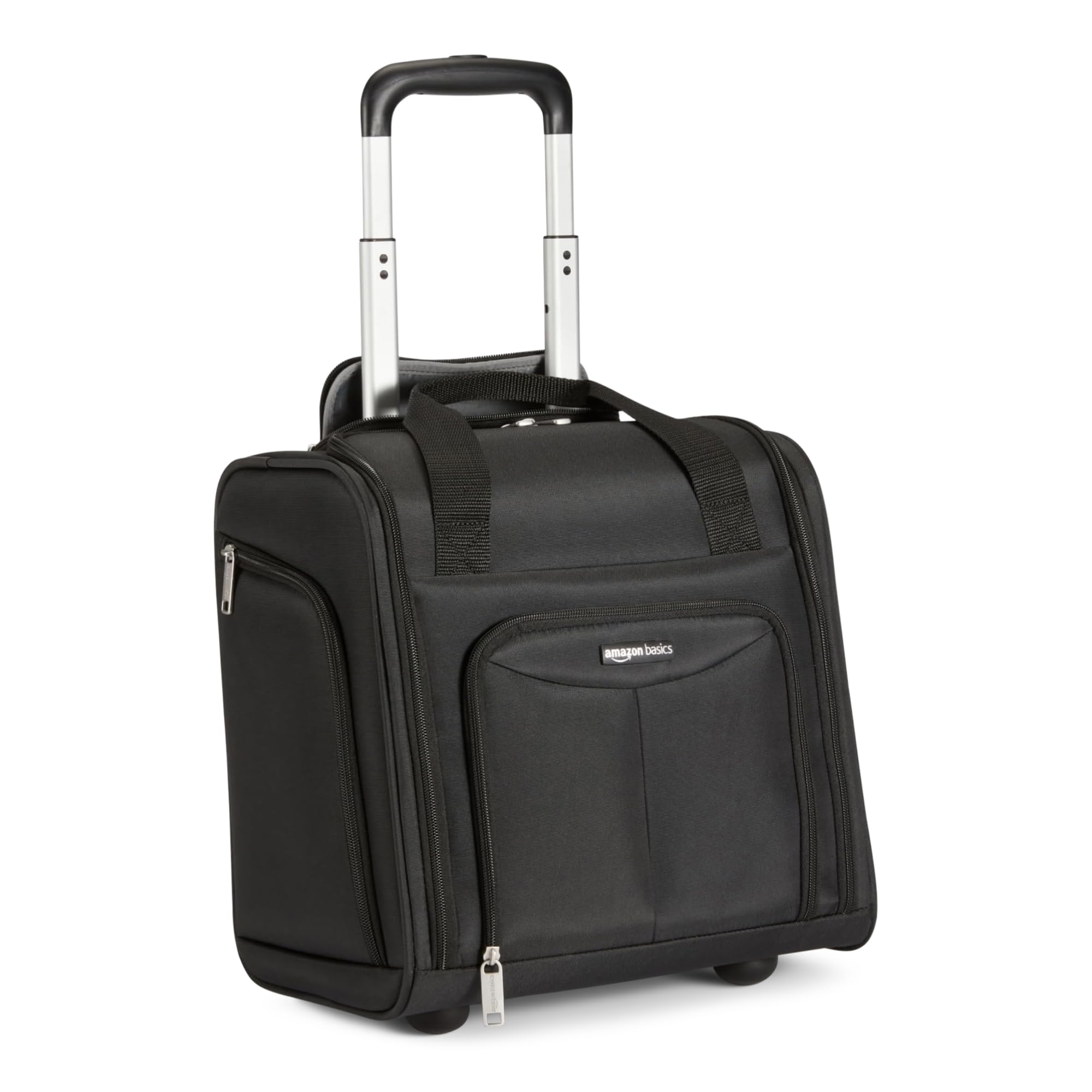
2. Amazon Basics Underseat 14 in
Best Budget Rolling Bag
Key Features
- Weight: 4.7 lb
- Wheels: 2 in-line skate
- Pockets: 7, including front organizer
- Exterior dimensions: 13.4 x 14.2 x 9.5 in with wheels
- Price: Budget
The budget pick of the rollers here, and the money goes to the right places: wheels that track, a handle that extends, and pockets. Seven of them, in fact — four zippered pockets inside the main compartment and a front organizer with three slots and its own zip. On a two-night trip we had a phone, a passport, a charger, and a paperback in the front and still had the main compartment to fill.
The footprint is 13.4 by 14.2 by 9.5 inches with the wheels, and it is the bag we take when the seat in front looks tight. That is the whole argument for it: you give up room — this is a two-night bag, not a four-day one — and in exchange you never do the aisle shuffle with a bag that will not go under. We minded the ceiling on capacity more than we minded the plain fabric.
The shell is the least substantial here and it has no water-resistant coating, so a rainy walk across a jet bridge is a plastic-bag-inside situation; we line it with a dry sack when the forecast is ugly. Otherwise it does what a first underseat roller should: rolls straight on two in-line wheels, stands when loaded evenly, and stacks on a bigger bag with the sleeve on the back.
Pros
- Budget price for a wheeled bag
- Seven pockets, including a front organizer
- Compact footprint for tight seats
Cons
- Telescoping handle can stop locking at height
For a first underseat roller, this is where we start: a budget price, seven pockets, and a footprint that clears the tightest seats in the cabin.
3. Travelpro Maxlite 5 Rolling Tote
Most Packing Room
Key Features
- Weight: 5.4 lb
- Warranty: Limited lifetime
- Packing capacity: 32 L
- Overall dimensions: 15.5 x 16.25 x 8.5 in
- Price: Premium
Nothing else in this group carries 32 liters, and that number changes what the bag is for: this is the underseater that handles four days, not one. Travelpro gets there with a soft-sided body and a single main compartment behind a front flap, plus a rear strap that slides over the handle of a bigger roller. We noticed the capacity first because it is unusual — most bags this size spend their interior on a laptop sleeve and a handle channel instead.
The figure to check is 16.25 inches, the overall length with wheels and handle hardware. That is the longest bag here, and it makes the fit conditional rather than guaranteed: under a standard main-cabin seat it goes in, and in the tightest regional rows it does not, which means the overhead bin or a gate-check tag. If your itinerary is mostly regional jets, this is the wrong bag; if it is mainline narrowbodies, it is the roomiest thing you can carry on.
The rest is Travelpro doing what Travelpro does: a PowerScope handle that wobbles less than most, a stain-resistant shell with a water-repellent coating, high-strength zippers, and a limited lifetime warranty that also covers airline damage for a year when you register it. That warranty is a real reason to spend more here, since it is the only one in this guide that promises to fix what a baggage handler breaks. At 5.4 pounds it is the heaviest of the rollers, and it is carrying the most, so that is a fair trade.
Pros
- Most packing room here at 32 liters
- Lifetime warranty that covers airline damage
- Low-wobble telescoping handle and coated shell
- Rear strap rides a larger roller’s handle
Cons
- Two in-line wheels don’t swivel
- Only two exterior pockets, no bottle holder
If your trips run three or four days, the 32 liters here are worth the extra money — just measure the overall length against your airline before you commit.
4. Travelpro Maxlite 5 Underseat Tote
Best Carry Tote
Key Features
- Size: 18 in
- Weight: 6 lb
- Pockets: Multiple zippered compartments
- Carry options: Shoulder strap and trolley sleeve
- Price: Midrange
Two rollers means two handles and two sets of wheels to steer through a crowded terminal, which is why the second bag on a two-bag trip should probably be a tote. This one is built to drop over the handle of a Maxlite roller and stay there, and it is the most structured carry bag in this group.
Structure is exactly what the 6 pounds buys. The body holds its shape, the top opens wide enough that you can see everything in it at once, and the interior is light enough to actually find things against. We packed a change of clothes, a 13-inch laptop in the front pocket, and a dopp kit, and it still went under the seat without a shove.
The pockets are why we prefer it to a plain tote: multiple zippered compartments, one sized for an iPad or a book, another for documents, and a shoulder strap that is easy to get over a coat. Ours is orchid pink, which is bolder than anything else in our luggage pile and has the side benefit of being impossible to confuse with someone else’s bag on a shared rack.
Pros
- Structured body holds its shape while you dig
- Slides over a Maxlite roller handle
- Multiple zippered pockets plus a laptop spot
Cons
- Six pounds empty is a lot on one shoulder
- Stuffed full, it can be a tight fit under the seat
We like it as the second bag on a two-bag trip: it holds its shape, swallows a laptop, and rides a roller’s handle instead of adding another set of wheels.
5. Narwey Underseat Duffel
Best Lightweight Duffel
Key Features
- Weight: 1.1 lb
- Wet pocket: Waterproof-lined zip compartment
- Packing capacity: 25 L
- Exterior dimensions: 17 x 11.5 x 7.5 in
- Price: Budget
A pound and a tenth, empty. That is less than the handle assembly on a couple of the rollers here, and it is the entire reason to own this bag: it costs you almost nothing in weight, so the personal-item allowance goes to your stuff instead of your luggage.
The wet pocket is the detail we liked most. It is a waterproof-lined zip compartment that takes a swimsuit, a damp shirt, or the bottle that decided to leak, and it keeps everything else dry. Around it there is a front zip for a passport and boarding pass, three mesh pockets inside, a detachable padded shoulder strap, and a band on the back that slides over a suitcase handle.
At 17 by 11.5 by 7.5 inches and 25 liters, this is a night or two — gym clothes and a spare outfit, or a weekend if you pack tight — and it does it at the bottom of the price range here. There is no frame and no wheels, so the padded strap does the work of getting it to the gate, which is fine for a parking garage and less fun across a long terminal with a coat over your arm.
The size we tested is the one without a laptop compartment, so a computer rides in the main bag wrapped in something soft. If you carry one on every trip, that is the reason to look at the LUGGEX instead; for a change of clothes and a toothbrush, this is plenty of bag.
Pros
- 1.1 pounds empty
- Waterproof-lined wet pocket
- Suitcase sleeve and detachable padded strap
Cons
- Slumps when it isn’t packed full
This is the bag for a single night and a short walk to the gate: barely a pound, with a wet pocket that keeps the rest of your clothes dry.
6. TPRC 15 in Underseat
Best for Short Trips

Key Features
- Wheels: 2 in-line skate
- USB port: Pass-through, power bank not included
- Packing capacity: 23.85 L
- Exterior dimensions: 15 x 14 x 8 in
It is the only bag here with a USB pass-through, and it is the useful version: a port on the outside that takes your own power bank, so the phone charges in your hand while the battery stays zipped inside. At a gate with one outlet and forty people waiting, that is a small feature that behaves like a big one.
The rest is a conventional 15-inch underseater: 15 by 14 by 8 inches, 23.85 liters, a fully lined interior with accessory pockets, an exterior side pocket, and two in-line skate wheels under a telescoping handle. The side pocket has a flap that opens wide — handy when you are in the seat and want the charger, less handy when you are walking and it swings open against your leg.
Packing it is more like a small suitcase than a tote. We folded clothes into the main section rather than stuffing them, and there is room for three days that way, with the accessory pockets taking cables, meds, and the small things that otherwise end up loose at the bottom. It slides under a seat and stays there, and the lined interior wipes out easily after a trip.
Bring your own power bank — the port does not include one — and top up while you are waiting rather than hunting for an outlet by the gate. That is where the design earns its keep: on a two-hour layover, not on a long-haul itinerary.
Pros
- Exterior USB pass-through for your own power bank
- 23.85 liters with a lined, pocketed interior
- Compact 15 by 14 by 8 inch body
Cons
- Telescoping handle can separate under load
- Not water resistant
It’s the only bag here that charges a phone from the outside, and it packs a three-day trip like a small suitcase — worth it if the port solves a real problem for you.
How We Tested Underseat Luggage
I started by pulling every underseat bag I could find that was marketed as a personal item, then narrowed the field by listed exterior dimensions, weight, wheel type, and whether the bag had a rigid frame or soft sides. I also read through customer reviews for recurring complaints about handles, zippers, and wheels. That left 12 bags, which we tested over eight months.
Each bag went on at least two round-trip flights, including regional jets and a budget carrier with a stingy sizer, plus weekend train trips and car trunks. At the gate, I slid each one under the seat in front of me and noted whether it fit without forcing, whether it left room for my feet, and whether it stayed put during the flight. I measured every bag with a tape and compared the numbers to the published sizer dimensions for the airlines we flew most.
For capacity, I packed each bag for a three-day trip using the same loadout: two shirts, a pair of pants, a light jacket, a toiletry bag, a laptop, a charger, and a pair of shoes. I noted what fit without overstuffing, whether the bag still rolled or carried comfortably when full, and how easy it was to reach items without unpacking everything. I also used the interior pockets and exterior sleeves as intended to see whether they added usable storage or just ate space.
Durability testing was less glamorous. I lifted each bag by a single handle, dropped it from waist height onto pavement, and ran it over curbs and through parking lots. I checked wheels for wobble, zippers for snags, and seams for loose threads after each trip. Bags that survived eight months of that were the ones that made the list.
How to Choose Underseat Luggage
The only measurement that matters is your airline’s personal-item limit, and the only fair way to compare a bag against it is the overall size with the wheels and handle hardware included.
Start With the Airline’s Number
Most U.S. carriers publish a personal-item limit near 18 by 14 by 8 inches, and that’s the envelope to shop against — not the word underseat on a product page. The trap is that listings usually give two sets of dimensions: the case alone and the overall size with wheels and handle hardware. Always use the overall figure. A case described as 16 inches can measure close to 18 once the wheels and handle mounts are counted.
If you fly several airlines, size to the smallest limit you meet, not the average. A bag that is a half inch over is a bag you are handing to a gate agent, and on a full flight that is the difference between boarding and checking.
Wheels Cost You Weight and Room
A rolling underseater spends roughly four to five pounds of empty weight and a slice of its interior on the handle channel. The LUGGEX, for example, lists 26 liters in total but 24 in the main compartment, and the difference is hardware. What you buy back is not carrying anything through a terminal, which is worth a great deal on a connection.
If the underseat bag is your only bag for a two- or three-day trip, take the wheels. If it is the second bag to a roller you are already pulling, a structured tote with a sleeve on the back is lighter, easier to live out of in your seat, and does not add another set of wheels to steer.
Expect Two Wheels, and Learn the Tilt
Nearly every bag in this size rolls on two fixed in-line wheels rather than four spinner casters, and that is not a downgrade. Two wheels keep the body narrow enough to get down an airplane aisle and save weight. The trade is that a two-wheeler only rolls when you tilt it back onto the wheels, so in the aisle you lift rather than steer.
Do not pay extra for spinner casters here. Put the money toward the telescoping handle, the shell fabric, and the warranty — those are what determine whether the bag is still rolling in three years.
Liters Matter Less Than Layout
This category runs from about 22 to 32 liters, and the headline figure tells you less than the layout does. A padded laptop sleeve, a zippered divider, and two exterior pockets you can reach while seated are worth more on a work trip than two extra liters you have to unpack to find. The Travelpro roller carries 32 liters with two exterior pockets; the LUGGEX carries 24 and organizes them better.
Packing cubes do more for a bag this small than any single feature, because a full bag is a stable bag — soft-sided luggage that is half empty slumps, tips, and wastes the space it has.
Handles Fail Before Zippers Do
On underseat bags the telescoping handle and the wheel housings go first, usually after a season of being dragged up stairs by the handle with too much inside. Warranty coverage is the clearest signal of how much a maker expects that: the Travelpro bags carry a limited lifetime warranty that also covers airline damage for a year, the LUGGEX a three-year one, and the cheapest bags nothing comparable.
Before your first trip, extend the handle all the way, load the bag, and roll it around the kitchen for a minute. A weak handle announces itself at home rather than at the gate.
Frequently Asked Questions
Will underseat luggage fit in front of a bulkhead or exit-row seat?
No. Bulkhead rows and exit rows have no seat in front of them, so there is no underseat space to use and the bag rides in the overhead for the flight. If you want your bag at your feet, book a standard row.
Expect less room in a middle seat, where the space under the two seats ahead is shared with your neighbor, and less again on the smallest regional jets, where even a personal-item-sized bag may end up in the bin.
Soft-sided or hard-sided for underseat luggage?
Soft-sided, for most travelers. Fabric gives when a seat frame is tight, which is the difference between sliding in and wedging under. A hard shell protects what is inside and holds its shape, but at this size the shell itself eats packing room and there is no give at the gate.
Every bag in this guide is soft-sided for that reason. Choose a hard case only if protection matters more to you than capacity and squeeze.
How do I keep a two-wheel underseat bag from tipping over?
Load the heavy items low and toward the wheel side, and the bag balances when you let go of the handle. Extend the handle fully while rolling, since a half-extended handle is what makes these bags wander.
When you are not pulling it, use the sleeve on the back to stack it on a bigger roller. If it still tips, move the laptop, shoes, or toiletry bag to the bottom before you blame the wheels.
Final Verdict
The LUGGEX is the one we point most travelers to. It measures inside the personal-item envelope the big U.S. carriers publish, the padded sleeve makes it a work bag as well as an overnight bag, and the three-year warranty covers the hardware that actually breaks.
If your trips run longer than three days, the Travelpro roller’s 32 liters and lifetime coverage are worth the extra money — check its 16.25-inch overall length against your seat first. And if you already pull a carry-on, the soft tote is the second bag that will not add another set of wheels to your life.